
Ainsliadimer ACAS# 1039431-94-1 |
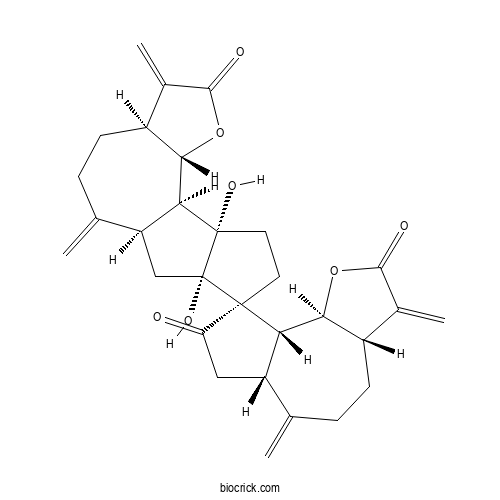
| Cas No. | 1039431-94-1 | SDF | File under preparation. |
| PubChem ID | 24939147.0 | Appearance | Powder |
| Formula | C30H34O7 | M.Wt | 506.6 |
| Type of Compound | N/A | Storage | Desiccate at -20°C |
| Solubility | Soluble in Chloroform,Dichloromethane,Ethyl Acetate,DMSO,Acetone,etc. | ||
| Chemical Name | (1S,2S,3\'aS,6S,6\'aR,9\'aR,9\'bS,10R,12S,13R,16S)-12,16-dihydroxy-3\',5,6\',9-tetramethylidenespiro[3-oxatetracyclo[8.6.0.02,6.012,16]hexadecane-13,9\'-4,5,6a,7,9a,9b-hexahydro-3aH-azuleno[4,5-b]furan]-2\',4,8\'-trione | ||
| SMILES | C=C1CCC2C(C3C1CC(=O)C34CCC5(C4(CC6C5C7C(CCC6=C)C(=C)C(=O)O7)O)O)OC(=O)C2=C | ||
| Standard InChIKey | QYIHABZOQGFHJO-RLKQMHIPSA-N | ||
| Standard InChI | InChI=1S/C30H34O7/c1-13-5-7-17-15(3)26(32)36-24(17)22-19(13)11-21(31)28(22)9-10-29(34)23-20(12-30(28,29)35)14(2)6-8-18-16(4)27(33)37-25(18)23/h17-20,22-25,34-35H,1-12H2/t17-,18-,19-,20-,22-,23-,24-,25-,28+,29-,30-/m0/s1 | ||
| General tips | For obtaining a higher solubility , please warm the tube at 37 ℃ and shake it in the ultrasonic bath for a while.Stock solution can be stored below -20℃ for several months. We recommend that you prepare and use the solution on the same day. However, if the test schedule requires, the stock solutions can be prepared in advance, and the stock solution must be sealed and stored below -20℃. In general, the stock solution can be kept for several months. Before use, we recommend that you leave the vial at room temperature for at least an hour before opening it. |
||
| About Packaging | 1. The packaging of the product may be reversed during transportation, cause the high purity compounds to adhere to the neck or cap of the vial.Take the vail out of its packaging and shake gently until the compounds fall to the bottom of the vial. 2. For liquid products, please centrifuge at 500xg to gather the liquid to the bottom of the vial. 3. Try to avoid loss or contamination during the experiment. |
||
| Shipping Condition | Packaging according to customer requirements(5mg, 10mg, 20mg and more). Ship via FedEx, DHL, UPS, EMS or other couriers with RT, or blue ice upon request. | ||
Quality Control & MSDS
3D structure
Package In Stock

Number of papers citing our products


Ainsliadimer A Dilution Calculator
Ainsliadimer A Molarity Calculator
| 1 mg | 5 mg | 10 mg | 20 mg | 25 mg | |
| 1 mM | 1.9739 mL | 9.8697 mL | 19.7394 mL | 39.4789 mL | 49.3486 mL |
| 5 mM | 0.3948 mL | 1.9739 mL | 3.9479 mL | 7.8958 mL | 9.8697 mL |
| 10 mM | 0.1974 mL | 0.987 mL | 1.9739 mL | 3.9479 mL | 4.9349 mL |
| 50 mM | 0.0395 mL | 0.1974 mL | 0.3948 mL | 0.7896 mL | 0.987 mL |
| 100 mM | 0.0197 mL | 0.0987 mL | 0.1974 mL | 0.3948 mL | 0.4935 mL |
| * Note: If you are in the process of experiment, it's necessary to make the dilution ratios of the samples. The dilution data above is only for reference. Normally, it's can get a better solubility within lower of Concentrations. | |||||
- 13-epi-10-Deacetylbaccatin III
Catalog No.:BCX2781
CAS No.:172018-16-5
- 10-Oxo-10-Deacetylbacatin III
Catalog No.:BCX2780
CAS No.:92950-45-3
- 10-Dehydrobaccatin V
Catalog No.:BCX2779
CAS No.:151636-94-1
- 13-Oxobaccatin III
Catalog No.:BCX2778
CAS No.:32981-89-8
- 10-Deacetyl-13-Oxobaccatin III
Catalog No.:BCX2777
CAS No.:92950-42-0
- 7-epi-10-Deacetylbaccatin III
Catalog No.:BCX2776
CAS No.:71629-92-0
- N-Acetyl-10-deacetyl-N-debenzoylpaclitaxel
Catalog No.:BCX2775
CAS No.:1144034-42-3
- Taxol E
Catalog No.:BCX2774
CAS No.:158948-96-0
- 10-Acetoacetylpaclitaxel
Catalog No.:BCX2773
CAS No.:2757197-26-3
- N-Debenzoyl-N-[(3E)-hex-3-enoyl]paclitaxel
Catalog No.:BCX2772
CAS No.:502626-06-4
- N-Debenzoyl-N-phenylacetylpaclitaxel
Catalog No.:BCX2771
CAS No.:173101-56-9
- N-Debenzoyl-N-cinnamoylpaclitaxel
Catalog No.:BCX2770
CAS No.:219783-77-4
- Taxol XL
Catalog No.:BCX2783
CAS No.:932042-85-8
- Ethyl (2R,3S)-3-(benzoylamino)-2-hydroxy-3-phenylpropanoate
Catalog No.:BCX2784
CAS No.:153433-80-8
- 2-Debenzoyl-2-tigloyl-10-deacetylbaccatin III
Catalog No.:BCX2785
CAS No.:171926-87-7
- 19-Hydroxy-10-deacetylbaccatin III
Catalog No.:BCX2786
CAS No.:154083-99-5
- 7,10,13-Tri-O-methyl-10-deacetylbaccatin III
Catalog No.:BCX2787
CAS No.:1584118-06-8
- 7,10-Di-O-methyl-13-oxo-10-deacetylbaccatin III
Catalog No.:BCX2788
CAS No.:1429551-13-2
- 7-O-Methyl-10-deacetylbaccatin III
Catalog No.:BCX2789
CAS No.:1444818-14-7
- 10-O-Methyl-10-deacetylbaccatin III
Catalog No.:BCX2790
CAS No.:183133-97-3
- 13-O-Triethylsilylbaccatin III
Catalog No.:BCX2791
CAS No.:208406-86-4
- 7-O-Triethylsilylpaclitaxel
Catalog No.:BCX2792
CAS No.:148930-55-6
- 2-Debenzoyl-2-tigloyldocetaxel
Catalog No.:BCX2793
CAS No.:1887057-05-7
- 2-Debenzoyl-2-pentenoyldocetaxel
Catalog No.:BCX2794
CAS No.:1412898-66-8
Oxidation-Induced Scaffold Remodeling in Ainsliaea Disesquiterpenoids: Total Synthesis of Macrocephadiolide A.[Pubmed:41846459]
Org Lett. 2026 Apr 3;28(13):4115-4119.
Late-stage oxidations extend terpenoid architectures beyond cyclase-defined boundaries, driving molecular complexity and functional diversity. Disesquiterpenoid biosynthesis illustrates this, as simple monomeric carbocycles evolve into sophisticated dimers through oxidative elaboration. Guided by this logic, we harnessed the oxidase phase of Ainsliaea congeners to generate natural and non-natural privileged scaffolds. A concise, five-step oxidative cascade from Ainsliadimer A (3) delivers macrocephadiolide A (5), showcasing oxidation-driven framework reorganization and terpenoid space expansion.
Ainsliadimer A induces ROS-mediated apoptosis in colorectal cancer cells via directly targeting peroxiredoxin 1 and 2.[Pubmed:36889312]
Cell Chem Biol. 2023 Mar 16;30(3):295-307.e5.
The peroxiredoxin (PRDX) family is a class of antioxidant enzymes with peroxidase activity. Human PRDXs currently have six members (PRDX1-6), which are gradually becoming potential therapeutic targets for major diseases such as cancer. In this study, we reported Ainsliadimer A (AIN), a sesquiterpene lactone dimer with antitumor activity. We found that AIN directly targets Cys173 of PRDX1 and Cys172 of PRDX2 and then inhibits their peroxidase activities. As a result, the level of intracellular ROS increases, causing oxidative stress damage in mitochondria, inhibiting mitochondrial respiration, and significantly inhibiting ATP production. AIN inhibits the proliferation and induces apoptosis of colorectal cancer cells. Additionally, it inhibits tumor growth in mice and the growth of tumor organoid models. Therefore, AIN can be one of the natural compounds targeting PRDX1 and PRDX2 in the treatment of colorectal cancer.
Dissecting Programmed Cell Death with Small Molecules.[Pubmed:32297735]
Acc Chem Res. 2020 May 19;53(5):1034-1045.
Programmed cell death (PCD) is fundamentally an indispensable process in all cellular activities, including cell development, wound healing, and immune surveillance of tumors (Galluzzi, L. et al. Cell Death Differ. 2018, 25, 486-541). Malfunctioning of PCD has been shown to be closely related to human diseases such as acute pancreatitis, neurodegenerative diseases, and diverse types of cancers. To date, multiple PCD processes have been discovered and the corresponding regulatory pathways have been elucidated. For example, apoptosis and autophagy are two PCD mechanisms that have been well studied by sophisticated models and probe toolkits. However, limited genetic and chemical tools for other types of PCD hamper the elucidation of their molecular mechanisms. Our group has been studying PCD using both function-oriented synthesis and chemical biology strategies, including the development of diverse chemical probes based on novel PCD modulators. For instance, in the development of downstream programmed necrosis (or necroptosis) inhibitor necrosulfonamide, we used a chemical probe to unveil a functional protein that was not previously implicated in necroptosis, mixed lineage kinase domain-like protein (MLKL). In addition, high throughput screening and medicinal chemistry enabled the discovery of bioymifi, a small molecule agonist which selectively causes oligomerization of the death receptor 5 (DR5), to induce extrinsic apoptosis. Furthermore, we developed a biomimetic synthetic strategy based on diverse Diels-Alder reactions in the total syntheses of ainsliadimers A and B, ainsliatrimers A and B, and gonchnatiolides A-C, which are natural product inhibitors or activators for PCD. Using synthetic Ainsliadimer A probe, we elucidated that Ainsliadimer A inhibits the NF-kappaB pathway by covalently binding to Cys46 of IKKbeta and triggers apoptosis of cancer cells. We have also revealed that IKKbeta is allosterically inhibited by Ainsliadimer A. In addition to total synthesis, we have developed a bioorthogonal click hetero-Diels-Alder cycloaddition of vinyl thioether and o-quinolinone quinone methide (TQ-ligation) to facilitate small molecule target identification. The combination of total synthesis and TQ-ligation enables subcellular imaging and identification of the cellular target of ainsliatrimer A to be PPARgamma. In addition, TQ-ligation has been applied in the discovery of heat shock protein 90 (HSP90) as one of the functional target proteins for kongensin A. We also confirmed that kongensin A covalently attaches to Cys420 within HSP90 and demonstrated that kongensin A blocks the interaction between HSP90 and CDC37 and subsequently inhibits necroptosis. Our development of these diverse PCD modulators provides not only effective chemical tools for fundamental biomedical research, but also the foundation for drug discovery targeting important human diseases such as cancers and inflammation caused by malfunction of PCD.
Synthesis and mode of action of oligomeric sesquiterpene lactones.[Pubmed:26510522]
Nat Prod Rep. 2016 May 4;33(5):602-11.
Covering: up to 2015In this highlight we describe two case studies from our laboratory, involving the biomimetic syntheses and the biological mechanism elucidation of the bioactive oligomeric sesquiterpenoids, (+)-Ainsliadimer A () and (-)-ainsliatrimer A (). Ainsliadimer A possesses potent anti-inflammatory activity by inhibition of the NF-kappaB signalling pathway via binding at a previously untargeted allosteric site. (-)-Ainsliatrimer A induces apoptosis in cancer cells by activation of PPARgamma. Furthermore, we highlight a new bioorthogonal ligation (TQ-ligation) developed in our laboratory which facilitates the target identification of complex natural products via pre-target fluorescence imaging and affinity chromatography. Generally, this paper will discuss the complete process from total synthesis to biological studies of complex natural products, and from the establishment of new bio-orthogonal chemistry to successful target identification. Our approach provides a systematic and efficient methodology for addressing the challenge of natural product target identification.
Ainsliadimer A selectively inhibits IKKalpha/beta by covalently binding a conserved cysteine.[Pubmed:25813672]
Nat Commun. 2015 Mar 27;6:6522.
Aberrant activation of NF-kappaB is associated with the development of cancer and autoimmune and inflammatory diseases. IKKs are well recognized as key regulators in the NF-kappaB pathway and therefore represent attractive targets for intervention with small molecule inhibitors. Herein, we report that a complex natural product Ainsliadimer A is a potent inhibitor of the NF-kappaB pathway. Ainsliadimer A selectively binds to the conserved cysteine 46 residue of IKKalpha/beta and suppresses their activities through an allosteric effect, leading to the inhibition of both canonical and non-canonical NF-kappaB pathways. Remarkably, Ainsliadimer A induces cell death of various cancer cells and represses in vivo tumour growth and endotoxin-mediated inflammatory responses. Ainsliadimer A is thus a natural product targeting the cysteine 46 of IKKalpha/beta to block NF-kappaB signalling. Therefore, it has great potential for use in the development of anticancer and anti-inflammatory therapies.
A biomimetic total synthesis of (+)-ainsliadimer A.[Pubmed:20812751]
Org Lett. 2010 Oct 1;12(19):4284-7.
A protecting group free and biomimetic total synthesis of (+)-Ainsliadimer A has been accomplished in 14 steps from alpha-santonin. The synthesis relies on a hydrogen bonding promoted [4 + 2]-hetero-Diels-Alder dimerization to afford the key homodimer intermediate, which demonstrates the feasibility of using nonenzymatic conditions to achieve the proposed biosynthesis.
Ainsliadimer A, a new sesquiterpene lactone dimer with an unusual carbon skeleton from Ainsliaea macrocephala.[Pubmed:18484734]
Org Lett. 2008 Jun 19;10(12):2397-400.
A phytochemical investigation of Ainsliaea macrocephala led to the isolation of a new dimeric sesquiterpene lactone, Ainsliadimer A (1). The structure of 1 was elucidated by spectroscopic analysis, and confirmed by single crystal X-ray diffraction. Ainsliadimer A represents an unusual carbon skeleton with a cyclopentane system connecting the two monomeric sesquiterpene lactone units. This unique molecule exerted potent inhibitory activity against the production of nitric oxide in RAW264.7 stimulated by LPS.

Calcutta University

University of Minnesota

University of Maryland School of Medicine

University of Illinois at Chicago

The Ohio State University

University of Zurich

Harvard University

Colorado State University

Auburn University

Yale University

Worcester Polytechnic Institute

Washington State University

Stanford University

University of Leipzig

Universidade da Beira Interior

The Institute of Cancer Research

Heidelberg University

University of Amsterdam

University of Auckland

TsingHua University

The University of Michigan

Miami University

DRURY University

Jilin University

Fudan University

Wuhan University

Sun Yat-sen University

Universite de Paris

Deemed University

Auckland University

The University of Tokyo

Korea University



