
1-(4-Hydroxybenzyl)-4-methoxy-9,10-dihydrophenanthrene-2,7-diolCAS# 87530-26-5 |
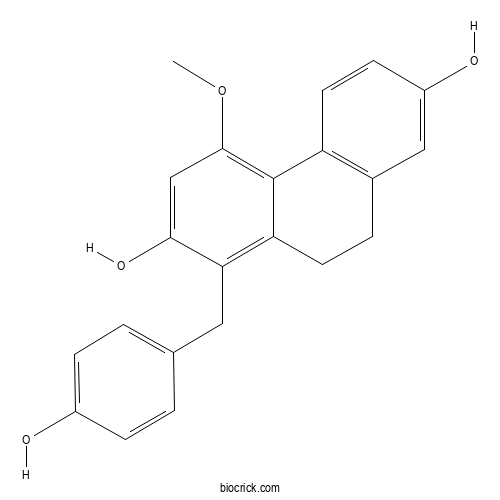
| Cas No. | 87530-26-5 | SDF | File under preparation. |
| PubChem ID | 11163864.0 | Appearance | Powder |
| Formula | C22H20O4 | M.Wt | 348.4 |
| Type of Compound | Other Phenolic Compounds | Storage | Desiccate at -20°C |
| Solubility | Soluble in Chloroform,Dichloromethane,Ethyl Acetate,DMSO,Acetone,etc. | ||
| Chemical Name | 1-[(4-hydroxyphenyl)methyl]-4-methoxy-9,10-dihydrophenanthrene-2,7-diol | ||
| SMILES | COC1=C2C(=C(C(=C1)O)CC3=CC=C(C=C3)O)CCC4=C2C=CC(=C4)O | ||
| Standard InChIKey | XNPQRYUNKPQOPF-UHFFFAOYSA-N | ||
| Standard InChI | InChI=1S/C22H20O4/c1-26-21-12-20(25)19(10-13-2-5-15(23)6-3-13)18-8-4-14-11-16(24)7-9-17(14)22(18)21/h2-3,5-7,9,11-12,23-25H,4,8,10H2,1H3 | ||
| General tips | For obtaining a higher solubility , please warm the tube at 37 ℃ and shake it in the ultrasonic bath for a while.Stock solution can be stored below -20℃ for several months. We recommend that you prepare and use the solution on the same day. However, if the test schedule requires, the stock solutions can be prepared in advance, and the stock solution must be sealed and stored below -20℃. In general, the stock solution can be kept for several months. Before use, we recommend that you leave the vial at room temperature for at least an hour before opening it. |
||
| About Packaging | 1. The packaging of the product may be reversed during transportation, cause the high purity compounds to adhere to the neck or cap of the vial.Take the vail out of its packaging and shake gently until the compounds fall to the bottom of the vial. 2. For liquid products, please centrifuge at 500xg to gather the liquid to the bottom of the vial. 3. Try to avoid loss or contamination during the experiment. |
||
| Shipping Condition | Packaging according to customer requirements(5mg, 10mg, 20mg and more). Ship via FedEx, DHL, UPS, EMS or other couriers with RT, or blue ice upon request. | ||
Quality Control & MSDS
3D structure
Package In Stock

Number of papers citing our products


1-(4-Hydroxybenzyl)-4-methoxy-9,10-dihydrophenanthrene-2,7-diol Dilution Calculator
1-(4-Hydroxybenzyl)-4-methoxy-9,10-dihydrophenanthrene-2,7-diol Molarity Calculator

| 1 mg | 5 mg | 10 mg | 20 mg | 25 mg | |
| 1 mM | 2.8703 mL | 14.3513 mL | 28.7026 mL | 57.4053 mL | 71.7566 mL |
| 5 mM | 0.5741 mL | 2.8703 mL | 5.7405 mL | 11.4811 mL | 14.3513 mL |
| 10 mM | 0.287 mL | 1.4351 mL | 2.8703 mL | 5.7405 mL | 7.1757 mL |
| 50 mM | 0.0574 mL | 0.287 mL | 0.5741 mL | 1.1481 mL | 1.4351 mL |
| 100 mM | 0.0287 mL | 0.1435 mL | 0.287 mL | 0.5741 mL | 0.7176 mL |
| * Note: If you are in the process of experiment, it's necessary to make the dilution ratios of the samples. The dilution data above is only for reference. Normally, it's can get a better solubility within lower of Concentrations. | |||||
- Cyclobuxosuffrine K
Catalog No.:BCX2640
CAS No.:10088-22-9
- Cyclosuffrobuxinine M
Catalog No.:BCX2639
CAS No.:7759-55-9
- 7-O-Methylcatechin
Catalog No.:BCX2638
CAS No.:182694-28-6
- 7-O-Methylepicatechin
Catalog No.:BCX2637
CAS No.:1156461-68-5
- 9-Hydroxymegastigma-4,6-dien-3-one
Catalog No.:BCX2636
CAS No.:165523-60-4
- 7,10-Dihydroxy-11-methoxydracaenone
Catalog No.:BCX2635
CAS No.:113477-35-3
- Chlorajaponilide A
Catalog No.:BCX2634
CAS No.:1312416-15-1
- 11-O-p-hydroxybenzoylbergenin
Catalog No.:BCX2633
CAS No.:189691-23-4
- (6R,9S)-3-Oxo-α-ionol
Catalog No.:BCX2632
CAS No.:68759-08-0
- 10-Hydroxy-11-methoxydracaenone
Catalog No.:BCX2631
CAS No.:113459-56-6
- Asarinol A
Catalog No.:BCX2630
CAS No.:131896-45-2
- 3-Carene-2,5-dione
Catalog No.:BCX2629
CAS No.:6617-34-1
- 2,4-Dihydroxy-α-oxobenzeneacetic acid
Catalog No.:BCX2642
CAS No.:5336-27-6
- Cyclobuxophylline M
Catalog No.:BCX2643
CAS No.:1053-21-0
- 4'-O-Methylsinolignan B
Catalog No.:BCX2644
CAS No.:619296-83-2
- O-Demethylfukanedone A
Catalog No.:BCX2645
CAS No.:246870-47-3
- Stizophyllin
Catalog No.:BCX2646
CAS No.:109237-00-5
- 7, 4'-Dihydroxy-8-methoxyhomoisoflavan
Catalog No.:BCX2647
CAS No.:1447664-19-8
- 4'-Demethylpicropodophyllin glucoside
Catalog No.:BCX2648
CAS No.:7598-48-3
- Idesin
Catalog No.:BCX2649
CAS No.:20331-85-5
- Isoeucommin A
Catalog No.:BCX2650
CAS No.:134859-90-8
- Lyohebecarpiin A
Catalog No.:BCX2651
CAS No.:420837-18-9
- Huazhongilexin
Catalog No.:BCX2652
CAS No.:135820-79-0
- 5-O-Methylshanciguol
Catalog No.:BCX2653
CAS No.:87530-27-6
LIMK1 and PKM as Integratively Identified Transcriptomic Signatures in Inflammatory Bowel Disease.[Pubmed:42584099]
OMICS. 2026 Oct;30(10):609-630.
Inflammatory bowel disease (IBD) involves complex immunometabolic dysregulation. Mitochondria-associated endoplasmic reticulum membranes (MAMs) link metabolic adaptation and inflammatory signaling, but gene expression features associated with MAM-related transcriptomic states in IBD remain unclear. Public transcriptomic datasets were integrated with a curated MAM-related gene set and herbal target information. Differential expression analysis, weighted gene coexpression network analysis, and machine learning-assisted feature selection were used to identify candidate genes. A two-gene nomogram was constructed and evaluated in discovery and independent validation datasets. Functional enrichment, immune deconvolution, regulatory network prediction, molecular docking, 200-ns molecular dynamics simulations, and preliminary quantitative polymerase chain reaction validation were performed. LIMK1 and PKM were identified as candidate transcriptomic signature genes associated with IBD status and MAM-related transcriptional states, showing discriminatory performance in independent datasets. Both genes were associated with cytokine-cytokine receptor interaction and drug metabolism-cytochrome P450 pathways and were linked to macrophage-related immune states. Structural analyses suggested stable predicted binding between PKM and 1-(4-Hydroxybenzyl)-4-methoxy-9,10-dihydrophenanthrene-2,7-diol and structurally plausible interactions between LIMK1 and palmatine. Preliminary tissue-level validation supported the disease-associated expression pattern of PKM, whereas LIMK1 showed a consistent but nonsignificant upward trend. LIMK1 and PKM may represent candidate transcriptomic signatures associated with MAM-related regulatory states in IBD. These findings should be interpreted as hypothesis-generating associations rather than evidence of MAM localization, functional causality, or therapeutic efficacy. Further protein-level and functional validation is required.
Antiallergic phenanthrenes and stilbenes from the tubers of Gymnadenia conopsea.[Pubmed:15386193]
Planta Med. 2004 Sep;70(9):847-55.
The methanolic extract from the tubers of Gymnadenia conopsea showed an antiallergic effect on ear passive cutaneous anaphylaxis reactions in mice. From the methanolic extract, three new dihydrophenanthrenes, gymconopins A ( 1), B ( 2), and C ( 3), and a new dihydrostilbene, gymconopin D ( 4), were isolated together with 10 known phenanthrene and stilbene constituents. The structures of the new compounds were determined on the basis of physicochemical evidence. Next, the inhibitory effects of the principal constituents on the release of beta-hexosaminidase, as a marker of degranulation, in RBL-2H3 cells were examined and five phenanthrenes, gymconopin B ( 2), 4-methoxy-9,10-dihydrophenanthrene-2,7-diol ( 6), 1-(4-hydroxybenzyl)-4-methoxyphenanthrene-2,7-diol ( 7), 1-(4-Hydroxybenzyl)-4-methoxy-9,10-dihydrophenanthrene-2,7-diol ( 8), and blestriarene A ( 9), and six dihydrostilbenes, gymconopin D ( 4), batatacin III ( 10), 3'- O-methylbatatacin III ( 11), 3,3'-dihydroxy-2-(4-hydroxybenzyl)-5-methoxybibenzyl ( 12), 3',5-dihydroxy-2-(4-hydroxybenzyl)-3-methoxybibenzyl ( 13), and 3,3'-dihydroxy-2,6-bis(4-hydroxybenzyl)-5-methoxybibenzyl ( 14) were found to inhibit the antigen-induced degranulation by 65.5 to 99.4 % at 100 microM in RBL-2H3 cells.

Calcutta University

University of Minnesota

University of Maryland School of Medicine

University of Illinois at Chicago

The Ohio State University

University of Zurich

Harvard University

Colorado State University

Auburn University

Yale University

Worcester Polytechnic Institute

Washington State University

Stanford University

University of Leipzig

Universidade da Beira Interior

The Institute of Cancer Research

Heidelberg University

University of Amsterdam

University of Auckland

TsingHua University

The University of Michigan

Miami University

DRURY University

Jilin University

Fudan University

Wuhan University

Sun Yat-sen University

Universite de Paris

Deemed University

Auckland University

The University of Tokyo

Korea University



