
Juncatrin BCAS# 2306413-51-2 |
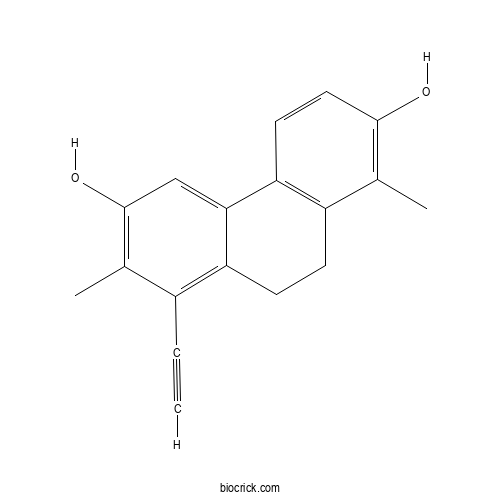
| Cas No. | 2306413-51-2 | SDF | File under preparation. |
| PubChem ID | 172653380.0 | Appearance | Powder |
| Formula | C18H16O2 | M.Wt | 264.3 |
| Type of Compound | N/A | Storage | Desiccate at -20°C |
| Solubility | Soluble in Chloroform,Dichloromethane,Ethyl Acetate,DMSO,Acetone,etc. | ||
| Chemical Name | 8-ethynyl-1,7-dimethyl-9,10-dihydrophenanthrene-2,6-diol | ||
| SMILES | CC1=C(C=CC2=C1CCC3=C(C(=C(C=C32)O)C)C#C)O | ||
| Standard InChIKey | KLMPTWHNIJPCCY-UHFFFAOYSA-N | ||
| Standard InChI | InChI=1S/C18H16O2/c1-4-12-10(2)18(20)9-16-14(12)6-5-13-11(3)17(19)8-7-15(13)16/h1,7-9,19-20H,5-6H2,2-3H3 | ||
| General tips | For obtaining a higher solubility , please warm the tube at 37 ℃ and shake it in the ultrasonic bath for a while.Stock solution can be stored below -20℃ for several months. We recommend that you prepare and use the solution on the same day. However, if the test schedule requires, the stock solutions can be prepared in advance, and the stock solution must be sealed and stored below -20℃. In general, the stock solution can be kept for several months. Before use, we recommend that you leave the vial at room temperature for at least an hour before opening it. |
||
| About Packaging | 1. The packaging of the product may be reversed during transportation, cause the high purity compounds to adhere to the neck or cap of the vial.Take the vail out of its packaging and shake gently until the compounds fall to the bottom of the vial. 2. For liquid products, please centrifuge at 500xg to gather the liquid to the bottom of the vial. 3. Try to avoid loss or contamination during the experiment. |
||
| Shipping Condition | Packaging according to customer requirements(5mg, 10mg, 20mg and more). Ship via FedEx, DHL, UPS, EMS or other couriers with RT, or blue ice upon request. | ||
Quality Control & MSDS
3D structure
Package In Stock

Number of papers citing our products


Juncatrin B Dilution Calculator
Juncatrin B Molarity Calculator
| 1 mg | 5 mg | 10 mg | 20 mg | 25 mg | |
| 1 mM | 3.7836 mL | 18.9179 mL | 37.8358 mL | 75.6716 mL | 94.5895 mL |
| 5 mM | 0.7567 mL | 3.7836 mL | 7.5672 mL | 15.1343 mL | 18.9179 mL |
| 10 mM | 0.3784 mL | 1.8918 mL | 3.7836 mL | 7.5672 mL | 9.4589 mL |
| 50 mM | 0.0757 mL | 0.3784 mL | 0.7567 mL | 1.5134 mL | 1.8918 mL |
| 100 mM | 0.0378 mL | 0.1892 mL | 0.3784 mL | 0.7567 mL | 0.9459 mL |
| * Note: If you are in the process of experiment, it's necessary to make the dilution ratios of the samples. The dilution data above is only for reference. Normally, it's can get a better solubility within lower of Concentrations. | |||||
- (4aR,10R)-9,10-Dihydroxy-2-methyl-4a,10-dihydroanthracen-1(4H)-one
Catalog No.:BCX2291
CAS No.:2305966-67-8
- 1-Hydroxyrutaecarpine 1-O-glucoside
Catalog No.:BCX2290
CAS No.:1884364-62-8
- Micrometam A
Catalog No.:BCX2289
CAS No.:1622947-22-1
- Plasiaticine B
Catalog No.:BCX2288
CAS No.:1528768-32-2
- 4'-O-Methylthujaplicatin
Catalog No.:BCX2287
CAS No.:1613381-17-1
- 7-O-Ethylepirosmanol
Catalog No.:BCX2286
CAS No.:1394242-96-6
- Rabdoternin D
Catalog No.:BCX2285
CAS No.:155969-81-6
- Rubescensin D
Catalog No.:BCX2284
CAS No.:88907-93-1
- Anol glucoside
Catalog No.:BCX2283
CAS No.:120396-85-2
- Zizyvoside I
Catalog No.:BCX2282
CAS No.:81425-28-7
- (3R,5R)-1,7-Bis(3,4-dihydroxyphenyl)heptane-3,5-diol 3-O-glucoside
Catalog No.:BCX2281
CAS No.:408324-05-0
- 30-Hydroxyquinoa-saponin 1
Catalog No.:BCX2280
CAS No.:898565-67-8
- Clausenalansine B
Catalog No.:BCX2293
CAS No.:2365501-63-7
- Ethyl lecanorate
Catalog No.:BCX2294
CAS No.:2611262-88-3
- Bisadinrone A
Catalog No.:BCX2295
CAS No.:2871811-08-2
- Sphalleroside A
Catalog No.:BCX2296
CAS No.:192324-34-8
- Foeniculoside I
Catalog No.:BCX2297
CAS No.:168010-10-4
- erythro-Anethole glycol
Catalog No.:BCX2298
CAS No.:103687-27-0
- Plantagiolide C
Catalog No.:BCX2299
CAS No.:913263-86-2
- Chantriolide C
Catalog No.:BCX2300
CAS No.:1206850-19-2
- threo-Anethole glycol
Catalog No.:BCX2301
CAS No.:112018-74-3
- 7β,20-Epoxyabieta-8,11,13-triene-6α,11,12-triol
Catalog No.:BCX2302
CAS No.:1353042-00-8
- 11-Oxocucurbita-5,24-diene-3,20-diol
Catalog No.:BCX2303
CAS No.:2491640-86-7
- Ganoderic acid F
Catalog No.:BCX2304
CAS No.:98665-15-7
Phenanthrenes from Juncus articulatus with Antibacterial and Biofilm Formation Inhibitory Activity.[Pubmed:39121346]
J Nat Prod. 2024 Aug 23;87(8):2068-2080.
Continuing our search for bioactive compounds in species from the Juncaceae family, Juncus articulatus was investigated. Ten previously undescribed phenanthrenes horizontal line articulins A-J (1-10) horizontal line and ten known compounds horizontal line juncuenin B, dehydrojuncuenin B, Juncatrin B, ensifolins E, F, H, I, K, juncuenin D, and luzulin A (11-20) horizontal line along with other compounds, have been isolated and identified. The isolated compounds were evaluated for antibacterial activity against Escherichia coli, Pseudomonas aeruginosa, methicillin-susceptible Staphylococcus aureus (MSSA), and methicillin-resistant Staphylococcus aureus (MRSA). Compounds 12 and 14 exhibited the most potent activity against planktonic and sessile MSSA and MRSA with minimum inhibitory concentration (MIC) values of 15.1 muM (12 for both bacterial strains) and 15.3 muM (14 for both bacterial strains). Compounds 15, 17, and 18 also exhibited activity against both strains, although to a lower extent, with MIC values ranging from 30.0 to 56.8 muM. The inhibition of biofilm formation of these compounds was observed at 15.1-114.3 muM. This study elucidates the phenanthrene composition of J. articulatus and the antibacterial effect of these compounds.
Unique Phenanthrenes from Juncus ensifolius and Their Antiproliferative and Synergistic Effects with the Conventional Anticancer Agent Doxorubicin against Human Cancer Cell Lines.[Pubmed:35335985]
Pharmaceutics. 2022 Mar 10;14(3):608.
Phenanthrenes are the main special metabolites of Juncaceae species from phytochemical, pharmacological, and chemotaxonomical points of view. The present study focused on the isolation, structure determination, and pharmacological investigation of phenanthrenes from Juncus ensifolius. Nineteen compounds, including 17 phenanthrenes, were identified from the methanol extract of the plant. Thirteen compounds, namely, ensifolins A-M (1-13), were obtained for the first time from natural sources. Four phenanthrenes [2-hydroxy-1,7-dimethyl-5-vinyl-9,10-dihydrophenanthrene (14), juncuenin B (15), Juncatrin B (16), and sylvaticin A (17)], 4-hydroxybenzaldehyde (18) and luteolin (19) were isolated for the first time from J. ensifolius. Ensifolins A (1) and B (2) are structurally unique phenanthrenes, considering that they are flavonoid- (1) or benzaldehyde-adducts (2). The antiproliferative activity of all isolated compounds against HeLa, COLO 205, and COLO 320 cancer cells and a non-tumor (MRC-5) cell line was tested using the 3-(4,5-dimethylthiazol-2-yl)-2,5-diphenyl-2H-tetrazolium bromide (MTT) viability assay. The luteolin-substituted phenanthrene ensifolin A (1) proved to be the most active against all three cancer cell lines (IC50 values 3.9-12.7 muM) and showed good selectivity (SI = 4.95) in the case of COLO 205. The best selectivity was recorded for ensifolins D (4, SI > 5.15, HeLa), H (8, SI > 8.13, HeLa), and 17 (SI > 9.43, HeLa). The synergistic activity of the compounds with doxorubicin was also tested on HeLa cells, and ensifolins E (5) and H (8) exhibited very strong synergism (CI < 0.1). In conclusion, these phenanthrenes are worthy of further investigation.

Calcutta University

University of Minnesota

University of Maryland School of Medicine

University of Illinois at Chicago

The Ohio State University

University of Zurich

Harvard University

Colorado State University

Auburn University

Yale University

Worcester Polytechnic Institute

Washington State University

Stanford University

University of Leipzig

Universidade da Beira Interior

The Institute of Cancer Research

Heidelberg University

University of Amsterdam

University of Auckland

TsingHua University

The University of Michigan

Miami University

DRURY University

Jilin University

Fudan University

Wuhan University

Sun Yat-sen University

Universite de Paris

Deemed University

Auckland University

The University of Tokyo

Korea University



