
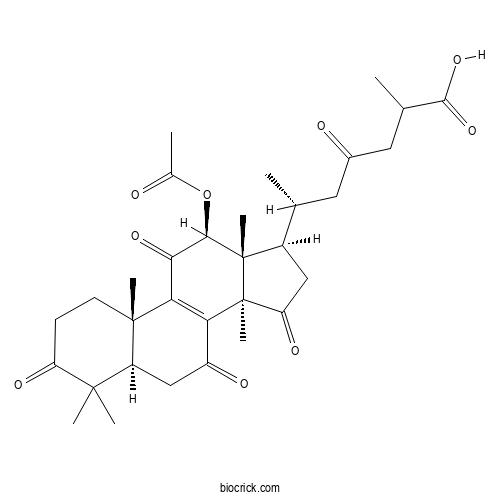
Ganoderic acid FCAS# 98665-15-7 |
| Cas No. | 98665-15-7 | SDF | File under preparation. |
| PubChem ID | 23247895.0 | Appearance | Powder |
| Formula | C32H42O9 | M.Wt | 570.7 |
| Type of Compound | N/A | Storage | Desiccate at -20°C |
| Solubility | Soluble in Chloroform,Dichloromethane,Ethyl Acetate,DMSO,Acetone,etc. | ||
| Chemical Name | (6R)-6-[(5R,10S,12S,13R,14R,17R)-12-acetyloxy-4,4,10,13,14-pentamethyl-3,7,11,15-tetraoxo-2,5,6,12,16,17-hexahydro-1H-cyclopenta[a]phenanthren-17-yl]-2-methyl-4-oxoheptanoic acid | ||
| SMILES | CC(CC(=O)CC(C)C(=O)O)C1CC(=O)C2(C1(C(C(=O)C3=C2C(=O)CC4C3(CCC(=O)C4(C)C)C)OC(=O)C)C)C | ||
| Standard InChIKey | BWCNWXLKMWWVBT-AIMUVTGPSA-N | ||
| Standard InChI | InChI=1S/C32H42O9/c1-15(11-18(34)12-16(2)28(39)40)19-13-23(37)32(8)24-20(35)14-21-29(4,5)22(36)9-10-30(21,6)25(24)26(38)27(31(19,32)7)41-17(3)33/h15-16,19,21,27H,9-14H2,1-8H3,(H,39,40)/t15-,16?,19-,21+,27-,30+,31+,32+/m1/s1 | ||
| General tips | For obtaining a higher solubility , please warm the tube at 37 ℃ and shake it in the ultrasonic bath for a while.Stock solution can be stored below -20℃ for several months. We recommend that you prepare and use the solution on the same day. However, if the test schedule requires, the stock solutions can be prepared in advance, and the stock solution must be sealed and stored below -20℃. In general, the stock solution can be kept for several months. Before use, we recommend that you leave the vial at room temperature for at least an hour before opening it. |
||
| About Packaging | 1. The packaging of the product may be reversed during transportation, cause the high purity compounds to adhere to the neck or cap of the vial.Take the vail out of its packaging and shake gently until the compounds fall to the bottom of the vial. 2. For liquid products, please centrifuge at 500xg to gather the liquid to the bottom of the vial. 3. Try to avoid loss or contamination during the experiment. |
||
| Shipping Condition | Packaging according to customer requirements(5mg, 10mg, 20mg and more). Ship via FedEx, DHL, UPS, EMS or other couriers with RT, or blue ice upon request. | ||
Quality Control & MSDS
3D structure
Package In Stock

Number of papers citing our products


Ganoderic acid F Dilution Calculator
Ganoderic acid F Molarity Calculator
-
 Ganoderic acid FCatalog No.: BCN3037CAS No.: 98665-14-6
-
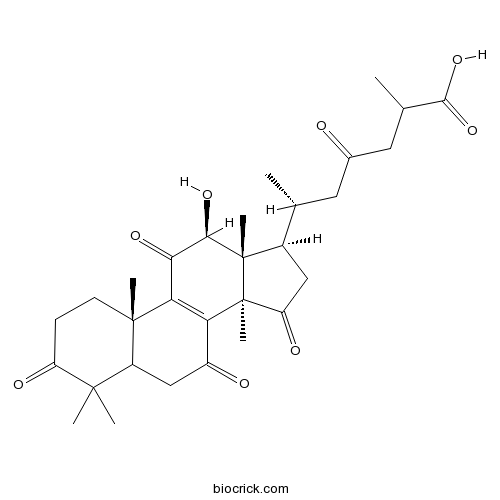 Deacetyl ganoderic acid FCatalog No.: BCN2870CAS No.: 100665-44-9
-
 Ganoderic acid HCatalog No.: BCN3038CAS No.: 98665-19-1
-
 Lucidenic acid D2Catalog No.: BCN8202CAS No.: 98665-16-8
-
 Methyl ganoderate HCatalog No.: BCN3258CAS No.: 98665-11-3
-
 Ganoderic acid ECatalog No.: BCN9038CAS No.:
-
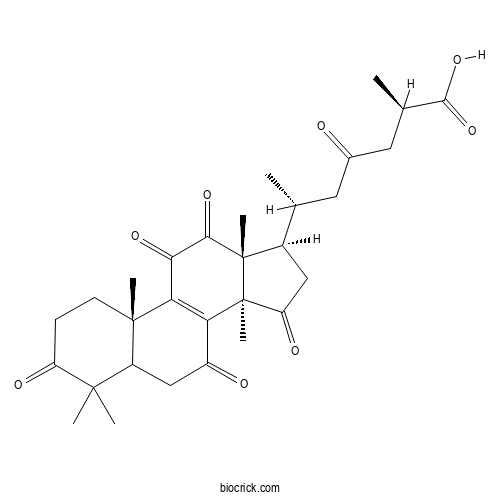 Ganosporeric acid ACatalog No.: BCX1137CAS No.: 135357-25-4
-
 Ganoderic acid KCatalog No.: BCN3039CAS No.: 104700-95-0
-
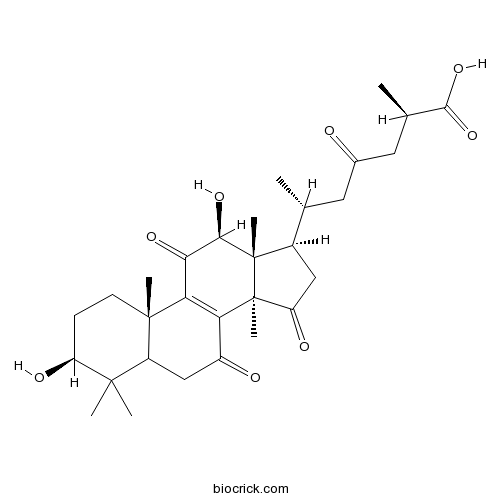 Ganoderic acid C6Catalog No.: BCN3257CAS No.: 105742-76-5
-
 Ganoderic acid MCatalog No.: BCN2871CAS No.: 100761-17-9
-
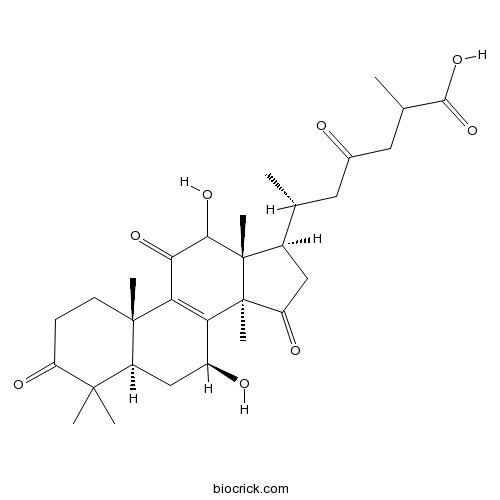 12-Hydroxyganoderic acid DCatalog No.: BCN8051CAS No.: 942950-96-1
-
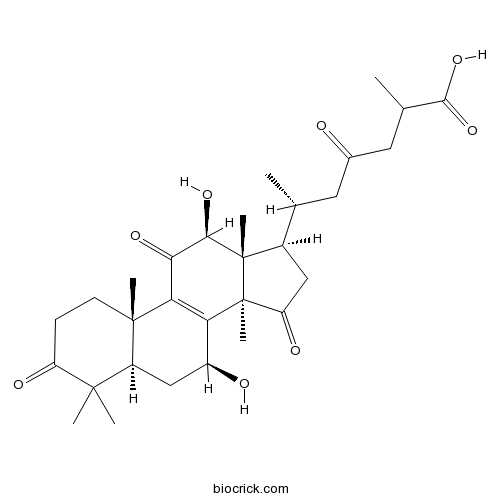 Ganoderic acid D2Catalog No.: BCC8989CAS No.: 97653-94-6
| 1 mg | 5 mg | 10 mg | 20 mg | 25 mg | |
| 1 mM | 1.7522 mL | 8.7612 mL | 17.5223 mL | 35.0447 mL | 43.8059 mL |
| 5 mM | 0.3504 mL | 1.7522 mL | 3.5045 mL | 7.0089 mL | 8.7612 mL |
| 10 mM | 0.1752 mL | 0.8761 mL | 1.7522 mL | 3.5045 mL | 4.3806 mL |
| 50 mM | 0.035 mL | 0.1752 mL | 0.3504 mL | 0.7009 mL | 0.8761 mL |
| 100 mM | 0.0175 mL | 0.0876 mL | 0.1752 mL | 0.3504 mL | 0.4381 mL |
| * Note: If you are in the process of experiment, it's necessary to make the dilution ratios of the samples. The dilution data above is only for reference. Normally, it's can get a better solubility within lower of Concentrations. | |||||
- 11-Oxocucurbita-5,24-diene-3,20-diol
Catalog No.:BCX2303
CAS No.:2491640-86-7
- 7β,20-Epoxyabieta-8,11,13-triene-6α,11,12-triol
Catalog No.:BCX2302
CAS No.:1353042-00-8
- threo-Anethole glycol
Catalog No.:BCX2301
CAS No.:112018-74-3
- Chantriolide C
Catalog No.:BCX2300
CAS No.:1206850-19-2
- Plantagiolide C
Catalog No.:BCX2299
CAS No.:913263-86-2
- erythro-Anethole glycol
Catalog No.:BCX2298
CAS No.:103687-27-0
- Foeniculoside I
Catalog No.:BCX2297
CAS No.:168010-10-4
- Sphalleroside A
Catalog No.:BCX2296
CAS No.:192324-34-8
- Bisadinrone A
Catalog No.:BCX2295
CAS No.:2871811-08-2
- Ethyl lecanorate
Catalog No.:BCX2294
CAS No.:2611262-88-3
- Clausenalansine B
Catalog No.:BCX2293
CAS No.:2365501-63-7
- Juncatrin B
Catalog No.:BCX2292
CAS No.:2306413-51-2
- 4-Hydroxy-3,5-diisopropylbenzaldehyde
Catalog No.:BCX2305
CAS No.:10537-86-7
- Allylbenzene
Catalog No.:BCX2306
CAS No.:300-57-2
- Diosbulbin A
Catalog No.:BCX2307
CAS No.:20086-05-9
- 2'-Deoxyadenosine
Catalog No.:BCX2308
CAS No.:958-09-8
- Piperonylic acid
Catalog No.:BCX2309
CAS No.:94-53-1
- Chavicol
Catalog No.:BCX2310
CAS No.:501-92-8
- Riboflavin sodium phosphate
Catalog No.:BCX2311
CAS No.:130-40-5
- Zeatin
Catalog No.:BCX2312
CAS No.:1637-39-4
- 4-Hydroxypyridine-2,6-dicarboxylic acid
Catalog No.:BCX2313
CAS No.:499-51-4
- Isatin
Catalog No.:BCX2314
CAS No.:91-56-5
- D-Galacturonic acid hydrate
Catalog No.:BCX2315
CAS No.:685-73-4
- Mandelic acid
Catalog No.:BCX2316
CAS No.:90-64-2
Untargeted LC-QTOF-MS/MS metabolomics and integrative pharmacology identify candidate triterpenoids associated with the gastrointestinal activity of Baliospermum montanum root extract.[Pubmed:42789214]
Inflammopharmacology. 2026 Sep 25.
Baliospermum montanum (Willd.) has been investigated for its gastrointestinal effects, but its metabolite composition and potential mechanisms underlying these effects remain insufficiently characterized. This study employed an integrative framework combining untargeted metabolomics, computational pharmacology, and in vivo evaluation to characterize candidate constituents and potential mechanisms associated with the gastrointestinal effects of B. montanum root extract. Methanolic root extract was profiled using untargeted LC-QTOF-MS/MS in positive and negative electrospray ionization modes. Facility-assisted database/library annotation and manual curation identified 15 prioritized putative metabolite annotations, including the triterpenoid candidates cucurbitacin C, Ganoderic acid F, ursolic acid, and 24-hydroxyglycyrrhetic acid. In accordance with the Metabolomics Standards Initiative framework, these compounds were classified as Level 2 putative annotations because authentic reference standards were not analyzed under identical experimental conditions. Network pharmacology, molecular docking, and molecular dynamics simulations were performed against gastrointestinal regulatory targets, including dopamine receptor D2 (DRD2), 5-hydroxytryptamine receptor 1A (5-HT1A), and cystic fibrosis transmembrane conductance regulator (CFTR). Cucurbitacin C showed a comparatively favorable predicted interaction profile among the prioritized candidates, while the corresponding DRD2-associated complex maintained a root-mean-square deviation below 2 A during molecular dynamics simulation, supporting stability of the simulated complex. In vivo, oral administration of the root extract to Wistar rats for five consecutive days at 300-900 mg/kg produced significant dose-related changes in fecal characteristics, stool output, and defecation frequency, with the greatest responses observed at 900 mg/kg (p < 0.001). No significant changes in body weight or serum AST, ALT, and ALP were observed under the tested conditions, providing no biochemical evidence of hepatocellular injury. Histopathological examination of the colon demonstrated alterations in goblet-cell mucin, crypt morphology, epithelial appearance, edema, and inflammatory features, consistent with changes in colonic secretory activity and mucosal architecture. Collectively, these findings indicate that B. montanum root extract produces measurable gastrointestinal effects accompanied by alterations in intestinal secretory and mucosal parameters. Integrative computational analysis identified potential interactions of prioritized putative metabolites with gastrointestinal regulatory targets, with cucurbitacin C emerging as a candidate constituent for further investigation. These findings provide a basis for future experimental validation of the metabolite-target relationships underlying the gastrointestinal activity of B. montanum root extract.Keywords: Baliospermum montanum; Untargeted LC-MS/MS metabolomics; Molecular dynamics simulation; Cucurbitacin C; Gastrointestinal motility.
The Potential Alleviating Property Against NAFLD by Ganoderma lucidum With Bacteria-Enzyme Synergistic Fermentation.[Pubmed:42255694]
Food Sci Nutr. 2026 Jun 2;14(6):e71981.
Ganoderma lucidum is an edible and medicinal fungus. Triterpenoids, particularly ganoderic acids, represent the principal bioactive constituents in Ganoderma lucidum. Bacteria-enzyme synergistic fermentation broth of Ganoderma lucidum (FBG) was optimized as a potential alternative to traditional water-extracted Ganoderma lucidum (WEG). The optimized parameters with Lactobacillus rhamnosus fermentation exhibited the highest content of Ganoderic acid F (GAF). Administration of FBG led to a pronounced decline in lipid deposition and contents of intracellular total cholesterol (TC), triglycerides (TG), low-density lipoprotein cholesterol (LDL-C), reactive oxygen species (ROS), and malonic dialdehyde (MDA). The FBG treatment also markedly increased the activities of high-density lipoprotein cholesterol (HDL-C), superoxide dismutase (SOD), and catalase (CAT). The results of network pharmacology analysis and molecular docking suggested that GAF exhibits a robust interaction with the core targets sodium leak channel, nonselective (NALCN) and eukaryotic translation elongation factor 1 alpha 2 (EEF1A2). Enzyme-linked immunosorbent assay (ELISA) results demonstrated that GAF could effectively reduce lipid accumulation while upregulating EEF1A2, phosphorylated AMP-activated protein kinase (p-AMPK), and peroxisome proliferator-activated receptor alpha (PPAR-alpha) protein expression. Collectively, these findings indicate that GAF alleviates free fatty acid (FFA)-induced hepatic lipid accumulation through activation of the EEF1A2/p-AMPK/PPAR-alpha signaling pathway, suggesting a potential mechanism involving AMPK-related pathways.
Bioactivity assessment of methanolic extract of Rhododendron cowanianum: An endemic species of Nepal.[Pubmed:41836786]
J Adv Pharm Technol Res. 2026 Jan-Mar;17(1):44-50.
Rhododendron cowanianum is an endemic shrub of Nepal. This study investigated the phytochemical profile along with the antioxidant, antimicrobial, and cytotoxic properties of its methanolic extract. Qualitative phytochemical screening showed the presence of alkaloids, phenols, flavonoids, tannins, terpenoids, steroids, and carbohydrates. Quantitatively, the extract contained 105.4 +/- 3.42 mg gallic acid equivalent/g of phenolics and 881.2 +/- 5.70 mg quercetin equivalent/g of flavonoids. The extract showed the antioxidant IC(50) values of 97.77 mug/mL and 39.63 mug/mL by 2,2-diphenyl-1-picrylhydrazyl and 2,2'- azinobis-(3-ethylbenzothiazoline-6-sulfonic acid) methods. It showed the zones of inhibition of 19.0 mm, 19.33 mm, 14.83 mm, and 10.67 mm and minimum inhibitory concentrations of 156.25 mug/mL, 312.5 mug/mL, 156.25 mug/mL, and 312.5 mug/mL against Bacillus subtilis, Enterococcus faecalis, Staphylococcus aureus, and Salmonella enterica, respectively. The minimum bactericidal concentration for S. enterica was 1.25 mg/mL and 0.625 mg/mL for the other three strains. The high-resolution liquid chromatography-mass spectrometry profiling of crude extract identified diverse classes of bioactive compounds, including lucidenic acid A, isopimaric acid, euphorin, and Ganoderic acid F, which are linked with different pharmacological properties. This study profiles the phytochemicals of R. cowanianum and integrates them with bioactivity, highlighting its potential as a medicinal plant.
Facile synthesis of xanthan gum-based sheets loaded with ganoderic acid F for evaluation of therapeutic potential, molecular docking, and ADMET profiling.[Pubmed:40782850]
Int J Biol Macromol. 2025 Sep;322(Pt 1):146619.
In the present work, Ganoderic acid F (GAF) was loaded in xanthan gum (XG) to synthesize novel XG-GAF sheets. It was analyzed using XRD, FTIR, SEM, HR-TEM, TGA, particle size, and zeta potential. XRD analysis revealed an amorphous nature, while SEM and HR-TEM observed their sheet-like morphology. Particle size and zeta potential studies showed that the particles were 870 nm, with good colloidal stability (-42.5 mV). The encapsulation efficiency of XG-GAF sheets was 95.1 +/- 1.2%, and the drug loading was 8.3 +/- 0.4%. XG-GAF fit the Korsmeyer-Peppas model with Fickian (pH 5.4) and non-Fickian (pH 7.4) diffusion mechanisms most effectively. The XG-GAF sheets demonstrated strong antioxidant activity of 79.17 +/- 0.8% and 73.32 +/- 1.2% in the metal chelating and DPPH assays. The anti-inflammatory and lipid peroxidation activity demonstrated effective inhibitory percentages, and it demonstrated significant cytotoxicity on 3T3-L1 and A549 cells, with IC(50) values of 70.16 +/- 1.8 and 9.50 +/- 1.2 mug/mL, respectively. Molecular docking and ADMET studies suggested GAF as a possible therapeutic option due to their potent binding affinities with target proteins and drug-likeness profiles. The innovation of this work lies in incorporating GAF into an XG matrix, offering significant potential for biomedical applications.
Influences of continuous and pulse atrazine exposure on intestinal flora and metabolites of Pelophylax nigromaculatus tadpoles.[Pubmed:37495155]
Sci Total Environ. 2023 Nov 25;901:165757.
Atrazine, a widely used herbicide, has adverse effects on the growth and metabolism of amphibians. Due to the cyclical application use of the pesticide atrazine in agricultural production, atrazine concentrations in water occur in the form of pulses. However, knowledge of the effects of atrazine pulse exposure on the gut microbiota and metabolism of amphibians is limited. In this study, Pelophylax nigromaculatus tadpoles (Gs 26) were exposed to continuous and pulse atrazine (100 mug/L) for 60 days. The results showed that continuous exposure and pulse exposure had different effects on the diversity of gut microbiota. At the phyla level, pulse exposure significantly increased the relative abundance of Actinobacteria, and decreased the relative abundance of Firmicutes compared to continuous exposure. At the genus level, continuous and pulse exposure to atrazine significantly altered the relative abundance of Acetobacterium, Microbacterium, Bacteroides, Eulopiscium and Leuconostoc. Compared to continuous exposure, pulse exposure significantly increased the relative abundance of Microbacterium, and significantly decreased the relative abundance of Acetobacterium and Eplopiscium. In terms of metabolism, pulse exposure significantly increased the relative abundance of creatine, guanine, and inosine and significantly decreased the relative abundance of 3-hydroxysebacic acid, Ganoderic acid F, hypoxanthine, and withaperuvin H compared to continuous exposure. Continuous and pulse exposure to atrazine significantly altered the relative abundance of metabolites of the pymidine metabolism, purine metabolism, beta-alanine metabolism and other pathways in the gut of P. nigromaculatus tadpoles. In addition, changes in most metabolites had a significant correlation with changes in gut microorganisms. In conclusion, our study confirmed that pulse exposure to atrazine has a greater effect on the composition of the gut microflora and the metabolism of P. nigromaculatus tadpoles than continuous exposure.
Effects of growth stage on the fermentation quality, microbial community, and metabolomic properties of Italian ryegrass (Lolium multiflorum Lam.) silage.[Pubmed:36713224]
Front Microbiol. 2023 Jan 13;13:1054612.
INTRODUCTION: This study aimed to investigate the effects of different growth stages (booting period-SYK; initial flowering-SCK; full flowering-SSK) on the fermentation quality, microbial community, metabolic pathways and metabolomic characteristics of Italian ryegrass silage. METHODS: Single molecule real-time (SMRT) sequencing and ultra-high performance liquid chromatography-mass spectrometry (UHPLC-MS/MS) were used to analyze bacterial communities and metabolites, respectively. RESULTS: After 60 d of fermentation, SYK had the lowest pH and the highest lactic acid content, which were significantly different from the other groups. The bacteria with the highest abundance in SYK, SCK and SSK groups were Lactiplantibacillus plantarum (63.98%), Weissella minor (28.82%) and Levilactobacillus brevis (64.81%), respectively. In addition, among the main differential metabolites in different growth stages, the number of amino acids was the most, and the corresponding metabolic pathways were mainly amino acid metabolic pathways. The biosynthesis of phenylalanine, tyrosine and tryptophan was significantly enriched (p<0.01) at booting stage and full flowering stage. Purine metabolism and ABC transporter pathway were significantly enriched at the initial flowering (p<0.001). Lactiplantibacillus plantarum had a negative correlation with xanthine and Ganoderic acid F. Weissella minor had a positive correlation with D-Mannose and Ganoderic acid F. Levilactobacillus brevis had a positive correlation with xanthine, and Latilactobacillus sakei had a positive correlation with cinnamic acid, D-Mannose, 2-Hydroxycinnamic acid and uridine. DISCUSSION: In conclusion, this study reveals the interaction mechanisms between ryegrass raw materials at different growth stages and epiphytic microorganisms during ensiling fermentation, providing new ideas for screening functional lactic acid bacteria, and laying a theoretical foundation for the production of safe and high-quality silage.
Novel Glycosylation by Amylosucrase to Produce Glycoside Anomers.[Pubmed:35741343]
Biology (Basel). 2022 May 27;11(6):822.
Glycosylation occurring at either lipids, proteins, or sugars plays important roles in many biological systems. In nature, enzymatic glycosylation is the formation of a glycosidic bond between the anomeric carbon of the donor sugar and the functional group of the sugar acceptor. This study found novel glycoside anomers without an anomeric carbon linkage of the sugar donor. A glycoside hydrolase (GH) enzyme, amylosucrase from Deinococcus geothermalis (DgAS), was evaluated to glycosylate Ganoderic acid F (GAF), a lanostane triterpenoid from medicinal fungus Ganoderma lucidum, at different pH levels. The results showed that GAF was glycosylated by DgAS at acidic conditions pH 5 and pH 6, whereas the activity dramatically decreased to be undetectable at pH 7 or pH 8. The biotransformation product was purified by preparative high-performance liquid chromatography and identified as unusual alpha-glucosyl-(2-->26)-GAF and beta-glucosyl-(2-->26)-GAF anomers by mass and nucleic magnetic resonance (NMR) spectroscopy. We further used DgAS to catalyze another six triterpenoids. Under the acidic conditions, two of six compounds, ganoderic acid A (GAA) and ganoderic acid G (GAG), could be converted to alpha-glucosyl-(2-->26)-GAA and beta-glucosyl-(2-->26)-GAA anomers and alpha-glucosyl-(2-->26)-GAG and beta-glucosyl-(2-->26)-GAG anomers, respectively. The glycosylation of triterpenoid aglycones was first confirmed to be converted via a GH enzyme, DgAS. The novel enzymatic glycosylation-formed glycoside anomers opens a new bioreaction in the pharmaceutical industry and in the biotechnology sector.
Metabolic fingerprinting of Ganoderma spp. using UHPLC-ESI-QTOF-MS and its chemometric analysis.[Pubmed:35331732]
Phytochemistry. 2022 Jul;199:113169.
A UHPLC-QTOF-MS method was developed to separate and identify 70 triterpenes present in each of the 18 strains of Ganoderma spp. Collected from various parts of India. A PCDL MS library was used to retrieve and identify these 70 triterpenes by meticulous analysis of MS/MS fragments. The MS data from these 18 strains were further statistically analysed to arrive at meaningful conclusions. Heatmap analysis suggested that Ganoderma spp. G44, G25 and G36 were the top three strains of Ganoderma mushrooms based on their metabolic concentration in Indian biota. From the PCA loading plot, it was observed that the triterpenes Ganoderic acid A, Ganoderic acid D, Ganoderic acid F, Ganoderic acid J, Ganoderic acid M, Ganoderic acid N, Ganoderenic acid B, Ganoderiol H, 3beta,7beta-Dihydroxy-11,15,23-trioxo-lanost-8,16-dien-26-oic acid, 3beta,7beta,15beta-trihydroxy-11,23-dioxo-lanost-8,16-dien-26-oic acid and 20 - hydroxy ganoderic acid AM1 were identified as the principal contributors for the discrimination of a particular strain of the mushroom. We have also identified the samples obtained from different regions of India with the highest concentration of metabolites with potent biological activity. The results presented here could be very helpful for both scientific and industrial applications such as quality control of various medicines and food additives containing triterpenes.
Deacetyl Ganoderic Acid F Inhibits LPS-Induced Neural Inflammation via NF-kappaB Pathway Both In Vitro and In Vivo.[Pubmed:31892211]
Nutrients. 2019 Dec 27;12(1):85.
Microglia mediated neuronal inflammation has been widely reported to be responsible for neurodegenerative disease. Deacetyl Ganoderic acid F (DeGA F) is a triterpenoid isolated from Ganoderma lucidum, which is a famous edible and medicinal mushroom used for treatment of dizziness and insomnia in traditional medicine for a long time. In this study the inhibitory effects and mechanisms of DeGA F against lipopolysaccharide (LPS)-induced inflammation both in vitro and in vivo were investigated. On murine microglial cell line BV-2 cells, DeGA F treatment inhibited LPS-triggered NO production and iNOS expression and affected the secretion and mRNA levels of relative inflammatory cytokines. DeGA F inhibited LPS-induced activation of the NF-kappaB pathway, as evidenced by decreased phosphorylation of IKK and IkappaB and the nuclear translocation of P65. In vivo, DeGA F treatment effectively inhibited NO production in zebrafish embryos. Moreover, DeGA F suppressed the serum levels of pro-inflammatory cytokines, including TNF-alpha and IL-6 in LPS-stimulated mice model. DeGA F reduced inflammatory response by suppressing microglia and astrocytes activation and also suppressed LPS-induced NF-kappaB activation in mice brains. Taken together, DeGA F exhibited remarkable anti-inflammatory effects and promising therapeutic potential for neural inflammation associated diseases.
Pharmacokinetics of ganoderic acids a and f after oral administration of ling zhi preparation in healthy male volunteers.[Pubmed:22577465]
Evid Based Complement Alternat Med. 2012;2012:780892.
The objectives of this paper were to evaluate the pharmacokinetics of ganoderic acids A and F after a single oral dose of the water extract of MG2-strain Ling Zhi (MG2FB-WE) and to assess the influence of food on the pharmacokinetics in 12 healthy male volunteers. This study was a single-dose, open-label, randomized, two-phase crossover study with at least 2 wk washout period. Each subject was randomly assigned to receive a single oral dose of 3,000 mg of MG2FB-WE in granular formulation dissolved in 200 mL of warm water, either under a fasting condition, or immediately after a standard breakfast (fed condition). Blood samples were collected immediately before and at specific time points until 8 h after MG2FB-WE administration. Plasma ganoderic acids A and F concentrations were determined by using liquid chromatography-mass spectrometry (LC-MS) technique. In conclusion, the pharmacokinetic profile of both ganoderic acids under a fasting condition was characterized by rapid absorption from the gastrointestinal tract (T(max) at approximately 30 min) and a short elimination half-life (<40 min). Food significantly decreased C(max) and delayed T(max), but did not affect the extent of ganoderic acid A absorption. However, concomitant food intake markedly impeded both rate and extent of Ganoderic acid F absorption.
Effects of triterpenes from Ganoderma lucidum on protein expression profile of HeLa cells.[Pubmed:20092987]
Phytomedicine. 2010 Jul;17(8-9):606-13.
To elucidate the cytotoxicity mechanism of Ganoderma triterpenes, a chemoproteomic study using five purified ganoderic acids, Ganoderic acid F (GAF), ganoderic acid K (GAK), ganoderic B (GAB), ganoderic acid D (GAD) and ganoderic acid AM1 (GAAM1) was conducted. GAF, GAK, GAB, GAD and GAAM1 treatment for 48 h inhibited the proliferation of HeLa human cervical carcinoma cells with IC(50) values of 19.5+/-0.6 microM, 15.1+/-0.5 microM, 20.3+/-0.4 microM, 17.3+/-0.3 microM, 19.8+/-0.7 microM, respectively. The protein expression profiles of HeLa cells treated with each ganoderic acid at dose of 15 microM for 48 h were checked using two-dimensional electrophoresis (2-DE). The possible target-related proteins of ganoderic acids, i.e. proteins with same change tendency in all five ganoderic acids-treated groups compared with control, were identified using MALDI-TOF MS/MS. Twelve proteins including human interleukin-17E, eukaryotic translation initiation factor 5A (eIF5A), peroxiredoxin 2, ubiquilin 2, Cu/Zn-superoxide dismutase, 14-3-3 beta/alpha, TPM4-ALK fusion oncoprotein type 2, PP2A subunit A PR65-alpha isoform, nucleobindin-1, heterogeneous nuclear ribonucleoprotein K, reticulocalbin 1 and chain A of DJ-1 protein were identified. Ganoderic acids might exert their cytotoxicity by altering proteins involved in cell proliferation and/or cell death, carcinogenosis, oxidative stress, calcium signaling and ER stress.
Antitumor and antimetastatic effects on liver of triterpenoid fractions of Ganoderma lucidum: mechanism of action and isolation of an active substance.[Pubmed:12530080]
Anticancer Res. 2002 Nov-Dec;22(6A):3309-18.
The triterpenoid fraction (100 and 200 mg/kg) of the fruit bodies of Ganoderma lucidum inhibited primary solid-tumor growth in the spleen, liver metastasis and secondary metastatic tumor growth in the liver in intrasplenic Lewis lung carcinoma (LLC)-implanted mice. In addition, the triterpenoid fraction (800 micrograms/mL) inhibited angiogenesis induced by Matrigel (a soluble basement membrane extract of the Engelbreth-Holm-Swam (EHS) tumor) supplemented with vascular endothelial growth factor (VEGF) and heparin in an in vivo model. This suggested that the antitumor and antimetastatic activities of the triterpenoid fraction of G. lucidum might be due to the inhibition of tumor-induced angiogenesis. Next, we attempted to isolate the active substance(s) using the in vivo assay system of Matrigel-induced angiogenesis. The acidic fraction of the triterpenoid fraction inhibited the Matrigel-induced angiogenesis. Compound I was isolated from the acidic fraction as an active substance that inhibited the Martigel-induced angiogenesis. Compound I was identified as Ganoderic acid F based on the data of IR, 1H- and 13C-NMR and MS analyses.

Calcutta University

University of Minnesota

University of Maryland School of Medicine

University of Illinois at Chicago

The Ohio State University

University of Zurich

Harvard University

Colorado State University

Auburn University

Yale University

Worcester Polytechnic Institute

Washington State University

Stanford University

University of Leipzig

Universidade da Beira Interior

The Institute of Cancer Research

Heidelberg University

University of Amsterdam

University of Auckland

TsingHua University

The University of Michigan

Miami University

DRURY University

Jilin University

Fudan University

Wuhan University

Sun Yat-sen University

Universite de Paris

Deemed University

Auckland University

The University of Tokyo

Korea University



