
ZeatinCAS# 1637-39-4 |
| Cas No. | 1637-39-4 | SDF | File under preparation. |
| PubChem ID | 449093.0 | Appearance | Powder |
| Formula | C10H13N5O | M.Wt | 219.2 |
| Type of Compound | N/A | Storage | Desiccate at -20°C |
| Solubility | Soluble in Chloroform,Dichloromethane,Ethyl Acetate,DMSO,Acetone,etc. | ||
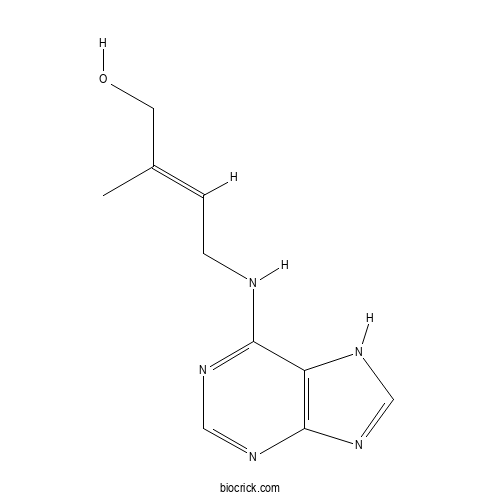
| Chemical Name | (E)-2-methyl-4-(7H-purin-6-ylamino)but-2-en-1-ol | ||
| SMILES | CC(=CCNC1=NC=NC2=C1NC=N2)CO | ||
| Standard InChIKey | UZKQTCBAMSWPJD-FARCUNLSSA-N | ||
| Standard InChI | InChI=1S/C10H13N5O/c1-7(4-16)2-3-11-9-8-10(13-5-12-8)15-6-14-9/h2,5-6,16H,3-4H2,1H3,(H2,11,12,13,14,15)/b7-2+ | ||
| General tips | For obtaining a higher solubility , please warm the tube at 37 ℃ and shake it in the ultrasonic bath for a while.Stock solution can be stored below -20℃ for several months. We recommend that you prepare and use the solution on the same day. However, if the test schedule requires, the stock solutions can be prepared in advance, and the stock solution must be sealed and stored below -20℃. In general, the stock solution can be kept for several months. Before use, we recommend that you leave the vial at room temperature for at least an hour before opening it. |
||
| About Packaging | 1. The packaging of the product may be reversed during transportation, cause the high purity compounds to adhere to the neck or cap of the vial.Take the vail out of its packaging and shake gently until the compounds fall to the bottom of the vial. 2. For liquid products, please centrifuge at 500xg to gather the liquid to the bottom of the vial. 3. Try to avoid loss or contamination during the experiment. |
||
| Shipping Condition | Packaging according to customer requirements(5mg, 10mg, 20mg and more). Ship via FedEx, DHL, UPS, EMS or other couriers with RT, or blue ice upon request. | ||
Quality Control & MSDS
3D structure
Package In Stock

Number of papers citing our products


Zeatin Dilution Calculator
Zeatin Molarity Calculator
| 1 mg | 5 mg | 10 mg | 20 mg | 25 mg | |
| 1 mM | 4.562 mL | 22.8102 mL | 45.6204 mL | 91.2409 mL | 114.0511 mL |
| 5 mM | 0.9124 mL | 4.562 mL | 9.1241 mL | 18.2482 mL | 22.8102 mL |
| 10 mM | 0.4562 mL | 2.281 mL | 4.562 mL | 9.1241 mL | 11.4051 mL |
| 50 mM | 0.0912 mL | 0.4562 mL | 0.9124 mL | 1.8248 mL | 2.281 mL |
| 100 mM | 0.0456 mL | 0.2281 mL | 0.4562 mL | 0.9124 mL | 1.1405 mL |
| * Note: If you are in the process of experiment, it's necessary to make the dilution ratios of the samples. The dilution data above is only for reference. Normally, it's can get a better solubility within lower of Concentrations. | |||||
- Riboflavin sodium phosphate
Catalog No.:BCX2311
CAS No.:130-40-5
- Chavicol
Catalog No.:BCX2310
CAS No.:501-92-8
- Piperonylic acid
Catalog No.:BCX2309
CAS No.:94-53-1
- 2'-Deoxyadenosine
Catalog No.:BCX2308
CAS No.:958-09-8
- Diosbulbin A
Catalog No.:BCX2307
CAS No.:20086-05-9
- Allylbenzene
Catalog No.:BCX2306
CAS No.:300-57-2
- 4-Hydroxy-3,5-diisopropylbenzaldehyde
Catalog No.:BCX2305
CAS No.:10537-86-7
- Ganoderic acid F
Catalog No.:BCX2304
CAS No.:98665-15-7
- 11-Oxocucurbita-5,24-diene-3,20-diol
Catalog No.:BCX2303
CAS No.:2491640-86-7
- 7β,20-Epoxyabieta-8,11,13-triene-6α,11,12-triol
Catalog No.:BCX2302
CAS No.:1353042-00-8
- threo-Anethole glycol
Catalog No.:BCX2301
CAS No.:112018-74-3
- Chantriolide C
Catalog No.:BCX2300
CAS No.:1206850-19-2
- 4-Hydroxypyridine-2,6-dicarboxylic acid
Catalog No.:BCX2313
CAS No.:499-51-4
- Isatin
Catalog No.:BCX2314
CAS No.:91-56-5
- D-Galacturonic acid hydrate
Catalog No.:BCX2315
CAS No.:685-73-4
- Mandelic acid
Catalog No.:BCX2316
CAS No.:90-64-2
- 9-Nitrocamptothecin
Catalog No.:BCX2317
CAS No.:86639-62-5
- Laurolitsine
Catalog No.:BCX2318
CAS No.:904927-11-3
- N6-Isopentenyladenine
Catalog No.:BCX2319
CAS No.:2365-40-4
- Glutathione disulfide
Catalog No.:BCX2320
CAS No.:27025-41-8
- Naringenin chalcone
Catalog No.:BCX2321
CAS No.:73692-50-9
- Spilanthol
Catalog No.:BCX2322
CAS No.:25394-57-4
- Cathayanin C
Catalog No.:BCX2323
CAS No.:330195-61-4
- Taurodeoxycholic acid
Catalog No.:BCX2324
CAS No.:516-50-7
Nitric Oxide Enhances Salt Tolerance in Ginger Seedlings Through Phytohormone Homeostasis and Starch and Sugar Metabolism.[Pubmed:42827088]
Physiol Plant. 2026 Sep-Oct;178(5):e71139.
Nitric oxide (NO) is a key signaling molecule regulating plant stress responses. In our study, the NO donor sodium nitroprusside (SNP) significantly promoted ginger seedling growth under salt stress, while treatment with the NO scavenger cPTIO resulted in an opposite response, supporting the involvement of NO in salt-stress responses. Transcriptome profiling of ginger leaves identified 2252 differentially expressed genes (DEGs), which were enriched in 55 Kyoto Encyclopedia of Genes and Genomes (KEGG) pathways. Further, analysis showed that 19 DEGs were enriched in plant hormone signal transduction, while 16 DEGs were enriched in starch and sugar metabolism. NO treatment increased the levels of indole-3-acetic acid (IAA), gibberellin 3 (GA(3)), and trans-Zeatin (ZR), while reducing the levels of abscisic acid (ABA), methyl jasmonate (MeJA), and brassinosteroid (BR). Moreover, NO promoted the accumulation of soluble sugars and sucrose and enhanced the activities of key enzymes involved in starch and sucrose metabolism, thereby effectively improving osmotic adjustment. Collectively, NO improves antioxidant capacity, maintains endogenous phytohormone balance, and enhances osmotic adjustment, ultimately alleviating salt stress damage in ginger seedlings.
Comparison of Extraction Methods for the Quantification of Phytohormones From Tomato Fruits and Leaves by LC-MS/MS.[Pubmed:42808338]
J Mass Spectrom. 2026 Oct;61(10):e70117.
Purification of crude plant extracts by solid-phase extraction (SPE) is assumed to reduce matrix effect in phytohormone quantification by LC-MS/MS, but its efficacy is rarely assessed. We used postextraction spiking of isotope-labeled phytohormones to estimate matrix effect, recovery, and processes efficiency in extracts prepared according to protocols that implement SPE with tC18 and HLB sorbents, respectively, and according to a protocol that does not include SPE. Across six structurally diverse phytohormone classes and tomato fruit and leaf matrices, we did not find significant matrix effects associated with extracts prepared with no SPE. For recovery efficiency, process efficiency, and variation, we rarely found conclusive evidence that the methods that implemented SPE were optimal relative to the one that does not. A notable exception was fruit extracts prepared using HLB sorbents, which had minimal variation for indole-3-acetic acid, trans-Zeatin, and trans-Zeatin riboside, all of which were detected with positive electrospray ionization.
Integrated Multi-Omics Analysis Reveals the Involvement of Alanine, Aspartate and Glutamate Metabolism in Wheat Responses to Salt Stress.[Pubmed:42796815]
Plants (Basel). 2026 Sep 11;15(18):2783.
Salt stress is frequently encountered by plants and is a major constraint on crop production. Wheat (Triticum aestivum L.) is a staple cereal crop that is important for human health and food security. However, the response mechanisms of roots from different wheat varieties to salt stress remain unclear. In this study, we analyzed the complex response mechanisms of the salt-tolerant variety Longjian 114 (LJ114) and the salt-sensitive variety Chinese Spring (CS) to salt stress using integrated transcriptomic and metabolomic analyses. The results showed that LJ114 maintained better growth and exhibited higher antioxidant enzyme activities and greater osmotic adjustment capacity under salt stress. Differentially expressed genes in LJ114 were predominantly enriched in flavonoid biosynthesis, alpha-linolenic acid metabolism, and Zeatin biosynthesis under salt stress. Metabolomic profiling identified 1366 differential metabolites, with LJ114 specifically enriched in tyrosine metabolism, tryptophan metabolism, glycerophospholipid metabolism, and fatty acid metabolism under salt stress. Integrated analyses further highlighted ABC transporters and alanine, aspartate, and glutamate metabolism as hub pathways, with notably higher GAD expression and GABA accumulation under salt stress. These findings suggest new insights into the molecular mechanisms underlying wheat salt tolerance and propose potential candidate targets for enhancing crop salinity tolerance.
Trans-zeatin suppresses osteoclastogenesis and prevents estrogen deficiency-induced bone loss by modulating Nrf2-mediated redox homeostasis and AKT signaling.[Pubmed:42790825]
Biochem Pharmacol. 2026 Sep 25;254(Pt 2):118502.
Postmenopausal osteoporosis (PMOP) is a metabolic bone disorder driven by excessive osteoclast (OC) activity, but current therapies are limited by adverse effects. Trans-Zeatin (TZ), a naturally occurring plant cytokinin with antioxidant properties, has not been investigated in bone metabolism. Here, we show that TZ suppresses receptor activator of nuclear factor-kappaB ligand (RANKL)-induced osteoclastogenesis and bone resorption in vitro and attenuates ovariectomy-induced trabecular bone loss in mice. Mechanistically, TZ activates nuclear factor erythroid 2-related factor 2 (Nrf2)-mediated antioxidant responses by upregulating heme oxygenase-1 (HO-1) and catalase while suppressing NADPH oxidase 4 (NOX4) expression, thereby reducing reactive oxygen species (ROS) accumulation. This redox modulation subsequently dampens protein kinase B (AKT) signaling, downregulates the c-Fos/nuclear factor of activated T-cells cytoplasmic 1 (NFATc1) transcriptional program, and decreases the expression of OC-specific effector genes. Notably, Nrf2 knockdown partially reverses the inhibitory effects of TZ, whereas concurrent AKT knockdown attenuates this rescue effect, suggesting that AKT is an important downstream signaling component associated with Nrf2-mediated redox regulation. Collectively, these findings identify TZ as a promising natural candidate for PMOP intervention through coordinated regulation of redox homeostasis and AKT-dependent osteoclastogenic signaling.
Comparative physiological, hormonal, and transcriptional analyses reveal the difference between diploid and autotetraploid rice under cadmium stress.[Pubmed:42763836]
Plant Cell Rep. 2026 Sep 20;45(10):298.
Elevated cadmium (Cd) stress tolerance in autotetraploid rice at the seedling stage is correlated with coordinated remodeling of ROS homeostasis, hormone signaling and transcriptional programs. Polyploid plants commonly exhibit robust tolerance to various abiotic stresses, while the underlying regulatory mechanisms remain largely elusive. To elucidate the intrinsic mechanisms underlying enhanced Cd stress tolerance in autotetraploid rice, two pairs of diploid (2X) rice and their corresponding autotetraploid (4X) lines were used as experimental materials for Cd stress treatment and systematic phenotypic, physiological, and molecular evaluation at the seedling stage. Phenotypic observations confirmed that autotetraploid rice displayed markedly stronger Cd stress tolerance than diploid rice, as reflected by approximately 1.5-fold greater plant height alongside elevated biomass and chlorophyll content. Physiological and biochemical assays revealed that autotetraploids exhibited markedly lower Cd content, higher levels of soluble sugars and proline, distinctly lower levels of ROS-related indicators (MDA and H(2)O(2)), and markedly elevated activities of antioxidant enzymes (catalase, CAT; peroxidase, POD). Comparative phytohormone quantification demonstrated that autotetraploid rice had significantly higher levels of tryptamine (TAM), indole-3-acetic acid (IAA), indole-3-acetyl-L-aspartic acid (IAA-Asp), jasmonic acid (JA), jasmonoyl-L-isoleucine (JA-Ile), and gibberellins A(1) (GA(1)) and A(7) (GA(7)) but significantly lower levels of cis- (cZ) and trans-Zeatin (tZ), with about 2.6, 1.3, 2.3, 1.4, 2.0, 2.6, 2.1, 0.5, 0.6 folds of diploid plants, respectively. Transcriptome profiling revealed that under control conditions, the number of differentially expressed genes (DEGs) between autotetraploid and diploid was merely 939 in roots and 313 in shoots. Under Cd stress, however, the counts of DEGs markedly increased to 4974 in roots and 1023 in shoots. Notably, genes involved in heavy metal transport, and hormone and ROS metabolism were significantly enriched in autotetraploids. Furthermore, qRT-PCR validated consistent expression trends of core metal transporters, hormone biosynthesis genes, and antioxidant genes between the RNA-seq data and independent samples. Collectively, this study suggests that the distinct regulations of physiological and biochemical processes, hormone metabolism, and transcription in autotetraploids under Cd stress are correlated with their enhanced Cd stress tolerance.
Drip fertigation technique with planting models strategies trigger grain filling, endogenous hormonal changes and maize productivity under semi-arid regions.[Pubmed:42760979]
Front Plant Sci. 2026 Sep 4;17:1919758.
Mulch drip fertigation strategies have been widely adopted to improve maize productivity in semi-arid regions. However, the impact of the mulch-based drip fertigation on endogenous hormone dynamics in crops and grain yield has not been fully elucidated, and the biochemical mechanisms underlying yield improvement under different drip fertigation strategies remain unclear. Grain filling has a significant impact on maize production. The aim of this study was to explore the effect of plastic film mulching materials on maize grain filling under a drip fertigation strategy, and the relationship between this effect and changes in endogenous hormones. This study compared biodegradable film mulching (BM) with soil crust ridges (SR) under high (H), medium (M), and low (L) drip irrigation conditions, and measured that the grain filling characteristics and changes in grain endogenous hormones in various parts of maize ears during the growth stage. The results showed that the grain filling rate, dry matter plant(-1), hormone changes, yield components, water use efficiency (WUE), and ET of maize under the BMH treatment were significantly higher than those under the SR treatment. BMH treatment significantly increased soil water storage significantly increased plant hormone contents such as abscisic acid (ABA), indole-3-Acetic acid (IAA), and Zeatin + Zeatin Riboside (Z+ZR), and decreased the evolution rate of gibberellins (Gas) and ethylene, thereby increasing maize yield. These results indicate that BMH treatment improved the filling process, soil respiration rate, WUE, yield, and yield composition of maize. High drip fertigation with BM or SR treatment significantly affected endogenous hormone changes, thereby regulating the activity grain-filling period (AGP), maximum grain-filling rate (G(max)), maximum grain weight (W(max)), mean grain-filling rates (G(mean)) and occurrence time of maximal filling rate (T(max)) of maize. In addition, high drip fertigation and the BM strategy significantly increased soil water storage and soil respiration rate during the grain filling period. Based on these results, we conclude that BMH significantly improved soil water storage, thereby regulating the maize grain filling rate, which was significantly correlated with the balance of endogenous hormones in the grains.
Nitric oxide and hydrogen gas synergistically promote adventitious rooting in cucumber: insights from transcriptomic and physiological analyses.[Pubmed:42758343]
Planta. 2026 Sep 18;264(5):134.
NO and H(2) synergistically promote cucumber adventitious rooting by regulating hormone, photosynthesis and antioxidant pathways. Adventitious root formation is essential for plant propagation and is modulated by nitric oxide (NO) and hydrogen gas (H(2)). This study used transcriptome sequencing to investigate cucumber explants treated with sodium nitroprusside (SNP, an NO donor) and hydrogen-rich water (HRW, an H(2) donor). In total, 2716 differentially expressed genes (DEGs) were identified under SNP treatment and 1443 under HRW treatment, with 570 genes co-regulated by both signals. KEGG enrichment analysis revealed significant enrichment in pathways involved in phytohormone signaling, photosynthesis-antenna proteins, and glutathione metabolism. Functional characterization of the 570 common genes showed enrichment of protein kinases, cytochrome P450, and transcription factor families (AP2/ERF, MYB, bHLH, NAC), and protein-protein interaction network analysis identified five hub genes (CsAUX1, CsCYCD3-3, CsGSTU8, CsXTH3, CsERFC3). Physiological assays verified that SNP and HRW coordinately regulated phytohormone homeostasis: they decreased Zeatin content while increasing brassinosteroids and ethylene levels. Additionally, both treatments improved photosynthetic parameters and enhanced glutathione antioxidant activity. Time-course qPCR revealed that HRW induced faster gene expression changes (peaks at 12-24 h) than SNP (peaks at 24-48 h), and NO scavenger (cPTIO) experiments confirmed that SNP effects are strictly NO-dependent while HRW acts through both NO-dependent and NO-independent pathways. Oxidative stress markers (MDA, H(2)O(2), O(2)(-)) were reduced, and antioxidant enzymes (SOD, POD, CAT, APX, GR, GPX, GSTs) were elevated, indicating enhanced redox buffering capacity rather than oxidative stress. Cis-regulatory analysis further detected transcription factor binding sites related to light, hormone, and stress responses. Collectively, these findings systematically reveal a synergistic molecular network by which NO and H(2) promote adventitious rooting. This study enhances our understanding of the regulatory mechanisms underlying adventitious root development and offers a theoretical foundation for optimizing propagation techniques in horticultural crops.
An effective method for isolation and regeneration of Solanum tuberosum mesophyll protoplasts for transgene-free genome editing.[Pubmed:42749437]
J Genet Eng Biotechnol. 2026 Sep;24(3):100767.
An effective system for isolating and regenerating protoplasts is crucial for research in genome engineering. This study focused on refining a protocol for the isolation and regeneration of mesophyll protoplasts from the leaves of Solanum tuberosum cv. Kufri Jyoti. Key factors influencing protoplast yield and viability, such as dark pretreatment, pre-plasmolysis, enzyme concentrations, and osmoticum levels, were thoroughly assessed and optimized. The highest protoplast yield and viability were achieved with an enzyme mixture of 1.0% cellulase R-10 and 0.5% macerozyme R-10 after 16 h of incubation. Furthermore, culturing on a Murashige and Skoog-based medium (MSPI) without ammonium nitrate, enriched with an osmoticum concentration of 0.4 M and a carefully adjusted auxin-to-cytokinin ratio, successfully facilitated protoplast division, microcalli proliferation, and minicalli formation. Callus proliferation and shoot induction were accomplished on MS(13K) medium supplemented with naphthaleneacetic acid (NAA) and Zeatin riboside. Root initiation and elongation were promoted on MS basal medium supplemented with indole-3-butyric acid (IBA) at 1 mg/L. The regenerated plantlets were subsequently acclimatized and hardened under controlled greenhouse conditions. This robust protoplast-to-plant protocol serves as a crucial resource for the introduction of ribonucleoprotein complexes into plant cells, facilitating accurate, transgene-free genome editing.
Comparative Effects of Cytokinins and Spermidine on In Vitro Organogenesis of Ruscus hypoglossum L. and Rooting of Regenerated Shoots.[Pubmed:42739382]
Plants (Basel). 2026 Aug 27;15(17):2615.
Ruscus hypoglossum L. is an evergreen ornamental species valued as cut foliage, but its commercial production is constrained by slow vegetative propagation and limited availability of uniform planting material. This study aimed to develop an efficient in vitro propagation protocol for R. hypoglossum by evaluating the effects of different cytokinins and spermidine on shoot organogenesis and subsequent rooting. Thidiazuron (TDZ), Zeatin, kinetin, and spermidine were applied at 0.5 and 1.0 mg L(-1) to rhizome explants derived from in vitro-grown seedlings. Explant length, shoot and cladode number, fresh weight, shoot diameter, chlorophyll a and b, total carotenoid content, SPAD value, and rooting performance were assessed. Significant treatment effects were observed for most traits. Kinetin at 1.0 mg L(-1) produced the highest shoot proliferation (4.66 shoots explant(-1)), cladode number (12.00 explant(-1)), fresh weight (0.31 g), chlorophyll a (0.72 mg g(-1) FW), chlorophyll b (0.29 mg g(-1) FW), and SPAD value (40.25). Spermidine at 1.0 mg L(-1) resulted in the highest carotenoid content (0.59 mg g(-1) FW) and promoted greater explant elongation, whereas TDZ at 1.0 mg L(-1) reduced cladode formation and pigment accumulation. Multivariate analyses consistently identified kinetin as the most favorable treatment during multiplication. Shoots regenerated with 1.0 mg L(-1) kinetin also showed the highest rooting response following a 10 s pulse treatment with 2.0 mg L(-1) IBA and transfer to hormone-free half-strength MS medium. Overall, kinetin was the most effective treatment under the conditions tested, providing a practical basis for efficient clonal propagation and ex situ conservation of R. hypoglossum.
Different Dynamics: Meta-Topolin Induces Faster and More Pronounced Upregulation of Selected Shoot Development-Related Genes in Arabidopsis thaliana Compared to Trans-Zeatin and Thidiazuron.[Pubmed:42737931]
Biology (Basel). 2026 Sep 2;15(17):1499.
Cytokinins (CKs) are a class of phytohormones that regulate a wide range of developmental processes in plants. Different structural forms of these phytohormones have been widely used in plant tissue culture, although comparative studies on their temporal effects on gene expression remain limited. In this study, we compared the effects of trans-Zeatin (tZ), meta-topolin (mT), and thidiazuron (TDZ) on the expression dynamics of ten CK-responsive genes associated with shoot growth and development in Arabidopsis thaliana. Ten-day-old Arabidopsis seedlings were exposed to liquid nutrient media containing 5 muM tZ, mT, or TDZ, or a control medium, for 15 min and 1, 2, 4, 8, and 24 h. Gene expression was analyzed by RT-qPCR using three independent biological replicates. All tested genes were strongly upregulated at 4 h following mT treatment, whereas most genes showed the highest expression at 8 h in response to TDZ. In contrast, tZ generally induced weaker and slower transcriptional responses. Expression levels of all analyzed genes returned to control-like or lower levels within 24 h. Overall, the three structurally distinct cytokinins induced markedly different temporal transcriptional responses, with mT producing the fastest and most pronounced effects on the expression of the tested genes under the applied experimental conditions. These findings improve our understanding of CK-dependent transcriptional dynamics during shoot development and provide a basis for future studies on CK-regulated morphogenesis and plant regeneration.
Ethylene signaling negatively regulates rapeseed resistance to Plasmodiophora brassicae.[Pubmed:42725639]
J Exp Bot. 2026 Sep 11:erag455.
Clubroot, caused by Plasmodiophora brassicae, poses a serious threat to the rapeseed (Brassica napus) industry. Due to B. napus being an allopolyploid with a complex genome and the current scarcity of available resistance gene resources, the molecular basis of rapeseed resistance to P. brassicae remains poorly understood. Here, we performed a functional characterization of BnEIN2 (ethylene-insensitive protein) to explore the role of ethylene signaling in rapeseed resistance to P. brassicae. The Bnein2 mutants generated through CRISPR/Cas9 technology exhibited enhanced resistance to P. brassicae, along with reduced 1-aminocyclopropane-1-carboxylic acid (ACC)/S-adenosyl-L-methionine (SAM) accumulation and ethylene insensitivity. Pharmacological assays demonstrated that inhibitors of ethylene biosynthesis or signaling improved the resistance of Bnein2 mutant plants to P. brassicae. Transcriptome analysis revealed that loss-of-function of BnEIN2 affected the expression of ethylene-, auxin-, and cytokinin-related genes. Moreover, the increased resistance of Bnein2 mutants to P. brassicae was accompanied by a reduction in auxin (indole-3-acetic acid, IAA) biosynthesis and degradation of cytokinin (trans-Zeatin, TZ). Collectively, these findings establish the negative regulatory role of ethylene signaling in rapeseed resistance to P. brassicae. This study represents the first effort to elucidate rapeseed resistance to P. brassicae by directly obtaining rapeseed genetic material and offer novel insights into the hormonal regulatory network underlying disease resistance and valuable resources for breeding clubroot-resistant varieties.
5-Aminolevulinic acid promotes cell division and young fruit development by suppressing the PpARF9-PpGH3.1 auxin-conjugation module in peach.[Pubmed:42702726]
Mol Hortic. 2026 Sep 7;6(1):69.
5-Aminolevulinic acid (ALA) is an emerging plant growth regulator, yet its mechanisms in fruit development remain unclear. Here, we show that ALA promotes early growth and ultimate size in peach (Prunus persica) fruits. ALA treatment significantly enhanced the mesocarp area and the cell number, accompanied by elevated levels of indole-3-acetic acid (IAA) and trans-Zeatin riboside. Transcriptomic analysis identified PpARF9 as a key transcriptional factor, regulating auxin homeostasis and responsive to ALA treatment. Functional studies with yeast-one-hybrid (Y1H), dual-luciferase (DLR), electrophoretic mobility shift assay (EMSA) and homogenous genetic transformation revealed that PpARF9 directly transcriptionally activates PpGH3.1, a crucial gene which encodes chloroplastic auxin amide synthetase to conjugate free IAA and repress cell division. Overexpression of PpGH3.1 reduced free IAA with more IAA conjugate accumulation, thereby suppressing cell cycle. Conversely, silencing PpGH3.1 with RNA interference had opposite effects. Notably, exogenous ALA alleviated the inhibitory effects of PpARF9 and PpGH3.1 on cell proliferation. These findings indicate that ALA promotes cell division by downregulating the PpARF9-PpGH3.1 module to maintain higher levels of active IAA, facilitating cell division, increasing cell number and fruit size. These provide a mechanistic insight into ALA-regulated fruit development and support its application in improving fruit production.
Comparative transcriptomics reveals hormone signaling and MADS-box genes in divergent development of inflorescences and tendrils in grapevine lateral shoots.[Pubmed:42663710]
Plant Cell Rep. 2026 Aug 28;45(9):270.
Hormone signaling and MADS-box genes regulate grapevine tendril and inflorescence growth divergence, offering molecular insights for managing tendril growth. Grapevine (Vitis vinifera L.) tendrils and inflorescences are homologous organs; however, their divergent development has important agronomic consequences because excessive tendril growth increases vineyard management costs. To explore the regulatory mechanisms, we compared the inflorescence-prone cultivar 'Einset Seedless' (ENT) with the tendril-prone cultivar 'Pinot Noir' (PN) using anatomical observation, transcriptome analysis of specific tendril nodes, and functional characterization of MADS-box genes. ENT exhibited a higher flowering rate at tendril nodes 1-4 than PN. Transcriptome profiling of specific tendril nodes uncovered 549 differentially expressed genes (DEGs) through an intersection/exclusion strategy, with Kyoto Encyclopedia of Genes and Genomes (KEGG) enrichment indicating that hormone and mitogen-activated protein kinase (MAPK) signaling were the primary candidates driving the divergence. To assess the spatiotemporal dynamics of these DEGs, we performed Mfuzz clustering, which revealed that multiple expression trajectories were highly consistent with the flowering gradient across different ENT and PN nodes. Plant hormone signal transduction was the predominantly enriched pathway across all dynamic clusters, highlighting the centrality of phytohormones in this process. Guided by this transcriptional evidence, we measured endogenous Zeatin and gibberellin (GA(3)) contents in the nodal tissues. Remarkably, the Zeatin-to-GA(3) ratio not only paralleled the flowering gradient but also correlated with the cluster expression trajectories, providing physiological evidence for a cytokinin-gibberellin interaction model governing organ divergence. Additionally, we analyzed the differentially expressed transcription factors among the DEGs and identified a MADS-box gene, FRUITFULL-LIKE (VvFUL-L), which was markedly upregulated in PN tendrils. Heterologous overexpression of VvFUL-L in arabidopsis promoted early flowering and reduced inflorescence branching, suggesting its potential role in regulating lateral meristem development and affecting tendril formation. Collectively, these findings establish that Hormone Signaling, particularly cytokinin-GA crosstalk, and MADS-box regulators, such as VvFUL-L, are key regulators of inflorescence versus tendril growth in grapevines, providing a basis for future molecular and breeding studies.
Dynamic transcriptomic and metabolomic responses to seed germination in Luffa cylindrica.[Pubmed:42660355]
Plant Sci. 2026 Nov;372:113405.
Seed dormancy is a critical agronomic trait that affects uniform germination and seedling establishment in Luffa cylindrica. In this study, we performed phenotypic, transcriptomic, and metabolomic analyses on two contrasting Luffa cylindrica materials: Z-184 and Z-114. Phenotypic evaluation revealed that compared with Z-114 seeds, Z-184 seeds exhibited significantly lower germination potentials and germination rates. Transcriptomic analysis revealed that the DEGs were predominantly associated with plant hormone signal transduction, MAPK signaling, and metabolic pathways. Metabolomic profiling revealed 2469 metabolites, with 728 showing significant changes during dormancy release. Integrated transcriptomic and metabolomic analyses highlighted coordinated changes in hormone-, energy-, and secondary metabolism-related pathways. Hormone quantification further demonstrated that the differential accumulation of GA(4), trans-Zeatin and trans-Zeatin riboside (tZ + tZR), and 2- cis-4-trans- (+) abscisic acid (an isomer of abscisic acid, ABA) was closely associated with the contrasting dormancy phenotypes. These findings provide reference data for the study of the seed dormancy mechanism in Luffa cylindrica and lay the foundation for the breeding of weakly dormant Luffa cylindrica.
Agronomic, Hormonal, and Seed Quality Responses of Soybeans to Four Spray Treatment Regimes Under Irrigated Conditions in Xinjiang: A Three-Year Field Study.[Pubmed:42654930]
Plants (Basel). 2026 Aug 20;15(16):2528.
Soybean production commonly faces challenges including severe pod abscission, incomplete seed filling, and uncoordinated source-sink relationships that limit yield potential. Plant growth regulator application may influence source-sink relationships and thereby affect soybean (Glycine max (L.) Merr.) yield formation. This three-year field study (2023-2025) evaluated the effects of four spray programs on soybean yield, quality, total above-ground biomass partitioning, and endogenous hormone dynamics under Xinjiang's irrigated production conditions. The four treatments were an untreated control (CK), naphthaleneacetic acid alone (NAA; 300 g ha(-1)), naphthaleneacetic acid plus prohexadione-calcium (NPC; 300 + 450 g ha(-1)), and naphthaleneacetic acid plus prohexadione-calcium and iron chlorin e6 (NCE; 300 + 450 + 45 g ha(-1)). The spray programs were applied at the fourth-trifoliolate and full-pod stages. Results showed that NCE treatment consistently produced the greatest yield increases (13.1-14.4%) compared with the control. This response was associated with greater middle-node pod retention, increased 100-seed weight (3.6-6.4%), and improved reproductive organ biomass allocation (44.7-53.3% at maturity vs. 40.9-45.7% in controls). NCE significantly elevated leaf trans-Zeatin content (37.1-91.9%) within 24 h after application and improved seed protein concentration by up to 11.2%, while seed residues of all applied compounds remained well below safety thresholds (<0.05 mg kg(-1)). Correlation analysis revealed strong positive relationships between trans-Zeatin levels and both reproductive biomass allocation (r = 0.74-0.90, p < 0.01) and grain yield (r = 0.86-0.96, p < 0.01). These findings indicate that NCE was the best-performing of the four tested spray programs under Xinjiang's irrigated production conditions, although the individual contributions and possible interactions of the three compounds require further factorial evaluation.

Calcutta University

University of Minnesota

University of Maryland School of Medicine

University of Illinois at Chicago

The Ohio State University

University of Zurich

Harvard University

Colorado State University

Auburn University

Yale University

Worcester Polytechnic Institute

Washington State University

Stanford University

University of Leipzig

Universidade da Beira Interior

The Institute of Cancer Research

Heidelberg University

University of Amsterdam

University of Auckland

TsingHua University

The University of Michigan

Miami University

DRURY University

Jilin University

Fudan University

Wuhan University

Sun Yat-sen University

Universite de Paris

Deemed University

Auckland University

The University of Tokyo

Korea University



