
N6-IsopentenyladenineCAS# 2365-40-4 |
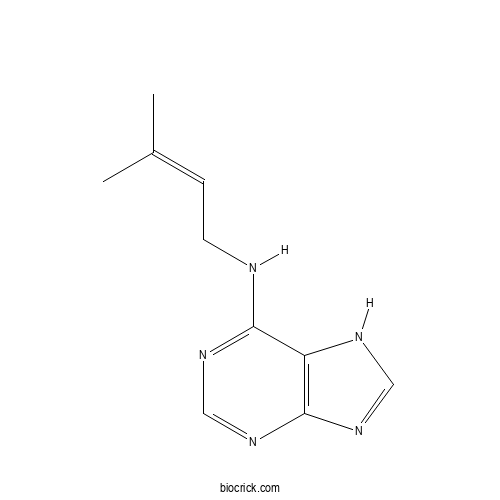
| Cas No. | 2365-40-4 | SDF | File under preparation. |
| PubChem ID | 92180.0 | Appearance | Powder |
| Formula | C10H13N5 | M.Wt | 203.2 |
| Type of Compound | N/A | Storage | Desiccate at -20°C |
| Solubility | Soluble in Chloroform,Dichloromethane,Ethyl Acetate,DMSO,Acetone,etc. | ||
| Chemical Name | N-(3-methylbut-2-enyl)-7H-purin-6-amine | ||
| SMILES | CC(=CCNC1=NC=NC2=C1NC=N2)C | ||
| Standard InChIKey | HYVABZIGRDEKCD-UHFFFAOYSA-N | ||
| Standard InChI | InChI=1S/C10H13N5/c1-7(2)3-4-11-9-8-10(13-5-12-8)15-6-14-9/h3,5-6H,4H2,1-2H3,(H2,11,12,13,14,15) | ||
| General tips | For obtaining a higher solubility , please warm the tube at 37 ℃ and shake it in the ultrasonic bath for a while.Stock solution can be stored below -20℃ for several months. We recommend that you prepare and use the solution on the same day. However, if the test schedule requires, the stock solutions can be prepared in advance, and the stock solution must be sealed and stored below -20℃. In general, the stock solution can be kept for several months. Before use, we recommend that you leave the vial at room temperature for at least an hour before opening it. |
||
| About Packaging | 1. The packaging of the product may be reversed during transportation, cause the high purity compounds to adhere to the neck or cap of the vial.Take the vail out of its packaging and shake gently until the compounds fall to the bottom of the vial. 2. For liquid products, please centrifuge at 500xg to gather the liquid to the bottom of the vial. 3. Try to avoid loss or contamination during the experiment. |
||
| Shipping Condition | Packaging according to customer requirements(5mg, 10mg, 20mg and more). Ship via FedEx, DHL, UPS, EMS or other couriers with RT, or blue ice upon request. | ||
Quality Control & MSDS
3D structure
Package In Stock

Number of papers citing our products


N6-Isopentenyladenine Dilution Calculator
N6-Isopentenyladenine Molarity Calculator
| 1 mg | 5 mg | 10 mg | 20 mg | 25 mg | |
| 1 mM | 4.9213 mL | 24.6063 mL | 49.2126 mL | 98.4252 mL | 123.0315 mL |
| 5 mM | 0.9843 mL | 4.9213 mL | 9.8425 mL | 19.685 mL | 24.6063 mL |
| 10 mM | 0.4921 mL | 2.4606 mL | 4.9213 mL | 9.8425 mL | 12.3031 mL |
| 50 mM | 0.0984 mL | 0.4921 mL | 0.9843 mL | 1.9685 mL | 2.4606 mL |
| 100 mM | 0.0492 mL | 0.2461 mL | 0.4921 mL | 0.9843 mL | 1.2303 mL |
| * Note: If you are in the process of experiment, it's necessary to make the dilution ratios of the samples. The dilution data above is only for reference. Normally, it's can get a better solubility within lower of Concentrations. | |||||
- Laurolitsine
Catalog No.:BCX2318
CAS No.:904927-11-3
- 9-Nitrocamptothecin
Catalog No.:BCX2317
CAS No.:86639-62-5
- Mandelic acid
Catalog No.:BCX2316
CAS No.:90-64-2
- D-Galacturonic acid hydrate
Catalog No.:BCX2315
CAS No.:685-73-4
- Isatin
Catalog No.:BCX2314
CAS No.:91-56-5
- 4-Hydroxypyridine-2,6-dicarboxylic acid
Catalog No.:BCX2313
CAS No.:499-51-4
- Zeatin
Catalog No.:BCX2312
CAS No.:1637-39-4
- Riboflavin sodium phosphate
Catalog No.:BCX2311
CAS No.:130-40-5
- Chavicol
Catalog No.:BCX2310
CAS No.:501-92-8
- Piperonylic acid
Catalog No.:BCX2309
CAS No.:94-53-1
- 2'-Deoxyadenosine
Catalog No.:BCX2308
CAS No.:958-09-8
- Diosbulbin A
Catalog No.:BCX2307
CAS No.:20086-05-9
- Glutathione disulfide
Catalog No.:BCX2320
CAS No.:27025-41-8
- Naringenin chalcone
Catalog No.:BCX2321
CAS No.:73692-50-9
- Spilanthol
Catalog No.:BCX2322
CAS No.:25394-57-4
- Cathayanin C
Catalog No.:BCX2323
CAS No.:330195-61-4
- Taurodeoxycholic acid
Catalog No.:BCX2324
CAS No.:516-50-7
- Cathayanin B
Catalog No.:BCX2325
CAS No.:330195-60-3
- Sorocein H
Catalog No.:BCX2326
CAS No.:157382-82-6
- 3-Methyl-1-(3-methylfuran-2-yl)but-3-en-1-one
Catalog No.:BCX2327
CAS No.:78173-38-3
- Putrescine
Catalog No.:BCX2328
CAS No.:110-60-1
- L-Ornithine
Catalog No.:BCX2329
CAS No.:70-26-8
- Dopamine
Catalog No.:BCX2330
CAS No.:51-61-6
- Norcantharidin
Catalog No.:BCX2331
CAS No.:29745-04-8
The photosynthetic bacteria delayed tomato leaf senescence under weak light conditions by regulating SlPIF4-SlIPT6/SlLOG8 module.[Pubmed:41397366]
Plant Physiol Biochem. 2026 Jan;230:110946.
Weak light threatens crop yield by impairing plant photosynthesis and growth. How to improve crop growth under such circumstances is extremely important for the agriculture and forestry. Photosynthetic bacteria can utilize bacteriochlorophyll to photosynthesize in weak light and anaerobic environments where plants cannot survive. Whether photosynthetic bacteria can be used to improve photosynthesis of plants under weak light environments has not been reported. Here, we found that foliar spraying of photosynthetic Rhodopseudomonas palustris strain CGA009 delayed leaf senescence and enhanced tomato photosynthesis under weak light conditions. Bacteria treatment maintained chlorophyll level by promoting the degradation of the negative regulator SlPIF4, which thereby relieved the repression of cytokinin biosynthesis genes SlIPT6/SlLOG8. Silencing of SlIPT6 and SlLOG8 made tomato plants insensitive to R. palustris treatment under weak light conditions, leading to a decrease in the synthesis of the active cytokinin N6-Isopentenyladenine (iP) and cis-Zeatin (cZ). Our findings demonstrated that R. palustris can rescue the photosynthetic capacity of tomatoes under weak light conditions through transcription regulation. Thus, this study provides an avenue to enhance crop yield under weak light stress by plant photosynthesis improvement mediated via photosynthetic bacteria.
Metabolomic Analysis of Plant Hormone-Related Metabolites in Medicago sativa Under Low-Temperature Stress.[Pubmed:40871526]
Molecules. 2025 Aug 13;30(16):3373.
(1) Background: This study used the cold-tolerant cultivar "Daye No. 3" (DY) and the cold-sensitive cultivar "Longdong" (LD) as plant materials to study the metabolic changes in plant hormones in alfalfa (Medicago sativa L.) under cold stress. (2) Methods: The targeted quantitative detection of phytohormones in alfalfa was carried out by liquid chromatography-tandem mass spectrometry (LC-MS/MS) technology. Principal component analysis (PCA), orthogonal signal correction, and partial least squares discriminant analysis (OPLS-DA) were used to investigate sample classification and screen differential metabolites. (3) Results: The results showed that 17 differential metabolites were detected. Seven metabolites showed common changes in the two cultivars after low-temperature stress induction. The levels of tryptamine, N-jasmonoylisoleucine, trans-zeatin riboside, isopentenyladenine riboside, cis-zeatin riboside, and gibberellin A7 were decreased, while N6-Isopentenyladenine levels increased. In addition, compared with the LD variety, DY had more metabolite changes in response to low-temperature stress. Abscisic acid and trans-zeatin were elevated, whereas IAA-alanine, dihydrozeatin riboside, and indole-3-carboxaldehyde showed reduced concentrations. Kyoto Encyclopedia of Genes and Genomes (KEGG) pathway enrichment analysis showed that differential plant hormones were more active in plant hormone signal transduction, zeatin biosynthesis, and tryptophan metabolism pathways. In addition, a total of 12 metabolites in these three pathways showed common changes under cold stress. (4) This study identified significant metabolomic differences between two alfalfa genotypes under stress. It highlighted key pathways and provided new insights into the metabolic changes of alfalfa under cold-stress conditions.
A 294 kb deletion causes reduced leaflet size and biomass in pigeonpea.[Pubmed:40237839]
Plant Cell Rep. 2025 Apr 16;44(5):98.
BSA-seq and fine mapping revealed a 294 kb deletion on chromosome 9 regulating leaflet size and biomass in pigeonpea. Leaf size critically influences photosynthetic capacity, impacting organic matter production and biomass yield. This study reports the identification and characterization of a small leaflet mutant (sl1) in pigeonpea (Cajanus cajan) generated via aerial mutagenesis. Compared to the wild-type Qiongzhong, sl1 displayed significantly reduced leaf area, plant height, stem diameter, and biomass, characteristic of a dwarf phenotype. Genetic analysis confirmed a single recessive locus controlling the sl1 phenotype. Bulked segregant analysis sequencing (BSA-seq) and fine mapping identified the causal mutation as a 294 kb deletion encompassing 21 genes on chromosome 9. Transcriptomic analysis identified 1,039 differentially expressed genes (DEGs), indicating disruptions in, among others, plant hormone signaling pathways. Analysis of 28 target plant hormone metabolites revealed significant shifts in sl1 mutant compared to wild-type, including increased levels of strigolactone, methyl indole-3-acetate, and trans-zeatin-riboside, and decreases in gibberellin A3, N6-Isopentenyladenine, and methyl jasmonate. Cytological analysis revealed a decreased cell number in sl1 leaves, contributing to the reduced leaflet size. Three candidate genes, CC09g01700, CC09g01705, and CC09g01707, within the deleted region were prioritized based on their altered expression patterns and their putative roles in leaf development. These findings elucidate the genetic regulation of leaf morphology and biomass in pigeonpea, offering potential targets for marker-assisted selection to enhance pigeonpea yield.
Laser-wound stimulated adventitious root formation of Rosa canina cuttings involves a complex response at plant hormonal and metabolic level.[Pubmed:39737379]
Front Plant Sci. 2024 Dec 16;15:1515990.
INTRODUCTION: The presence of wounds in addition to the excision-induced wounds after severance from the stock plants is known to positively influence adventitious root formation of woody plant cuttings. Previous morphological studies highlighted laser wounding as a technique allowing to precisely control the decisive ablation depth. However, the biochemical processes involved in the response of rooting to the additional wounding remained unexplored. METHODS: The present study analyzed changes in the plant hormone and carbohydrate profiles in response to laser treatments of rose leafy single-node stem cuttings (Rosa canina 'Pfander'). Concentrations of four groups of plant hormones and of carbohydrates were monitored in three different stem sections of the cutting base during the first eight days after excision of cuttings. In addition, histology was employed to investigate anatomical changes at the basal wound and the laser wounds at the start and the end of the experiment after 40 days. RESULTS: Laser ablation caused an increase of vascular tissue dimension directly in the laser wound, and increased the quantity and quality of rooting compared to control cuttings. A clear early local rise of jasmonic acid (JA) was detected directly in wounded areas after laser marking, as well as an increase in abscisic acid (ABA) that persisted for the subsequent days. Indole-3-acetic acid (IAA) levels were relatively high on day zero, but decreased thereafter. Interestingly, higher IAA levels were maintained in the stem section below the axillary bud compared with the opposite section. Laser-treated cuttings presented a clear increase in contents of IAA-amino acid conjugates (IAAGlu and IAAsp) and the oxidation product OxIAA. Differences in concentration of these IAA metabolites were related to the position of the laser wound relative to the axillary bud and leaf. Additionally, laser treatments caused gradually increased levels of the cytokinin N6-Isopentenyladenine (iP) in laser-treated zones, and of zeatin riboside specifically when the laser wound was placed on the leaf-bud side. Additional laser wounding reduced starch and sucrose levels in all wounded sections at the end of the evaluation period, independently of the wounding location. DISCUSSION: The results of this study indicate that presence of additional injured tissue triggers a complex biochemical adjustment at the base of the cutting responsible of inducing vascular tissue growth and capable of generating a positive response to adventitious root formation.
Integrated transcriptome and endogenous hormone analyses reveal the factors affecting the yield of Camellia oleifera.[Pubmed:39304819]
BMC Genomics. 2024 Sep 20;25(1):887.
Camellia oleifera is an important woody oil tree in China, in which the flowers and fruits appear during the same period. The endogenous hormone changes and transcription expression levels in different parts of the flower tissue (sepals, petals, stamens, and pistils), flower buds, leaves, and seeds of Changlin 23 high-yield (H), Changlin low-yield (L), and control (CK) C. oleifera groups were studied. The abscisic acid (ABA) content in the petals and stamens in the L group was significantly higher than that in the H and CK groups, which may be related to flower and fruit drops. The high N6-Isopentenyladenine (iP) and indole acetic acid (IAA) contents in the flower buds may be associated with a high yield. Comparative transcriptome analysis showed that the protein phosphatase 2C (PP2C), jasmonate-zim-domain protein (JAZ), and WRKY-related differentially expressed genes (DEGs) may play an important role in determining leaf color. Gene set enrichment analysis (GSEA) comparison showed that jasmonic acid (JA) and cytokinin play an important role in determining the pistil of the H group. In this study, endogenous hormone and transcriptome analyses were carried out to identify the factors influencing the large yield difference in C. oleifera in the same year, which provides a theoretical basis for C. oleifera in the future.
Metabolomics, phytohormone and transcriptomics strategies to reveal the mechanism of barley heading date regulation to responds different photoperiod.[Pubmed:39300396]
BMC Genomics. 2024 Sep 19;25(1):879.
BACKGROUND: The correlation between heading date and flowering time significantly regulates grain filling and seed formation in barley and other crops, ultimately determining crop productivity. In this study, the transcriptome, hormone content detection, and metabolome analysis were performed systematically to analyze the regulatory mechanism of heading time in highland barley under different light conditions. The heading date of D18 (winter highland barley variety, Dongqing18) was later than that of K13 (vernal highland barley variety) under normal growth conditions or long-day (LD) treatment, while this situation will reverse with short-day (SD) treatment. RESULTS: The circadian rhythm plant, plant hormone signaling transduction, starch and sucrose metabolism, and photosynthesis-related pathways are significantly enriched in barley under SD and LD to influence heading time. In the plant circadian rhythm pathway, the key genes GI (Gigantea), PRR (Pesudoresponseregulator), FKF1 (Flavin-binding kelch pepeat F-Box 1), and FT (Flowering locus T) are identified as highly expressed in D18SD3 and K13SD2, while they are significantly down-regulated in K13SD3. These genes play an important role in regulating the heading date of D18 earlier than that of K13 under SD conditions. In photosynthesis-related pathways, a-b binding protein and RBS were highly expressed in K13LD3, while NADP-dependent malic enzyme, phosphoenolpyruvate carboxylase, fructose-bisphosphate aldolase, and triosephosphate isomerase were significantly expressed in D18SD3. In the starch and sucrose metabolism pathway, 41 DEGs (differentially expressed genes) and related metabolites were identified as highly expressed and accumulated in D18SD3. The DEGs SAUR (Small auxin-up RNA), ARF (Auxin response factor), TIR1 (Transport inhibitor response 1), EIN3 (Ethylene-insensitive 3), ERS1 (Ethylene receptor gene), and JAZ1 (Jasmonate ZIM-domain) in the plant hormone pathway were significantly up-regulated in D18SD3. Compared with D18LD3, the content of N6-Isopentenyladenine, indole-3-carboxylic acid, 1-aminocyclopropanecarboxylic acid, trans-zeatin, indole-3-carboxaldehyde, 1-O-indol-3-ylacetylglucose, and salicylic acid in D18SD3 also increased. The expression levels of vernalization genes (HvVRN1, HvVRN2, and HvVRN3), photoperiod genes (PPD), and PPDK (Pyruvate phosphate dikinase) that affect photosynthetic efficiency in barley are also analyzed, which play important regulatory roles in barley heading date. The WGCNA analysis of the metabolome data and circadian regulatory genes identified the key metabolites and candidate genes to regulate the heading time of barley in response to the photoperiod. CONCLUSION: These studies will provide a reference for the regulation mechanism of flowering and the heading date of highland barley.
Karrikinolide1 (KAR(1)), a Bioactive Compound from Smoke, Improves the Germination of Morphologically Dormant Apium graveolens L. Seeds by Reducing Indole-3-Acetic Acid (IAA) Levels.[Pubmed:39124214]
Plants (Basel). 2024 Jul 29;13(15):2096.
Smoke-water (SW) and Karrikinolide1 (KAR(1)) release dormancy and improve seed germination in many plant species. Therefore, we tested SW (1:2500 v/v) and KAR(1) (10(-7) M) to break the morphological dormancy of celery cultivar (Apium graveolens L.). In the first trial, seeds were subjected to a 21-day incubation period at 20 degrees C with SW and KAR(1) applied as single treatments. KAR(1) showed significantly improved germination (30.7%) as compared to SW (17.2%) and a water control (14.7%). In seed soaking experiments, SW, KAR(1), and gibberellic acid (GA(3)) treatments showed higher germination percentages than the water control after 3 and 6 h of soaking. However, prolonged soaking (12 h) reduced germination percentages for all treatments, indicating a detrimental effect. Analysis of KAR(1) content dynamics in 7-day- and 21-day-old celery seeds indicated its prolonged effects on germination and dormancy alleviation. Phytohormones, including auxins in 7-day-old and cytokinins in 7-day- and 21-day-old celery seedlings, along with their precursors and metabolites, were analyzed using ultra-high-performance liquid chromatography-tandem mass spectrometry (UHPLC-MS/MS) after treatment with KAR(1) and SW. The analysis of auxin levels in 7-day-old seeds revealed a negative correlation between seed germination and auxin (indole-3-acetic acid, IAA) content. Notably, it was found that KAR(1)-treated seeds significantly reduced IAA levels in all treatments. SW and KAR(1) did not significantly affect cytokinin levels during celery germination except for N6-Isopentenyladenine. Hence, further research is needed to understand their precise role in celery seed germination. This work will improve our understanding of the role of bioactive compounds from plant-derived smoke and how they regulate hormonal responses and improve germination efficiency in celery.
Integrated analysis of miRNAs, transcriptome and phytohormones in the flowering time regulatory network of tea oil camellia.[Pubmed:38974357]
Physiol Mol Biol Plants. 2024 Jun;30(6):945-956.
Camellia oleifera is a crucial cash crop in the southern region of China. Timely flowering is a crucial characteristic for maximizing crop productivity. Nevertheless, the cold temperature and wet weather throughout the fall and winter seasons in South China impact the timing of flowering and the yield produced by C. oleifera. This study examined the miRNAs, transcriptomes, and phytohormones that are part of the flowering time regulatory networks in distinct varieties of C. oleifera (Sep, Oct, and Nov). This study provides evidence that phytohormones significantly impact the timing of flowering in C. oleifera leaves. There is a positive correlation between the accumulation variations of zeatin (cZ), brassinolide (BL), salicylic acid (SA), 1-amino cyclopropane carboxylic acid (ACC), and jasmonic acid (JA) and flowering time. This means that blooming occurs earlier when the quantity of these substances in leaves increases. Abscisic acid (ABA), trans-zeatin-riboside (tZR), dihydrozeatin (dh-Z), and IP (N6-Isopentenyladenine) exhibit contrasting effects. Furthermore, both miR156 and miR172 play a crucial function in regulating flowering time in C. oleifera leaves by modulating the expression of SOC1, primarily through the miR156-SPL and miR172-AP2 pathways. These findings establish a strong basis for future research endeavors focused on examining the molecular network associated with the flowering period of C. oleifera and controlling flowering time management through external treatments. SUPPLEMENTARY INFORMATION: The online version contains supplementary material available at 10.1007/s12298-024-01473-2.
Cold-stress induced metabolomic and transcriptomic changes in leaves of three mango varieties with different cold tolerance.[Pubmed:38600447]
BMC Plant Biol. 2024 Apr 10;24(1):266.
BACKGROUND: Mango (Mangifera indica L.) is grown in Hainan, Guangdong, Yunnan, Sichuan, and Fujian provinces and Guanxi autonomous region of China. However, trees growing in these areas suffer severe cold stress during winter, which affects the yield. To this regard, data on global metabolome and transcriptome profiles of leaves are limited. Here, we used combined metabolome and transcriptome analyses of leaves of three mango cultivars with different cold stress tolerance, i.e. Jinhuang (J)-tolerant, Tainung (T) and Guiremang No. 82 (G)-susceptible, after 24 (LF), 48 (MF) and 72 (HF) hours of cold. RESULTS: A total of 1,323 metabolites belonging to 12 compound classes were detected. Of these, amino acids and derivatives, nucleotides and derivatives, and lipids accumulated in higher quantities after cold stress exposure in the three cultivars. Notably, Jinhuang leaves showed increasing accumulation trends of flavonoids, terpenoids, lignans and coumarins, and alkaloids with exposure time. Among the phytohormones, jasmonic acid and abscisic acid levels decreased, while N6-Isopentenyladenine increased with cold stress time. Transcriptome analysis led to the identification of 22,526 differentially expressed genes. Many genes enriched in photosynthesis, antenna proteins, flavonoid, terpenoid (di- and sesquiterpenoids) and alkaloid biosynthesis pathways were upregulated in Jihuang leaves. Moreover, expression changes related to phytohormones, MAPK (including calcium and H(2)O(2)), and the ICE-CBF-COR signalling cascade indicate involvement of these pathways in cold stress responses. CONCLUSION: Cold stress tolerance in mango leaves is associated with regulation of primary and secondary metabolite biosynthesis pathways. Jasmonic acid, abscisic acid, and cytokinins are potential regulators of cold stress responses in mango leaves.
Comparative Analysis Based on Physiological and Transcriptomic Data between Juvenile and Adult Tree Peony (Paeonia delavayi).[Pubmed:37446082]
Int J Mol Sci. 2023 Jun 30;24(13):10906.
A long juvenile period limits the breeding process of many woody plants including tree peony. To investigate the physiological and transcriptomic differences between juvenile and adult plants of tree peony and to explore the key SQUAMOSA PROMOTER BINDING PROTEIN-LIKE (SPL) genes, which are vital in age-dependent pathways, 1-year-old and 3-year-old Paeonia delavayi plants were used to compare the relevant physiological parameters and transcriptomic profiles of the leaves in two phases of plants. The results of the physiological parameters showed that the starch content in the leaves of adult plants remained unchanged and that the soluble sugar content significantly increased compared with those in the juvenile plants. In terms of plant hormones, the contents of cytokinin-like hormone (N6-Isopentenyladenine (iP)) and jasmonic acid (JA) significantly decreased, whereas the contents of auxin (indole-3-acetic acid, IAA), abscisic acid (ABA), cytokinin-like hormone (N6-isopentenyladenenosine (iPR)), and ethylene precursor (1-aminocyclopropane-1-carboxylic acid, ACC) showed no statistic difference. Transcriptome sequencing results showed that there were 194 differentially expressed genes (DEGs) between juvenile and adult plants, including 171 up-regulated DEGs and 23 down-regulated DEGs. Circadian rhythm, plant hormone signal transduction, and sugar metabolism were closely related to the juvenile-to-adult transition in P. delavayi, involving a total of 12 DEGs. In addition, a total of 13 SPL genes were identified in the transcriptome data, but only PdSPL10 (c71307.graph_c0) was differentially expressed. It was further validated via qRT-PCR analysis, indicating that PdSPL10 might be a key gene regulating the process of juvenile-to-adult in P. delavayi. Based on the above results, a hypothetical transcriptional network regulating juvenile-to-adult transition and flowering in P. delavayi was proposed. These findings provide a reference for understanding the mechanism of juvenile-to-adult transition in tree peony.
Cytokinin oxidase/dehydrogenase inhibitors: outlook for selectivity and high efficiency.[Pubmed:35522987]
J Exp Bot. 2022 Aug 11;73(14):4806-4817.
Inhibitors of cytokinin oxidase/dehydrogenase (CKX) reduce the degradation of cytokinins in plants, and this effect can be exploited in agriculture and in plant tissue culture. In this study, we examine the structure-activity relationship of two series of CKX inhibitors based on diphenylurea. The compounds of Series I were derived from the recently published CKX inhibitors 3TFM-2HM and 3TFM-2HE, and we identified key substituents with increased selectivity for maize ZmCKX1 and ZmCKX4a over AtCKX2 from Arabidopsis. Series II contained compounds that further exceled in CKX inhibitory activity as well as in the ease of their synthesis. The best inhibitors exhibited half-maximal inhibitory concentration (IC50) values in low nanomolar ranges with ZmCKX1 and especially with ZmCKX4a, which is generally more resistant to inhibition. The activity of the key compounds was verified in tobacco and lobelia leaf-disk assays, where N6-Isopentenyladenine was protected from degradation and promoted shoot regeneration. All the prepared compounds were further tested for toxicity against Caenorhabditis elegans, and the assays revealed clear differences in toxicity between compounds with and without a hydroxyalkyl group. In a broader perspective, this work increases our understanding of CKX inhibition and provides a more extensive portfolio of compounds suitable for agricultural and biotechnological research.
Cytokinins are involved in drought tolerance of Pinus radiata plants originating from embryonal masses induced at high temperatures.[Pubmed:32348507]
Tree Physiol. 2021 Jun 7;41(6):912-926.
Vegetative propagation through somatic embryogenesis is an effective method to produce elite varieties and can be applied as a tool to study the response of plants to different stresses. Several studies show that environmental changes during embryogenesis could determine future plant development. Moreover, we previously reported that physical and chemical conditions during somatic embryogenesis can determine the protein, hormone and metabolite profiles, as well as the micromorphological and ultrastructural organization of embryonal masses and somatic embryos. In this sense, phytohormones are key players throughout the somatic embryogenesis process as well as during numerous stress-adaptation responses. In this work, we first applied different high-temperature regimes (30 degrees C, 4 weeks; 40 degrees C, 4 days; 50 degrees C, 5 min) during induction of Pinus radiata D. Don somatic embryogenesis, together with control temperature (23 degrees C). Then, the somatic plants regenerated from initiated embryogenic cell lines and cultivated in greenhouse conditions were subjected to drought stress and control treatments to evaluate survival, growth and several physiological traits (relative water content, water potential, photosynthesis, stomatal conductance and transpiration). Based on those preliminary results, even more extreme high-temperature regimes were applied during induction (40 degrees C, 4 h; 50 degrees C, 30 min; 60 degrees C, 5 min) and the corresponding cytokinin profiles of initiated embryonal masses from different lines were analysed. The results showed that the temperature regime during induction had delayed negative effects on drought resilience of somatic plants as indicated by survival, photosynthetic activity and water- use efficiency. However, high temperatures for extended periods of time enhanced subsequent plant growth in well-watered conditions. High-temperature regime treatments induced significant differences in the profile of total cytokinin bases, N6-Isopentenyladenine, cis-zeatin riboside and trans-zeatin riboside. We concluded that phytohormones could be potential regulators of stress-response processes during initial steps of somatic embryogenesis and that they may have delayed implications in further developmental processes, determining the performance of the generated plants.
Leaf metabolites profiling between red and green phenotypes of Suaeda salsa by widely targeted metabolomics.[Pubmed:31155029]
Funct Plant Biol. 2019 Aug;46(9):845-856.
The Chenopodiaceae Suaeda salsa (L.) Pall. is a traditional Chinese medicine and food with green and red phenotypes in the Yellow River Delta. We identified 521 metabolites using widely targeted metabolomics, of which 165 were selected as significantly differential metabolites which could be related to the leaf traits of different phenotypes of S. salsa. Two anthocyanins (i.e. cyanidin O-acetylhexoside and delphinidin-3-O-(6'-O-alpha-rhamnopyranosy l-beta-glucopyranoside)) were responsible for red colour in red leaves of S. salsa. Gallic acid, which existed only in red one, was the main reason for leaf succulence. D-arabitol and ribitol were two significantly upregulated carbohydrates in red phenotype. Four alkaloids (i.e. harmaline, aminophylline, pipecolate and trigonelline) were upregulated in red leaves. Hormonal changed involved a decrease in indoleacetic acid-valine (IAA-Val), N6-isopentenyladenosine-5'-monophosphate (iPRMP), isopentenyladenineriboside (iPR), trans-abscisic acid (S-ABA), salicylic acid O-hexoside, methyl jasmonate, N6-Isopentenyladenine (iP), trans-zeatin riboside-O-glucoside iso2, trans-zeatin riboside-O-glucoside, and a tendency for dihydrozeatin 9-O-glucoside (DZ9G) down accumulation. In addition, the regulation of amino acids and lipids also contributed to the adaptation of red phenotype to harsh environment. Generally, our findings provide a comprehensive comparison of the metabolites between two phenotypes of S. salsa and an interpretation of phenotypic differences from the point of metabolomics.

Calcutta University

University of Minnesota

University of Maryland School of Medicine

University of Illinois at Chicago

The Ohio State University

University of Zurich

Harvard University

Colorado State University

Auburn University

Yale University

Worcester Polytechnic Institute

Washington State University

Stanford University

University of Leipzig

Universidade da Beira Interior

The Institute of Cancer Research

Heidelberg University

University of Amsterdam

University of Auckland

TsingHua University

The University of Michigan

Miami University

DRURY University

Jilin University

Fudan University

Wuhan University

Sun Yat-sen University

Universite de Paris

Deemed University

Auckland University

The University of Tokyo

Korea University



