
4-Hydroxypyridine-2,6-dicarboxylic acidCAS# 499-51-4 |
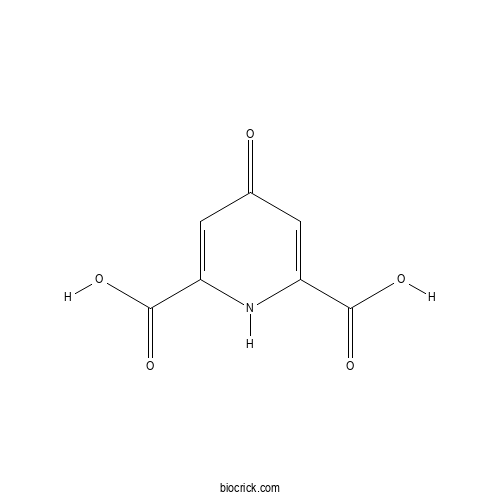
| Cas No. | 499-51-4 | SDF | File under preparation. |
| PubChem ID | 8743.0 | Appearance | Brown powder |
| Formula | C7H5NO5 | M.Wt | 183.1 |
| Type of Compound | N/A | Storage | Desiccate at -20°C |
| Solubility | Soluble in Chloroform,Dichloromethane,Ethyl Acetate,DMSO,Acetone,etc. | ||
| Chemical Name | 4-oxo-1H-pyridine-2,6-dicarboxylic acid | ||
| SMILES | C1=C(NC(=CC1=O)C(=O)O)C(=O)O | ||
| Standard InChIKey | XTLJJHGQACAZMS-UHFFFAOYSA-N | ||
| Standard InChI | InChI=1S/C7H5NO5/c9-3-1-4(6(10)11)8-5(2-3)7(12)13/h1-2H,(H,8,9)(H,10,11)(H,12,13) | ||
| General tips | For obtaining a higher solubility , please warm the tube at 37 ℃ and shake it in the ultrasonic bath for a while.Stock solution can be stored below -20℃ for several months. We recommend that you prepare and use the solution on the same day. However, if the test schedule requires, the stock solutions can be prepared in advance, and the stock solution must be sealed and stored below -20℃. In general, the stock solution can be kept for several months. Before use, we recommend that you leave the vial at room temperature for at least an hour before opening it. |
||
| About Packaging | 1. The packaging of the product may be reversed during transportation, cause the high purity compounds to adhere to the neck or cap of the vial.Take the vail out of its packaging and shake gently until the compounds fall to the bottom of the vial. 2. For liquid products, please centrifuge at 500xg to gather the liquid to the bottom of the vial. 3. Try to avoid loss or contamination during the experiment. |
||
| Shipping Condition | Packaging according to customer requirements(5mg, 10mg, 20mg and more). Ship via FedEx, DHL, UPS, EMS or other couriers with RT, or blue ice upon request. | ||
Quality Control & MSDS
3D structure
Package In Stock

Number of papers citing our products


4-Hydroxypyridine-2,6-dicarboxylic acid Dilution Calculator
4-Hydroxypyridine-2,6-dicarboxylic acid Molarity Calculator
| 1 mg | 5 mg | 10 mg | 20 mg | 25 mg | |
| 1 mM | 5.4615 mL | 27.3075 mL | 54.615 mL | 109.2299 mL | 136.5374 mL |
| 5 mM | 1.0923 mL | 5.4615 mL | 10.923 mL | 21.846 mL | 27.3075 mL |
| 10 mM | 0.5461 mL | 2.7307 mL | 5.4615 mL | 10.923 mL | 13.6537 mL |
| 50 mM | 0.1092 mL | 0.5461 mL | 1.0923 mL | 2.1846 mL | 2.7307 mL |
| 100 mM | 0.0546 mL | 0.2731 mL | 0.5461 mL | 1.0923 mL | 1.3654 mL |
| * Note: If you are in the process of experiment, it's necessary to make the dilution ratios of the samples. The dilution data above is only for reference. Normally, it's can get a better solubility within lower of Concentrations. | |||||
- Zeatin
Catalog No.:BCX2312
CAS No.:1637-39-4
- Riboflavin sodium phosphate
Catalog No.:BCX2311
CAS No.:130-40-5
- Chavicol
Catalog No.:BCX2310
CAS No.:501-92-8
- Piperonylic acid
Catalog No.:BCX2309
CAS No.:94-53-1
- 2'-Deoxyadenosine
Catalog No.:BCX2308
CAS No.:958-09-8
- Diosbulbin A
Catalog No.:BCX2307
CAS No.:20086-05-9
- Allylbenzene
Catalog No.:BCX2306
CAS No.:300-57-2
- 4-Hydroxy-3,5-diisopropylbenzaldehyde
Catalog No.:BCX2305
CAS No.:10537-86-7
- Ganoderic acid F
Catalog No.:BCX2304
CAS No.:98665-15-7
- 11-Oxocucurbita-5,24-diene-3,20-diol
Catalog No.:BCX2303
CAS No.:2491640-86-7
- 7β,20-Epoxyabieta-8,11,13-triene-6α,11,12-triol
Catalog No.:BCX2302
CAS No.:1353042-00-8
- threo-Anethole glycol
Catalog No.:BCX2301
CAS No.:112018-74-3
- Isatin
Catalog No.:BCX2314
CAS No.:91-56-5
- D-Galacturonic acid hydrate
Catalog No.:BCX2315
CAS No.:685-73-4
- Mandelic acid
Catalog No.:BCX2316
CAS No.:90-64-2
- 9-Nitrocamptothecin
Catalog No.:BCX2317
CAS No.:86639-62-5
- Laurolitsine
Catalog No.:BCX2318
CAS No.:904927-11-3
- N6-Isopentenyladenine
Catalog No.:BCX2319
CAS No.:2365-40-4
- Glutathione disulfide
Catalog No.:BCX2320
CAS No.:27025-41-8
- Naringenin chalcone
Catalog No.:BCX2321
CAS No.:73692-50-9
- Spilanthol
Catalog No.:BCX2322
CAS No.:25394-57-4
- Cathayanin C
Catalog No.:BCX2323
CAS No.:330195-61-4
- Taurodeoxycholic acid
Catalog No.:BCX2324
CAS No.:516-50-7
- Cathayanin B
Catalog No.:BCX2325
CAS No.:330195-60-3
Systematic Study on Zirconium Chelidamates: From a Molecular Complex to a M-HOF and a MOF.[Pubmed:37384893]
Inorg Chem. 2023 Aug 7;62(31):12252-12259.
We report the synthesis and in-depth characterization of three zirconium chelidamates, a molecular complex (H(8)C(2)N)(2)[Zr(HL)(3)] (1), a porous metal-containing hydrogen-bonded organic framework (M-HOF) [Zr(H(2)O)(2)(HL)(2)].xH(2)O (2), and a metal-organic framework (MOF) (H(8)C(2)N)(2-2n)[Zr(H(n)L)(2)].x solvent (0 4-Hydroxypyridine-2,6-dicarboxylic acid) as the ligand (H(8)C(2)N(+) = dimethylammonium). High-throughput investigations of the system Zr(4+)/H(3)L/HCl/DMF/H(2)O were carried out, which resulted in highly crystalline compounds. The crystal structures of 1 and 2 were determined by single-crystal X-ray diffraction. Single-crystal three-dimensional (3D) electron diffraction and Rietveld refinements of powder X-ray diffraction (PXRD) data had to be used to elucidate the crystal structure of 3 since only very small single crystals of about 500 nm in diameter could be obtained. In all structures, chelidamate ions act as anionic palindromic pincer ligands, and in 3, a coordinative bond is additionally formed by the aryloxy group. While dense packing of the molecular complexes is found in 1, hydrogen bonding of the molecular complexes in 2 leads to a porous network that shows flexibility depending on the water content. The three-dimensional framework structure of the Zr-MOF 3 contains a mononuclear inorganic building unit (IBU), which is very uncommon in Zr-MOF chemistry. The three compounds are stable in several organic solvents, and thermal decomposition starts above 280 degrees C. While the hydrogen-bonded framework 2 is only porous toward water with a water uptake of almost 3.75 mol mol(-1) at p/p(0) = 0.9, 3 is porous against N(2), CO(2), methanol, ethanol, and water with a specific Brunauer-Emmett-Teller (BET) surface area of a(S,BET) = 410 m(2) g(-1) derived from the N(2) adsorption isotherm. Stability upon water adsorption covering 10 cycles between 0.5% < p/p(0) < 90% for 3 is also demonstrated.
Supramolecular network of a framework material supported by the anion-pi linkage of Keggin-type heteropolyoxotungstates: experimental and theoretical insights.[Pubmed:33475649]
Dalton Trans. 2021 Feb 9;50(5):1895-1900.
A novel inorganic-organic hybrid, Na[Tb(L)(H2O)4]3(SiW12O40).4H2O, in which L = 4-Hydroxypyridine-2,6-dicarboxylic acid (chelidamic acid), was prepared and characterized by elemental analyses, Fourier transform infrared spectroscopy, and single-crystal X-ray diffraction. It consists of a trinuclear terbium cluster bonded to a Keggin-type polyoxotungstate. In the terbium cluster three crystallographically equivalent Tb3+ ions are bridged by carboxylate oxygen atoms belonging to three chelidamic acid units to form an equilateral triangle. These triangle units connect to each other through hydrogen-bonding and anion-pi interactions. A CSD survey was carried out focusing on the cation and the ligand roles in the structure formation of this type of compounds. Finally, DFT calculations were used to analyse the role of the anion-pi interactions that are important in the formation of 1D supramolecular assemblies in the solid state. The noncovalent interaction plot (NCIplot) computational tool has been used to characterize the anion-pi interaction.
Surface-grafted lanthanoid complexes of the tungstosilicate polyanion [SiW(12)O(40)](4-): a synthetic, structural and computational investigation.[Pubmed:30398183]
Acta Crystallogr C Struct Chem. 2018 Nov 1;74(Pt 11):1300-1309.
As an extension of our continued interest in the preparation of inorganic-organic hybrids, we report the successful hydrothermal synthesis of sodium tris[triaqua(mu-1,10-phenanthroline-2,9-dicarboxylato)dysprosium(III)] silicododecatungstate dodecahydrate, [DyNa(C(14)H(6)N(2)O(4))(3)(H(2)O)(9)(SiW(12)O(40))].12H(2)O(n) or Na[Dy(PDA)(H(2)O)(3)](3)[SiW(12)O(40)].12H(2)O (1), and sodium aqua tris[tetraaqua(mu-4-hydroxypyridine-2,6-dicarboxylato)praseodymium(III)] silicododecatungstate dodecahydrate, [NaPr(C(7)H(3)NO(5))(3)(H(2)O)(13)(SiW(12)O(40))].12H(2)O(n) or Na(H(2)O)[Pr(pydc-OH)(H(2)O)(4)](3)[SiW(12)O(40)].12H(2)O (2) (in which H(2)PDA is 1,10-phenanthroline-2,9-dicarboxylic acid and H(2)pydc-OH is 4-Hydroxypyridine-2,6-dicarboxylic acid or chelidamic acid). Both compounds have been characterized using elemental analysis, IR spectroscopy and X-ray diffraction methods. Structural characterization by single-crystal X-ray diffraction reveals that these compounds consist of [SiW(12)O(40)](4-) Keggin-type polyoxometalates (POMs), where a single W(3)O(13) triad is decorated with a trinuclear Ln complex. Moreover, the decorated polyanions are involved in a series of intermolecular interactions, such as hydrogen bonds and anion-pi interactions, resulting in three-dimensional supramolecular architectures. Density functional theory (DFT) studies were conducted to support these intermolecular interactions in both 1 and 2, and have been rationalized using molecular electrostatic potential (MEP) surface calculations.
Air and moisture stable covalently-bonded tin(ii) coordination polymers.[Pubmed:29869660]
Dalton Trans. 2018 Jun 19;47(24):8013-8022.
Four covalently-bonded tin(ii) coordination polymers, (1)-(4), were hydrothermally prepared in aqueous alkaline media by the reactions of SnSO4 with 1,2,4,5-benzenetetracarboxylic acid (1), 1,3,5-benzenetricarboxylic acid (2), 4-Hydroxypyridine-2,6-dicarboxylic acid (3), and 1,3,5-cyclohexanetricarboxylic acid (4). All products were structurally authenticated by single-crystal X-ray diffraction, and the number of different tin centres and their oxidation states were confirmed by 119Sn Mossbauer spectroscopy. In addition, the comparison between experimental and simulated X-ray powder diffraction patterns confirmed the authenticity of the samples. Our crystallographic results for (1)-(4) show that the Sn(ii) centres are tetracoordinated and exhibit distorted disphenoidal geometries, corroborating the presence of one stereochemically active lone electron pair at each metal site. Products (1) and (2) display bi-dimensional polymeric structures, (3) exhibits a one-dimensional architecture, whereas (4) shows a remarkable three-dimensional coordination network. Hirshfeld surface and supramolecular analyses for the repeating units of (1)-(4) were also performed in order to identify structurally important non-covalent interactions.
catena-Poly[[di-mu2-aqua-hexaaquabis(mu3-4-oxidopyridine-2,6-dicarboxylato)trimanganese(II)] trihydrate]: a new one-dimensional coordination polymer based on a trinuclear Mn(II) complex of chelidamic acid.[Pubmed:24096503]
Acta Crystallogr C. 2013 Oct;69(Pt 10):1140-3.
4-Hydroxypyridine-2,6-dicarboxylic acid (chelidamic acid, hypydc[H]H2) reacts with MnCl2.2H2O in the presence of piperazine in water to afford the title complex, [Mn3(C7H2NO5)2(H2O)8].3H2On or [Mn3(hypydc)2(H2O)8].3H2On. This compound is a one-dimensional coordination polymer, with the twofold symmetric repeat unit containing three metal centres. Two different coordination geometries are observed for the two independent Mn(II) metal centres, viz. a distorted pentagonal bipyramid and a distorted octahedron. The 4-oxidopyridine-2,6-dicarboxylate anions and two of the water molecules act as bridging ligands. The zigzag-like geometry of the coordination polymer is stabilized by hydrogen bonds. O-H...O and C-H...O hydrogen bonds and water clusters consolidate the three-dimensional network structure.
Synthesis, structure and characterization of a helical seven-coordinated pyridine-2,6-dicarboxylate-bridged cadmium(II) complex.[Pubmed:23841343]
Acta Chim Slov. 2013;60(1):138-43.
[Cd(C7H3NO4)(H2O)1.5]n or [Cd(2,6-pydc)(H2O)1.5]n, (1) (2,6-pydc = pyridine-2,6-dicarboxylate) was obtained from the reaction of pyridine-2,6-dicarboxylic acid and 4-Hydroxypyridine-2,6-dicarboxylic acid with cadmium(II) nitrate tetrahydrate in the presence of piperazine and characterized by elemental analysis, IR spectra and X-ray single crystal diffraction. Complex (1) is a novel carboxylate-bridged one-dimensional pincer-shaped helical chain of cadmium(II) polymer. Each Cd atom is seven-coordinate and exhibits an approximately pentagonal-bipyramidal CdNO6 coordination geometry. The metal fragments are linked via the central four-membered Cd2O2 ring and the structural analysis showed that 4-Hydroxypyridine-2,6-dicarboxylic acid and piperazine do not appear in the structure.
Pseudopolymorphs of chelidamic acid and its dimethyl ester.[Pubmed:22935501]
Acta Crystallogr C. 2012 Sep;68(Pt 9):o344-50.
Different tautomeric and zwitterionic forms of chelidamic acid (4-Hydroxypyridine-2,6-dicarboxylic acid) are present in the crystal structures of chelidamic acid methanol monosolvate, C(7)H(5)NO(5).CH(4)O, (Ia), dimethylammonium chelidamate (dimethylammonium 6-carboxy-4-hydroxypyridine-2-carboxylate), C(2)H(8)N(+).C(7)H(4)NO(5)(-), (Ib), and chelidamic acid dimethyl sulfoxide monosolvate, C(7)H(5)NO(5).C(2)H(6)OS, (Ic). While the zwitterionic pyridinium carboxylate in (Ia) can be explained from the pK(a) values, a (partially) deprotonated hydroxy group in the presence of a neutral carboxy group, as observed in (Ib) and (Ic), is unexpected. In (Ib), there are two formula units in the asymmetric unit with the chelidamic acid entities connected by a symmetric O-H...O hydrogen bond. Also, crystals of chelidamic acid dimethyl ester (dimethyl 4-hydroxypyridine-2,6-dicarboxylate) were obtained as a monohydrate, C(9)H(9)NO(5).H(2)O, (IIa), and as a solvent-free modification, in which both ester molecules adopt the hydroxypyridine form. In (IIa), the solvent water molecule stabilizes the synperiplanar conformation of both carbonyl O atoms with respect to the pyridine N atom by two O-H...O hydrogen bonds, whereas an antiperiplanar arrangement is observed in the water-free structure. A database study and ab initio energy calculations help to compare the stabilities of the various ester conformations.
Decaaquabis(mu3-4-hydroxypyridine-2,6-dicarboxylato)bis(4-hydroxypyridine-2,6-dicarboxylato)tetramanganese(II) 3.34-hydrate: a new three-dimensional open metal-organic framework based on a tetranuclear Mn(II) complex of chelidamic acid and undecameric stitching water clusters.[Pubmed:22223279]
Acta Crystallogr C. 2012 Jan;68(Pt 1):m7-11.
4-Hydroxypyridine-2,6-dicarboxylic acid (chelidamic acid, cdaH(3)) reacts with MnCl(2).2H(2)O in the presence of 2-amino-4-methylpyrimidine in water to afford the tetranuclear title complex, [Mn(4)(C(8)H(3)NO(5))(4)(H(2)O)(10)].3.34H(2)O, built through carboxylate bridging. The tetranuclear complex sits on a centre of inversion at ((1/2), (1/2), (1/2)). In the crystal, discrete undecameric (H(2)O)(10.34) water clusters (involving both coordinated and uncoordinated water molecules, with one site of an uncoordinated water molecule not fully occupied) assemble these tetranuclear Mn(II) complex units via an intricate array of hydrogen bonding into an overall three-dimensional network. The degree of structuring of the (H(2)O)(10.34) supramolecular association of water molecules observed in the present compound, imposed by its environment and vice versa, will be discussed in comparison to that observed for the (H(2)O)(14) supramolecular clusters in the case of the dinuclear complex [Mn(2)(cdaH)(2)(H(2)O)(4)].4H(2)O [Ghosh et al. (2005). Inorg. Chem. 44, 3856-3862].
Coordination polymers with pyridine-2,4,6-tricarboxylic acid and alkaline-earth/lanthanide/transition metals: synthesis and X-ray structures.[Pubmed:19421610]
Dalton Trans. 2009 Mar 7;(9):1644-58.
Pyridine-2,4,6-tricarboxylic acid (ptcH(3)) reacts with Cd(II), Mn(II), Ni(II), Mg(II), Ca(II), Sr(II), Ba(II), Dy(III) salts forming different products depending on the reaction conditions. In the presence of pyridine at room temperature the acetate, chloride or nitrate salt of Cd(II) breaks the ligand to form an open framework structure with the empirical formula, [Cd(Ox)(H(2)O)(2)]H(2)O(n) (Ox = oxalate), 1. In the absence of pyridine, no crystalline compound could be isolated at room temperature (RT). However, under hydrothermal conditions and in the absence of pyridine, a discrete tetrameric complex with the formula, [Cd(2)(cda)(2)(H(2)O)(4)](H(2)O)(3)(2) (cdaH(2) = 4-Hydroxypyridine-2,6-dicarboxylic acid), 2, is formed where the carboxylate group at the 4-position of the ligand is reduced to a hydroxyl group. When Ni(II), Mn(II), Mg(II), Ca(II), Sr(II), Ba(II), Dy(III) salts are used in place of Cd(II), no crystalline product could be isolated at RT. But under hydrothermal conditions, coordination polymers ([Ni(1.5)(ptc)(pip)(0.5)(H(2)O)(4)].H(2)O(n), (pip = piperazine), 3; Mn(1.5)(ptc).2H(2)O(n), 4; Mg(3)(ptc)(2).8H(2)O(n), 5; [Mg(ptc)(H(2)O)(2)].1/2[Mg(H(2)O)(6)].H(2)O(n), 6; Ca(1.5)(ptc).2H(2)O(n), 7; Sr(1.5)(ptc).5H(2)O(n), 8; [Ba(ptc)(H(2)O)][Ba(ptcH(2))H(2)O](n), 9; [Dy(ptc).3H(2)O].H(2)O(n), 10) are formed. The structures exhibit different dimensionality depending on the nature of the metal ions. In 1 a discrete acyclic water hexamer is also identified. All the compounds are characterized in the solid state by X-ray crystallography, IR and elemental analysis.
Synthesis and characterization of metal-organic frameworks based on 4-hydroxypyridine-2,6-dicarboxylic acid and pyridine-2,6-dicarboxylic acid ligands.[Pubmed:16842004]
Inorg Chem. 2006 Jul 24;45(15):5980-8.
The self-assembly of 4-Hydroxypyridine-2,6-dicarboxylic acid (H(3)CAM) and pyridine-2,6-dicarboxylic acid (H2PDA) with Zn(II) salts under hydrothermal conditions gave two novel coordination polymers [Zn(HCAM)].H2On (1) and [Zn(PDA)(H2O)(1.5)]n (1a). 1 and 1a comprise of a 2D (4,4) net and a 1D zigzag chain, respectively, in which a new coordination mode of PDA is found. The reactions of H(3)CAM and H2PDA with Nd2O3 in the M/L ratio 2:3 gave [Nd2(HCAM)3(H2O)4].2H2On (2) and [Nd(2)(PDA)3(H2O)(3)].0.5H2On (2a). In 2, a square motif as a building block constructed by four Nd(III) ions was further assembled into a highly ordered 2D (4,4) grid. 2a is a 3D microporous coordination polymer. It is interesting to note that, when Ln(III) salts rather than oxides were employed, the reaction produced [Ln(CAM)(H2O)3].H2On (Ln = Gd, 3; Dy, 4; Er, 5) for H(3)CAM and [Gd2(PDA)3(H2O)3].H2On (3a) for H2PDA. 3-5 are 2D coordination polymers with a 3(3)4(2) uniform net, where hydroxyl groups of H3CAM coordinate with metal ions. The reaction of H3CAM and Er2O3 instead of Er(ClO4)3 produced [Er2(HCAM)3(H2O)4].2H2On (6). The compounds 2a and 3a, 2 and 6 are isomorphous. The stereochemical and supramolecular effects of hydroxyl groups result in the dramatic structural changes from 1D (1a) to 2D (1) and from 2D (2) to 3D (2a). When Ln(III) salts instead of Ln2O3 were employed in the hydrothermal reactions with H(3)CAM, different self-assembly processes gave the products of different metal/ligand ratio with reactants (3-5).
Mn(II) staircase structures stitched by water clusters to a 3D metal-organic open framework: X-ray structural and magnetic studies.[Pubmed:15907111]
Inorg Chem. 2005 May 30;44(11):3856-62.
4-Hydroxypyridine-2,6-dicarboxylic acid (chelidamic acid, cdaH2) reacts with Mn(OAc)2 x 4H2O to form a 1D staircase structure with dimeric Mn(II) units connected by water clusters to form a 3D framework, [Mn2(cda)2 x 4H2O] x 4H2On, 1, in aqueous pyridine at room temperature. The compound crystallizes in the triclinic space group P1 with a = 9.495(3), b =10.733(5), c = 11.065(4) A, alpha = 87.42(5), beta = 74.14(5), gamma = 80.07(2) degrees, U = 1068.5(9) A3, Z = 2, rho(calcd) = 1.915 g cm(-3), T = 100 K, mu = 1.28 mm(-1), R1 = 0.0453 (I > 2sigma(I)), wR2 = 0.1046, GOOF = 1.282. Upon removal of the water molecules by heating, the 3D structure breaks down. Thermogravimetric analysis, infrared, X-ray powder diffraction studies, and X-ray crystallography were performed to characterize this compound. Since the coordination polymer has diaqua-bridged Mn(II) centers, it was subjected to variable-temperature magnetic studies.
Calixarenes as scaffolds: introduction of tridentate rare earth metal binding units into calix[4]arene.[Pubmed:11196940]
Inorg Chem. 2000 Oct 16;39(21):4678-87.
The reactions of various derivatives of chelidamic acid (4-Hydroxypyridine-2,6-dicarboxylic acid) with p-tert-butylcalix[4]arene have produced several new mono- and difunctionalized derivatives of the calixarene in which tridentate functional groups suitable for the binding of rare earth metal cations have been incorporated. Single-crystal X-ray structure determinations have been performed on two difunctionalized calixarenes found to adopt different "cone" and "1,2-alternate" conformations, as well as on a complex of europium(III) with the phenoxide form of a monofunctionalized ligand, this structure confirming that charge factors are dominant in determining the site of lanthanide metal binding in these ligands.

Calcutta University

University of Minnesota

University of Maryland School of Medicine

University of Illinois at Chicago

The Ohio State University

University of Zurich

Harvard University

Colorado State University

Auburn University

Yale University

Worcester Polytechnic Institute

Washington State University

Stanford University

University of Leipzig

Universidade da Beira Interior

The Institute of Cancer Research

Heidelberg University

University of Amsterdam

University of Auckland

TsingHua University

The University of Michigan

Miami University

DRURY University

Jilin University

Fudan University

Wuhan University

Sun Yat-sen University

Universite de Paris

Deemed University

Auckland University

The University of Tokyo

Korea University



