
AllylbenzeneCAS# 300-57-2 |
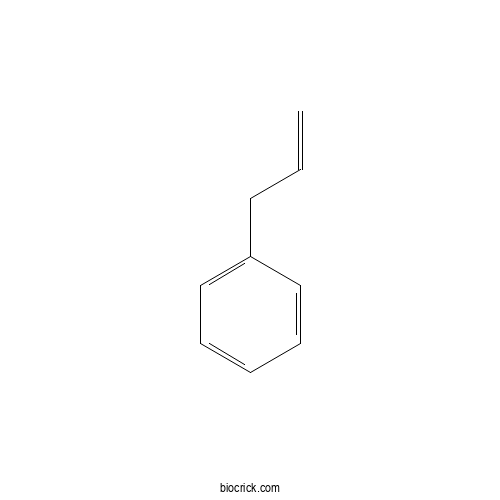
| Cas No. | 300-57-2 | SDF | File under preparation. |
| PubChem ID | 9309.0 | Appearance | Liquid |
| Formula | C9H10 | M.Wt | 118.2 |
| Type of Compound | N/A | Storage | Desiccate at -20°C |
| Solubility | Soluble in Chloroform,Dichloromethane,Ethyl Acetate,DMSO,Acetone,etc. | ||
| Chemical Name | prop-2-enylbenzene | ||
| SMILES | C=CCC1=CC=CC=C1 | ||
| Standard InChIKey | HJWLCRVIBGQPNF-UHFFFAOYSA-N | ||
| Standard InChI | InChI=1S/C9H10/c1-2-6-9-7-4-3-5-8-9/h2-5,7-8H,1,6H2 | ||
| General tips | For obtaining a higher solubility , please warm the tube at 37 ℃ and shake it in the ultrasonic bath for a while.Stock solution can be stored below -20℃ for several months. We recommend that you prepare and use the solution on the same day. However, if the test schedule requires, the stock solutions can be prepared in advance, and the stock solution must be sealed and stored below -20℃. In general, the stock solution can be kept for several months. Before use, we recommend that you leave the vial at room temperature for at least an hour before opening it. |
||
| About Packaging | 1. The packaging of the product may be reversed during transportation, cause the high purity compounds to adhere to the neck or cap of the vial.Take the vail out of its packaging and shake gently until the compounds fall to the bottom of the vial. 2. For liquid products, please centrifuge at 500xg to gather the liquid to the bottom of the vial. 3. Try to avoid loss or contamination during the experiment. |
||
| Shipping Condition | Packaging according to customer requirements(5mg, 10mg, 20mg and more). Ship via FedEx, DHL, UPS, EMS or other couriers with RT, or blue ice upon request. | ||
Quality Control & MSDS
3D structure
Package In Stock

Number of papers citing our products


Allylbenzene Dilution Calculator
Allylbenzene Molarity Calculator
| 1 mg | 5 mg | 10 mg | 20 mg | 25 mg | |
| 1 mM | 8.4602 mL | 42.3012 mL | 84.6024 mL | 169.2047 mL | 211.5059 mL |
| 5 mM | 1.692 mL | 8.4602 mL | 16.9205 mL | 33.8409 mL | 42.3012 mL |
| 10 mM | 0.846 mL | 4.2301 mL | 8.4602 mL | 16.9205 mL | 21.1506 mL |
| 50 mM | 0.1692 mL | 0.846 mL | 1.692 mL | 3.3841 mL | 4.2301 mL |
| 100 mM | 0.0846 mL | 0.423 mL | 0.846 mL | 1.692 mL | 2.1151 mL |
| * Note: If you are in the process of experiment, it's necessary to make the dilution ratios of the samples. The dilution data above is only for reference. Normally, it's can get a better solubility within lower of Concentrations. | |||||
- 4-Hydroxy-3,5-diisopropylbenzaldehyde
Catalog No.:BCX2305
CAS No.:10537-86-7
- Ganoderic acid F
Catalog No.:BCX2304
CAS No.:98665-15-7
- 11-Oxocucurbita-5,24-diene-3,20-diol
Catalog No.:BCX2303
CAS No.:2491640-86-7
- 7β,20-Epoxyabieta-8,11,13-triene-6α,11,12-triol
Catalog No.:BCX2302
CAS No.:1353042-00-8
- threo-Anethole glycol
Catalog No.:BCX2301
CAS No.:112018-74-3
- Chantriolide C
Catalog No.:BCX2300
CAS No.:1206850-19-2
- Plantagiolide C
Catalog No.:BCX2299
CAS No.:913263-86-2
- erythro-Anethole glycol
Catalog No.:BCX2298
CAS No.:103687-27-0
- Foeniculoside I
Catalog No.:BCX2297
CAS No.:168010-10-4
- Sphalleroside A
Catalog No.:BCX2296
CAS No.:192324-34-8
- Bisadinrone A
Catalog No.:BCX2295
CAS No.:2871811-08-2
- Ethyl lecanorate
Catalog No.:BCX2294
CAS No.:2611262-88-3
- Diosbulbin A
Catalog No.:BCX2307
CAS No.:20086-05-9
- 2'-Deoxyadenosine
Catalog No.:BCX2308
CAS No.:958-09-8
- Piperonylic acid
Catalog No.:BCX2309
CAS No.:94-53-1
- Chavicol
Catalog No.:BCX2310
CAS No.:501-92-8
- Riboflavin sodium phosphate
Catalog No.:BCX2311
CAS No.:130-40-5
- Zeatin
Catalog No.:BCX2312
CAS No.:1637-39-4
- 4-Hydroxypyridine-2,6-dicarboxylic acid
Catalog No.:BCX2313
CAS No.:499-51-4
- Isatin
Catalog No.:BCX2314
CAS No.:91-56-5
- D-Galacturonic acid hydrate
Catalog No.:BCX2315
CAS No.:685-73-4
- Mandelic acid
Catalog No.:BCX2316
CAS No.:90-64-2
- 9-Nitrocamptothecin
Catalog No.:BCX2317
CAS No.:86639-62-5
- Laurolitsine
Catalog No.:BCX2318
CAS No.:904927-11-3
Synergistic Silylium-Ion and Palladium Catalysis Enables Migratory Alkene Silylation With Allylsilanes by Formal C-H/C-Si Metathesis.[Pubmed:42731083]
Angew Chem Int Ed Engl. 2026 Sep 12:e5617321.
A conceptually distinct approach to the Heck-type silylation of terminal alkenes to yield allylsilanes under synergistic silylium-ion and palladium catalysis is reported. The combination of an electrophilic silylium carborate, such as [Me(3)Si(HCB(11)H(5)Br(6))], and the nucleophilic phosphine-coordinated palladium(0) complex (o-Tol(3)P)(2)Pd, leads to the formation of the cationic silylpalladium adduct [(o-Tol(3)P)(2)Pd-SiMe(3)](+), which catalyzes the silylation of Allylbenzene derivatives using an allylsilane as the stoichiometric silicon electrophile. Mechanistic studies including DFT calculations support a mechanism involving regioselective stepwise ionic addition of the silylpalladium cation across the double bond followed by beta-hydride elimination to form a cationic palladium hydride. Exploiting the Bronsted acidity of this intermediate facilitates the regeneration of the active silylpalladium complex by productive proton-into-silylium ion interconversion through deallylative protolysis (protodesilylation) of the allylsilane reagent, thereby maintaining the catalytic turnover. Hence, there is no need for an exogeneous base, whereas the conventional silyl-Heck reaction requires the addition of (over)stoichiometric amounts of a base to trap the formed acid (HX) waste. Moreover, the established silyl-Heck reaction relies on the oxidative addition of the silicon-halogen bond of a halosilane electrophile as the critical step, while this synergistic process makes use of an allylsilane as the coupling partner, releasing propene as the sole by-product.

Calcutta University

University of Minnesota

University of Maryland School of Medicine

University of Illinois at Chicago

The Ohio State University

University of Zurich

Harvard University

Colorado State University

Auburn University

Yale University

Worcester Polytechnic Institute

Washington State University

Stanford University

University of Leipzig

Universidade da Beira Interior

The Institute of Cancer Research

Heidelberg University

University of Amsterdam

University of Auckland

TsingHua University

The University of Michigan

Miami University

DRURY University

Jilin University

Fudan University

Wuhan University

Sun Yat-sen University

Universite de Paris

Deemed University

Auckland University

The University of Tokyo

Korea University



