
2'-DeoxyadenosineCAS# 958-09-8 |
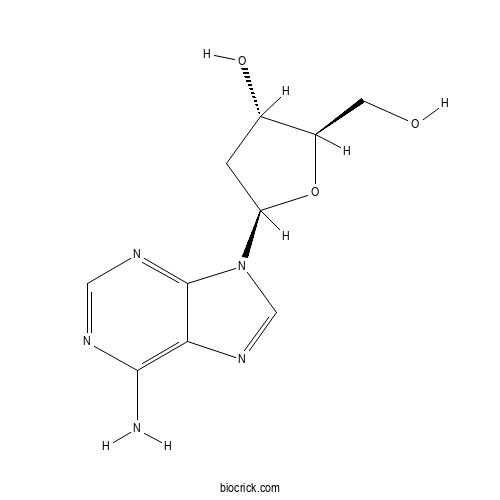
| Cas No. | 958-09-8 | SDF | File under preparation. |
| PubChem ID | 13730.0 | Appearance | Powder |
| Formula | C10H13N5O3 | M.Wt | 251.2 |
| Type of Compound | N/A | Storage | Desiccate at -20°C |
| Solubility | Soluble in Chloroform,Dichloromethane,Ethyl Acetate,DMSO,Acetone,etc. | ||
| Chemical Name | (2R,3S,5R)-5-(6-aminopurin-9-yl)-2-(hydroxymethyl)oxolan-3-ol | ||
| SMILES | C1C(C(OC1N2C=NC3=C(N=CN=C32)N)CO)O | ||
| Standard InChIKey | OLXZPDWKRNYJJZ-RRKCRQDMSA-N | ||
| Standard InChI | InChI=1S/C10H13N5O3/c11-9-8-10(13-3-12-9)15(4-14-8)7-1-5(17)6(2-16)18-7/h3-7,16-17H,1-2H2,(H2,11,12,13)/t5-,6+,7+/m0/s1 | ||
| General tips | For obtaining a higher solubility , please warm the tube at 37 ℃ and shake it in the ultrasonic bath for a while.Stock solution can be stored below -20℃ for several months. We recommend that you prepare and use the solution on the same day. However, if the test schedule requires, the stock solutions can be prepared in advance, and the stock solution must be sealed and stored below -20℃. In general, the stock solution can be kept for several months. Before use, we recommend that you leave the vial at room temperature for at least an hour before opening it. |
||
| About Packaging | 1. The packaging of the product may be reversed during transportation, cause the high purity compounds to adhere to the neck or cap of the vial.Take the vail out of its packaging and shake gently until the compounds fall to the bottom of the vial. 2. For liquid products, please centrifuge at 500xg to gather the liquid to the bottom of the vial. 3. Try to avoid loss or contamination during the experiment. |
||
| Shipping Condition | Packaging according to customer requirements(5mg, 10mg, 20mg and more). Ship via FedEx, DHL, UPS, EMS or other couriers with RT, or blue ice upon request. | ||
Quality Control & MSDS
3D structure
Package In Stock

Number of papers citing our products


2'-Deoxyadenosine Dilution Calculator
2'-Deoxyadenosine Molarity Calculator



| 1 mg | 5 mg | 10 mg | 20 mg | 25 mg | |
| 1 mM | 3.9809 mL | 19.9045 mL | 39.8089 mL | 79.6178 mL | 99.5223 mL |
| 5 mM | 0.7962 mL | 3.9809 mL | 7.9618 mL | 15.9236 mL | 19.9045 mL |
| 10 mM | 0.3981 mL | 1.9904 mL | 3.9809 mL | 7.9618 mL | 9.9522 mL |
| 50 mM | 0.0796 mL | 0.3981 mL | 0.7962 mL | 1.5924 mL | 1.9904 mL |
| 100 mM | 0.0398 mL | 0.199 mL | 0.3981 mL | 0.7962 mL | 0.9952 mL |
| * Note: If you are in the process of experiment, it's necessary to make the dilution ratios of the samples. The dilution data above is only for reference. Normally, it's can get a better solubility within lower of Concentrations. | |||||
- Diosbulbin A
Catalog No.:BCX2307
CAS No.:20086-05-9
- Allylbenzene
Catalog No.:BCX2306
CAS No.:300-57-2
- 4-Hydroxy-3,5-diisopropylbenzaldehyde
Catalog No.:BCX2305
CAS No.:10537-86-7
- Ganoderic acid F
Catalog No.:BCX2304
CAS No.:98665-15-7
- 11-Oxocucurbita-5,24-diene-3,20-diol
Catalog No.:BCX2303
CAS No.:2491640-86-7
- 7β,20-Epoxyabieta-8,11,13-triene-6α,11,12-triol
Catalog No.:BCX2302
CAS No.:1353042-00-8
- threo-Anethole glycol
Catalog No.:BCX2301
CAS No.:112018-74-3
- Chantriolide C
Catalog No.:BCX2300
CAS No.:1206850-19-2
- Plantagiolide C
Catalog No.:BCX2299
CAS No.:913263-86-2
- erythro-Anethole glycol
Catalog No.:BCX2298
CAS No.:103687-27-0
- Foeniculoside I
Catalog No.:BCX2297
CAS No.:168010-10-4
- Sphalleroside A
Catalog No.:BCX2296
CAS No.:192324-34-8
- Piperonylic acid
Catalog No.:BCX2309
CAS No.:94-53-1
- Chavicol
Catalog No.:BCX2310
CAS No.:501-92-8
- Riboflavin sodium phosphate
Catalog No.:BCX2311
CAS No.:130-40-5
- Zeatin
Catalog No.:BCX2312
CAS No.:1637-39-4
- 4-Hydroxypyridine-2,6-dicarboxylic acid
Catalog No.:BCX2313
CAS No.:499-51-4
- Isatin
Catalog No.:BCX2314
CAS No.:91-56-5
- D-Galacturonic acid hydrate
Catalog No.:BCX2315
CAS No.:685-73-4
- Mandelic acid
Catalog No.:BCX2316
CAS No.:90-64-2
- 9-Nitrocamptothecin
Catalog No.:BCX2317
CAS No.:86639-62-5
- Laurolitsine
Catalog No.:BCX2318
CAS No.:904927-11-3
- N6-Isopentenyladenine
Catalog No.:BCX2319
CAS No.:2365-40-4
- Glutathione disulfide
Catalog No.:BCX2320
CAS No.:27025-41-8
Treatment of Erdheim-Chester disease from the perspective in 2026.[Pubmed:42663152]
Klin Onkol. 2026;39(4):255-261.
BACKGROUND: With the discovery of new drugs, treatment of Erdheim-Chester disease (ECD) is gradually evolving and changing. The text provides an overview of effective drugs available in 2026 for patients with ECD. Treatment options: We consider it appropriate to divide treatment into treatment targeting the inflammatory reaction induced by ECD, and treatment targeting malignant histiocytes. To suppress the inflammatory reaction, high doses of glucocorticoids can be used, but only short-term. For long-term suppression of the inflammatory reaction, anakinra is most commonly used. In rare cases, a similar effect has been reported with canakinumab, as well as with sirolimus and anti-TNF drugs. Anakinra is used both alone and in combination with other drugs. ECD cells, like histiocytosis cells from Langerhans cells, are derived from a monocytic lineage, which similarly to the lymphocytic lineage, is very sensitive to cladribine (2-chloro-2'-deoxyadenosine). This drug is the most effective cytostatic agent for patients with ECD. In several smaller clinical studies, the benefit of treatment with interferon alfa has been described. Thus, interferon alfa, despite its side effects, represents one of the treatment options. In cases of severe ECD and the presence of the BRAFV600E mutation, two drugs are recommended - vemurafenib and dabrafenib. For patients with a severe course without the BRAFV600E mutation, MEK kinase inhibitors trametinib and cobimetinib are recommended. The literature contains conflicting conclusions in studies evaluating the dependence of the effectiveness of these drugs on the detection of mutations in the MAPK signaling pathway. Targeted therapy is associated with numerous side effects, as well as the risk of relapse after its discontinuation. If the administered drugs trigger an inflammatory response, anakinra is again used to suppress it. CONCLUSION: Treatment of ECD always requires an assessment of the extent of the disease and degree of organ damage in order to choose the appropriate therapy.
Microbiome analysis and epigenetic patterns revealed distinct differences between two elm species with contrasting Dutch elm disease resistance.[Pubmed:42618954]
Microbiome. 2026 Aug 19;14(1):204.
BACKGROUND: Dutch elm disease (DED), caused by the fungus Ophiostoma novo-ulmi, has devastated elm species in Europe and North America for over a century. While the Chinese elm (Ulmus parvifolia) frequently displays notable resistance to DED, the European wych elm (Ulmus glabra) remains highly susceptible. Understanding microbiome interaction and epigenetic factors might help to explain this contrasting resilience and subsequently improve disease management. RESULTS: Seedlings of both elm species were germinated and maintained under identical environmental conditions. Comparative metabarcoding revealed distinct differences in bacterial and eukaryotic microbiomes, as well as in their associations with lichenized fungi and their photobiont algae. In U. parvifolia, 24 eukaryotic and 14 bacterial taxa were identified as the most differentially abundant microbiome components, and exhibited significantly different levels compared to U. glabra. In particular, Leotiomycetes fungi and Rhizobiales bacteria, both previously implicated in resistance to pathogens, were strongly enriched in U. parvifolia. Lichenized fungi and chlorophyte algae were likewise more abundant in U. parvifolia. In U. glabra, 11 eukaryotic and 16 bacterial taxa were significantly more abundant, including Nocardioides bacteria and Leptospora fungi. Ultra-performance liquid chromatography coupled with mass spectrometry revealed that, compared to U. glabra, U. parvifolia exhibited higher levels of 5-(hydroxymethyl)-2'-deoxycytidine and lower levels of 5-methyl-2'-deoxycytidine and N6-methyl-2'-deoxyadenosine in DNA, as well as increased amounts of 5-methylcytidine, N6-methyladenosine, and 5-hydroxymethyluridine in RNA. The elevated levels of well-established epigenetic markers in DNA and RNA are remarkable. However, it remains unclear what part of the holobiont may be responsible for this effect. CONCLUSIONS: The contrasting susceptibility of Chinese and European elms to DED correlates with pronounced differences in their associated microbial communities and lichens, as well as in patterns of epigenetic nucleoside modifications. In particular, the enrichment of specific stress-associated microbiome components, together with lichen associations and elevated levels of modified DNA and RNA nucleosides in U. parvifolia, may underlie its increased tolerance to DED. Although this study did not identify the factors responsible for DED resistance, it provides valuable insights into microbiomic and epigenetic features that could contribute to the development of new approaches to combat DED. Video Abstract.
Applicability of HILIC-SPE pretreatment for the quantitation of N(2)-Ethyl-2'-deoxyguanosine in LC-ESI/MS/MS.[Pubmed:42584559]
Anal Sci. 2026 Oct;42(10):1009-1016.
DNA adducts analysis is crucial for elucidating the mechanism of mutagenesis and carcinogenesis induced by various chemical compounds. Liquid chromatography-electrospray ionization-tandem mass spectrometry (LC-MS/MS) is commonly employed to determine DNA adduct. Pretreatment is essential in DNA adduct analysis due to a significant concentration disparity between normal 2'-deoxynucleosides (dNs) and DNA adducts. The level of DNA adducts is typically assessed by the ratio of DNA adducts to normal 2'-deoxyguanosine (dG) when the DNA adducts originate from dG. Consequently, the determination of dG and DNA adducts is necessary for accurate evaluation. Reversed-phase (RP)-solid-phase extraction (SPE) is the first choice for pretreatment of DNA adducts analysis. This pretreatment using RP-SPE effectively enriches DNA adducts while removing a substantial amount of dNs, particularly thymidine (T) and 2'-deoxyadenosine (dA), which may suppress the ionization of DNA adducts in the electrospray ionization (ESI) process. However, two separate measurements are required to determine the concentrations of dG and DNA adducts, as dG is removed during the SPE process. Therefore, an SPE method that simultaneously extracts dG and DNA adducts is desirable. In this study, we investigated the applicability of hydrophilic interaction chromatography (HILIC)-type SPE sorbents developed by our team, for the pretreatment of DNA adduct analysis. N(2)-ethyl-2'-deoxyguanosine (EtdG), an acetaldehyde-derived DNA adduct, was selected as a model DNA adduct. By optimizing the washing and eluting solutions, dG and EtdG were simultaneously extracted from the sample solution while eliminating T and dA. This pretreatment method enables the simultaneous measurements of dG and DNA adducts concentration, thereby enhancing the accuracy and rapidity of the DNA adducts analysis.
Deoxyguanosine kinase deficiency couples purine metabolism to innate immune activation and lipid accumulation in hepatocytes.[Pubmed:42529171]
Front Immunol. 2026 Jul 15;17:1758569.
INTRODUCTION: Mitochondrial DNA depletion syndromes (MDS) caused by deoxyguanosine kinase (DGUOK) deficiency are classically attributed to impaired mitochondrial DNA (mtDNA) maintenance. However, many patients develop hepatic steatosis and inflammation despite preserved mtDNA content, suggesting that additional pathogenic mechanisms contribute to disease. DGUOK is a key enzyme in the mitochondrial purine salvage pathway, but its role in coordinating purine metabolism with lipid homeostasis and innate immune signaling remains poorly understood. METHODS: Acute DGUOK deficiency was induced in human hepatocellular carcinoma (HepG2) hepatocytes by siRNA-mediated knockdown. Mitochondrial integrity was assessed by mtDNA quantification, mitochondrial morphology, and oxidative phosphorylation (OXPHOS) protein expression. Lipid accumulation was evaluated by BODIPY staining, and transcriptomic changes were analyzed by bulk RNA sequencing. Purine imbalance was modeled by treatment of wild-type cells with 2'-deoxyadenosine, followed by assessment of DNA methylation, interferon signaling, and lipid accumulation. RESULTS: Acute DGUOK depletion induced a 2.9-fold increase in intracellular lipid droplet accumulation and activation of a type I interferon (IFN) transcriptional program despite preserved mtDNA copy number, mitochondrial morphology, and OXPHOS complex expression. Bulk RNA sequencing revealed induction of human endogenous retroviruses (HERVs) and interferon-stimulated genes (ISGs), together with suppression of lipid metabolic pathways and remodeling of purine-, methionine-, and methylation-associated networks. Consistent with these transcriptional changes, DGUOK-deficient cells exhibited an approximately 40% reduction in global DNA methylation, accompanied by hypomethylation of CpG-rich region within the ISG15 and ISG20 promoters. Perturbation of purine homeostasis with exogenous 2'-deoxyadenosine phenocopied DGUOK deficiency, driving DNA hypomethylation, activation of viral mimicry pathways, and lipid accumulation.a. DISCUSSION: These findings demonstrate that acute DGUOK deficiency promotes innate immune activation and metabolic reprogramming through a purine-dependent mechanism that precedes mtDNA depletion and overt mitochondrial dysfunction. By linking disrupted mitochondrial purine salvage to HERV and ISG derepression, interferon signaling, epigenetic remodeling, and steatosis, this study provides a mechanistic framework for the immunometabolic pathology of DGUOK deficiency and identifies mitochondrial purine metabolism as an important regulator of hepatic immune and metabolic homeostasis.
Determining Critical Physiological and Drug Specific Parameters for Enhancing a Physiologically Based Pharmacokinetics Model for the Female Reproductive Tract.[Pubmed:42514978]
Pharmaceutics. 2026 Jul 22;18(7):903.
Background/Objectives: Given the potential for achieving high concentrations at the target site while limiting systemic exposure, delivering drugs directly to the female reproductive tract (FRT) is emerging as a promising strategy for enhancing women's reproductive health. However, quantitative data describing matrix-specific solubility, matrix-specific binding, and permeability across FRT tissues remain limited, constraining development of physiologically based pharmacokinetic (PBPK) models for intravaginal and intrauterine therapies. Methods: Our work was conducted to help fill this critical gap, evaluating four model drugs with diverse physicochemical and transporter profiles, dapivirine (DPV), levonorgestrel (LNG), MK-2048, and 4'-ethynyl-2-fluoro-2'-deoxyadenosine (EFdA; also known as islatravir or MK-8591) in in vitro and ex vivo human models. Plasma solubility, matrix-specific binding in plasma, cervicovaginal fluid, and FRT tissues, and bidirectional permeability across FRT tissues were quantified. Results: Our results demonstrated that the plasma solubility varied markedly across compounds, following lipophilicity trends, with DPV (34.14 +/- 1.04 microg/mL) and EFdA (1808.02 +/- 67.36 microg/mL) exhibiting the lowest and highest solubility, respectively. Hydrophobicity-dependent solubility enhancement by plasma proteins (~2x to >30x higher comparing to aqueous solubility in the literature) was observed for all four model drugs. Apparent binding in plasma, cervicovaginal fluid, and FRT tissues was highly correlated with the model compounds' lipophilicity, with DPV having the most highly matrix-specific binding (97-99%) and EFdA having the least matrix-specific binding with the greatest variability (15-62%). Regional permeability differed significantly across FRT tissues: the human ectocervix, myometrium, endometrium, and fallopian tubes demonstrated distinct transport patterns consistent with epithelial architecture and the transporter-substrate status of the model compounds. Efflux transporter involvement was evident for MK-2048 and EFdA in Caco-2 models (efflux ratios 2.59 and 7.14, respectively), but was less pronounced in the 3D vaginal model and ex vivo tissues. Across all datasets, permeability and binding were strongly influenced by drug lipophilicity and ionization characteristics. Conclusions: Collectively, these findings demonstrate the interplay among solubility, matrix-specific binding, and tissue permeability in governing local drug distribution within the FRT. The experimentally derived parameters provide quantitative inputs for FRT PBPK model development, and are expected to inform design of safe and effective localized therapies for women's reproductive health.
Non-Targeted Metabolomics Reveals the Metabolic Differentiation of Rice from Adjacent Small-Scale Producing Areas and Its Response to Climatic and Soil Factors.[Pubmed:42511245]
Foods. 2026 Jul 15;15(14):2499.
Geographical traceability of rice is critical for authenticity identification and quality control, yet it poses considerable challenges for tracing origins in adjacent small-scale producing areas. To explore the causes of metabolic differences and geographical traceability potential of rice from adjacent small-scale producing areas, non-targeted metabolomics combined with multivariate statistical analysis was employed to systematically investigate the metabolic profiles of rice from Panjin (PJ), Donggang (DG) and Yingkou (YK) in Liaoning Province. The characteristic metabolic markers for each producing area were screened, and the effects of climatic and soil factors as well as their interactive effects on grain metabolite composition were elucidated. The results showed that the partial least squares-discriminant analysis (PLS-DA) model established based on differential metabolites achieved acceptable discrimination among rice samples from the three regions. With variable importance in projection (VIP) > 2.0 as the screening threshold, the core characteristic markers of each producing area were determined: PJ is LPC 17:2, LPA 18:3, D-(+)-Arabitol, DG is 2'-Deoxyadenosine, LDGTS 18:2, and YK is LPE 17:2; the markers are mainly primary metabolites, including lipids, sugar alcohols and nucleotides. Sunshine duration, air humidity, wind conditions and soil layer temperature were highly correlated climatic drivers responsible for metabolic differentiation, and characteristic metabolic markers from different producing areas exhibited distinct meteorological response patterns. Soil physicochemical properties and mineral elements significantly affected the differential accumulation of metabolites, among which soil Sr element and organic matter exhibited crucial indicative significance for metabolic variation of rice in adjacent regions. Multi-factor interaction analysis verified significant synergistic coupling effects between regional climate and soil environment. Meteorological factors, including sunshine, wind and soil temperature, together with soil chemical factors involving organic matter, pH, Sr, K and Ca, were identified as core driving factors for the spatial differentiation of region-specific rice metabolites. The present study provides theoretical support at the metabolic level for the construction of a small-scale rice geographical traceability system and the mechanism research on the regional quality formation of rice.
Current evidence on islatravir drug resistance and implications for future HIV treatment.[Pubmed:42467805]
Top Antivir Med. 2026 Jul 16;34(3):527-532.
Islatravir (ISL; MK-8591; 4'-ethynyl-2-fluoro-2'-deoxyadenosine; EFdA) is the first antiviral drug that acts as a nucleoside reverse transcriptase translocation inhibitor (NRTTI). Unlike classic nucleoside and nucleotide analogue reverse transcriptase inhibitors (nRTIs) that terminate viral DNA chain extension upon incorporation because they lack the 3'-hydroxyl group, ISL primarily interferes with reverse transcriptase (RT) translocation. After ISL-triphosphate (ISL-TP) is incorporated into viral DNA, RT has a reduced ability to shift along the template to effectively position the subsequent nucleotide for incorporation, thereby inhibiting further DNA synthesis. In addition, ISL is frequently misincorporated by RT, leading to mismatched primer termini that further reduces productive DNA elongation. ISL has highly potent antiviral activity against both wildtype HIV-1 (50% effective concentration [EC(5)(0)], approximately 0.07-0.20 nM) and a broad panel of nRTI-resistant clinical isolates in vitro. It is also active against HIV-2, with an EC50 on average 4.8-fold more potent than observed for HIV-1. In late 2025, a fixed-dose combination of the nonnucleoside reverse transcriptase inhibitor (NNRTI) doravirine (DOR) and ISL (DOR/ISL 100/0.25 mg once daily) was filed with the US Food and Drug Administration for therapy in adults with HIV who are virologically suppressed on their antiretroviral (ARV) regimens and have no known resistance to either drug. In parallel, a once-weekly oral regimen combining ISL with the capsid inhibitor lenacapavir is currently undergoing phase III clinical investigation as maintenance therapy for people with HIV-1 who are virologically suppressed. People with HIV who are expected to be eligible for combinations with ISL may have been previously exposed to ARV therapy or preexposure prophylaxis, during which resistance mutations may have emerged. In addition, some individuals may have acquired virus containing resistance mutations through the transmission of a resistant strain.
Disentangling Complex UV-Induced Relaxation Dynamics of 2'-Deoxyadenosine from 30 fs to 10 ps.[Pubmed:42447302]
J Phys Chem Lett. 2026 Jul 30;17(30):8648-8655.
We characterize the photoactivated processes in 2'-deoxyadenosine (dA) in aqueous solution by combining transient absorption spectroscopy with 30 fs resolution, quantum mechanical calculations, and quantum dynamical simulations. Using TD-DFT within a polarized continuum model, we map the lowest-lying excited states - two pipi* (La and Lb) and one npi* (Sn) - identifying five low-energy basins and computing their absorption spectra. Nonadiabatic transitions among them are described through quantum dynamics propagations. The evolution of the experimental photoinduced bands is rationalized through comparison with computed spectra, avoiding global multiexponential fits, incompatible with the evolving electronic structure of the chromophore. The first 100 fs are governed by the Lb - La interplay. Subsequently, the wave packet undergoes nonradiative decay to the ground state or explores the nonplanar region of the La surface, whose lifetime is 470 fs. Sn is the longest living excited state, decaying with a time constant of 1 ps.
Hydrophilic-Stable Nucleoside-Based Hydrogen-Bonded Organic Frameworks (N-HOF) for Therapeutic Bacterial Hybrid Systems.[Pubmed:42376891]
Adv Mater. 2026 Aug;38(43):e73854.
Hydrogen-bonded organic frameworks (HOFs) have emerged as promising materials for biomedical applications owing to their metal-free biocompatibility and recyclability. Notably, most HOFs are synthesized and utilized in organic solvents, limiting their biomedical translation. Although water is a biologically compatible alternative, it competes for hydrogen bonding and disrupts interactions between building blocks, making the construction of stable aqueous HOFs challenging. Inspired by the DNA base pairing structure, the first nucleoside-based HOF (N-HOF-1) was developed using a multi-hydrogen bonding strategy. This framework is synthesized entirely in water by simply mixing 2-amino-2'-fluoro-2'-deoxyadenosine (2FA) and cyanuric acid (CA), enabling grade production while maintaining stability under physiological conditions. Microcrystal electron diffraction (MicroED) and single-crystal X-ray diffraction (SCXRD) studies revealed the confinement of M-shaped water clusters within the channels of N-HOF-1, mimicking DNA hydration and preserving the HOF architecture. Notably, the porous and positively charged properties of N-HOF-1 enable interaction with bacteria to form the bacteria-nanoparticle biohybrid systems. Leveraging the intrinsic bioactivity of nucleoside building blocks, this system enhances engineered bacterial colonization in the periodontium, periodontal tissue regeneration, and lymphoma therapy. These findings highlighted the potential of nucleosides as versatile building blocks for hydrophilically stable HOFs, offering new possibilities for their biomedical applications.
Fluorogenic Sydnones for Bioorthogonal Labeling of DNA.[Pubmed:42337968]
Chemistry. 2026 Oct 1;32(37):e71314.
Five cyanine-styryl dyes were synthetically conjugated to sydnones combining fluorogenicity with bioorthogonal reactivity. The synthesis was based on synthetic modules and building blocks using Heck couplings as central conjugation steps. The novel cyanine-styryl dyes show significant Stokes shifts to well separate excitation and emission for fluorescent cell imaging. Reaction kinetics and fluorogenicity of the strain-promoted sydnone-alkyne cycloaddition (SPSAC) with 7-deazadenosine, 7-deaza-2'-deoxyadenosine and DNA modified by bicyclo[6.1.0]non-4-yne (BCN) were investigated by spectroscopic means. The determined second-order rate constants k(2) with nucleoside and 2-deoxynucleoside were found in a range from k(2) = 0.4+/-0.05 M(-1)s(-1) to 7.0+/-0.3 M(-1)s(-1). The reaction is accompanied by fluorescence turn-on up to 8. SPSAC with BCN-modified DNA showed significantly enlarged fluorescence turn-on of up to 17 and significant acceleration of reaction kinetics up to k(2) = 2,300 M(-1)s(-1) due to the DNA template effect. The bioorthogonality of fluorogenic SPSAC was evidenced by fluorescence labeling of HeLa cells transfected by BCN-modified DNA. The fluorescence of one SPSAC product showed a red-shift of 123 nm which is a potentially useful for metabolic labeling of RNA and DNA because it helps to distinguish the labeling of the modified nucleosides from the labeling of modified DNA by the fluorescence color as readout inside cells.
Structural and Mechanistic Basis of F227C-Mediated Hypersusceptibility to Islatravir in HIV-1 Reverse Transcriptase.[Pubmed:42327331]
bioRxiv [Preprint]. 2026 Jun 10:2026.06.08.730881.
Islatravir (ISL; 4'-ethynyl-2-fluoro-2'-deoxyadenosine (EFdA)), a first-in-class nucleoside reverse transcriptase (RT) translocation inhibitor (NRTTI), was recently approved by the FDA for the treatment of HIV-1 infection in combination with the non-nucleoside RT inhibitor (NNRTI), doravirine (DOR). Notably, the RT mutation F227C, which confers clinical resistance to multiple NNRTIs, including DOR, unexpectedly increases susceptibility to ISL. To elucidate the mechanistic basis of this hypersusceptibility, we determined a 1.8 angstrom crystal structure of F227C RT in complex with a ddGMP-terminated primer/template and ISL-triphosphate. The structure reveals conformational rearrangements that propagate into a cleft, thereby affecting ATP-mediated unblocking of chain-terminating antivirals. Complementary biochemical assays showed that although F227C does not significantly affect ISL incorporation, it alters RT translocation and impairs ATP-dependent phosphorolytic excision of ISL-terminated primers, thereby enhancing ISL susceptibility. These findings establish direct structural and mechanistic links between NNRTI resistance and ISL hypersusceptibility, providing a structural foundation for rationally designed, resistance-informed combination regimens that exploit this unique collateral sensitivity.
pH Tunes the DNA Repair Efficiency and Strand Preference of the AlkB Family Enzymes.[Pubmed:42257680]
Chem Res Toxicol. 2026 Jul 20;39(7):1418-1430.
AlkB-family Fe(II)/2-oxoglutarate-dependent dioxygenases repair alkylated nucleic acid lesions through oxidative dealkylation and play important roles in genome maintenance. 1-Methyl-2'-deoxyadenosine (1mA) and 3-methyl-2'-deoxycytidine (3mC) are well-established substrates of AlkB, ALKBH2, and ALKBH3. Although these enzymes have been extensively studied, the influence of proton concentration (pH) on their catalytic behavior and strand preference remains poorly defined. Here, we systematically examined how pH modulates the activity of the prototypical bacterial AlkB and the human homologues ALKBH2 and ALKBH3 using defined DNA substrates in both single-stranded (ssDNA) and double-stranded (dsDNA) contexts containing 1mA and 3mC lesions. Across a broad pH range, all three enzymes mainly exhibit bell-shaped activity profiles with distinct optima. The prevailing view in the field is that AlkB preferentially repairs these lesions in ssDNA, ALKBH2 favors dsDNA, and ALKBH3 prefers ssDNA. However, our results demonstrate that pH influences the catalytic efficiency and strand utilization in a substrate- and enzyme-dependent manner. AlkB maintains a consistent ssDNA preference for 3mC but exhibits variable strand preference for 1mA at different pH values. ALKBH2 retains a strong dsDNA preference for 1mA across all conditions but shows a clear pH-dependent strand switch for 3mC, favoring ssDNA under acidic conditions and preferring dsDNA at neutral to alkaline pH conditions. In contrast, ALKBH3 consistently favors ssDNA for 3mC but exhibits pH-dependent strand preference for 1mA. Our results show that the reported strand preferences largely hold at pH 7.0-8.0 but are not complete, as strand utilization and pH optima vary by enzyme and substrate. The observations demonstrate that proton availability strongly influences AlkB-family catalysis and is an important factor in how these enzymes process damaged DNA. These findings may also aid the optimization of AlkB-based protein engineering and sequencing technologies.
A PUFA-rich diet increases endogenous genotoxic stress and mitochondrial DNA damage in mice.[Pubmed:42169097]
Genes Environ. 2026 May 21;48(1):12.
BACKGROUND: Substitution of dietary saturated fat with seed oils highly enriched in n-6 polyunsaturated fatty acids (PUFAs) has been advocated as healthy strategy to offset elevated cholesterol levels. However, both n-6 as well as n-3 PUFAs, considered essential because vertebrates lack the enzymatic apparatus for their de novo synthesis, are the main source of endogenous DNA damage during the aging process due to their high oxidizability. The membrane pacemaker theory of aging is an extension to the oxidative theory of aging and postulates that higher PUFA content in membrane lipids determines the lifespan of different species. OBJECTIVE: We have examined whether a saturated fat-rich diet lacking the essential fatty acids versus a PUFA-rich diet differentially affects lipid profiles and membrane fatty-acid composition, as well as markers of oxidative protein and DNA damage and mitochondrial DNA (mtDNA) integrity in vivo. METHODS: Three-week-old male C57BL/6J mice were fed isocaloric, high-fat diets containing either coconut oil (SFA-rich) or soybean oil (PUFA-rich) for 12 weeks. Plasma and liver lipids were measured, and the fatty acid composition was analyzed in liver and erythrocyte membranes. Endogenous DNA damage was assessed using 1,N(6)-etheno-2'-deoxyadenosine (epsilondA) detection in blood and liver. mtDNA damage and lipid peroxidation derived protein adducts from liver were also examined. RESULTS: Mice were maintained on a SFA-rich diet for 12 weeks without exhibiting any symptoms of essential fatty acid deficiency (EFAD) as described in historical literature despite the massive synthesis of compensatory n-9 PUFAs. Furthermore, EFAD mice showed reduced levels of endogenous epsilondA and mtDNA damage as well as protein adducts originating from the primary n-6 PUFA lipid peroxidation product, 4-hydroxy-2-nonenal. However, some other lipid peroxidation-derived protein adducts, such as malondialdehyde and, surprisingly, 4-hydroxy-2-hexenal, were elevated on a SFA-rich diet. CONCLUSIONS: A PUFA-rich diet, relative to the SFA-rich diet, is associated with increased lipid-peroxidation linked adducts and a greater degree of mtDNA damage in vivo, in parallel with membrane enrichment in n-6 PUFA. These findings provide clear evidence of the biological effects of a PUFA-rich diet on endogenous genotoxic stress.
7-Deaza-2'-Deoxyxanthosine: Impact of Halogens and Vinyl Side Chains on Purine-Purine Base Pairs in Watson-Crick DNA, Functionalization by Bioorthogonal Inverse-Electron-Demand Diels-Alder Reaction, and Mismatch Discrimination.[Pubmed:42139706]
Chemistry. 2026 Aug 24;32(32):e71134.
Expanding the chemical diversity of DNA through functionalization of purine-purine base pairs by bioorthogonal reactions offers new opportunities for site-specific labeling. Herein, the bioconjugation of 7-functionalized 7-deaza-2'-deoxyxanthosine (c(7)X(d)) by inverse electron-demand Diels-Alder (iEDDA) reaction in oligonucleotides is reported. For this, 7-iodo, 7-vinyl, and 7-cyclopropenyl nucleoside derivatives of c(7)X(d) were synthesized by Stille- and Sonogashira cross-coupling reactions performed on bis-NPE protected nucleosides. Oligonucleotide synthesis was accomplished on solid-phase using iodinated and vinylated phosphoramidites of c(7)X(d), whereas cyclopropenyl side chains were unstable even under mild conditions. Hybridization of modified oligonucleotides with complementary strands containing 2-amino-2'-deoxyadenosine or 2-amino-7-deaza-2'-deoxyadenosine furnished Watson-Crick duplexes containing single or consecutive incorporations of 7-functionalized (iodo, vinyl) purine-purine base pairs. 7-Vinylated and 7-alkynylated oligonucleotides served as effective substrates for iEDDA cycloaddition with 3,6-dipyridyl-1,2,4,5-tetrazine, producing oligonucleotide pyridazine adducts under mild, copper-free conditions. Thermal denaturation studies demonstrated that 7-iodinated and 7-vinylated duplexes retained base-pair stability, whereas duplexes with pyridazine conjugates showed reduced stability. Studies on mismatch discrimination disclosed almost identical duplex stability among 7-functionalized and non-functionalized 7-deazaxanthine 2'-deoxyribonucleosides in DNA opposite canonical nucleosides. The results of this study demonstrate the proof of concept that 7-vinylated and 7-alkynylated 7-deazaxanthine 2'-deoxyribonucleosides incorporated in oligonucleotides are applicable to functionalization by bioorthogonal iEDDA reaction.

Calcutta University

University of Minnesota

University of Maryland School of Medicine

University of Illinois at Chicago

The Ohio State University

University of Zurich

Harvard University

Colorado State University

Auburn University

Yale University

Worcester Polytechnic Institute

Washington State University

Stanford University

University of Leipzig

Universidade da Beira Interior

The Institute of Cancer Research

Heidelberg University

University of Amsterdam

University of Auckland

TsingHua University

The University of Michigan

Miami University

DRURY University

Jilin University

Fudan University

Wuhan University

Sun Yat-sen University

Universite de Paris

Deemed University

Auckland University

The University of Tokyo

Korea University



