
IsatinCAS# 91-56-5 |
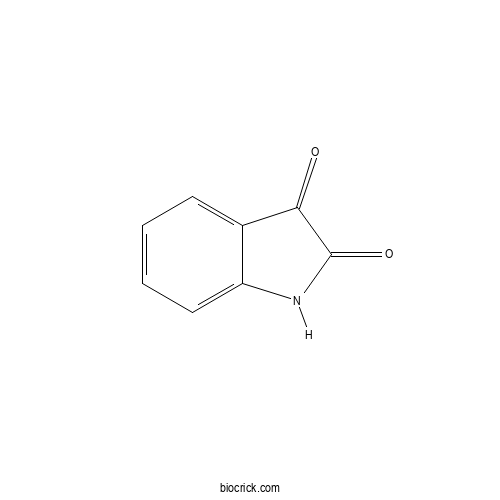
| Cas No. | 91-56-5 | SDF | File under preparation. |
| PubChem ID | 7054.0 | Appearance | Orange powder |
| Formula | C8H5NO2 | M.Wt | 147.1 |
| Type of Compound | N/A | Storage | Desiccate at -20°C |
| Solubility | Soluble in Chloroform,Dichloromethane,Ethyl Acetate,DMSO,Acetone,etc. | ||
| Chemical Name | 1H-indole-2,3-dione | ||
| SMILES | C1=CC=C2C(=C1)C(=O)C(=O)N2 | ||
| Standard InChIKey | JXDYKVIHCLTXOP-UHFFFAOYSA-N | ||
| Standard InChI | InChI=1S/C8H5NO2/c10-7-5-3-1-2-4-6(5)9-8(7)11/h1-4H,(H,9,10,11) | ||
| General tips | For obtaining a higher solubility , please warm the tube at 37 ℃ and shake it in the ultrasonic bath for a while.Stock solution can be stored below -20℃ for several months. We recommend that you prepare and use the solution on the same day. However, if the test schedule requires, the stock solutions can be prepared in advance, and the stock solution must be sealed and stored below -20℃. In general, the stock solution can be kept for several months. Before use, we recommend that you leave the vial at room temperature for at least an hour before opening it. |
||
| About Packaging | 1. The packaging of the product may be reversed during transportation, cause the high purity compounds to adhere to the neck or cap of the vial.Take the vail out of its packaging and shake gently until the compounds fall to the bottom of the vial. 2. For liquid products, please centrifuge at 500xg to gather the liquid to the bottom of the vial. 3. Try to avoid loss or contamination during the experiment. |
||
| Shipping Condition | Packaging according to customer requirements(5mg, 10mg, 20mg and more). Ship via FedEx, DHL, UPS, EMS or other couriers with RT, or blue ice upon request. | ||
Quality Control & MSDS
3D structure
Package In Stock

Number of papers citing our products


Isatin Dilution Calculator
Isatin Molarity Calculator
| 1 mg | 5 mg | 10 mg | 20 mg | 25 mg | |
| 1 mM | 6.7981 mL | 33.9905 mL | 67.981 mL | 135.9619 mL | 169.9524 mL |
| 5 mM | 1.3596 mL | 6.7981 mL | 13.5962 mL | 27.1924 mL | 33.9905 mL |
| 10 mM | 0.6798 mL | 3.399 mL | 6.7981 mL | 13.5962 mL | 16.9952 mL |
| 50 mM | 0.136 mL | 0.6798 mL | 1.3596 mL | 2.7192 mL | 3.399 mL |
| 100 mM | 0.068 mL | 0.3399 mL | 0.6798 mL | 1.3596 mL | 1.6995 mL |
| * Note: If you are in the process of experiment, it's necessary to make the dilution ratios of the samples. The dilution data above is only for reference. Normally, it's can get a better solubility within lower of Concentrations. | |||||
- 4-Hydroxypyridine-2,6-dicarboxylic acid
Catalog No.:BCX2313
CAS No.:499-51-4
- Zeatin
Catalog No.:BCX2312
CAS No.:1637-39-4
- Riboflavin sodium phosphate
Catalog No.:BCX2311
CAS No.:130-40-5
- Chavicol
Catalog No.:BCX2310
CAS No.:501-92-8
- Piperonylic acid
Catalog No.:BCX2309
CAS No.:94-53-1
- 2'-Deoxyadenosine
Catalog No.:BCX2308
CAS No.:958-09-8
- Diosbulbin A
Catalog No.:BCX2307
CAS No.:20086-05-9
- Allylbenzene
Catalog No.:BCX2306
CAS No.:300-57-2
- 4-Hydroxy-3,5-diisopropylbenzaldehyde
Catalog No.:BCX2305
CAS No.:10537-86-7
- Ganoderic acid F
Catalog No.:BCX2304
CAS No.:98665-15-7
- 11-Oxocucurbita-5,24-diene-3,20-diol
Catalog No.:BCX2303
CAS No.:2491640-86-7
- 7β,20-Epoxyabieta-8,11,13-triene-6α,11,12-triol
Catalog No.:BCX2302
CAS No.:1353042-00-8
- D-Galacturonic acid hydrate
Catalog No.:BCX2315
CAS No.:685-73-4
- Mandelic acid
Catalog No.:BCX2316
CAS No.:90-64-2
- 9-Nitrocamptothecin
Catalog No.:BCX2317
CAS No.:86639-62-5
- Laurolitsine
Catalog No.:BCX2318
CAS No.:904927-11-3
- N6-Isopentenyladenine
Catalog No.:BCX2319
CAS No.:2365-40-4
- Glutathione disulfide
Catalog No.:BCX2320
CAS No.:27025-41-8
- Naringenin chalcone
Catalog No.:BCX2321
CAS No.:73692-50-9
- Spilanthol
Catalog No.:BCX2322
CAS No.:25394-57-4
- Cathayanin C
Catalog No.:BCX2323
CAS No.:330195-61-4
- Taurodeoxycholic acid
Catalog No.:BCX2324
CAS No.:516-50-7
- Cathayanin B
Catalog No.:BCX2325
CAS No.:330195-60-3
- Sorocein H
Catalog No.:BCX2326
CAS No.:157382-82-6
Discovery of tricyclic benzo[4,5]imidazo[2,1-b]thiazole-3-hydroxyindolin-2-one hybrids as selective MAO-B and cholinesterase inhibitors.[Pubmed:42788140]
RSC Adv. 2026 Sep 24.
A series of 13 novel 3-hydroxyindolin-2-one-benzo[4,5]imidazo[2,1-b]thiazole hybrids was designed, synthesized, and evaluated as potential anti-Alzheimer agents targeting monoamine oxidase B (MAO-B) and cholinesterases. The target compounds were obtained by condensing a benzo[4,5]imidazo[2,1-b]thiazole-based ketone with substituted and N-alkylated Isatins and were structurally confirmed by (1)H NMR, (13)C NMR, and elemental analysis. All synthesized compounds were screened for their inhibitory activities against MAO-A and MAO-B enzymes. Most derivatives displayed weak MAO-A inhibition while exhibiting a marked preference for MAO-B inhibition. Among them, compounds 6c and 6b emerged as the most potent MAO-B inhibitors, with IC(50) values of 0.90 +/- 0.005 and 0.97 +/- 0.010 microM, respectively. Structure-activity relationship studies revealed that substitution at the C-5 position of the Isatin ring, particularly with halogen atoms, significantly enhanced MAO-B inhibitory activity, whereas N-alkylation generally reduced both potency and selectivity. Based on their superior MAO-B inhibitory profiles, compounds 6b and 6c were further evaluated against acetylcholinesterase (AChE) and butyrylcholinesterase (BuChE). Notably, compound 6c exhibited potent dual cholinesterase inhibition, showing AChE inhibitory activity comparable to that of donepezil and superior BuChE inhibition. Furthermore, SwissADME analysis indicated favorable drug-likeness properties for the most active compounds. Molecular docking studies demonstrated favorable binding interactions of the lead compounds within the active sites of MAO-B and AChE, while a 200 ns molecular dynamics simulation confirmed the stability of the MAO-B-6c complex. Collectively, these findings identify 6c as a promising multitarget lead compound combining selective MAO-B inhibition with potent cholinesterase inhibitory activity and highlight the 3-hydroxyindolin-2-one-benzo[4,5]imidazo[2,1-b]thiazole scaffold as a valuable platform for the development of novel therapeutic agents for Alzheimer's disease.
Design and Computational Evaluation of Isatin Derivatives as Dual MAO-A/IDO1 Inhibitors: Molecular Docking and Molecular Dynamics Insights.[Pubmed:42786817]
Curr Med Chem. 2026 Sep 21.
BACKGROUND: Monoamine oxidase-A (MAO-A) and indoleamine 2,3- dioxygenase-1 (IDO1) contribute to major depressive disorder via monoamine depletion and activation of the kynurenine pathway. Dual inhibition of these enzymes represents a rational multitarget therapeutic strategy. OBJECTIVE: To identify potent dual MAO-A/IDO1 inhibitors from a focused library of Isatin derivatives using an integrated computational approach. METHODS: A total of 140 Isatin derivatives were screened against MAO-A (PDB ID: 2BXR) and IDO1 (PDB ID: 6E35) using AutoDock 4.2. Top-ranked candidates were subjected to 100 ns molecular dynamics simulations using the Desmond module. Complex stability was evaluated through root mean square deviation (RMSD), root mean square fluctuation (RMSF), radius of gyration (rGyr), and solvent-accessible surface area (SASA) analyses to assess the structural stability and dynamic behavior of the protein- ligand complexes throughout the 100 ns molecular dynamics simulations. Moclobemide was used as the reference inhibitor. RESULTS: Several derivatives demonstrated improved docking scores and favorable interactions within the catalytic pockets of both targets. SDI-107 and SDI-113 maintained stable binding conformations during 100 ns simulations, with protein backbone deviations within 2.0 to 2.5 A, limited active-site residue fluctuations, sustained hydrogen bonding, and favorable binding free energy profiles compared with moclobemide. DISCUSSION: The combined docking and molecular dynamics analyses indicate that structural stability and persistent intermolecular interactions underpin the dual inhibitory potential of SDI-107 and SDI-113. The Isatin scaffold appears well suited for simultaneous engagement of the catalytic environments of MAO-A and IDO1, supporting its potential as a multitarget pharmacophore for antidepressant drug discovery. CONCLUSION: SDI-107 and SDI-113 emerged as promising dual MAO-A/IDO1 inhibitors, demonstrating favorable binding affinity, stable protein-ligand interactions, and encouraging binding free energy profiles. These findings support further experimental validation and structural optimization toward the development of multitarget-directed antidepressant agents.
Isatin derivatives as potent cholinesterase inhibitors: recent developments and future challenges.[Pubmed:42761709]
RSC Adv. 2026 Sep 18.
Alzheimer's disease (AD) is a progressive neurodegenerative disorder characterized by cognitive decline, memory impairment, and neuronal loss, primarily associated with beta-amyloid plaque deposition, tau hyperphosphorylation, and cholinergic dysfunction. Since the disruption of cholinergic neurotransmission is a key pathological feature of AD, the cholinesterase (ChE) inhibitors targeting acetylcholinesterase (AChE) and butyrylcholinesterase (BChE) remain the mainstay of symptomatic treatment by enhancing synaptic acetylcholine levels. However, the currently approved small molecules, including tacrine, donepezil, rivastigmine, and galantamine, are limited by their modest efficacy, poor selectivity, and adverse effects, necessitating the development of improved therapeutic agents. Among emerging scaffolds, Isatin (1H-indole-2,3-dione) has attracted considerable research attention owing to its structural versatility, synthetic accessibility, and favorable pharmacological properties. Recent studies have reported diverse Isatin-based derivatives, including hydrazones, Schiff bases, thiosemicarbazones, spirooxindoles, and molecular hybrids, exhibiting potent AChE and BChE inhibitory activities, often in the submicromolar or nanomolar ranges. Structure-activity relationship studies have revealed the critical influence of electronic effects, linker optimization, N-substitution, and molecular hybridization on inhibitory potency and selectivity. This review summarizes the most promising Isatin-based cholinesterase inhibitors reported from 2020 to the present, highlighting their biological activities, structure-activity relationships, and potential for the development of next-generation anti-Alzheimer therapeutics.
Unlocking the Potential of Isatin Scaffolds in Acetylcholinesterase Inhibition.[Pubmed:42748401]
Arch Pharm (Weinheim). 2026 Sep;359(9):e70336.
The therapeutic significance of acetylcholinesterase (AChE) inhibition is most prominently observed in the management of various neurodegenerative and neuromuscular disorders, including Alzheimer's disease (AD), and myasthenia gravis (MG). The present review examines Isatin-based compounds as a promising class of drugs for treating these conditions, focusing on their ability to inhibit AChE. While AD is characterized by a significant loss of cholinergic neurons leading to a deficiency in acetylcholine (ACh), MG is an autoimmune disease where the body produces antibodies that block or destroy ACh receptors at the neuromuscular junction. By inhibiting AChE, therapeutic agents increase the availability of ACh, thereby enhancing cholinergic neurotransmission and improving muscle strength or cognitive function. The underlying issue in MG is the reduced number of functional receptors rather than a primary decrease in AChE production. However, inhibition of the enzyme remains a vital strategy for symptom management. Accordingly, this review provides a systematic overview of the various synthetic strategies reported in the literature over the last decade for enhancing Isatin-based AChE inhibitory activity. These strategies include modifications of the Isatin nitrogen, such as N-alkylation, N-acylation, or N-arylation. Another strategy is aromatic ring substitution, where various substituents (e.g., halogens, nitro, amino, and alkyl groups) are introduced typically at the C(5), C(6), and/or C(7) positions. C(3)-carbonyl functionalization is also reported, exemplified by the formation of Schiff bases, hydrazones, or spirocyclic derivatives. Our findings highlight the exceptional potential and adaptability of Isatin derivatives in medicinal chemistry, highlighting the major advances within the last 10 years and the future directions.
Unraveling anaerobic indole degradation in an acclimated sludge consortium: Candidate pathways and microbial division of labor inferred from metagenomic and metatranscriptomic analyses.[Pubmed:42735627]
J Hazard Mater. 2026 Sep 12;517:143606.
Indole is a widespread nitrogen-containing heterocyclic compound in manure, sludge, and wastewater systems, yet the enzymes and microbial populations involved in its anaerobic transformation remain poorly resolved. Here, we established a long-term acclimated anaerobic sludge consortium and combined degradation assays, metabolite profiling, metatranscriptomics, and genome-resolved metagenomics to investigate the functional basis of anaerobic indole degradation. After 120 days of acclimation, the consortium stably degraded 100 mg/L indole, whereas skatole was not effectively removed under the same strategy, indicating substrate-specific adaptation of the microbial community. Metabolite profiling detected oxindole, dioxindole, Isatin, and anthranilic acid, supporting a putative transformation route involving pyrrole-ring oxidation and ring cleavage toward anthranilate-like intermediates. Metatranscriptomic analysis identified 16,660 differentially expressed genes after indole addition, with strong transcriptional responses involving oxidoreductases, hydrolases, cofactor-dependent redox metabolism, aromatic-CoA-related metabolism, and methane metabolism-associated pathways. Transcriptional responses highlighted the xanthine dehydrogenase-like molybdenum-enzyme system and Isatin hydrolase as candidate contributors to upstream indole transformation, whereas those of abmG-like, bcrC, and oah genes were consistent with possible anthranilic acid activation and downstream CoA-type processing. MAG-resolved analysis further suggested that these candidate functions may be distributed among populations affiliated with Bacteroidota, Chloroflexota, Desulfobacterota, and Methanobacterium. Together, these findings establish a stable anaerobic indole-degrading consortium and provide a testable functional framework for syntrophic interactions linking upstream indole transformation, aromatic-CoA metabolism, and methanogenesis-associated carbon flow.
Enhanced Dipolar Interaction Combined with Rigid-Flexible Side Chains for Promoting the Performance of Anion Exchange Membranes.[Pubmed:42728210]
ACS Appl Mater Interfaces. 2026 Sep 14.
Anion exchange membrane (AEM) performance is essential to fuel cell operation as it is the main component of anion exchange membrane fuel cells (AEMFCs). The development of advanced AEMs featuring efficient hydroxide conductivity and excellent alkali resistance holds substantial importance for the development of AEMFC. In this paper, a series of poly(carbazole-Isatin)-based AEMs featuring different side chain structures are designed, aiming to explore the influence of different cation-dipole interaction strengths acting on flexible and "rigid-flexible" side chains on the overall membrane performance. Among them, membrane QCI-2O/8CF exhibits the best performance, as evidenced by a hydrophilic channel size of 4.49 nm from small-angle X-ray scattering testing, a hydroxide ionic conductivity of 166.25 mS cm-1 at 80 degrees C, and a conductivity retention of 90.71% after being immersed in 2 M NaOH solution at 80 degrees C for 1200 h. The fuel cell result shows that QCI-2O/8CF attains a peak power density of 695.24 mW cm-2 and its voltage decay rate is 0.47 mV h-1 after 60 h under a constant current density of 100 mA cm-2. This research will broaden the design directions of AEMs and promote the further development of AEMFC technology.
Harnessing Synergy: A Review on the Synthesis and Bioactivity of Artemisinin-Isatin Hybrid Molecules.[Pubmed:42725591]
Mini Rev Med Chem. 2026 Sep 7.
INTRODUCTION: To examine the design, synthesis, and pharmacological potential of novel artemisinin-Isatin hybrid compounds as a strategy to overcome drug resistance and expand therapeutic applications beyond malaria. METHODS: Researchers employed molecular hybridization techniques-specifically Cu-promoted azide-alkyne cycloaddition, etherification, and esterification-to covalently link modified Isatin moieties to the artemisinin scaffold. These methods produced diverse series of triazole, two-carbon, and ester-tethered hybrids. The compounds were evaluated using MTT assays to determine biological activity against various cancer cell lines. RESULTS: Pharmacological testing identified several potent hybrids: Hybrids 3c and 3d: Demonstrated efficacy against breast cancer lines comparable to the standard drug doxorubicin. Hybrid 5d: Showed significant anti-leukemic activity with an enhanced safety profile. SAR Analysis: Structure-activity relationship (SAR) data indicated that therapeutic effectiveness is highly dependent on the length of the alkyl linker (with two carbons being ideal) and specific modifications at the C-3 and C-5 positions. DISCUSSION: The review discussed the preparation and biological activities of artemisinin and Isatin hybrid molecules. It has been discussed that after the resistant reported against artemisinin, several approaches have been tried to improve the efficacy of drugs in the treatment of deadly diseases like malaria. It has been found that hybrids like artemisinin-1,2,3-triazole-Isatin, dihydroartemisininIsatin, two-carbon tethered artemisinin-Isatin hybrids, ester tethered artemisinin-Isatin hybrids, ester tethered artemisinin-Isatin hybrids reported better efficacy. Also, the comparison between linkers showed that alkyl linkers provide more potency than 1,2,3- triazole linkers for artemisinin and Isatin hybrids. CONCLUSION: Artemisinin-Isatin hybrids represent a promising new class of pharmaceuticals that utilize synergy to target multiple cellular pathways. These hybrids offer a robust approach for treating complex diseases, including aggressive breast cancer and leukemia, while addressing the challenges of drug resistance.
Exploring novel isatin derivatives as SARS-CoV-2 3CL(pro) inhibitors.[Pubmed:42723354]
J Enzyme Inhib Med Chem. 2026 Dec;41(1):2707859.
A series of novel Isatin derivatives were synthesised by incorporating phenyl, biphenyl, naphthyl and indolyl moieties into the N-1 position and screened in vitro against SARS-CoV-2 3CL(pro), respectively. These Isatin compounds with halogen substitution at the Isatin ring and trifluoromethylbenzyl substitution at N-1 position were strong inhibitors of SARS-CoV-2 3CL(pro). Furthermore, introduction of electron withdrawing groups at the C-5 and C-7 of Isatin ring, such as bromo group, might be more favourable for the inhibition activity. The most potent compound 34 demonstrated an IC(50) of 0.363 +/- 0.045 microM against SARS-CoV-2 3CL(pro). Additionally, a jump dilution assay, surface plasmon resonance (SPR) spectroscopy and in silico analysis were used to measure the binding of compound 34 to SARS-CoV-2 3CL(pro) respectively, supporting the obtained in vitro findings. Moreover, compound 34 inhibited viral cell proliferation with an IC(50) of 0.404 +/- 0.021 muM (selectivity index (SI) =170). Therefore, it is worth to further investigate compound 34 as a SARS-CoV-2 3CL(pro) inhibitor.
Design, Synthesis, Molecular Dynamics, and In Vitro Evaluation of Isatin-Based Quinazoline Derivatives as Potential Antidiabetic Agents.[Pubmed:42720058]
Chem Biodivers. 2026 Sep;23(9):e71694.
A series of substituted indolo[2,1-b]quinazoline-6,12-diones (SJ1-SJ8), which consist of already published derivatives (SJ1-SJ5) and newly synthesized derivatives (SJ6-SJ8), has been studied for their possible alpha-amylase inhibition property as an antidiabetic lead compound. The synthesized derivatives have been identified by spectroscopy and analysis methods and tested for their in vitro alpha-amylase inhibitory activity. The most potent inhibitory activity among the tested derivatives was showed by SJ2 (IC(50) = 18.49 +/- 0.06 microM), similar to the reference drug acarbose (IC(50) = 16.26 +/- 0.02 microM). The second-best activity was observed for the newly identified derivative SJ8 (IC(50) = 19.67 +/- 0.19 microM). Molecular docking and 100 ns molecular dynamics simulations supported favorable and stable interactions of SJ2 in the alpha-amylase active site, while MM-PBSA analysis showed favorable binding energetics. The electronic properties of SJ2 were also clarified by DFT and molecular electrostatic potential analyzes, and in silico ADMET profiling indicated promising predicted drug-like and pharmacokinetic properties. To summarize, SJ2 is a promising lead for alpha-amylase inhibition, which needs further optimization and biological validation. Future evaluation against alpha-glucosidase and relevant in vivo models will be essential to determine the more general antidiabetic potential of this scaffold.
The influence of neuroprotector isatin on haloperidolinduced catalepsy and proteomic profile of mice brain.[Pubmed:42708568]
Biomed Khim. 2026 Sep;72(4):267-278.
Isatin (indol-2,3-dione) is an endogenous regulator found in humans and animals. It interacts with numerous target proteins and exhibits a wide range of biological activities, including neuroprotective action in animal models of Parkinson's disease (PD) induced by administration of neurotoxins MPTP (1-methyl-4-phenyl-1,2,3,6- tetrahydropyridine) or rotenone. An antipsychotic drug haloperidol, which impairs neurotransmitter balance in the nigrostriatal pathway, models dopamine deficiency and promotes the development of motor disorders characteristic of PD. In this work, the effect of two doses of Isatin (10 mg/kg and 80 mg/kg) on the haloperidol catalepsy and on the proteomic profile of mice brain was investigated. The pretreatment of animals with Isatin (1 h before haloperidol administration) reduced the occurrence of haloperidol catalepsy. The administration of haloperidol and also Isatin with haloperidol influenced the relative content of a number of proteins associated with PD and other neurodegenerative diseases.
Isatin-based Strategies for Microbial Infections: A Multifaceted Perspective.[Pubmed:42708268]
Rev Recent Clin Trials. 2026 Aug 29.
Novel chemotherapeutic drugs that can fight multidrug-resistant bacteria are desperately needed due to the fast growth of antimicrobial resistance (AMR). As a favoured scaffold in medicinal chemistry, the naturally produced indole derivative Isatin (1H-indole-2,3-dione) is found in microorganisms, plants, and the metabolic pathways of mammals, has garnered significant interest. Isatin is a crucial pharmacophore for the creation of broad-spectrum antibacterial medicines because of its adaptable chemical structure and ease of structural alteration at several reactive locations. The therapeutic potential of Isatin and its derivatives against bacterial, fungal, viral, and microbacterial diseases is well highlighted in this study. Schiff bases, Mannich bases, thiosemicarbazones, azole, furan, sulfonamide, fluoroquinolone, chalcone, and coumarin conjugates are among the many Isatinbased hybrids and analogs that show strong and specific antimicrobial action. According to mechanistic investigations, these compounds function via a variety of mechanisms, including biofilm suppression, membrane disruption, interference with DNA gyrase and topoisomerase IV, inhibition of cell-wall production, and targeting vital enzymes like FtsZ and CrtM. To enhance biological potency and overcome drug resistance, electronic substituents, linker flexibility, and hybridization techniques are crucial, according to structure-activity relationship (SAR) studies. The clinical approval of numerous Isatin-based drugs, including sunitinib and nintedanib, for the treatment of cancer, as well as the evaluation of other drugs, like TD-1792 and Ro 23-9424, for the treatment of infectious diseases, demonstrate the translational success of this scaffold. This review focuses on significant advancements, procedures, and potential treatments in Isatin-based antimicrobial research.
Schiff Bases as Multifunctional Agents in Parkinson's Disease Therapy: A Comprehensive Review.[Pubmed:42693851]
Mini Rev Med Chem. 2026 Aug 24.
Parkinson's disease (PD) is an irreversible neurodegenerative disorder leading to movement disorders including trembling, rigidity, and bradykinesia. The majority of these symptoms result from the death of dopaminergic neurons in the substantia nigra. Despite various pharmaceutical and surgical methods like levodopa treatment and neuromodulation being applied, none of them prevent the progression of PD. Various factors, both genetic and environmental (pesticides, head trauma, mitochondrial dysfunction), contribute to the development of this disease. Recent studies demonstrate the potential of MAO-B inhibitors to prevent dopamine degradation and oxidative stress. Schiff base derivatives are among the most interesting novel structures due to their ability to provide neuroprotection, free radical scavenging, and enzyme inhibition. The studies on Isatin, benzothiazole, benzimidazole, and coumarin Schiff bases proved their potent and selective inhibition of MAO-B. Some of them demonstrate nanomolar IC50 values and promising pharmacokinetic parameters, including BBB penetration. According to the SAR, substitutions (EWG (-NO2, -Cl, -Br) and hydroxyl) increase lipophility and affinity to MAO-B. Schiff base structures have been identified as potential multi-functional platforms for the development of novel agents for neuroprotection against the effects of motor impairment and non-motor dysfunction in PD patients.
Design and synthesis of 1,3,4-oxadiazole-tethered N-substituted isatin hybrids as SARS-CoV-2 main protease inhibitors: biological evaluation, kinetic investigation, and in silico studies.[Pubmed:42682986]
RSC Adv. 2026 Sep 1;16(42):51489-51506.
The ongoing emergence of SARS-CoV-2 mutations underscores the urgent need for new antivirals that target key viral proteins. This study describes the design, synthesis, and evaluation of two series of 1,3,4-oxadiazole-tethered N-substituted Isatin hybrids as inhibitors of the SARS-CoV-2 main protease (M(pro)): 1,2,3-triazole-linked derivatives (9a-h) and pyrazole-linked derivatives (15a-d). Compounds 15a-c were identified as the most active derivatives in initial FRET-based screening. With an IC(50) of 15.38 microM, 15c was the most effective inhibitor, as determined by subsequent enzymatic assays. 15a and 15b had IC(50) values of 24.43 and 30.55 microM, respectively. The active chemicals inhibit M(pro) via a noncompetitive/mixed mechanism (alpha = 0.41-0.44), at a K (I) value of 13.24 microM, according to enzyme kinetic studies. Additionally, the compounds exhibited favorable physicochemical and ADMET profiles and minimal cytotoxicity against normal IMR-90 cells. The stable predicted binding of the most active compound, 15c, within the M(pro) active site was further supported by molecular docking and molecular dynamics simulations. Collectively, these findings identify 15c as the most active derivative in the present series and provide preliminary SAR insights that may guide further optimization of this scaffold as a potential class of SARS-CoV-2 M(pro) inhibitors.
Spirooxindole Derivatives as Emerging Scaffolds in Drug Discovery: Synthetic Strategies, Structure-Activity Relationship, and Biological Activities.[Pubmed:42675552]
ChemMedChem. 2026 Sep 14;21(17):e70468.
Spirooxindoles are a class of spirocyclic scaffolds in drug discovery, as the rigid frame and well-defined substitution pattern can interact with various biological targets. Recent advances in synthetic methodologies, including multicomponent 1,3-dipolar cycloadditions, organocatalytic cascades, and one-pot protocols, have facilitated the efficient synthesis of a wide variety of derivatives for SAR studies. A diverse range of classes, including pyrrolidine, cyclopropyl carboxamide, carbamate, oxadiazoline, pyrrolizidine, and furan derivatives, show cytotoxicity in the submicromolar-to-low micromolar range with good selectivity. The SAR studies suggest that substitution on the Isatin core generally enhances biological activity in individual series, especially with electron-withdrawing groups, but these effects are scaffold dependent. Furthermore, spirooxindole derivatives have been reported to show antibacterial activity, including TrpRS inhibition, antimicrobial, acetylcholinesterase inhibition, alpha-glucosidase inhibition, antiviral, and anticonvulsant activities. The recent patents, especially on MDM2 inhibitors and other anticancer agents with nanomolar potency, provide further evidence for the continued interest in spirooxindole-based drug discovery. This review highlights the recent advancements in spirooxindole chemistry involving synthetic strategies, SAR, biological activities, and recent patents.

Calcutta University

University of Minnesota

University of Maryland School of Medicine

University of Illinois at Chicago

The Ohio State University

University of Zurich

Harvard University

Colorado State University

Auburn University

Yale University

Worcester Polytechnic Institute

Washington State University

Stanford University

University of Leipzig

Universidade da Beira Interior

The Institute of Cancer Research

Heidelberg University

University of Amsterdam

University of Auckland

TsingHua University

The University of Michigan

Miami University

DRURY University

Jilin University

Fudan University

Wuhan University

Sun Yat-sen University

Universite de Paris

Deemed University

Auckland University

The University of Tokyo

Korea University



