
SpilantholCAS# 25394-57-4 |
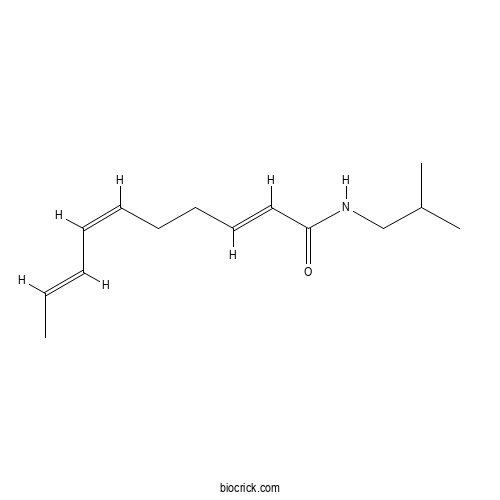
| Cas No. | 25394-57-4 | SDF | File under preparation. |
| PubChem ID | 5353001.0 | Appearance | Oil |
| Formula | C14H23NO | M.Wt | 221.3 |
| Type of Compound | N/A | Storage | Desiccate at -20°C |
| Solubility | Soluble in Chloroform,Dichloromethane,Ethyl Acetate,DMSO,Acetone,etc. | ||
| Chemical Name | (2E,6Z,8E)-N-(2-methylpropyl)deca-2,6,8-trienamide | ||
| SMILES | CC=CC=CCCC=CC(=O)NCC(C)C | ||
| Standard InChIKey | BXOCHUWSGYYSFW-HVWOQQCMSA-N | ||
| Standard InChI | InChI=1S/C14H23NO/c1-4-5-6-7-8-9-10-11-14(16)15-12-13(2)3/h4-7,10-11,13H,8-9,12H2,1-3H3,(H,15,16)/b5-4+,7-6-,11-10+ | ||
| General tips | For obtaining a higher solubility , please warm the tube at 37 ℃ and shake it in the ultrasonic bath for a while.Stock solution can be stored below -20℃ for several months. We recommend that you prepare and use the solution on the same day. However, if the test schedule requires, the stock solutions can be prepared in advance, and the stock solution must be sealed and stored below -20℃. In general, the stock solution can be kept for several months. Before use, we recommend that you leave the vial at room temperature for at least an hour before opening it. |
||
| About Packaging | 1. The packaging of the product may be reversed during transportation, cause the high purity compounds to adhere to the neck or cap of the vial.Take the vail out of its packaging and shake gently until the compounds fall to the bottom of the vial. 2. For liquid products, please centrifuge at 500xg to gather the liquid to the bottom of the vial. 3. Try to avoid loss or contamination during the experiment. |
||
| Shipping Condition | Packaging according to customer requirements(5mg, 10mg, 20mg and more). Ship via FedEx, DHL, UPS, EMS or other couriers with RT, or blue ice upon request. | ||
Quality Control & MSDS
3D structure
Package In Stock

Number of papers citing our products


Spilanthol Dilution Calculator
Spilanthol Molarity Calculator
-
 α-SanshoolCatalog No.: BCX1569CAS No.: 504-97-2
-
 β-SanshoolCatalog No.: BCX1585CAS No.: 10076-00-3
-
 Dodeca 2E,4E,8Z,10E,Z-tetraenoic acid isobutylamideCatalog No.: BCN9763CAS No.: 866602-52-0
-
 γ-sanshoolCatalog No.: BCX0626CAS No.: 78886-65-4
-
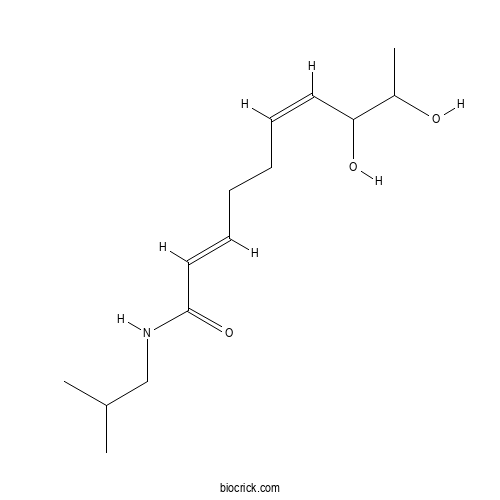 (2E,6Z)-8,9-Dihydroxy-N-isobutyldeca-2,6-dienamideCatalog No.: BCX2271CAS No.: 1492015-25-4
| 1 mg | 5 mg | 10 mg | 20 mg | 25 mg | |
| 1 mM | 4.5188 mL | 22.5938 mL | 45.1875 mL | 90.3751 mL | 112.9688 mL |
| 5 mM | 0.9038 mL | 4.5188 mL | 9.0375 mL | 18.075 mL | 22.5938 mL |
| 10 mM | 0.4519 mL | 2.2594 mL | 4.5188 mL | 9.0375 mL | 11.2969 mL |
| 50 mM | 0.0904 mL | 0.4519 mL | 0.9038 mL | 1.8075 mL | 2.2594 mL |
| 100 mM | 0.0452 mL | 0.2259 mL | 0.4519 mL | 0.9038 mL | 1.1297 mL |
| * Note: If you are in the process of experiment, it's necessary to make the dilution ratios of the samples. The dilution data above is only for reference. Normally, it's can get a better solubility within lower of Concentrations. | |||||
- Naringenin chalcone
Catalog No.:BCX2321
CAS No.:73692-50-9
- Glutathione disulfide
Catalog No.:BCX2320
CAS No.:27025-41-8
- N6-Isopentenyladenine
Catalog No.:BCX2319
CAS No.:2365-40-4
- Laurolitsine
Catalog No.:BCX2318
CAS No.:904927-11-3
- 9-Nitrocamptothecin
Catalog No.:BCX2317
CAS No.:86639-62-5
- Mandelic acid
Catalog No.:BCX2316
CAS No.:90-64-2
- D-Galacturonic acid hydrate
Catalog No.:BCX2315
CAS No.:685-73-4
- Isatin
Catalog No.:BCX2314
CAS No.:91-56-5
- 4-Hydroxypyridine-2,6-dicarboxylic acid
Catalog No.:BCX2313
CAS No.:499-51-4
- Zeatin
Catalog No.:BCX2312
CAS No.:1637-39-4
- Riboflavin sodium phosphate
Catalog No.:BCX2311
CAS No.:130-40-5
- Chavicol
Catalog No.:BCX2310
CAS No.:501-92-8
- Cathayanin C
Catalog No.:BCX2323
CAS No.:330195-61-4
- Taurodeoxycholic acid
Catalog No.:BCX2324
CAS No.:516-50-7
- Cathayanin B
Catalog No.:BCX2325
CAS No.:330195-60-3
- Sorocein H
Catalog No.:BCX2326
CAS No.:157382-82-6
- 3-Methyl-1-(3-methylfuran-2-yl)but-3-en-1-one
Catalog No.:BCX2327
CAS No.:78173-38-3
- Putrescine
Catalog No.:BCX2328
CAS No.:110-60-1
- L-Ornithine
Catalog No.:BCX2329
CAS No.:70-26-8
- Dopamine
Catalog No.:BCX2330
CAS No.:51-61-6
- Norcantharidin
Catalog No.:BCX2331
CAS No.:29745-04-8
- L-Arabinose
Catalog No.:BCX2332
CAS No.:5328-37-0
- L-Galactose
Catalog No.:BCX2333
CAS No.:15572-79-9
- L-Mannose
Catalog No.:BCX2334
CAS No.:10030-80-5
Enhanced In Vivo Antinociceptive Activity and GC-MS Chemical Profiling of In Vitro-Grown Acmella radicans Plants Elicited with Rhizopus microsporus.[Pubmed:42653986]
Molecules. 2026 Aug 20;31(16):2906.
Pain remains a major global health challenge, driving the search for safer analgesics from medicinal plants. Although Acmella radicans is traditionally used for pain relief, the effects of fungal elicitation on its chemical profile and antinociceptive activity remain unknown. Therefore, this study evaluated the effects of Rhizopus microsporus elicitation on the chemical profile and in vivo antinociceptive activity of lipophilic fractions from in vitro-grown A. radicans. In vitro-grown plants were biotically elicited with aqueous mycelial extracts of R. microsporus. Lipophilic fractions obtained from ethanolic extracts were analyzed by GC-MS and evaluated for antinociceptive activity using the mouse formalin test. Elicitation with a 0.5% mycelial extract (48 h fungal culture, 48 h exposure) increased ethanol extract yield to 18.8%, compared with 15.3% in non-elicited in vitro plants and 6.1% in wild plants. GC-MS analysis tentatively identified 62 metabolites and indicated marked changes in the lipophilic chemical profile, including lower relative abundance of Spilanthol and higher relative abundances of phenethyl alkamides, stigmasterol, beta-sitosterol, and 2,4-di-tert-butylphenol, along with the tentative identification of (2E,4E)-N-(2-phenylethyl)deca-2,4-dienamide, a compound not previously reported in the genus Acmella. LFEP showed the highest efficacy among the plant fractions, reducing neurogenic pain by 60.3% versus 88.7% with tramadol, while its significant effect in the inflammatory phase approached that of diclofenac (54.1% inhibition), with tramadol producing the strongest inhibition (81.0%). Fungal elicitation modified the lipophilic chemical profile of A. radicans and enhanced its in vivo antinociceptive activity, supporting its application as a biotechnological strategy to improve the pharmacological potential of medicinal plant in vitro cultures.
Encapsulation of a N-Alkylamide-Enriched Fraction from Acmella oleracea and Its Efficacy Against Tuta absoluta, the Invasive Key Tomato Pest.[Pubmed:42188122]
Insects. 2026 Apr 26;17(5):455.
In the framework of integrated pest management, plant-based insecticides represent a promising tool for the control of insect pests. Indeed, N-alkylamides extracted from Acmella oleracea (L.) RK Jansen (Asteraceae) have been recently studied for their insecticidal properties. The encapsulation of these substances into stable formulations, like nanoemulsions (NEs), could boost their efficacy and stability. Herein, a N-alkylamide-enriched fraction (AEF) encapsulated into a stable NE was tested against Tuta absoluta (Meyrick) (Lepidoptera: Gelechiidae), a key tomato pest, able to develop resistance towards chemical insecticides. Acmella oleracea was reported to be effective against many target species, but this is the first time that this extract was tested against T. absoluta in terms of toxicity against eggs, ingestion toxicity on larvae and repellence on adults. The AEF, containing 42.8% of Spilanthol, was prepared by combining two eco-friendly techniques, namely supercritical CO(2) extraction and wiped-film short path molecular distillation, and then encapsulated into a stable NE. Preliminary tests on the phytotoxicity of the AEF-NEs at 0.25 and 0.5% (w/w) a.i., compared with a control NE solution (i.e., the AEF-free NE) and a negative control (distilled water), showed a negative effect on tomato plants at the highest concentration. On this basis, three concentrations (0.06, 0.125, and 0.25% a.i.) were evaluated against eggs (topical toxicity), larvae of 2nd instar (ingestion and topical toxicity), and adults (ovideterrence) of T. absoluta. The results showed that all adopted AEF-NE concentrations caused a significant inhibition in egg hatching (>20%). The larval survival, at the end of the evaluation (72 h), in ingestion toxicity tests were significantly different in the AEF-NEs at 0.06, 0.12, and 0.25% (56.7, 33.3 and 26.7%, respectively) compared with control NE and distilled water (100% both). Similar results were obtained in the adult emergence in ingestion toxicity comparing AEF-NEs at 0.06, 0.12, and 0.25% (64.7, 50.0 and 75.0%, respectively) with control NE and distilled water (100% both). Finally, a significant ovideterrent effect was shown by the concentrations 0.125 and 0.25% of the AEF-NEs (% of egg laid: 7.5 and 27.4% respectively), compared with distilled water. Overall, the AEF-NE tested showed promising and encouraging effectiveness as ovicidal and larvicidal against T. absoluta. This supports its potential use as an effective alternative to synthetic products for the control of this important pest.
Enhanced transdermal delivery of [6]-Gingerol via Co-Administration of Acmella oleracea and Zingiber officinale lipophilic extracts.[Pubmed:41819387]
Int J Pharm. 2026 Apr 25;695:126745.
Acmella oleracea and Zingiber officinale (ginger) are two plants of great interest due to their antioxidant, antimicrobial, and especially anti-inflammatory properties. These effects are mainly attributed to the presence of bioactive compounds such as Spilanthol in Acmella oleracea and [6]-gingerol in Zingiber officinale. However, [6]-gingerol is primarily metabolised at the gastrointestinal and hepatic levels after oral administration, limiting its systemic bioavailability and effectiveness. In this study, a cream formulation containing both extracts was prepared using a preformed commercial transdermal vehicle and characterised through rheological studies. The ex vivo skin permeation of Spilanthol and [6]-gingerol was evaluated using Franz diffusion cells. Results showed that the presence of Acmella oleracea lipophilic extract promoted the permeation of [6]-gingerol. Moreover, no histological alterations were observed in explanted human skin after transdermal application in a fluidic dynamic system. Based on these findings, topical administration of a formulation containing both Zingiber officinale and Acmella oleracea lipophilic extracts appears to be a promising strategy for enhancing the skin permeability of the active ingredients and, specifically for [6]-gingerol, avoiding its transformation in the gastrointestinal tract.
Anti-hyperplastic effects of Acmella oleracea flower and leaf extracts in prostate cell lines and in spontaneously hypertensive rats.[Pubmed:41729335]
J Mol Histol. 2026 Feb 23;57(2):88.
Benign prostatic hyperplasia (BPH) is a highly prevalent age-associated disorder and a leading cause of lower urinary tract symptoms in men worldwide. Given the limitations of current therapies, there is increasing interest in phytotherapeutic compounds as sources of biologically active agents. Acmella oleracea, a medicinal plant rich in the alkamide Spilanthol, has been traditionally associated with urogenital effects; however, the biological impact of distinct plant organs on prostate hyperplasia remains poorly defined. In this study, we investigated the effects of flower (A.Fl) and leaf (A.Le) extracts of A. oleracea using human prostate cell lines (RWPE-1 and PC-3) and a spontaneously hypertensive rat (SHR) model of BPH. In vitro analyses included cell viability assays and immunofluorescence for androgen receptor (AR), estrogen receptor alpha (ERalpha), and proliferating cell nuclear antigen (PCNA). In vivo, SHR were treated orally with A.Fl or A.Le (100 mg/kg/day for 21 days), followed by morphological, immunohistochemical, ultrastructural, and oxidative stress analyses of the ventral prostate. A.Fl displayed lower cytotoxicity than A.Le in both prostate cell lines and preferentially increased ERalpha immunoreactivity, whereas A.Le more strongly modulated AR without affecting cell proliferation. In SHR, both extracts attenuated prostatic hyperplasia, although A.Fl produced a more pronounced reduction in epithelial proliferation and stromal remodeling. These effects occurred independently of changes in systemic blood pressure or antioxidant activity. Collectively, these findings demonstrate that flower and leaf extracts of A. oleracea exert distinct biological and endocrine-modulatory effects on prostate tissue. The present data provide experimental evidence that different plant organs differentially influence epithelial-stromal dynamics and steroid receptor signaling in prostatic hyperplasia, supporting further mechanistic and translational investigations.
Efficacy of lidocaine-prilocaine combined with amitriptyline or Acmella oleracea in a liposomal cream for topical anesthesia: a randomized crossover clinical trial.[Pubmed:41377174]
J Dent Anesth Pain Med. 2025 Dec;25(6):409-420.
BACKGROUND: Pain remains one of the main causes of apprehension during dental procedures. In this context, topical anesthetics play an essential role in reducing discomfort, and new compounds such as amitriptyline and jambu (Acmella oleracea) extract have been investigated as promising alternatives. Drug delivery systems, such as Pentravan((R)), a nanosomal transdermal base, are also of interest; however, their application on oral mucosa has not yet been clinically evaluated. Therefore, this study aimed to compare the anesthetic efficacy of lidocaine (LDC) and prilocaine (PLC) combined with either amitriptyline or jambu, formulated as ointments or incorporated into Pentravan((R)), for topical anesthesia of the buccal and palatal mucosa of maxillary premolars, using pulpal response and puncture sensitivity as outcome measures. METHODS: A randomized, blinded, crossover clinical trial was conducted with 40 healthy volunteers who received six formulations: (1) LDC 2.5% + PLC 2.5% (positive control); (2) LDC 2.5% + PLC 2.5% + amitriptyline 5%; (3) LDC 2.5% + PLC 2.5% + jambu extract 20% (7.5% Spilanthol); (4) LDC 2.5% + PLC 2.5% + amitriptyline 5% in Pentravan((R)); (5) LDC 2.5% + PLC 2.5% + jambu extract 20% in Pentravan((R)); and (6) base ointment without active ingredients (placebo). Pain upon needle puncture was assessed using the visual analog scale, and pulpal anesthesia was evaluated with an electric pulp tester. RESULTS: Formulations 1 and 2 produced the lowest pain scores in the buccal mucosa, with Formulation 1 showing statistically superior results than Formulations 3, 4, 5, and 6 (P < 0.05). Formulation 6 yielded the highest pain scores, while Formulations 2-5 demonstrated intermediate efficacy without significant differences. Formulations 1 and 2 were also the most effective on the palatal mucosa. None of the formulations achieved significant pulpal anesthesia. Adverse effects were mild and self-limiting, with mucosal desquamation observed only with Formulation 2. CONCLUSION: Amitriptyline demonstrated relevant clinical potential, whereas jambu extract showed intermediate efficacy. Pentravan((R))-based formulations did not exhibit clinical superiority. Future studies should focus on optimizing these combined formulations to enhance the efficacy of topical anesthesia in dentistry.
Acmella uliginosa (Sw.) Cass hampers complete Freund's adjuvant-induced arthritis in rats by inhibiting the VEGF axis.[Pubmed:41061997]
Fitoterapia. 2025 Dec;187:106925.
Rheumatoid arthritis (RA), which is characterized by joint inflammation, is associated with excessive angiogenesis. Acmella uliginosa (Sw) Cass, known as "Subang nenek" in Malaysia, is traditionally used to treat various inflammatory conditions. This study examined the anti-arthritic effects and underlying mechanisms of A. uliginosa leaf ethanolic extract (AULE) and its hexane-fractionated extract (AULH) in arthritic rats induced with complete Freund's adjuvant (CFA) for 28 d. Weekly evaluations were conducted for parameters including paw volume, body weight, and arthritic score, while hematological, biochemical, and the levels of various mediators (COX-2, 5-LOX, VEGF) were assessed upon termination of the study. The phytochemical composition of the extracts was analyzed via GC-MS to identify the bioactive compounds linked to anti-arthritic activity. AULE and AULH showed significant anti-arthritic effects, with AULH showing slightly higher potency. The anti-arthritic effects were mediated through modulation of the VEGF axis, implicating angiogenesis. COX-2 and 5-LOX protein levels were significantly reduced by both extracts. No notable variations in body mass, weights of target organs, and blood-related and biochemical indicators were observed in the extract-treated groups compared to the control rats, indicating possible nontoxic effects. Phytochemical analysis identified bioactive compounds, such as Spilanthol and phytol, which underwent molecular docking studies and were identified as the main contributors to anti-arthritic activity via COX-2 and 5-LOX inhibition. However, VEGF inhibition was attributed to other compounds present in the extracts. A. uliginosa leaf extract show potential as a natural RA treatment, with effects mediated through the modulation of the VEGF axis and angiogenesis.
Antiarrhythmic Effects of Supercritical Extract of Acmella oleracea in Rats: Electrophysiological Evidence and Cardioprotective Potential.[Pubmed:41012000]
Plants (Basel). 2025 Sep 12;14(18):2848.
Cardiovascular diseases (CVDs) are the leading cause of death worldwide, with cardiac arrhythmias being one of the main factors contributing to morbidity. Currently, several established antiarrhythmic medications with proven efficacy are available. However, frequent use of these medications causes adverse effects with medium- and long-term use. This necessitates the development of new medications, preferably of natural origin and with ethnopharmacological relevance. In this sense, Acmella oleracea presents itself as an alternative for the treatment of arrhythmia, considering studies suggesting its cardioprotective effect. Therefore, the objective of this study was to evaluate the electrophysiological and antiarrhythmic effects of a supercritical extract of Acmella oleracea (SEAO) in rats. The extract was obtained by supercritical CO(2) extraction at 70 degrees C and 320 bar, with an extract yield of 9.72 +/- 0.26% (db) and a Spilanthol yield of 25.91%. The extract was administered intraperitoneally at doses of 10, 15, and 20 mg/kg in two experimental models: (1) assessment of cardiac electrophysiology and (2) epinephrine-induced arrhythmia. Electrocardiogram (ECG) parameters were measured and compared with controls treated with epinephrine and lidocaine. The SEAO group maintained sinus rhythm and preserved cardiac intervals, with a significant reduction in heart rate and R-R interval compared to the epinephrine group. These findings demonstrate that SEAO exerts dose-dependent antiarrhythmic effects comparable to those of lidocaine. The results corroborate the potential use of SEAO as a natural alternative for arrhythmia management, encouraging further pharmacological and clinical studies.
Neuroprotective Potential of Acmella oleracea Aerial Parts and Root Extracts: The Role of Phenols and Alkylamides Against Neuropathic Pain.[Pubmed:40871616]
Nutrients. 2025 Aug 8;17(16):2588.
Background: Chemotherapy-induced neuropathic pain is a major side effect of antineoplastic treatment. This study investigated the neuroprotective potential of Acmella oleracea L. extracts containing the N-alkylamide Spilanthol, phenolic acids, and glycosylated flavonoids. Methods: Hydroalcoholic extracts of aerial parts (AP) and roots (R) of in vitro seedlings were quali-quantitatively characterized by HPLC-DAD-MS and by (1)H-NMR. Different concentrations (15-150 microg/mL) of AP and R were tested in SH-SY5Y cells differentiated into neurons exposed to oxaliplatin (10 microM), assessing cell viability (MTT), cytotoxicity (LDH), SOD activity, and expression of ATF-3, Ire1alpha, and Nf-H genes. To evaluate the impact on neuropathic pain, CD-1 mice were treated intraperitoneally with oxaliplatin (2.4 mg/kg), the effect of AP and R extracts (200-1200 mg/kg) were measured by the cold plate test. Results: AP extract was rich in phenols and alkylamides, whereas R extract showed higher phenolic levels but lower alkylamides content. Both extracts significantly reduced mortality and cytotoxicity and counteracted oxidative imbalance by enhancing SOD activity. Gene expression analysis confirmed their neuroprotective effects. In vivo, oxaliplatin induced a 50% reduction in pain threshold, while acute treatment with AP and R extracts dose-dependently alleviated neuropathic pain. Despite the lower Spilanthol content in R extract, its efficacy was comparable to AP, suggesting an important role of phenolic compounds. Conclusions: Extracts from both aerial parts and roots of A. oleracea show promise in alleviating chemotherapy-induced neuropathy through mechanisms not solely related to Spilanthol. Further studies to elucidate the contribution of phenolic components are desirable.
GC-MS-Identified Alkamides and Evaluation of the Anti-Inflammatory, Antibacterial, and Antioxidant Activities of Wild Acmella radicans.[Pubmed:40869204]
Int J Mol Sci. 2025 Aug 15;26(16):7884.
Acmella radicans, commonly known as the "toothache plant," is traditionally attributed with medicinal properties, although few studies have validated its biological effects. In the present study, a chemical analysis of the wild plant was performed using gas chromatography-mass spectrometry (GC-MS). In addition, the antioxidant, anti-inflammatory, and antibacterial potential of ethanolic extracts from the roots (RE) and aerial parts (AE), as well as their respective fractions, was evaluated. The dichloromethane fractions of the aerial parts (DFAE) and root extracts (DFRE) at a concentration of 25 mug/mL demonstrated the highest inhibition of nitric oxide (NO) production, reducing levels to 22.2 +/- 1.9 and 22.2 +/- 2.9 muM, respectively. Moreover, these fractions exhibited a notable inhibition of TNF-alpha production, lowering its concentration to 22.6 +/- 3.3 pg/mL (DFAE) and 24.8 +/- 5.3 pg/mL (DFRE) at 25 microg/mL. GC-MS chemical profiling revealed the presence of alkamides such as N-isobutyl-2E,6Z,8E-decatrienamide, N-(2-methylbutyl)-2E,6Z,8E-decatrienamide, and N-(2-phenylethyl)-2E,4Z-octadienamide in both root and aerial part extracts. The dichloromethane fractions showed a higher abundance of alkamides compared to the hexane fractions, suggesting that these compounds may be at least partially responsible for the observed anti-inflammatory activity. Additionally, AE showed moderate activity against S. typhimurium and low activity against other bacteria, while RE was especially effective against a resistant strain of S. aureus, indicating an MIC of 31.25 mug/mL, likely due to its high content of alkamides, particularly Spilanthol. Several fractions also inhibited bacteria such as P. aeruginosa, S. aureus, and E. coli, possibly because of the presence of alkamides and compounds like beta-amyrin.
The Multitarget Antinociceptive Compound Affinin and Its Effects on Hypothermia, Hypolocomotion, and Sickness Behavior in Lipopolysaccharide-Treated Mice.[Pubmed:40572518]
Molecules. 2025 Jun 11;30(12):2554.
Affinin (Spilanthol) is the main bioactive alkylamide present in Heliopsis longipes roots, exerting antinociceptive and anti-inflammatory effects that involve the activation of TRP channels. Previous studies indicated that affinin reduces the LPS-induced increase in pro-inflammatory cytokine production in murine macrophages. However, no studies have evaluated whether affinin produces antinociceptive, anti-inflammatory, and behavioral effects in experimental animals treated with LPS, nor has the mechanism of action involved in these pharmacological effects been established. The present study evaluated whether affinin induces hypothermia, catalepsy, hypolocomotion, and analgesia and, moreover, whether the analgesia involves the activation of the CB1 cannabinoid receptor and TRPV1 and TRPA1 channels. Subsequently, the anti-inflammatory activity and behavioral effects induced by affinin (20 mg/kg) in mice were evaluated via LPS (2.5 mg/kg)-induced hypothermia. The results of the experiments indicate that the analgesic effect of affinin involves the activation of the CB1 cannabinoid receptors and the TRPV1 and TRPA1 channels. Additionally, affinin reduced the severity of LPS-induced hypothermia and attenuated the increase in TNF-alpha and IL-6 levels in serum. The results obtained demonstrate that affinin induces antinociceptive, anti-hypothermic, and anti-inflammatory activities, which involve the CB1 receptor and the TRPV1 and TRPA1 channels and the suppression of pro-inflammatory cytokines.
Spilanthol from Acmella oleracea (L.) R. K. Jansen induces metabolic alterations and impair an important virulence factor in Cryptococcus neoformans.[Pubmed:40517685]
Microb Pathog. 2025 Sep;206:107806.
INTRODUCTION: Cryptococcus neoformans is a critical opportunistic fungal pathogen, responsible for cryptococcosis with high mortality rates, particularly in HIV patients, largely due to escalating antifungal resistance and limited treatment options. The World Health Organization has critically categorized this yeast, highlighting the urgent need for novel therapeutic strategies. This study investigates Spilanthol, a prominent N-alkylamide from Acmella oleracea (jambu), a Brazilian medicinal plant known for its diverse bioactivities. METHODS: Through shotgun proteomics, we identified differences in the protein profiles of cells exposed to Spilanthol, when comparing to control (not exposed). A bioinformatic approach was used to analyze the metabolic changes and molecular characteristics of the proteome. RESULTS: Our data suggests general alterations in energy metabolism, oxidative stress, and a reduction in a significant cryptococcal virulence factor, urease, which was experimentally confirmed. Moreover, Spilanthol induces modifications in the cell membrane, as confirmed by cell leakage and a decrease in ergosterol content. CONCLUSION: Spilanthol induced metabolic and morphological alterations, triggered profound oxidative stress, and suppressed the virulence factor urease, potentially elucidating the mechanism responsible for its antifungal properties.
Hydrogels Powered by Nanoemulsion Technology for the Topical Delivery of Acmella oleracea Extract.[Pubmed:40430916]
Pharmaceutics. 2025 May 8;17(5):625.
Background/Objectives: Natural products are gaining increasing importance due to the large variety of biological activities exerted by their constituents. Among these, the products deriving from Acmella oleracea (L.) R.K. Jansen can be exploited for their local anaesthetic, myorelaxant, anti-inflammatory/analgesic, and antifungal properties. In this regard, there is a need to develop novel formulations for the topical delivery of A. oleracea-derived extracts to widen their use in the pharmaceutical and cosmetic fields. Methods: Nanoformulations, i.e., nanoemulsions (NEs) and microemulsions (MEs), were investigated as a strategy to encapsulate an extract from A. oleracea at the nanoscale level in water and then incorporated into xanthan gum-based hydrogels. Results: Only NEs provided a physically stable formulation, while the precipitation of solid hydrophobic components from the extract was observed during ME preparation under all tested conditions despite the use of ethyl oleate as an oily co-solvent. The optimized NE-based hydrogel remained physically stable over six months, as confirmed by rheological measurements and polarized optical microscope observation, without a phase separation phenomenon. Therefore, NEs resulted more suitable nanodispersed systems than MEs for the encapsulation of A. oleracea extract, which contains a large amount of hydrophobic constituents that are solid at room temperature. Furthermore, the sustained Spilanthol release across an artificial membrane (Franz cell apparatus) and the cytotoxic profile on HaCaT cell line support its potential topical application. Conclusions: The outcomes of this study provided valuable insights into the formulation of A. oleracea extract, broadening its fields of applicability, including topical administration.
Assessment of the N-Alkylamide Content and Volatile Profiles in Two Cultivars of Acmella oleracea (L.) R.K. Jansen Grown in Aquaponics.[Pubmed:40364429]
Plants (Basel). 2025 May 7;14(9):1401.
Acmella oleracea (L.) R.K. Jansen, also called jambu, is a medicinal and aromatic plant native to the Brazilian Amazon rainforest and phytochemically characterized by N-alkylamides with Spilanthol as the main active compound. Jambu recently attracted the interest of many companies because of its wide range of pharmaceutical, nutraceutical, and cosmetic applications. In this context, it is desirable to identify eco-friendly cultivation methods that not only minimize the environmental footprint but also support the biosynthesis of the plant's valuable bioactive compounds. The zero-discharge approach of aquaponics makes this growing system an eco-friendly and sustainable production strategy for crops. Thus, a greenhouse experiment was conducted on two jambu cultivars, i.e., cv 'purple' and cv 'yellow', grown in aquaponic and hydroponic systems. The objective was to compare their contents of N-alkylamides, their numbers of capitula, which are the main source of these bioactives, and their volatile profiles. The results highlighted differences between the two cultivars and among plants harvested at different periods. Interestingly, aquaponics yielded plants with a high N-alkylamide content, which was comparable to that obtained with hydroponics. Overall, this study highlighted the feasibility of adopting aquaponics to grow A. oleracea, paving the way for circular economy-based and sustainable agricultural practices.
Effects of the Agrobacterium rhizogenes rolC Gene Insertion on Secondary Metabolites Profile and In Vitro Biological Activity of Acmella oleracea (L.) R.K. Jansen.[Pubmed:40364402]
Plants (Basel). 2025 May 1;14(9):1373.
This study investigates the transformation of Acmella oleracea with the Agrobacterium rhizogenes rolC gene and evaluates its impact on phytochemical composition and biological activity. A total of 480 plant nodes were subjected to Agrobacterium-mediated transformation, leading to the regeneration of 35 putative transgenic plants. Molecular analysis confirmed the presence of the rolC transgene in 17 clones, of which four (C123, C127, C129, and C132) exhibited rolC mRNA expression. Phytochemical profiling of hydroalcoholic extracts of aerial parts (AP) and roots (R) revealed significant differences (p Spilanthol. Functional assessments across antioxidant and anti-inflammatory assays demonstrated that R extracts exhibited stronger bioactivity compared to AP extracts, as indicated by lower IC(50) values (0.004-2.18 mg/mL for R vs. 0.007-7.24 mg/mL for AP). However, iron-chelating capacity was higher in AP extracts, correlating with flavonoid concentration. Hierarchical clustering confirmed that transgenic lines C123 and C127 most closely resembled the control, while C129 and C132 displayed distinct metabolic profiles. These findings highlight rolC's role in modulating secondary metabolite synthesis, influencing both the phytochemical composition and functional properties of A. oleracea extracts.

Calcutta University

University of Minnesota

University of Maryland School of Medicine

University of Illinois at Chicago

The Ohio State University

University of Zurich

Harvard University

Colorado State University

Auburn University

Yale University

Worcester Polytechnic Institute

Washington State University

Stanford University

University of Leipzig

Universidade da Beira Interior

The Institute of Cancer Research

Heidelberg University

University of Amsterdam

University of Auckland

TsingHua University

The University of Michigan

Miami University

DRURY University

Jilin University

Fudan University

Wuhan University

Sun Yat-sen University

Universite de Paris

Deemed University

Auckland University

The University of Tokyo

Korea University



