
L-ArabinoseCAS# 5328-37-0 |
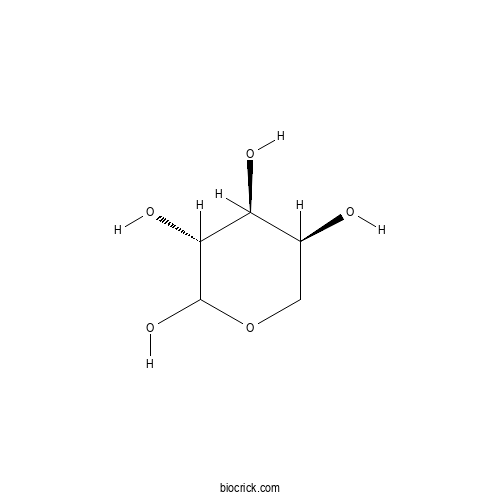
| Cas No. | 5328-37-0 | SDF | File under preparation. |
| PubChem ID | 439195.0 | Appearance | Powder |
| Formula | C5H10O5 | M.Wt | 150.1 |
| Type of Compound | N/A | Storage | Desiccate at -20°C |
| Solubility | Soluble in Chloroform,Dichloromethane,Ethyl Acetate,DMSO,Acetone,etc. | ||
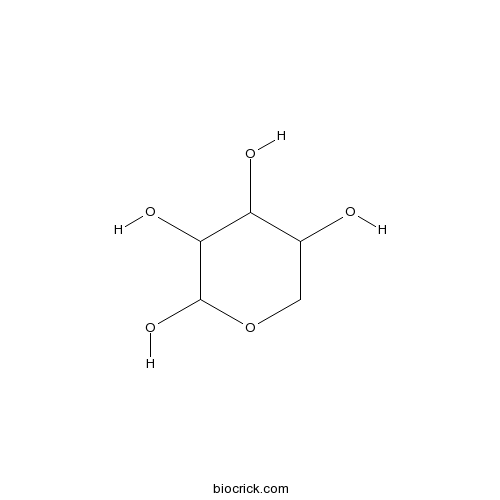
| Chemical Name | (3R,4S,5S)-oxane-2,3,4,5-tetrol | ||
| SMILES | C1C(C(C(C(O1)O)O)O)O | ||
| Standard InChIKey | SRBFZHDQGSBBOR-HWQSCIPKSA-N | ||
| Standard InChI | InChI=1S/C5H10O5/c6-2-1-10-5(9)4(8)3(2)7/h2-9H,1H2/t2-,3-,4+,5?/m0/s1 | ||
| General tips | For obtaining a higher solubility , please warm the tube at 37 ℃ and shake it in the ultrasonic bath for a while.Stock solution can be stored below -20℃ for several months. We recommend that you prepare and use the solution on the same day. However, if the test schedule requires, the stock solutions can be prepared in advance, and the stock solution must be sealed and stored below -20℃. In general, the stock solution can be kept for several months. Before use, we recommend that you leave the vial at room temperature for at least an hour before opening it. |
||
| About Packaging | 1. The packaging of the product may be reversed during transportation, cause the high purity compounds to adhere to the neck or cap of the vial.Take the vail out of its packaging and shake gently until the compounds fall to the bottom of the vial. 2. For liquid products, please centrifuge at 500xg to gather the liquid to the bottom of the vial. 3. Try to avoid loss or contamination during the experiment. |
||
| Shipping Condition | Packaging according to customer requirements(5mg, 10mg, 20mg and more). Ship via FedEx, DHL, UPS, EMS or other couriers with RT, or blue ice upon request. | ||
Quality Control & MSDS
3D structure
Package In Stock

Number of papers citing our products


L-Arabinose Dilution Calculator
L-Arabinose Molarity Calculator

| 1 mg | 5 mg | 10 mg | 20 mg | 25 mg | |
| 1 mM | 6.6622 mL | 33.3111 mL | 66.6223 mL | 133.2445 mL | 166.5556 mL |
| 5 mM | 1.3324 mL | 6.6622 mL | 13.3245 mL | 26.6489 mL | 33.3111 mL |
| 10 mM | 0.6662 mL | 3.3311 mL | 6.6622 mL | 13.3245 mL | 16.6556 mL |
| 50 mM | 0.1332 mL | 0.6662 mL | 1.3324 mL | 2.6649 mL | 3.3311 mL |
| 100 mM | 0.0666 mL | 0.3331 mL | 0.6662 mL | 1.3324 mL | 1.6656 mL |
| * Note: If you are in the process of experiment, it's necessary to make the dilution ratios of the samples. The dilution data above is only for reference. Normally, it's can get a better solubility within lower of Concentrations. | |||||
- Norcantharidin
Catalog No.:BCX2331
CAS No.:29745-04-8
- Dopamine
Catalog No.:BCX2330
CAS No.:51-61-6
- L-Ornithine
Catalog No.:BCX2329
CAS No.:70-26-8
- Putrescine
Catalog No.:BCX2328
CAS No.:110-60-1
- 3-Methyl-1-(3-methylfuran-2-yl)but-3-en-1-one
Catalog No.:BCX2327
CAS No.:78173-38-3
- Sorocein H
Catalog No.:BCX2326
CAS No.:157382-82-6
- Cathayanin B
Catalog No.:BCX2325
CAS No.:330195-60-3
- Taurodeoxycholic acid
Catalog No.:BCX2324
CAS No.:516-50-7
- Cathayanin C
Catalog No.:BCX2323
CAS No.:330195-61-4
- Spilanthol
Catalog No.:BCX2322
CAS No.:25394-57-4
- Naringenin chalcone
Catalog No.:BCX2321
CAS No.:73692-50-9
- Glutathione disulfide
Catalog No.:BCX2320
CAS No.:27025-41-8
- L-Galactose
Catalog No.:BCX2333
CAS No.:15572-79-9
- L-Mannose
Catalog No.:BCX2334
CAS No.:10030-80-5
- 5-Methoxytryptamine
Catalog No.:BCX2335
CAS No.:608-07-1
- Doxofylline
Catalog No.:BCX2336
CAS No.:69975-86-6
- Turanose
Catalog No.:BCX2337
CAS No.:547-25-1
- 3-Methyl-4-isopropylphenol
Catalog No.:BCX2338
CAS No.:3228-02-2
- 3-Amino-3-(3,4-dimethoxyphenyl)propionic acid
Catalog No.:BCX2339
CAS No.:54160-63-3
- Guanidinoacetic acid
Catalog No.:BCX2340
CAS No.:352-97-6
- 6-Hydroxyflavanone
Catalog No.:BCX2341
CAS No.:190831-08-4
- D-Glucuronic acid
Catalog No.:BCX2342
CAS No.:6556-12-3
- Bryodulcosigenin
Catalog No.:BCX2343
CAS No.:88930-16-9
- Lactose
Catalog No.:BCX2344
CAS No.:63-42-3
Thermal adaptation of Lactiplantibacillus plantarum by laboratory evolution does not enhance tagatose biosynthesis.[Pubmed:42799668]
Lett Appl Microbiol. 2026 Sep 26:ovag084.
D-Tagatose is recognized as a promising sugar alternative, but its biosynthesis is limited by poor thermodynamics of isomerization from D-galactose. Higher reaction temperatures favor tagatose production, but microbial whole cell conversion is limited by viability of cells at elevated temperatures. This work attempts to address this by engineering Lactiplantibacillus plantarum for growth at elevated temperatures towards development of a high-temperature galactose to tagatose isomerization biocatalytic system. Using adaptive laboratory evolution (ALE), a strain capable of growth at 43 degrees C was isolated over 85 passages of increasing thermal stress. The adaptation required using a cycling approach, where cultures were cultured at permissive (37 degrees C) between growth at elevated temperatures. At passage #85, the cells were able to grow at 43 degrees C over multiple passages, indicating complete adaptation. They were also able to grow well at 37 degrees C. Unfortunately, galactose to tagatose conversion reaction at 37, 50, and 60 degrees C using an L-Arabinose isomerase transformed strain revealed no benefit of using the evolved strain over the parental strain. Nevertheless, the ALE protocol and isolated strain may be of benefit for other applications.
Advances in the Production of D-Tagatose Using L-Arabinose Isomerase.[Pubmed:42795665]
Microorganisms. 2026 Sep 17;14(9):2085.
D-tagatose is a rare sugar that occurs naturally and combines high sweetness with a low caloric value. It has several beneficial effects, including anticariogenic activity, modulation of the intestinal microbiota, and potential benefits for diabetes management. It is used as a novel sweetener and pharmaceutical excipient in the food and pharmaceutical industries. Currently, D-tagatose is produced mainly through chemical synthesis and biocatalysis. The chemical preparation of D-tagatose requires complex product purification and entails high waste-treatment costs, while biological preparation of D-tagatose offers high catalytic efficiency, mild reaction conditions, and fewer by-products. Therefore, in recent years, the biocatalytic conversion of D-galactose into D-tagatose using L-Arabinose isomerase (L-AI) has attracted considerable attention, prompting extensive efforts to develop more economical and environmentally friendly production methods. To date, L-AI from various microbial sources has been identified and characterized, and researchers have engineered L-AI into a more effective biocatalyst through mutagenesis to improve process feasibility. This paper comprehensively reviews the current status and the latest advancements in the synthesis of D-tagatose from the perspective of biocatalysis.

Calcutta University

University of Minnesota

University of Maryland School of Medicine

University of Illinois at Chicago

The Ohio State University

University of Zurich

Harvard University

Colorado State University

Auburn University

Yale University

Worcester Polytechnic Institute

Washington State University

Stanford University

University of Leipzig

Universidade da Beira Interior

The Institute of Cancer Research

Heidelberg University

University of Amsterdam

University of Auckland

TsingHua University

The University of Michigan

Miami University

DRURY University

Jilin University

Fudan University

Wuhan University

Sun Yat-sen University

Universite de Paris

Deemed University

Auckland University

The University of Tokyo

Korea University



