
DoxofyllineCAS# 69975-86-6 |
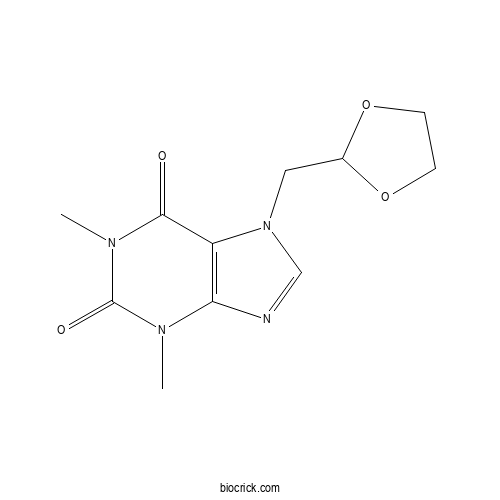
| Cas No. | 69975-86-6 | SDF | File under preparation. |
| PubChem ID | 50942.0 | Appearance | Powder |
| Formula | C11H14N4O4 | M.Wt | 266.2 |
| Type of Compound | N/A | Storage | Desiccate at -20°C |
| Solubility | Soluble in Chloroform,Dichloromethane,Ethyl Acetate,DMSO,Acetone,etc. | ||
| Chemical Name | 7-(1,3-dioxolan-2-ylmethyl)-1,3-dimethylpurine-2,6-dione | ||
| SMILES | CN1C2=C(C(=O)N(C1=O)C)N(C=N2)CC3OCCO3 | ||
| Standard InChIKey | HWXIGFIVGWUZAO-UHFFFAOYSA-N | ||
| Standard InChI | InChI=1S/C11H14N4O4/c1-13-9-8(10(16)14(2)11(13)17)15(6-12-9)5-7-18-3-4-19-7/h6-7H,3-5H2,1-2H3 | ||
| General tips | For obtaining a higher solubility , please warm the tube at 37 ℃ and shake it in the ultrasonic bath for a while.Stock solution can be stored below -20℃ for several months. We recommend that you prepare and use the solution on the same day. However, if the test schedule requires, the stock solutions can be prepared in advance, and the stock solution must be sealed and stored below -20℃. In general, the stock solution can be kept for several months. Before use, we recommend that you leave the vial at room temperature for at least an hour before opening it. |
||
| About Packaging | 1. The packaging of the product may be reversed during transportation, cause the high purity compounds to adhere to the neck or cap of the vial.Take the vail out of its packaging and shake gently until the compounds fall to the bottom of the vial. 2. For liquid products, please centrifuge at 500xg to gather the liquid to the bottom of the vial. 3. Try to avoid loss or contamination during the experiment. |
||
| Shipping Condition | Packaging according to customer requirements(5mg, 10mg, 20mg and more). Ship via FedEx, DHL, UPS, EMS or other couriers with RT, or blue ice upon request. | ||
Quality Control & MSDS
3D structure
Package In Stock

Number of papers citing our products


Doxofylline Dilution Calculator
Doxofylline Molarity Calculator
| 1 mg | 5 mg | 10 mg | 20 mg | 25 mg | |
| 1 mM | 3.7566 mL | 18.7829 mL | 37.5657 mL | 75.1315 mL | 93.9144 mL |
| 5 mM | 0.7513 mL | 3.7566 mL | 7.5131 mL | 15.0263 mL | 18.7829 mL |
| 10 mM | 0.3757 mL | 1.8783 mL | 3.7566 mL | 7.5131 mL | 9.3914 mL |
| 50 mM | 0.0751 mL | 0.3757 mL | 0.7513 mL | 1.5026 mL | 1.8783 mL |
| 100 mM | 0.0376 mL | 0.1878 mL | 0.3757 mL | 0.7513 mL | 0.9391 mL |
| * Note: If you are in the process of experiment, it's necessary to make the dilution ratios of the samples. The dilution data above is only for reference. Normally, it's can get a better solubility within lower of Concentrations. | |||||
- 5-Methoxytryptamine
Catalog No.:BCX2335
CAS No.:608-07-1
- L-Mannose
Catalog No.:BCX2334
CAS No.:10030-80-5
- L-Galactose
Catalog No.:BCX2333
CAS No.:15572-79-9
- L-Arabinose
Catalog No.:BCX2332
CAS No.:5328-37-0
- Norcantharidin
Catalog No.:BCX2331
CAS No.:29745-04-8
- Dopamine
Catalog No.:BCX2330
CAS No.:51-61-6
- L-Ornithine
Catalog No.:BCX2329
CAS No.:70-26-8
- Putrescine
Catalog No.:BCX2328
CAS No.:110-60-1
- 3-Methyl-1-(3-methylfuran-2-yl)but-3-en-1-one
Catalog No.:BCX2327
CAS No.:78173-38-3
- Sorocein H
Catalog No.:BCX2326
CAS No.:157382-82-6
- Cathayanin B
Catalog No.:BCX2325
CAS No.:330195-60-3
- Taurodeoxycholic acid
Catalog No.:BCX2324
CAS No.:516-50-7
- Turanose
Catalog No.:BCX2337
CAS No.:547-25-1
- 3-Methyl-4-isopropylphenol
Catalog No.:BCX2338
CAS No.:3228-02-2
- 3-Amino-3-(3,4-dimethoxyphenyl)propionic acid
Catalog No.:BCX2339
CAS No.:54160-63-3
- Guanidinoacetic acid
Catalog No.:BCX2340
CAS No.:352-97-6
- 6-Hydroxyflavanone
Catalog No.:BCX2341
CAS No.:190831-08-4
- D-Glucuronic acid
Catalog No.:BCX2342
CAS No.:6556-12-3
- Bryodulcosigenin
Catalog No.:BCX2343
CAS No.:88930-16-9
- Lactose
Catalog No.:BCX2344
CAS No.:63-42-3
- Acridone
Catalog No.:BCX2345
CAS No.:578-95-0
- Caffealdehyde
Catalog No.:BCX2346
CAS No.:141632-15-7
- (+)-Licarin B
Catalog No.:BCX2347
CAS No.:42016-15-9
- Pyridoxal phosphate
Catalog No.:BCX2348
CAS No.:54-47-7
Pharmacokinetic interaction between evodiamine and doxofylline in rats.[Pubmed:42436632]
Pak J Pharm Sci. 2026 Sep;39(9):2757-2766.
BACKGROUND: Doxofylline (DFL) is a medication widely employed in the management of asthma and chronic obstructive pulmonary disease. Evodiamine (EVO), a bioactive alkaloid from traditional Chinese medicine (TCM), is commonly utilized for treating hypertension, gastropathy, and eczema. Cytochrome P450 enzymes primarily mediate the metabolism of both pharmaceuticals and TCMs in-vivo, which potentially lead to drug-drug interactions. OBJECTIVES: This study aimed to investigate the effects of oral EVO on the pharmacokinetics (PK) of DFL and its metabolite, theophylline (TPL), in rats. METHODS: Twelve rats were randomly assigned to control and experimental groups. The experimental group received 50 mg/kg EVO orally once daily for one week, while the control group received 0.5% sodium carboxymethyl cellulose. On day 7, DFL (80 mg/kg) was administered 2 h post-treatment. Venous blood specimens were collected from the retro-orbital venous plexus at 0.1667, 0.5, 1, 1.5, 2, 3, 4, 6, 8, 12, 24 and 48 h post-dose. Plasma concentrations of DFL and TPL were analyzed by liquid chromatography-tandem mass spectrometry (LC-MS/MS). RESULTS: Compared with the control group, the experimental group showed significant alterations in several PK parameters for both DFL and TPL. The administration of EVO markedly increased MRT((0-infinity)), MRT((0-t)), VRT((0-infinity)), VRT((0-t)), t(1/2z), and Vz/F for DFL while also enhancing CLz/F and Vz/F for TPL. Conversely, EVO notably decreased AUC((0-infinity)), AUC((0-t)), and MRT((0-t)) values associated with TPL. CONCLUSION: Concomitant administration of EVO alongside DFL resulted in substantial modifications to key PK parameters concerning both DFL and its metabolite TPL in rats. Specifically, EVO prolonged the retention time and increased the volume of distribution of DFL, while simultaneously reducing the bioavailability and accelerating the clearance of TPL (P<0.05). Therefore, it is imperative to closely monitor the impact of TCM EVO on the PKs of DFL and TPL in experimental animals, necessitating further research and clinical observation.
Effective Component Compatibility of Bufei Yishen Formula III Alleviates Pulmonary Vascular Inflammation in COPD: Via VEGF(165)/P38 MAPK Pathway.[Pubmed:41867466]
J Inflamm Res. 2026 Jan 23;19:523270.
PURPOSE: Chronic inflammation of the lungs can affect pulmonary vascular remodeling in chronic obstructive pulmonary disease (COPD). The Bufei Yishen formula (BYF) and Effective-compound combination of BYF III (ECC-BYF III) ameliorate lung histopathological injury and remodeling, but the mechanism remains unclear. This study aimed to observe the effects of ECC-BYF III on pulmonary vascular inflammation in COPD and to elucidate its detailed mechanism. METHODS: In vivo, COPD rat model was established through cigarette smoke exposure (CSE) combined with repeated infections of Klebsiella pneumoniae. Rats were randomly treated with ECC-BYF III (5.5 mg/kg, once a day) or Doxofylline (36 mg/kg, once a day) for eight weeks. In vitro, Human umbilical vein endothelial cells (HUVECs) and human monocyte leukemia cells (THP-1) were induced with 10 mug/mL LPS for 24h. The pulmonary function, histopathology, inflammatory factor levels, immunoblotting results were evaluated. RESULTS: Compared with the model group, ECC-BYF III significantly improved the lung function, alleviated pulmonary artery inflammation and relieved pulmonary vascular remodeling in COPD rats. At the molecular level, ECC-BYF III down-regulated VEGF(165)/P38 MAPK signaling pathway. In the inflammatory model of HUVEC induced by LPS, 35 and 70mug/mL ECC-BYF III significantly decreased the levels of tumor necrosis factor -alpha (TNF-alpha), interleukin-1beta (IL-1beta) and Endothelin-1 (ET-1) mRNA, and increased the expression of endothelial nitric oxide synthase (eNOS) mRNA. In addition, ECC-BYF III also inhibited VEGF(165)/P38 MAPK pathway in LPS-induced HUVEC and THP-1/HUVEC co-cultured inflammatory models. CONCLUSION: Our findings demonstrate that ECC-BYF III can improve pulmonary vascular remodeling in COPD rats, and its key pharmacodynamic mechanism involves the inhibition of the VEGF(165)/P38 MAPK pathway, thereby reducing inflammatory infiltration.
Investigating the therapeutic mechanism of Bufei Decoction in COPD: Schisandrin B targets the TLR4/NF-kappaB/JAK-STAT signaling pathway.[Pubmed:41456077]
Hereditas. 2025 Dec 27;163(1):17.
OBJECTIVE: Evaluate Bufei Decoction effects on chronic obstructive pulmonary disease (COPD) and elucidate Schisandrin B (Sch B) mechanism via TLR4 pathway. METHODS: COPD was induced in rats using LPS/cigarette smoke. Effects of low, medium, high-dose Bufei Decoction and Doxofylline were assessed on lung pathology, function, blood gases, and inflammation. Sch B role was investigated via network pharmacology (identifying active components/targets), molecular docking (schisandrin B-TLR4 binding), and in vivo validation. RESULTS: Bufei Decoction dose-dependently ameliorated COPD-induced lung injury, improved pulmonary function/blood gases, and reduced inflammation (high-dose most effective). Network pharmacology identified 241 Bufei Decoction components (including Sch B) targeting core molecules (TLR4, JAK1, STAT3). Molecular docking confirmed strong Sch B-TLR4 binding. Functional analysis implicated immune/inflammatory pathways. In vivo experiments showed that Sch B dose-dependently alleviated lung injury, improved pulmonary function, reduced the levels of inflammatory markers, and inhibited the M1/M2 macrophage ratio as well as the expression of proteins related to the NF-kappaB/JAK-STAT signaling pathway. Crucially, TLR4 knockdown reversed Sch B's protective effects, worsening injury and inflammation. CONCLUSIONS: Bufei Decoction treats COPD through multi-component synergy. Sch B is a key active component, exerting therapeutic effects by targeting TLR4 to regulate macrophage polarization and inhibit the NF-kappaB/JAK-STAT signaling pathway, thereby improving lung function and reducing inflammation.
Comparative effects of respiratory stimulants in mechanically ventilated patients: a network meta-analysis of randomized controlled trials.[Pubmed:41298796]
Sci Rep. 2025 Nov 26;15(1):45409.
Mechanical ventilation (MV) is a cornerstone of supportive care in intensive care units (ICUs), but prolonged ventilation is associated with adverse outcomes. Several pharmacologic agents with respiratory stimulants have been investigated to facilitate weaning and improve clinical outcomes; yet no comprehensive comparison across available agents exists. This network meta-analysis (NMA) aimed to compare and rank available interventions in adult patients receiving MV. A systematic search of PubMed, Web of Science, and Scopus (up to November 10, 2023) identified 15 randomized controlled trials (1,528 participants) evaluating ten respiratory stimulants in mechanically ventilated critically ill adults: Almitrine Bismesylate (AB), Doxofylline (DX), Progesterone (PRG), Acetazolamide (ACZT), Growth Hormone (GH), Oxandrolone (OXA), Nandrolone (NA), Caffeine (CAF), Donepezil (DPZ), and a multi-agent adjuvant therapeutic (AT) regimen containing anisodamine. Data were analyzed using a frequentist network meta-analysis with treatment rankings based on SUCRA values. Risk of bias was assessed using the modified Cochrane RoB 2 tool. No pharmacologic intervention significantly reduced hospital or ICU mortality, duration of mechanical ventilation, or time to successful weaning compared with placebo. According to SUCRA rankings, NA, OXA, and PRG had the highest probabilities of reducing hospital mortality, with NA also associated with shorter ICU and hospital stays. DPZ and PRG significantly shortened weaning duration, while GH showed the greatest reduction in mechanical ventilation duration. GH, PRG, and DPZ had the highest likelihood of successful weaning. Heterogeneity and inconsistency were generally low, except for the duration of mechanical ventilation (I(2) = 86.2%, p < 0.001). No pharmacologic intervention significantly reduced hospital mortality. However, agents such as NA, GH, and DPZ may help shorten ICU stay, reduce duration of mechanical ventilation, or improve weaning efficiency. These findings underscore the potential value of multi-agent adjuvant approaches and highlight the need for larger, high-quality trials to confirm their clinical benefits.Trial registration: CRD42023454122 (18/10/2023).
Potential of doxofylline in the treatment of chronic obstructive airway diseases (Review).[Pubmed:41089433]
Biomed Rep. 2025 Sep 22;23(5):182.
Doxofylline, a xanthine derivative introduced in 1987, was developed as an alternative to theophylline for the treatment of chronic respiratory disease, including chronic obstructive pulmonary disease and bronchial asthma, but also a promising agent with therapeutic potential, unique pharmacological profile, improved safety and tolerability, potential to decrease corticosteroid dependence and applicability in diverse healthcare settings, including resource-limited environments. The present review examines the utility of Doxofylline as an effective bronchodilator, highlighting its improved tolerability profile, minimal drug interactions and distinct pharmacological activities, including its roles as a phosphodiesterase inhibitor, adenosine receptor antagonist and beta-adrenergic receptor agonist, alongside its bronchodilator, antitussive and anti-inflammatory properties. The present review performed a comprehensive analysis of literature and a comparative evaluation of relevant clinical trials. By contrast with theophylline, whose clinical use has diminished due to its narrow therapeutic window and notable side effects, Doxofylline demonstrates a more favorable safety profile and wider therapeutic range. Doxofylline not only enhances spirometric values and reduces the need for salbutamol administration but also exhibits fewer adverse effects, contributing to improved patient tolerance and adherence to treatment. Clinical findings further suggest significant improvements in lung function, exercise capacity and quality of life among patients treated with Doxofylline. These results underscore its potential as a viable long-term therapeutic option, particularly in resource-limited settings, where it may reduce corticosteroid dependency and provide an effective, affordable and safer alternative to theophylline.
A validated method for the determination of doxofylline and its pharmacokinetic application in healthy volunteers.[Pubmed:40735826]
Bioanalysis. 2025 Jul;17(13):847-855.
BACKGROUND: Current HPLC-based methods for Doxofylline analysis lack speed and precision. A rapid, specific, and sensitive UPLC-MS/MS method was developed for the determination of Doxofylline in this study. RESEARCH DESIGN AND METHODS: This method was fully validated and doxophylline-d4 was used as an internal standard. A Kinetex-C18 column (EVO 100A, 50 x 2.1 mm, 5 mum) was used for the separation procedure, with mobile phases consisting of 0.3% formic acid (A) and 90% acetonitrile solution with 0.3% formic acid (B). The total runtime of the gradient elution procedure was 2.6 minutes. The mass spectrometry analysis was carried out employing a multiple reaction monitoring model and using the transitions of m/z 267.000-->181.000 for Doxofylline and m/z 271.200-->181.100 for the internal standard. RESULTS: The linear range of detection for doxophylline was between 20.0 to 16,000 ng/mL. The intra-batch accuracy deviations of each concentration level ranged from -8.0% to 2.5%, while the intra-batch precisions ranged from 1.3% to 9.0%. And the inter-batch accuracy deviations were -5.8% ~0.8%, while the inter-batch precisions were 2.2% ~7.0%. CONCLUSIONS: This method was applied to pharmacokinetic clinical trials of single oral administration of doxophylline tablets successfully. CLINICAL TRIAL REGISTRATION: www.clinicaltrials.gov identifier is CTR20240006 and CTR20233665.
Effects of Oral Doxofylline and Procaterol on Chronic Obstructive Pulmonary Disease: A Randomized Crossover Study.[Pubmed:40407544]
Med Sci (Basel). 2025 Apr 29;13(2):49.
Background: Oral bronchodilators may serve as an adjunctive therapy in patients with chronic obstructive pulmonary disease (COPD). This study aimed to evaluate the effects of oral Doxofylline and oral procaterol on lung function and clinical symptoms in COPD patients. Methods: A crossover randomized controlled trial was conducted in patients with clinically stable COPD. Participants first received either Doxofylline or procaterol for 4 weeks, followed by a 1-week washout period. Assessments included the modified Medical Research Council (mMRC) dyspnea scale, COPD assessment test (CAT) scores, and 6-minute walking distance (6MWD). Pulmonary function was evaluated using spirometry with bronchodilator (BD) testing and all adverse events were recorded. Results: Twenty patients were randomly assigned to begin treatment with either Doxofylline or procaterol. Their mean age was 71.7 +/- 9.4 years. After four weeks of treatment, the Doxofylline group showed significantly greater improvement in pulmonary function parameters (post-BD peak expiratory flow and post-BD forced expiratory flow 25-75) compared to the procaterol group. However, there were no significant differences in mMRC scores, CAT scores, or 6MWD between the two groups. More neurological adverse events were observed in the Doxofylline group compared to the procaterol group (35% vs. 5%, p = 0.044). Conclusions: Doxofylline improved pulmonary function in COPD patients but did not provide superior functional performance compared to procaterol. Neurological adverse events were more frequently associated with Doxofylline. Doxofylline may serve as an adjunctive therapy to enhance pulmonary function in COPD patients, but caution is advised due to its potential side effects.
A non-toxigenic Corynebacterium diphtheriae biovar Belfanti isolated from a patient with rheumatoid arthritis in China: Insights from a comprehensive genome-based analysis.[Pubmed:40388766]
Medicine (Baltimore). 2025 May 16;104(20):e42467.
RATIONALE: Diphtheria is caused by infection with Corynebacterium diphtheriae and is typically associated with upper respiratory tract involvement, which can manifest with high invasiveness. However, in recent years, non-toxigenic C diphtheriae strains have increasingly emerged as major pathogens responsible for invasive diseases. The uniqueness of this case lies in the challenges of culturing and identifying the bacterial strain, its atypical upper respiratory tract manifestations (which are easily overlooked clinically), and its potential for covert transmission, all of which warrant heightened clinical attention. PATIENT CONCERNS: A 71-year-old female patient with rheumatoid arthritis presented to the respiratory department of cough with shortness of breath for >2 months. DIAGNOSES: Pulmonary infections caused by Proteus vulgaris and C diphtheriae biovar Belfanti, and pulmonary interstitial fibrosis. INTERVENTIONS: The patient received intravenous infusion of cefoperazone sodium and sulbactam sodium. Concurrently, Doxofylline was prescribed. The patient continued to receive aerosol inhalation of Budesonide Suspension for Inhalation and levosalbutamol hydrochloride. OUTCOMES: The patient had improved chest tightness and shortness of breath, no other special discomfort, and stable vital signs after physical examination. LESSONS: C diphtheriae biovar Belfanti strain was isolated. The strain can't decompose nitrate, no virulence gene and drug-resistance gene, but it has strong transposing ability and infection ability, and has the possibility of transforming into a pathogenic strain, which needs to be concerned.
Development of a rapid method for the simultaneous determination of aminophylline, doxofylline, bromhexine, and ambroxol by HPLC.[Pubmed:39492710]
Sci Prog. 2024 Oct-Dec;107(4):368504241296305.
Introduction: Antitussive and expectorant drugs such as aminophylline (APL), Doxofylline (DXL), bromhexine hydrochloride (BXH), and ambroxol hydrochloride (AXH), either individually or in combination, are widely used in the prevention and treatment of respiratory diseases. The study aimed to establish a high-performance liquid chromatography (HPLC) method for the simultaneous determination of these four drugs and to investigate their stability in 0.9% sodium chloride injection or 5% glucose injection over 48 hours. Methods: An InertSustain C(18) column (150 mm x 4.6 mm, 5 mum) was used. The mobile phase consisted of acetonitrile and 50 mmol.L(-1) potassium dihydrogen phosphate solution (pH 4.0) with gradient elution. The flow rate was 0.8 mL.min(-1), and the column temperature was maintained at 30 degrees C. The stability of APL, DXL, BXH, and AXH in 0.9% sodium chloride and 5% glucose injections over 48 h was determined using HPLC. Results: APL, DXL, BXH, and AXH showed good linearity within the ranges of 0.01 to 0.20, 0.003-0.06, 0.015-0.30, and 0.016-0.16 mg.mL(-1), respectively (r > 0.999). The intraday and interday relative standard deviations were <2%, with recovery rates between 98.4% and 102.2%. The four drugs remained colorless and clear in infusion mixtures. The pH value fluctuated within +/-0.3 over 48 hours, and the relative percentage content of the drugs ranged from 95.0% to 105.0%. Conclusion: The established HPLC method is simple, reliable, and stable, allowing for the simultaneous determination of the four antitussive and expectorant drugs. APL, DXL, BXH, and AXH were stable within 48 hours when mixed with 0.9% sodium chloride and 5% glucose injections.
Efficacy and safety profile of doxofylline in asthma: a meta-analysis.[Pubmed:39264111]
J Asthma. 2025 Feb;62(2):205-215.
OBJECTIVE: This work aims to explore the effectiveness and safety of Doxofylline in asthma treatment. DATA SOURCES: Relevant studies published before March 2023 were retrieved from EMBASE, Cochrane Library, PubMed, and Web of Science databases. STUDY SELECTIONS: Risk of Bias tool (RoB 2) was applied to determine the quality of randomized controlled trials (RCTs). Relative risks (RR, 95% confidence intervals [CI]) and weighted mean differences (WMD, 95% CI) were calculated for dichotomous and continuous outcomes, respectively, under fixed or random-effects models. RESULTS: A total of eight clinical trials comprising 1627 patients were analyzed. The meta-analysis revealed no notable change in forced expiratory volume in 1 s (FEV1) (WMD = 0.48; 95% CI: -2.09 to 3.05), the use of albuterol as a rescue medication (WMD = -0.02; 95% CI: -0.57 to 0.52), forced vital capacity (FVC) (WMD = 0.19; 95% CI: -0.28 to 0.67) and FEV1 predicted value (WMD = 1.53; 95%CI: -0.88 to 3.94) between Doxofylline and control groups. However, Doxofylline treatment significantly reduced adverse reactions (RR = 0.71; 95% CI: 0.60 to 0.84) and decreased the incidence of asthma events (WMD = -0.18; 95% CI: -0.33 to 0.03). Subgroup analysis results indicated that the improvement in FEV1 with Doxofylline combined with budesonide was superior to that of budesonide combined with montelukast or tiotropium but inferior to that of budesonide plus formoterol combination. CONCLUSION: Doxofylline treatment significantly reduces the risk of asthma events and adverse events (AEs), demonstrating good safety and longer-term benefits.
Role of Doxofylline, Low Dose Theophylline, and Dexamethasone in Mice (BALB/C) Model of Corticosteroid Resistant Asthma: A Comparative Study.[Pubmed:39048174]
Ann Clin Lab Sci. 2024 May;54(3):313-325.
OBJECTIVE: This study was designed to determine the comparative efficacy of Doxofylline (DOXO) compared to low-dose theophylline (LDT) in treating corticosteroid-resistant asthma. METHODS: This study was conducted on 56 adult BALB/C mice aged six to eight weeks old with an average weight of 20-25 g. They were divided into seven groups: control group, ovalbumin (OVA)+lipopolysaccharide (LPS) group, OVA+LPS+dexamethasone (DEXA) group, OVA+LPS+LDT group, OVA+LPS+ group, OVA+LPS+DEXA+LDT group, and OVA +LPS+DEXA+DOXO group. All mice were administered IP DOXO+DEXA. All the doses were administrated one day before the first challenge and lasted for five consecutive days after one hour of the OVA challenge until sacrificed. Lung biochemical parameters, including interleukin (IL)-2, IL-4, IL-8, IL-10, and IL-17 levels, were measured using enzyme-linked immunosorbent assay (ELISA). In addition, Histone deacetylase (HDAC) activity and lung histological analysis were also performed. Furthermore, the glucocorticoid receptor was measured by nexttec. RESULTS: The OVA+LPS group exhibited significantly (p<0.05) elevated levels of interleukin (IL)-2, IL-4, IL-8, IL-10, and IL-17 compared to controls, indicative of airway inflammation. Moreover, OVA+LPS induction significantly (p<0.05) increased the levels of Interferon-gamma (IFN-gamma), NF[Formula: see text]B, Tumor Necrosis Factor (TNFalpha), and Immunoglobulin E (IgE) parameters, indicating severe inflammation and immune response and successfully induced the disease model. Meanwhile, LDT and DOXO in conjunction with DEXA, further augmented HDAC2 activity compared to DEXA alone. Similarly, the administration of LDT increased the expression of GR by 64.5% (23.72+/-0.34), while DOXO increased the expression of GR by 94.10% (27.99+/-0.15), which restores it back to control. Furthermore, according to Hematoxylin and eosin (H&E) stained sections, the DOXO group exhibited a slight improvement in these histopathological features, suggesting a modest therapeutic effect. Masson's Trichrome staining showed a slightly improved patchy collagen deposition within alveolar spaces in intra-alveolar and interstitial inflammatory cell accumulation in DOXO group, and the combination of these drugs (DEXA+LDT group) improved collagen deposition moderately within alveolar spaces in intra-alveolar and interstitial inflammatory cell accumulation. Overall, treatment with DOXO, LDT alone, and with DEXA combination led to reductions in cytokine levels, with DOXO and LDT showing significant (p<0.05) efficacy to DEXA used alone, which showed non-significant (p>0.05) efficacy. CONCLUSIONS: Doxofylline and LDT were found to be effective therapeutic agents when used alone or in combination with Dexamethasone. However, randomized controlled trials are required to evaluate its further efficacy.
Assessment of Bitterness in Non-Charged Pharmaceuticals with a Taste Sensor: A Study on Substances with Xanthine Scaffold and Allopurinol.[Pubmed:38893328]
Molecules. 2024 May 23;29(11):2452.
Taste sensors with an allostery approach have been studied to detect non-charged bitter substances, such as xanthine derivatives, used in foods (e.g., caffeine) or pharmaceuticals (e.g., etofylline). In this study, the authors modified a taste sensor with 3-bromo-2,6-dihydroxybenzoic acid and used it in conjunction with sensory tests to assess the bitterness of non-charged pharmaceuticals with xanthine scaffolds (i.e., acefylline and Doxofylline), as well as allopurinol, an analogue of hypoxanthine. The results show that the sensor was able to differentiate between different levels of sample bitterness. For instance, when assessing a 30 mM sample solution, the sensor response to acefylline was 34.24 mV, which corresponded to the highest level of bitterness (tau = 3.50), while the response to allopurinol was lowest at 2.72 mV, corresponding to relatively weaker bitterness (tau = 0.50). Additionally, this study extended the application of the sensor to detect pentoxifylline, an active pharmaceutical ingredient in pediatric medicines. These results underscore the taste sensor's value as an additional tool for early-stage assessment and prediction of bitterness in non-charged pharmaceuticals.
A narrative review of theophylline: is there still a place for an old friend?[Pubmed:38883616]
J Thorac Dis. 2024 May 31;16(5):3450-3460.
BACKGROUND AND OBJECTIVE: Theophylline has been used for decades in human medicine for its psychostimulant, anti-inflammatory, and bronchodilator effects. Historically, in pulmonary medicine, theophylline has been used in the treatment of obstructive pulmonary diseases such as bronchial asthma (BA) or chronic obstructive pulmonary disease (COPD). This review aims to determine whether theophylline still has its place in the therapy of obstructive pulmonary diseases or whether we can even extend its use to other diagnoses such as atropine-resistant cardiac arrests, apnea of prematurity, or others. Moreover, we also aim to determine if there is a rationale for using low-dose theophylline due to its immunomodulatory and anti-inflammatory effect, or if the future of methylxanthines lies in newly synthesized derivates of theophylline such as bamifylline, or Doxofylline. METHODS: The narrative review is based on a literature search of the articles indexed in the PubMed database in 2023. We searched the database since the year 2009 using the MeSH terms "theophylline", "aminophylline", and "methylxanthines" and we included original articles in the English language. KEY CONTENT AND FINDINGS: Theophylline has a number of adverse drug reactions (ADRs), the most serious of which is its effect on the cardiovascular system. It can cause severe arrhythmias or even cardiac arrest when overdosed. On the other hand, there is still a substantial amount of its applications in current clinical practice. CONCLUSIONS: There is considerable controversy associated with its use in current medicine, which can be attributed both to its narrow therapeutic range and its mentioned cardiotoxic effect. Herein, we summarize the current state-of-art of theophylline and its use in human medicine.

Calcutta University

University of Minnesota

University of Maryland School of Medicine

University of Illinois at Chicago

The Ohio State University

University of Zurich

Harvard University

Colorado State University

Auburn University

Yale University

Worcester Polytechnic Institute

Washington State University

Stanford University

University of Leipzig

Universidade da Beira Interior

The Institute of Cancer Research

Heidelberg University

University of Amsterdam

University of Auckland

TsingHua University

The University of Michigan

Miami University

DRURY University

Jilin University

Fudan University

Wuhan University

Sun Yat-sen University

Universite de Paris

Deemed University

Auckland University

The University of Tokyo

Korea University



