
3-Methyl-4-isopropylphenolCAS# 3228-02-2 |
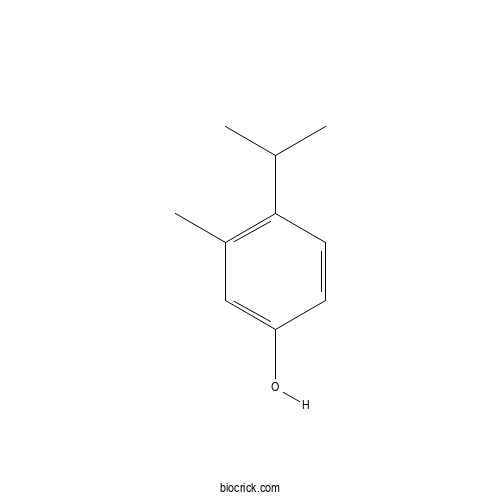
| Cas No. | 3228-02-2 | SDF | File under preparation. |
| PubChem ID | 18597.0 | Appearance | Powder |
| Formula | C10H14O | M.Wt | 150.2 |
| Type of Compound | N/A | Storage | Desiccate at -20°C |
| Solubility | Soluble in Chloroform,Dichloromethane,Ethyl Acetate,DMSO,Acetone,etc. | ||
| Chemical Name | 3-methyl-4-propan-2-ylphenol | ||
| SMILES | CC1=C(C=CC(=C1)O)C(C)C | ||
| Standard InChIKey | IJALWSVNUBBQRA-UHFFFAOYSA-N | ||
| Standard InChI | InChI=1S/C10H14O/c1-7(2)10-5-4-9(11)6-8(10)3/h4-7,11H,1-3H3 | ||
| General tips | For obtaining a higher solubility , please warm the tube at 37 ℃ and shake it in the ultrasonic bath for a while.Stock solution can be stored below -20℃ for several months. We recommend that you prepare and use the solution on the same day. However, if the test schedule requires, the stock solutions can be prepared in advance, and the stock solution must be sealed and stored below -20℃. In general, the stock solution can be kept for several months. Before use, we recommend that you leave the vial at room temperature for at least an hour before opening it. |
||
| About Packaging | 1. The packaging of the product may be reversed during transportation, cause the high purity compounds to adhere to the neck or cap of the vial.Take the vail out of its packaging and shake gently until the compounds fall to the bottom of the vial. 2. For liquid products, please centrifuge at 500xg to gather the liquid to the bottom of the vial. 3. Try to avoid loss or contamination during the experiment. |
||
| Shipping Condition | Packaging according to customer requirements(5mg, 10mg, 20mg and more). Ship via FedEx, DHL, UPS, EMS or other couriers with RT, or blue ice upon request. | ||
Quality Control & MSDS
3D structure
Package In Stock

Number of papers citing our products


3-Methyl-4-isopropylphenol Dilution Calculator
3-Methyl-4-isopropylphenol Molarity Calculator
| 1 mg | 5 mg | 10 mg | 20 mg | 25 mg | |
| 1 mM | 6.6578 mL | 33.2889 mL | 66.5779 mL | 133.1558 mL | 166.4447 mL |
| 5 mM | 1.3316 mL | 6.6578 mL | 13.3156 mL | 26.6312 mL | 33.2889 mL |
| 10 mM | 0.6658 mL | 3.3289 mL | 6.6578 mL | 13.3156 mL | 16.6445 mL |
| 50 mM | 0.1332 mL | 0.6658 mL | 1.3316 mL | 2.6631 mL | 3.3289 mL |
| 100 mM | 0.0666 mL | 0.3329 mL | 0.6658 mL | 1.3316 mL | 1.6644 mL |
| * Note: If you are in the process of experiment, it's necessary to make the dilution ratios of the samples. The dilution data above is only for reference. Normally, it's can get a better solubility within lower of Concentrations. | |||||
- Turanose
Catalog No.:BCX2337
CAS No.:547-25-1
- Doxofylline
Catalog No.:BCX2336
CAS No.:69975-86-6
- 5-Methoxytryptamine
Catalog No.:BCX2335
CAS No.:608-07-1
- L-Mannose
Catalog No.:BCX2334
CAS No.:10030-80-5
- L-Galactose
Catalog No.:BCX2333
CAS No.:15572-79-9
- L-Arabinose
Catalog No.:BCX2332
CAS No.:5328-37-0
- Norcantharidin
Catalog No.:BCX2331
CAS No.:29745-04-8
- Dopamine
Catalog No.:BCX2330
CAS No.:51-61-6
- L-Ornithine
Catalog No.:BCX2329
CAS No.:70-26-8
- Putrescine
Catalog No.:BCX2328
CAS No.:110-60-1
- 3-Methyl-1-(3-methylfuran-2-yl)but-3-en-1-one
Catalog No.:BCX2327
CAS No.:78173-38-3
- Sorocein H
Catalog No.:BCX2326
CAS No.:157382-82-6
- 3-Amino-3-(3,4-dimethoxyphenyl)propionic acid
Catalog No.:BCX2339
CAS No.:54160-63-3
- Guanidinoacetic acid
Catalog No.:BCX2340
CAS No.:352-97-6
- 6-Hydroxyflavanone
Catalog No.:BCX2341
CAS No.:190831-08-4
- D-Glucuronic acid
Catalog No.:BCX2342
CAS No.:6556-12-3
- Bryodulcosigenin
Catalog No.:BCX2343
CAS No.:88930-16-9
- Lactose
Catalog No.:BCX2344
CAS No.:63-42-3
- Acridone
Catalog No.:BCX2345
CAS No.:578-95-0
- Caffealdehyde
Catalog No.:BCX2346
CAS No.:141632-15-7
- (+)-Licarin B
Catalog No.:BCX2347
CAS No.:42016-15-9
- Pyridoxal phosphate
Catalog No.:BCX2348
CAS No.:54-47-7
- Methylaervine
Catalog No.:BCX2349
CAS No.:86293-40-5
- Pipemidic acid
Catalog No.:BCX2350
CAS No.:51940-44-4
Metabolic Patterns of Fluconazole Resistant and Susceptible Candida auris Clade V and I.[Pubmed:39194844]
J Fungi (Basel). 2024 Jul 25;10(8):518.
Candida auris, an emerging non-albicans multidrug-resistant yeast, has become a significant cause of invasive candidiasis in healthcare settings. So far, data on the metabolites of C. auris in different clades are minimal, and no studies have focused on clade V metabolites. Therefore, Gas chromatography-mass spectrometry (GC-MS) was used for the metabolomic profiling of clade I C. auris compared with fluconazole-resistant and susceptible C. auris in clade V strains. GC-MS chromatography revealed 28, 22, and 30 compounds in methanolic extracts of the fluconazole-susceptible and fluconazole-resistant C. auris clade V and C. auris clade I strain, respectively. Some compounds, such as acetamide and metaraminol, were found in fluconazole-susceptible and resistant C. auris clade V and clade I. N-methyl-ethanamine and bis(2-ethylhexyl) phthalate metabolites were found in both fluconazole -susceptible and resistant C. auris clade V, as well as 3-Methyl-4-isopropylphenol, 3,5-bis(1,1-dimethyl)-1,2-benzenediol, and diisostyl phthalate metabolites in both fluconazole resistant C. auris clade V and I. Identifying these metabolites contributes to understanding the morphogenesis and pathogenesis of C. auris, highlighting their potential role in antifungal drug resistance and the control of fungal growth. However, further experiments are warranted to fully comprehend the identified metabolites' regulatory responses, and there may be potential challenges in translating these findings into clinical applications.
Rosemary (Rosmarinus officinalis L.) hydrosol based on serotonergic synapse for insomnia.[Pubmed:37532071]
J Ethnopharmacol. 2024 Jan 10;318(Pt B):116984.
ETHNOPHARMACOLOGICAL RELEVANCE: Rosemary (Rosmarinus officinalis L.) has been widely used as a traditional remedy for insomnia, depression and anxiety in China and Western countries. Modern pharmacological studies have shown that rosemary has important applications in neurological disorders. However, the mechanism of action of rosemary hydrosol in the treatment of insomnia is not known. AIMS OF THE STUDY: Insomnia is closely linked to anxiety and depression, and its pathogenesis is related to biology, psychology, and sociology. Rosemary is a natural plant that has been used to treat insomnia and depression and has good biological activity, but its material basis and mechanism for the treatment of insomnia are not clear. Here, we report on the role of aqueous extracts of rosemary in the treatment of insomnia. MATERIALS AND METHODS: The study was based on network pharmacology, using a combination of RNA-sequencing, "quantity-effect" weighting coefficients, and pharmacodynamic experiments. DL-4-chlorophenylalanine (PCPA) was intraperitoneally injected into SD rats to replicate the insomnia model with a blank, model, diazepam, and rosemary hydrosol low-, medium-, and high-dose groups were set up for the experiment. The key pathways in the treatment of insomnia with rosemary hydrosol were analyzed by molecular docking, open field assay, ELISA, western-Blot, Rt-PCR, and immunohistochemical assay. RESULTS: Rosemary hydrosol was analyzed by GC-MS to identify 19 components. 1579 differential genes were obtained by RNA-Seq analysis, 533 targets for rosemary hydrosol and 2705 targets for insomnia, and 29 key targets were obtained by intersection. The KEGG results were ranked by "quantity-effect" weighting coefficients, resulting in serotonergic synapse was the key pathway for the treatment of insomnia with rosemary hydrosol. Molecular docking results showed that 1,7,7-trimethylbicyclo[2.2.1] heptan-2-one, 3-Methyl-4-isopropylphenol, caryophyllene, and citronellol of rosemary hydrosol acted synergistically to achieve a therapeutic effect on insomnia. Caryophyllene acts on the HTR1A target by upregulating 5-HT1AR, leading to increased 5-HT release, and upregulation of ADCY5, cAMP, PKA and GABAA at serotonergic synapses; citronellol upregulated ADCY5 and 1,7,7-trimethylbicyclo[2.2.1] heptan-2-one, and 3-Methyl-4-isopropylphenol up-regulated GABAA to improve insomnia symptoms. In open-field experiments, ELISA kits (5-HT, GABA, and DA), Western-blotting, Rt-PCR and immunohistochemical assay experiments, insomnia rats in the low-, medium- and high-dose groups of rosemary hydrosol showed different degrees of improvement compared with the model group. CONCLUSIONS: It was shown that rosemary hydrosol may exert its therapeutic effects on insomnia through serotonergic synapses by combining RNA-Seq, "quantity-effect" weighting coefficients network pharmacology and pharmacodynamic experiments. We have provided a preliminary theoretical study for the development of rosemary hydrosol additive into a beverage for the treatment of insomnia, but it needs to be studied in depth. This study was conducted in rats and the results have limitations and may not apply to humans.
The investigation of synergistic activity of protamine with conventional antimicrobial agents against oral bacteria.[Pubmed:31932035]
Biochem Biophys Res Commun. 2020 Mar 12;523(3):561-566.
In this study, we applied protamine, which is an antimicrobial peptide, to oral healthcare in combination with conventional antimicrobial agents. First, we explored the antimicrobial activity of protamine, with or without other antimicrobial agents, against Streptococcus mutans (S. mutans). Co-treatment with protamine and 3-Methyl-4-isopropylphenol (IPMP) decreased the viability of S. mutans synergistically within 10 min. Interestingly, sodium fluoride (NaF) did not exhibit synergistic activity with protamine. Next, S. mutans and Streptococcus gordonii (S. gordonii) were co-treated with protamine and IPMP for 5 min to simulate tooth brushing. As a result, this co-treatment killed S. mutans faster than S. gordonii. Therefore, co-treatment with protamine and IPMP could be incorporated into oral healthcare products to prevent dental caries.
[GC-MS analysis of chemical components of volatile oil from Viburnm schensianum leaf and their antibacterial activity].[Pubmed:25090682]
Zhong Yao Cai. 2013 Dec;36(12):1962-6.
OBJECTIVE: To analyze the chemical constituents of the volatile oil from Viburnm schensianum leaves and investigate their antibacterial activity in vitro. METHODS: The volatile oil from Viburnm schensianum leaves were extracted by steam distillation. The chemical compositions were separated and analyzed by GC-MS. Their relative percentage content were calculated with peak area normalization method. Agar dilution method was used to determine the minimum inhibitory concentration of the volatile oil and Ciprofloxacin to the five kinds of experimental strains. RESULTS: 54 compounds were isolated and 45 compounds were identified. The volatile oil showed strong antibacterial activity against Staphyloccocus aureus, and the minimum inhibitory concentration was 0. 032 mg/mL. CONCLUSION: The main chemical constituents of the volatile oil are n-hexadecanoic acid (29.24%), 4-methy-l--(1-methylethyl)-bicyclo [3.1.0] hex-3-en-2-one (5.71%), 3-Methyl-4-isopropylphenol (5.68%)and linolenyl alcohol (4.84%). The volatile oil has strong antibacterial activity against Staphyloccocus aureus.

Calcutta University

University of Minnesota

University of Maryland School of Medicine

University of Illinois at Chicago

The Ohio State University

University of Zurich

Harvard University

Colorado State University

Auburn University

Yale University

Worcester Polytechnic Institute

Washington State University

Stanford University

University of Leipzig

Universidade da Beira Interior

The Institute of Cancer Research

Heidelberg University

University of Amsterdam

University of Auckland

TsingHua University

The University of Michigan

Miami University

DRURY University

Jilin University

Fudan University

Wuhan University

Sun Yat-sen University

Universite de Paris

Deemed University

Auckland University

The University of Tokyo

Korea University



