
MethylaervineCAS# 86293-40-5 |
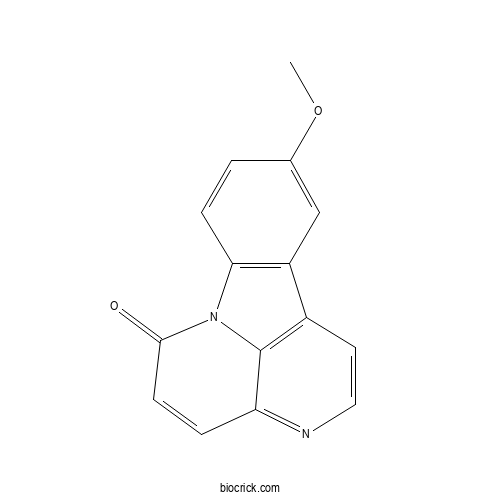
| Cas No. | 86293-40-5 | SDF | File under preparation. |
| PubChem ID | 158928.0 | Appearance | Yellow powder |
| Formula | C15H10N2O2 | M.Wt | 250.2 |
| Type of Compound | N/A | Storage | Desiccate at -20°C |
| Solubility | Soluble in Chloroform,Dichloromethane,Ethyl Acetate,DMSO,Acetone,etc. | ||
| Chemical Name | 12-methoxy-1,6-diazatetracyclo[7.6.1.05,16.010,15]hexadeca-3,5(16),6,8,10,12,14-heptaen-2-one | ||
| SMILES | COC1=CC2=C(C=C1)N3C(=O)C=CC4=NC=CC2=C43 | ||
| Standard InChIKey | FDBMONUDUKGKGY-UHFFFAOYSA-N | ||
| Standard InChI | InChI=1S/C15H10N2O2/c1-19-9-2-4-13-11(8-9)10-6-7-16-12-3-5-14(18)17(13)15(10)12/h2-8H,1H3 | ||
| General tips | For obtaining a higher solubility , please warm the tube at 37 ℃ and shake it in the ultrasonic bath for a while.Stock solution can be stored below -20℃ for several months. We recommend that you prepare and use the solution on the same day. However, if the test schedule requires, the stock solutions can be prepared in advance, and the stock solution must be sealed and stored below -20℃. In general, the stock solution can be kept for several months. Before use, we recommend that you leave the vial at room temperature for at least an hour before opening it. |
||
| About Packaging | 1. The packaging of the product may be reversed during transportation, cause the high purity compounds to adhere to the neck or cap of the vial.Take the vail out of its packaging and shake gently until the compounds fall to the bottom of the vial. 2. For liquid products, please centrifuge at 500xg to gather the liquid to the bottom of the vial. 3. Try to avoid loss or contamination during the experiment. |
||
| Shipping Condition | Packaging according to customer requirements(5mg, 10mg, 20mg and more). Ship via FedEx, DHL, UPS, EMS or other couriers with RT, or blue ice upon request. | ||
Quality Control & MSDS
3D structure
Package In Stock

Number of papers citing our products


Methylaervine Dilution Calculator
Methylaervine Molarity Calculator


| 1 mg | 5 mg | 10 mg | 20 mg | 25 mg | |
| 1 mM | 3.9968 mL | 19.984 mL | 39.968 mL | 79.9361 mL | 99.9201 mL |
| 5 mM | 0.7994 mL | 3.9968 mL | 7.9936 mL | 15.9872 mL | 19.984 mL |
| 10 mM | 0.3997 mL | 1.9984 mL | 3.9968 mL | 7.9936 mL | 9.992 mL |
| 50 mM | 0.0799 mL | 0.3997 mL | 0.7994 mL | 1.5987 mL | 1.9984 mL |
| 100 mM | 0.04 mL | 0.1998 mL | 0.3997 mL | 0.7994 mL | 0.9992 mL |
| * Note: If you are in the process of experiment, it's necessary to make the dilution ratios of the samples. The dilution data above is only for reference. Normally, it's can get a better solubility within lower of Concentrations. | |||||
- Pyridoxal phosphate
Catalog No.:BCX2348
CAS No.:54-47-7
- (+)-Licarin B
Catalog No.:BCX2347
CAS No.:42016-15-9
- Caffealdehyde
Catalog No.:BCX2346
CAS No.:141632-15-7
- Acridone
Catalog No.:BCX2345
CAS No.:578-95-0
- Lactose
Catalog No.:BCX2344
CAS No.:63-42-3
- Bryodulcosigenin
Catalog No.:BCX2343
CAS No.:88930-16-9
- D-Glucuronic acid
Catalog No.:BCX2342
CAS No.:6556-12-3
- 6-Hydroxyflavanone
Catalog No.:BCX2341
CAS No.:190831-08-4
- Guanidinoacetic acid
Catalog No.:BCX2340
CAS No.:352-97-6
- 3-Amino-3-(3,4-dimethoxyphenyl)propionic acid
Catalog No.:BCX2339
CAS No.:54160-63-3
- 3-Methyl-4-isopropylphenol
Catalog No.:BCX2338
CAS No.:3228-02-2
- Turanose
Catalog No.:BCX2337
CAS No.:547-25-1
- Pipemidic acid
Catalog No.:BCX2350
CAS No.:51940-44-4
- 2-tert-Butyl-4-methoxyphenol
Catalog No.:BCX2351
CAS No.:121-00-6
- 5-Pentadecylresorcinol
Catalog No.:BCX2352
CAS No.:3158-56-3
- Dotriacontane
Catalog No.:BCX2353
CAS No.:544-85-4
- Phenylephrine
Catalog No.:BCX2354
CAS No.:59-42-7
- Uridine 5'-diphosphogaluronic acid trisodium
Catalog No.:BCX2355
CAS No.:148407-07-2
- Cisplatin
Catalog No.:BCX2356
CAS No.:15663-27-1
- Adenosine triphosphate
Catalog No.:BCX2357
CAS No.:56-65-5
- Uridine 5'-diphosphoxylose disodium
Catalog No.:BCX2358
CAS No.:108320-89-4
- Uridine 5'-diphosphogalactose disodium
Catalog No.:BCX2359
CAS No.:137868-52-1
- 2,2-Dimethyl-2,3-dihydroquinazolin-4(1H )-one
Catalog No.:BCX2360
CAS No.:77726-78-4
- Desmosterol
Catalog No.:BCX2361
CAS No.:313-04-2
Antifungal Activity and Multi-Target Mechanism of Action of Methylaervine on Candida albicans.[Pubmed:39339297]
Molecules. 2024 Sep 11;29(18):4303.
The discovery of a lead compound against Candida albicans is urgently needed because of the lack of clinically available antifungal drugs and the increase in drug resistance. Herein, a beta-carboline alkaloid Methylaervine (MET) exhibited potential activity against C. albicans (MIC = 16-128 mug/mL), no hemolytic toxicity, and a low tendency to induce drug resistance. An antifungal mechanism study indicated that MET effectively inhibited the biofilm formation and disrupted the mature biofilm. Moreover, filamentation formation and spore germination were also weakened. The electron microscopy analysis revealed that MET could damage the cell structure, including the cell wall, membrane, and cytoplasm. In particular, the permeability and integrity of the cell membrane were destroyed. When it entered the fungi cell, it interfered with the redox homeostasis and DNA function. Overall, MET can inhibit the growth of C. albicans from multiple channels, such as biofilm, filamentation, cell structure, and intracellular targets, which are difficult to mutate at the same time to generate drug resistance. This work provides a promising lead compound for the creation of new antifungal agents against C. albicans.
Methylaervine as Potential Lead Compound Against Cervical Carcinoma: Pharmacologic Mechanism Prediction based on Network Pharmacology.[Pubmed:34080967]
Curr Comput Aided Drug Des. 2022;18(1):73-80.
BACKGROUND: The discovery of therapeutic anticancer agents based on natural products is one of the current research focuses. Network pharmacology will broaden our understanding of drug actions by bioinformatics analysis. OBJECTIVE: To explore the potential and provide scientific evidence for Methylaervine as a lead compound against cervical carcinoma. METHODS: Methylaervine was synthesized, and its activity against four cancer cell lines was evaluated by MTT assay. Pharmacokinetic properties were obtained by in silico approaches, and the pharmacologic mechanism was predicted by network pharmacology. Then we validated and investigated our predictions of candidate targets using a molecular docking study. RESULTS: Methylaervine was synthesized with a total yield of 54.9%, which displayed activity against HeLa (IC50 = 14.8 muM) with good predicted pharmacokinetic properties, thus it was considered a potential lead compound. The network pharmacology study indicated that Methylaervine could act against cervical carcinoma by regulating the function of multiple pivotal targets, such as CTNNB1, PTPRJ, RPA1, and TJP1, mainly covering cell growth, cell motility, and cell proliferation. Moreover, docking analysis showed that hydrogen bonds and hydrophobic interactions were the main forms of interactions. CONCLUSION: This work would provide new insight into the design of anti-cervical carcinoma drugs based on Methylaervine.
Cellular and non-target metabolomics approaches to understand the antifungal activity of methylaervine against Fusarium solani.[Pubmed:33915256]
Bioorg Med Chem Lett. 2021 Jul 1;43:128068.
Botanical fungicides are promising replacements for pure chemical synthetic pesticides in agriculture and organic food production. Methylaervine with good physicochemical properties exhibited effective activity against F. solani (EC(50) = 10.56 microM) better than the positive control thiophanate-methyl (EC(50) = 27.94 microM). The activity changes of malondialdehyde (MDA), catalase (CAT) and superoxide dismutase (SOD) showed that Methylaervine could significantly induce lipid peroxidation and activate the antioxidant enzymes. According to the metabolomics analysis, fifty-one differential metabolites and two major antifungal-related pathways covering tricarboxylic acid (TCA) cycle and steroid biosynthesis were identified. Moreover, the disturbance for TCA cycle was validated by the activity changes of dehydrogenase (MDH) and succinate dehydrogenase (SDH) as well as docking simulation. Homology modeling and docking study revealed that hydrogen bonds and hydrophobic interactions played a vital role in Methylaervine-protein stability. This study provided new insight into the antifungal activity of Methylaervine, which is important for the development of novel botanical fungicides based on Methylaervine.
Isolation, structural elucidation and cytotoxicity evaluation of a new pentahydroxy-pimarane diterpenoid along with other chemical constituents from Aerva lanata.[Pubmed:25348942]
Nat Prod Res. 2015 Feb;29(3):253-61.
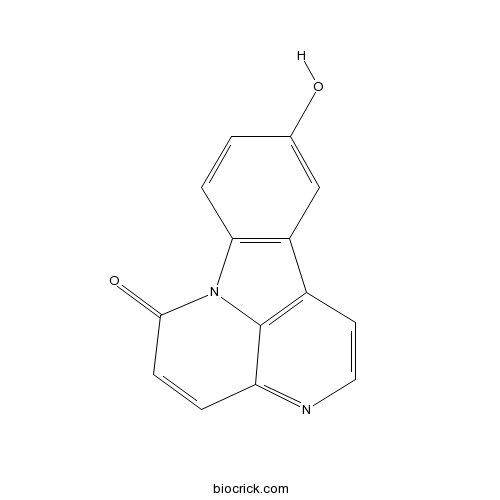
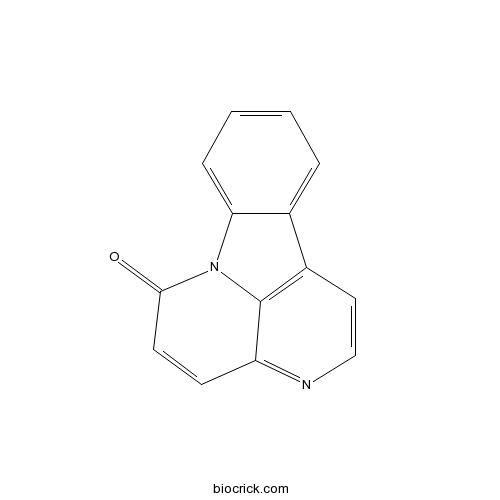
Aervalanata possesses various useful medicinal and pharmaceutical activities. Phytochemical investigation of the plant has now led to the isolation of a new 2alpha,3alpha,15,16,19-pentahydroxy pimar-8(14)-ene diterpenoid (1) together with 12 other known compounds identified as beta-sitosterol (2), beta-sitosterol-3-O-beta-D-glucoside (3), canthin-6-one (4), 10-hydroxycanthin-6-one (aervine, 5), 10-methoxycanthin-6-one (Methylaervine, 6), beta-carboline-1-propionic acid (7), 1-O-beta-D-glucopyranosyl-(2S,3R,8E)-2-[(2'R)-2-hydroxylpalmitoylamino]-8-octadecene-1,3-diol (8), 1-O-(beta-D-glucopyranosyl)-(2S,3S,4R,8Z)-2-[(2'R)-2'-hydroxytetracosanoylamino]-8(Z)-octadene-1,3,4-triol (9), (2S,3S,4R,10E)-2-[(2'R)-2'-hydroxytetracosanoylamino]-10-octadecene-1,3,4-triol (10), 6'-O-(4''-hydroxy-trans-cinnamoyl)-kaempferol-3-O-beta-D-glucopyranoside (tribuloside, 11), 3-cinnamoyltribuloside (12) and sulfonoquinovosyldiacylglyceride (13). Among these, six compounds (8-13) are reported for the first time from this plant. Cytotoxicity evaluation of the compounds against five cancer cell lines (CHO, HepG2, HeLa, A-431 and MCF-7) shows promising IC50 values for compounds 4, 6 and 12.
Aerva lanata: A review on phytochemistry and pharmacological aspects.[Pubmed:22279378]
Pharmacogn Rev. 2011 Jul;5(10):195-8.
Aerva lanata (L.) A. L. Juss. ex Schultes. (Amaranthaceae) locally known as 'bui' is an erect or prostrate undershrub with a long tap-root and many wolly-tomentose branches, found in the wild, throughout India. In traditional medicine the plant is used in cough, strangury (slow to be and painful discharge of urine), headache and urolithiasis. The photochemical constituents present in the plant include alkaloids (ervine, methylervine, ervoside, aervine, Methylaervine, aervoside, ervolanine, and aervolanine), flavanoids (kaempferol, quercetin, isorhamnetin, persinol, persinosides A and B), methyl grevillate, lupeol, lupeol acetate benzoic acid, beta-sitosteryl acetate and tannic acid. Pharmacological studies reported diuretic, anti-inflammatory, hypoglycemic, anti-diabetic, antiparasitic, antimicrobial, hepoprotective, anti-urolithiasis, antiasthmatic, antifertility and hypolipidemic properties of Aerva lanata. This review article includes the detailed exploration of the morphology, phytochemistry, and pharmacological aspects of Aerva lanata in an attempt to provide a direction for further research.

Calcutta University

University of Minnesota

University of Maryland School of Medicine

University of Illinois at Chicago

The Ohio State University

University of Zurich

Harvard University

Colorado State University

Auburn University

Yale University

Worcester Polytechnic Institute

Washington State University

Stanford University

University of Leipzig

Universidade da Beira Interior

The Institute of Cancer Research

Heidelberg University

University of Amsterdam

University of Auckland

TsingHua University

The University of Michigan

Miami University

DRURY University

Jilin University

Fudan University

Wuhan University

Sun Yat-sen University

Universite de Paris

Deemed University

Auckland University

The University of Tokyo

Korea University



