
CisplatinCAS# 15663-27-1 |
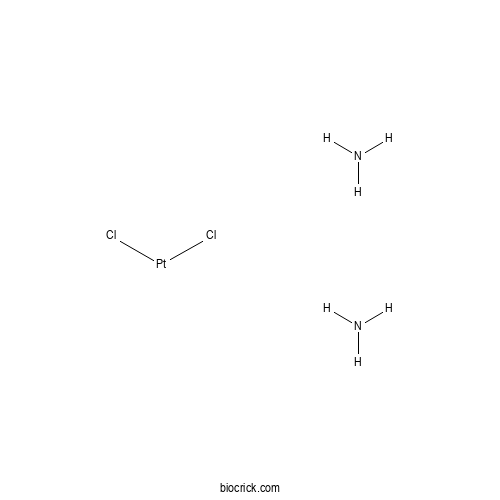
| Cas No. | 15663-27-1 | SDF | File under preparation. |
| PubChem ID | 5460033.0 | Appearance | Powder |
| Formula | Cl2H6N2Pt | M.Wt | 300.1 |
| Type of Compound | N/A | Storage | Desiccate at -20°C |
| Solubility | Soluble in Chloroform,Dichloromethane,Ethyl Acetate,DMSO,Acetone,etc. | ||
| Chemical Name | azane;dichloroplatinum | ||
| SMILES | N.N.Cl[Pt]Cl | ||
| Standard InChIKey | LXZZYRPGZAFOLE-UHFFFAOYSA-L | ||
| Standard InChI | InChI=1S/2ClH.2H3N.Pt/h2*1H;2*1H3;/q;;;;+2/p-2 | ||
| General tips | For obtaining a higher solubility , please warm the tube at 37 ℃ and shake it in the ultrasonic bath for a while.Stock solution can be stored below -20℃ for several months. We recommend that you prepare and use the solution on the same day. However, if the test schedule requires, the stock solutions can be prepared in advance, and the stock solution must be sealed and stored below -20℃. In general, the stock solution can be kept for several months. Before use, we recommend that you leave the vial at room temperature for at least an hour before opening it. |
||
| About Packaging | 1. The packaging of the product may be reversed during transportation, cause the high purity compounds to adhere to the neck or cap of the vial.Take the vail out of its packaging and shake gently until the compounds fall to the bottom of the vial. 2. For liquid products, please centrifuge at 500xg to gather the liquid to the bottom of the vial. 3. Try to avoid loss or contamination during the experiment. |
||
| Shipping Condition | Packaging according to customer requirements(5mg, 10mg, 20mg and more). Ship via FedEx, DHL, UPS, EMS or other couriers with RT, or blue ice upon request. | ||
Quality Control & MSDS
3D structure
Package In Stock

Number of papers citing our products


Cisplatin Dilution Calculator
Cisplatin Molarity Calculator
| 1 mg | 5 mg | 10 mg | 20 mg | 25 mg | |
| 1 mM | 3.3322 mL | 16.6611 mL | 33.3222 mL | 66.6445 mL | 83.3056 mL |
| 5 mM | 0.6664 mL | 3.3322 mL | 6.6644 mL | 13.3289 mL | 16.6611 mL |
| 10 mM | 0.3332 mL | 1.6661 mL | 3.3322 mL | 6.6644 mL | 8.3306 mL |
| 50 mM | 0.0666 mL | 0.3332 mL | 0.6664 mL | 1.3329 mL | 1.6661 mL |
| 100 mM | 0.0333 mL | 0.1666 mL | 0.3332 mL | 0.6664 mL | 0.8331 mL |
| * Note: If you are in the process of experiment, it's necessary to make the dilution ratios of the samples. The dilution data above is only for reference. Normally, it's can get a better solubility within lower of Concentrations. | |||||
- Uridine 5'-diphosphogaluronic acid trisodium
Catalog No.:BCX2355
CAS No.:148407-07-2
- Phenylephrine
Catalog No.:BCX2354
CAS No.:59-42-7
- Dotriacontane
Catalog No.:BCX2353
CAS No.:544-85-4
- 5-Pentadecylresorcinol
Catalog No.:BCX2352
CAS No.:3158-56-3
- 2-tert-Butyl-4-methoxyphenol
Catalog No.:BCX2351
CAS No.:121-00-6
- Pipemidic acid
Catalog No.:BCX2350
CAS No.:51940-44-4
- Methylaervine
Catalog No.:BCX2349
CAS No.:86293-40-5
- Pyridoxal phosphate
Catalog No.:BCX2348
CAS No.:54-47-7
- (+)-Licarin B
Catalog No.:BCX2347
CAS No.:42016-15-9
- Caffealdehyde
Catalog No.:BCX2346
CAS No.:141632-15-7
- Acridone
Catalog No.:BCX2345
CAS No.:578-95-0
- Lactose
Catalog No.:BCX2344
CAS No.:63-42-3
- Adenosine triphosphate
Catalog No.:BCX2357
CAS No.:56-65-5
- Uridine 5'-diphosphoxylose disodium
Catalog No.:BCX2358
CAS No.:108320-89-4
- Uridine 5'-diphosphogalactose disodium
Catalog No.:BCX2359
CAS No.:137868-52-1
- 2,2-Dimethyl-2,3-dihydroquinazolin-4(1H )-one
Catalog No.:BCX2360
CAS No.:77726-78-4
- Desmosterol
Catalog No.:BCX2361
CAS No.:313-04-2
- 7-Dehydrocholestero
Catalog No.:BCX2362
CAS No.:434-16-2
- Acetyl CoA
Catalog No.:BCX2363
CAS No.:102029-73-2
- CoA
Catalog No.:BCX2364
CAS No.:85-61-0
- Caffeoyl CoA
Catalog No.:BCX2365
CAS No.:53034-79-0
- 22(S)-Hydroxycholesterol
Catalog No.:BCX2366
CAS No.:22348-64-7
- Feruloyl CoA
Catalog No.:BCX2367
CAS No.:30802-02-9
- Palmitoyl CoA
Catalog No.:BCX2368
CAS No.:188174-64-3
Quercetin Attenuates Cisplatin-Induced Nephrotoxicity While Enhancing Antitumor Efficacy in Gastric Cancer via Cell Type-Specific Modulation of the ERK1/2 Pathway.[Pubmed:42831533]
J Biochem Mol Toxicol. 2026 Oct;40(10):e71121.
Cisplatin (DDP) is a cornerstone chemotherapeutic agent for gastric cancer, yet its clinical application is often limited by severe adverse effects, particularly dose-dependent nephrotoxicity. Quercetin (Que) is a dietary flavonoid widely present in everyday foods such as onions, apples, tea, and broccoli. It has been reported to possess both renoprotective and antitumor properties. This study evaluated the therapeutic potential of combining DDP with Que in gastric cancer treatment. In vitro, CCK-8 assays, flow cytometry, and scratch wound tests were employed to assess the impact of Que on DDP-induced nephrotoxicity and chemosensitivity, while potential mechanisms were investigated through western blot analysis. In vivo, the combined regimen was tested in tumor-bearing nude mice by monitoring tumor growth and renal function. Our results showed that Que alleviated DDP-induced suppression of proliferation and apoptosis in HK-2 cells, indicating protection against nephrotoxicity. In comparison, in AGS gastric cancer cells, Que potentiated DDP-induced inhibition of proliferation and migration, and improved apoptosis. Mechanistically, Que inhibited ERK1/2 activation in both cell types. In HK-2 cells, ERK1/2 inhibition increased c-Myc expression and decreased cleaved caspase-3 levels, whereas in AGS cells, ERK1/2 inhibition reduced c-Myc and MMP-2 levels while elevating cleaved caspase-3 expression. These effects were reversed upon TBHQ treatment. In vivo, Que enhanced the antitumor efficacy of DDP while attenuating its nephrotoxicity. Collectively, these results indicate that Que achieves the abovementioned dual effect via cell type-specific modulation of the ERK1/2 pathway, supporting its potential as an adjuvant for gastric cancer chemotherapy.
Pure Red Cell Aplasia Associated With Thymoma: A Case Report.[Pubmed:42831160]
Cureus. 2026 Sep 4;18(9):e115780.
A 55-year-old male, former smoker, presented with exertional dyspnea associated with an anterior mediastinal mass. Biopsy findings were consistent with a type B2 thymoma. The tumor was deemed unresectable, and curative concurrent chemoradiotherapy was not feasible after three cycles of cyclophosphamide, adriamycin (doxorubicin), and platinum (Cisplatin) (CAP) chemotherapy. Treatment was therefore continued to six cycles. Following radiological progression, second-line chemotherapy with paclitaxel and carboplatin was initiated. After two cycles, the patient developed superior vena cava syndrome. Palliative mediastinal radiotherapy was subsequently delivered. The patient experienced five episodes of severe hyporegenerative anemia, in the absence of bleeding or hemolysis, requiring repeated blood transfusions. Both the bone marrow aspirate and the bone marrow biopsy revealed pure red cell aplasia (PRCA). Testing for parvovirus B19 infection was negative. Immunosuppressive therapy with prednisone, combined with third-line etoposide-based chemotherapy, was initiated. However, the patient discontinued treatment after two cycles and remained transfusion-dependent during follow-up. This case highlights the diagnostic and therapeutic challenges posed by thymoma-associated PRCA in patients with advanced unresectable disease.
A Comparative Study of the Acute Toxicities of Three-Dimensional Conformal Radiotherapy (3D-CRT) Versus Intensity-Modulated Radiotherapy (IMRT) in Locally Advanced and Inoperable Oral Cavity Cancer.[Pubmed:42830812]
Cureus. 2026 Sep 3;18(9):e115752.
Background Oral cavity cancer is a substantial and increasing public health burden in Bangladesh due to widespread tobacco abuse and betel nut chewing. According to GLOBOCAN 2022, oral cavity cancer is the second most common cancer in Bangladesh after esophageal cancer. Locally advanced and medically inoperable oral cavity cancer can be treated with concurrent chemoradiotherapy (CCRT) as an established standard of care, which can be delivered using either three-dimensional conformal radiotherapy (3D-CRT) or intensity-modulated radiotherapy (IMRT) techniques. Methods This quasi-experimental study was carried out among 84 patients with locally advanced and inoperable oral cavity cancer (LAIOCC) from December 2022 to October 2023 who fulfilled the eligibility criteria and were equally distributed (42 in each arm) into two treatment arms. Arm A received CCRT with 3D-CRT and weekly Cisplatin (40 mg/m(2)), whereas Arm B received IMRT with weekly Cisplatin (40 mg/m(2)). Follow-up was conducted weekly during chemoradiotherapy and at the sixth week after completion of treatment. Results Xerostomia was observed more frequently in the 3D-CRT arm than in the IMRT arm (p = 0.04). Similarly, dysphagia occurred more often in the 3D-CRT arm than in the IMRT arm (p = 0.02). However, the difference in mucositis was not statistically significant (p = 0.22). Likewise, the difference in dermatitis between the two arms was not statistically significant (p = 0.63). Acute hematological toxicities, including anemia (p = 0.75), leukopenia (p = 1.00), and thrombocytopenia (p = 0.52), also did not differ significantly between the arms. Conclusion IMRT was associated with a lower incidence of dysphagia and xerostomia than 3D-CRT. Therefore, the IMRT technique provides a significant benefit to patients with oral cavity carcinoma compared with the 3D-CRT technique in terms of acute toxicities, particularly xerostomia and dysphagia.
Synthesis, in vitro and in silico studies of novel N-benzoyl EF24 analogs as potential anticancer agents.[Pubmed:42830631]
Future Med Chem. 2026 Oct 4:1-16.
INTRODUCTION: EF24, a synthetic curcumin derivative, is effective against different forms of cancers but its derivatives are underdeveloped, particularly to improve cytotoxicity and drug-receptor interactions in colorectal cancer. AREAS COVERED: Nine N-benzoyl EF24 analogs were prepared and identified by Fourier transform infrared (FT IR), proton nuclear magnetic resonance ((1)H NMR), and mass spectra. Cytotoxicity against the HT-29 cancer cell was screened by 3 (4,5 dimethylthiazol 2 yl) 2,5 diphenyltetrazolium bromide (MTT) assay at 24 and 48 hours. Molecular docking on glyoxalase I compared binding interactions. Compounds 4, 5, 7, and 10 were significantly cytotoxic with compound 10 being more cytotoxic than EF24 and Cisplatin. Compound 10 was found to have maximum binding affinity by docking with active-site residues. EXPERT OPINION/COMMENTARY: The N-benzoyl EF24 analogs, especially compound 10, have shown encouraging cytotoxicity and favorable drug-receptor interaction, suggesting their clinical utility as agents against colorectal cancer. Pharmacokinetic and in vivo explorations are also needed to further advance the compounds for clinical application.
Multi-omics profiling reveals homologous recombination repair hyperactivation as a therapeutic vulnerability in neuroendocrine cervical carcinoma.[Pubmed:42830288]
Signal Transduct Target Ther. 2026 Oct 5;11(1):424.
Neuroendocrine cervical carcinoma (NECC) is an aggressive and rare malignancy comprising 0.9-1.5% of cervical cancers. Its molecular basis remains poorly understood, limiting treatment options. A national multicenter cohort survival analysis showed that NECC patients had a 5.17-fold higher death risk than non-NECC patients and demonstrated broad chemotherapy resistance, which was further validated in both NECC cell lines and patient-derived organoids. To identify therapeutic targets, multi‑omics profiling of NECC tumors and matched normal adjacent tissues revealed pronounced DNA replication stress and hyperactivation of homologous recombination repair (HRR). These findings were validated in cells and patient-derived organoids using DR-GFP reporter and pRPA32 assays, suggesting that NECC may be susceptible to PARP inhibitor therapy. NECC cells exhibited moderate PARP inhibitor sensitivity, greater than that of resistant non‑NECC lines but less than that of highly sensitive A2780 cells. However, combining PARP inhibitors with Cisplatin/carboplatin did not enhance efficacy, prompting the exploration of alternative combinatorial targets. Multi-omics analysis and in vitro validation identified Bloom syndrome helicase (BLM) as a key factor overexpressed in NECC that modulates PARP inhibitor sensitivity. Further in vitro and in vivo experiments confirmed that combining PARP and BLM inhibitors achieved potent anticancer effects. Mechanistically, cancer-associated fibroblasts (CAFs) infiltration in the tumor microenvironment upregulated the transcription factor E2F1 via IL6, with ChIP‒qPCR verifying that activated E2F1 directly binds the BLM promoter (hg38, chr15:90,715,346-90,717,346) to drive its expression, suppressing PARP inhibitor sensitivity. Our findings establish dual PARP and BLM inhibition as a promising therapeutic strategy for NECC by blocking HRR pathway compensation.
ROLE OF NEOADJUVANT THERAPY FOR PATIENTS WITH GASTRIC CANCER: MULTIDISCIPLINARY HOSPITAL WITH ONCOLOGY CENTER.[Pubmed:42830032]
Georgian Med News. 2026 Jul-Aug;(376-377):32-37.
PURPOSE: To compare the efficacy and safety of doublet (capecitabine + Cisplatin) and triplet (capecitabine + Cisplatin + docetaxel) neoadjuvant chemotherapy (NACT) regimens in patients with locally advanced gastric cancer at a regional oncology center in Kazakhstan. METHODS: A prospective stratified randomized study included 107 patients with locally advanced gastric cancer. Patients were stratified by age, tumor location, and histological type/differentiation grade and then randomized in a 1:1 ratio to receive either capecitabine plus Cisplatin or capecitabine plus Cisplatin plus docetaxel. Tumor response was assessed using RECIST 1.1, pathological response was assessed in resected specimens, and toxicity was graded according to CTCAE v5.0. RESULTS: The triplet regimen was associated with numerically higher rates of radiological partial response according to RECIST 1.1 (68.0% vs. 59.3%, p=0.423) and radical surgery among patients with partial response (91.7% vs. 78.1%, p=0.172). Pathological response was assessed in 58 patients who underwent radical gastrectomy. Pathological complete response (ypT0N0/TRG 1a) was observed in 2 patients in the triplet group and in none of the patients in the doublet group (0% vs. 6.1%, p=0.501). Favorable pathological regression (TRG 1a-1b) was more frequent after triplet therapy than after doublet therapy (24.2% vs. 12.0%, p=0.320). Grade III-IV neutropenia was more frequent in the triplet group (24.5% vs. 9.3%, p=0.041). CONCLUSIONS: The triplet regimen showed a numerical efficacy advantage but was associated with increased hematologic toxicity, requiring careful monitoring. Treatment personalization based on histology and comorbidities is critical. LIMITATIONS: Small sample size, lack of survival data, and the need for multicenter validation.
Ru3: a novel ruthenium-based compound overcomes cisplatin resistance in non-small cell lung cancer via the E2F2-IGFBP3-GPX4 pathway.[Pubmed:42829402]
Apoptosis. 2026 Oct 3;31(10):243.
Cisplatin resistance remains a major hurdle in non-small cell lung cancer (NSCLC) treatment. Here, we designed and synthesized a novel ruthenium-based compound, which selectively kills Cisplatin-resistant NSCLC cells while sparing parental cells. Mechanistically, Ru3 triggers mitochondrial damage and reactive oxygen species (ROS) accumulation. In addition, it upregulates the transcription factor E2F2, which directly represses IGFBP3 expression. IGFBP3 normally scavenges ROS via the GPX4 system; thus, E2F2-mediated IGFBP3 suppression disrupts this antioxidant defense, exacerbating ROS levels and cell death. Notably, Cisplatin-resistant cells exhibit elevated GPX4 and IGFBP3 expression, making them particularly vulnerable to Ru3. This study elucidates the E2F2-IGFBP3-GPX4 axis as a novel therapeutic vulnerability and highlights Ru3 as a promising agent for refractory NSCLC.
From initial complete response to recurrence: ENPP1 mutation drives cisplatin resistance through STING/NF-kappaB/IL-6 axis in hypopharyngeal squamous cell carcinoma.[Pubmed:42829370]
Br J Cancer. 2026 Oct 3.
BACKGROUND: Induction chemotherapy proves critical in hypopharyngeal squamous cell carcinoma (HPSCC). However, the mechanisms of acquired resistance to induction chemotherapy have not been fully elucidated yet. METHODS: Nine patients with HPSCC who showed an initial response to IC followed by progression and had available paired paraffin-embedded tissue samples were retrospectively analysed. Whole exome sequencing and functional validation were performed in both in vivo and in vitro experiments using CRISPR-Cas9-mediated knockout and mutant variant transfection. RESULTS: 66.7% (6/9) of the patients acquired novel mutations during progression. Among the newly emerged variants, alterations in ENPP1, ALK, and ATP10B were notable for potential functional relevance. Specifically, ENPP1 mutations were present in 50% (3/6) of the cases with acquired alterations. Functional assays demonstrated that ENPP1 knockout suppressed malignant phenotypes in vitro, while overexpression of the mutant ENPP1 (c.2596 G > C, p.Glu866Gln) promoted Cisplatin resistance, enhanced 2'3'-cGAMP hydrolysis, and increased tumorigenic capacity in xenograft models. Mechanistically, ENPP1 mutation was associated with sustained activation of STING, accompanied by enchanced NF-kappaB signaling and elevated IL-6 production, ultimately promoting tumor cell survival and Cisplatin resistance. CONCLUSION: Our study identifies ENPP1 mutation as one of the key genetic drivers of recurrence, mediating both chemotherapy resistance and immunomodulation.
Zinc Deficiency Exacerbates Cisplatin-Induced Acute Kidney Injury by Impairing Metabolic Adaptation and Antioxidant Defenses.[Pubmed:42829133]
Chem Biol Interact. 2026 Oct 3:112355.
Cisplatin-induced acute kidney injury (Cis-AKI) is a major limitation of chemotherapy and is largely driven by the inability of renal tubular epithelial cells to adapt to metabolic and oxidative stress. Zinc, an essential regulator of cellular stress responses, may influence this vulnerability, but its role in Cisplatin nephrotoxicity remains unclear. Here, zinc-normal and zinc-deficient mice were subjected to Cis-AKI. Renal injury was evaluated by histology, serum creatinine (Scr), blood urea nitrogen (BUN), renal zinc levels, and NGAL expression. Transcriptomic analysis was performed to identify pathways altered by zinc deficiency, followed by validation of the AMPK/SIRT1/PGC-1alpha axis. Oxidative stress and apoptosis were assessed by Nrf2 signaling, antioxidant enzyme expression, SOD activity, MDA levels, TUNEL staining, and Bax/Bcl-2 expression. Zinc deficiency significantly aggravated Cis-AKI, as indicated by increased tubular damage, elevated Scr, BUN, and NGAL levels, and reduced renal zinc content. RNA sequencing revealed suppression of energy metabolism-related programs, accompanied by inhibition of the AMPK/SIRT1/PGC-1alpha axis, suggesting impaired metabolic adaptation. Zinc deficiency was also associated with reduced Nrf2 signaling, accompanied by decreased expression of antioxidant enzymes and total SOD activity, increased MDA accumulation, and enhanced tubular apoptosis. These findings suggest that zinc deficiency exacerbates Cis-AKI by weakening metabolic adaptation and antioxidant defenses, thereby promoting oxidative stress and apoptosis. Our study identifies zinc as a key regulator of tubular stress adaptation and suggests zinc homeostasis as a potential therapeutic target in Cisplatin nephrotoxicity.
Assessment of the DNA lesion specificity of the comet assay in combination with DNA repair inhibitors (Aphidicolin and Hydroxyurea/Cytosine Arabinoside).[Pubmed:42828740]
Mutagenesis. 2026 Oct 3:geag034.
The standard alkaline comet assay is a straightforward and cost-effective genotoxicity test commonly used in genetic toxicology to detect strand breaks and alkali-labile sites in DNA. Furthermore, with certain modifications, other altered bases such as oxidised and alkylated bases and cross-links can also be detected. However, it cannot detect bulky DNA adducts, which are a significant DNA lesion formed by the attachment of a chemical to DNA. Given that bulky adducts are mainly repaired by nucleotide excision repair (NER), the modification of the comet assay by adding blockers of the repair synthesis stage of NER, lead to the accumulation of incision intermediates, i.e. DNA breaks. Although this modification has been proposed as a method for detecting bulky adducts, the literature suggests that it may also detect other DNA lesions and that it has not yet been validated. To study the DNA lesion specificity of the in vitro comet assay in combination with DNA repair inhibitors, we tested a set of seven genotoxic compounds with different mechanisms of action and two non-genotoxic compounds, in TK6 cells. The assays were performed in the absence or presence of the inhibitors, specifically the combination of hydroxyurea (HU) and cytosine arabinoside (Ara-C), or aphidicolin (APC). The panel of genotoxic compounds included a bulky DNA adducts inducer (BPDE), two alkylating agents (methyl methanesulfonate (MMS) and ethyl methanesulfonate (EMS)), two oxidising agents (KBrO(3) and H(2)O(2)), and two cross-linking agents (Cisplatin (CisPt) and mitomycin C (MitC)). The MTS and comet assays were performed to determine cytotoxicity and DNA damage, respectively. Results showed that this approach increases the sensitivity of the comet assay for detecting DNA damage, but not specifically bulky DNA adducts.
Colonic Angiosarcoma 16 Years After Pelvic Radiotherapy for Cervical Cancer: A Case Report.[Pubmed:42828051]
Cureus. 2026 Oct 1;18(10):e117323.
Angiosarcomas are rare and aggressive malignant neoplasms of vascular or lymphatic endothelial origin, accounting for approximately 2% of soft-tissue sarcomas. They occur predominantly in the skin and superficial soft tissues, particularly in the head and neck region and the breast, whereas gastrointestinal involvement is exceptionally rare. Previous radiotherapy is a well-established risk factor for secondary angiosarcoma. However, radiation-associated gastrointestinal angiosarcomas are extremely uncommon and have been reported predominantly in the small bowel. We report the case of a 55-year-old woman who presented with abdominal pain, hemorrhagic ascites, intermittent rectal bleeding, severe anemia, anorexia, and weight loss 16 years after pelvic radiotherapy and Cisplatin-based chemotherapy for cervical squamous cell carcinoma. Computed tomography revealed circumferential thickening of the cecum and right colon with abundant hyperdense ascites. Colonoscopy showed an obstructing, ulcerated, and contact-bleeding mass involving the cecum and right colon. Histopathological examination of endoscopic biopsies revealed a poorly differentiated malignant vascular neoplasm. Immunohistochemical staining was positive for cluster of differentiation (CD)31 and CD34 and negative for cytokeratin, CD3, CD20, and Human Herpesvirus (HHV)8, with a Ki-67 proliferation index of 40%, supporting the diagnosis of colonic angiosarcoma. Surgical resection was considered; however, the patient developed a massive bilateral pulmonary embolism and died seven days after admission. Given the prolonged latency and the histological distinction from the primary cervical carcinoma, a possible radiation-associated etiology was considered. Nevertheless, the original radiotherapy plan was unavailable, preventing definitive confirmation that the tumor arose within the irradiated field. This case highlights the diagnostic difficulty, aggressive clinical course, and poor prognosis of colonic angiosarcoma following pelvic radiotherapy.
Curative Resection for Thoracic Esophageal Carcinoma with an Aberrant Right Subclavian Artery: A Case Report.[Pubmed:42827451]
Surg Case Rep. 2026;12(1):26-0415.
INTRODUCTION: Esophagectomy in the presence of an aberrant right subclavian artery (ARSA) is rare, and the anomalous vascular anatomy can complicate lymphadenectomy because of the risk of nerve injury. CASE PRESENTATION: The patient was a 67-year-old man who presented with pharyngeal discomfort. Right pyriform sinus cancer and middle thoracic esophageal cancer were detected. After neoadjuvant chemotherapy with docetaxel, Cisplatin, and 5-fluorouracil for the esophageal cancer, the pyriform sinus cancer disappeared, indicating a complete response. Accordingly, esophagectomy with reconstruction using a gastric conduit was planned, with preservation of the hypopharynx. Because the presence of an ARSA had been recognized preoperatively, cervical lymphadenectomy was first performed via a cervical approach. Esophagectomy was performed thoracoscopically without injury to the nonrecurrent inferior laryngeal nerve (NRILN). CONCLUSIONS: Esophagectomy in a patient with an ARSA was performed while preserving the NRILN by initiating cervical lymphadenectomy before the thoracoscopic procedure.
Transcription remodeling and stalling by cisplatin-induced interstrand crosslinks.[Pubmed:42827153]
Nat Chem Biol. 2026 Oct 2.
Interstrand crosslinks (ICLs) block transcription by mechanisms that remain incompletely understood. Cisplatin induces ICLs that suppress transcription and contribute to its antitumor activity but these effects can be mitigated by transcription-coupled repair. Using reconstituted transcription systems and cryo-electron microscopy, we investigated how RNA polymerase II (Pol II) processes Cisplatin-ICLs and captured eight sequential transcriptional states. Pol II unexpectedly remodels the crosslinked guanines into a novel conformation positioned above the bridge helix. This rearranged ICL prevents the damaged base from entering the active site and triggers Pol II backtracking following ATP misincorporation. Furthermore, Cockayne syndrome protein B, an ATP-dependent translocase that initiates transcription-coupled repair, neither promotes lesion bypass nor displaces stalled Pol II, thereby committing the lesion to transcription-coupled repair. These findings identify Pol II as a structural remodeler of Cisplatin-ICLs and reveal how the remodeled lesion stalls transcription, providing insight into cellular responses to platinum-based chemotherapy.
Integrated transcriptomic and deep learning analyses define acRG signature for prognosis and therapeutic options in osteosarcoma.[Pubmed:42826870]
Biochim Biophys Acta Mol Basis Dis. 2026 Oct 2:168492.
Osteosarcoma is a highly malignant bone tumor characterized by significant clinical heterogeneity and poor prognostic outcomes. In this study, we integrated single-cell RNA sequencing data to characterize the landscape of genes related to N(4)-acetylcytidine (ac4C) modification. We calculated an acRG activity score and found that activity was predominantly enriched in osteoblastic cells. Using a machine learning framework, we constructed a six-gene prognostic signature termed acRGBS. This signature served as a robust and independent predictor of overall survival across multiple independent cohorts. Further analysis revealed that high acRGBS scores were associated with an immunosuppressive tumor microenvironment and increased immune evasion potential. Among the hub genes identified, S100A13 was highlighted as a potential driver of tumor progression. Functional experiments demonstrated that S100A13 knockdown significantly inhibited cell proliferation and reduced xenograft tumor growth in vivo. Mechanistically, S100A13 physically interacts with the mitochondrial calcium uniporter (MCU) to maintain mitochondrial calcium homeostasis. Silencing S100A13 led to mitochondrial calcium overload, which exacerbated oxidative stress and induced cell apoptosis. Finally, we showed that S100A13 knockdown significantly enhanced the anti-tumor efficacy of Cisplatin treatment. These findings suggest that S100A13 is a promising therapeutic target and a valuable biomarker for risk stratification in patients with osteosarcoma.

Calcutta University

University of Minnesota

University of Maryland School of Medicine

University of Illinois at Chicago

The Ohio State University

University of Zurich

Harvard University

Colorado State University

Auburn University

Yale University

Worcester Polytechnic Institute

Washington State University

Stanford University

University of Leipzig

Universidade da Beira Interior

The Institute of Cancer Research

Heidelberg University

University of Amsterdam

University of Auckland

TsingHua University

The University of Michigan

Miami University

DRURY University

Jilin University

Fudan University

Wuhan University

Sun Yat-sen University

Universite de Paris

Deemed University

Auckland University

The University of Tokyo

Korea University



