
CoACAS# 85-61-0 |
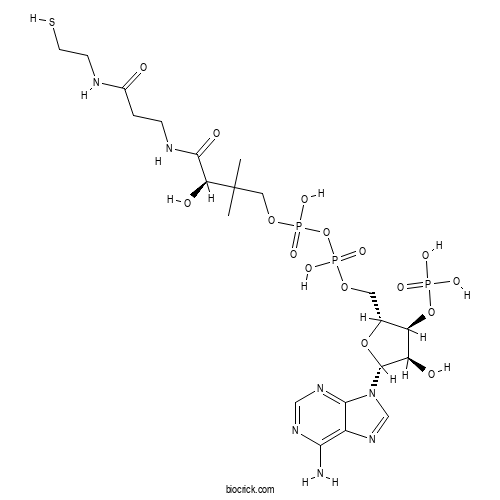
| Cas No. | 85-61-0 | SDF | File under preparation. |
| PubChem ID | 87642.0 | Appearance | Powder |
| Formula | C21H36N7O16P3S | M.Wt | 767.5 |
| Type of Compound | N/A | Storage | Desiccate at -20°C |
| Solubility | Soluble in Chloroform,Dichloromethane,Ethyl Acetate,DMSO,Acetone,etc. | ||
| Chemical Name | [[(2R,3S,4R,5R)-5-(6-aminopurin-9-yl)-4-hydroxy-3-phosphonooxyoxolan-2-yl]methoxy-hydroxyphosphoryl] [(3R)-3-hydroxy-2,2-dimethyl-4-oxo-4-[[3-oxo-3-(2-sulfanylethylamino)propyl]amino]butyl] hydrogen phosphate | ||
| SMILES | CC(C)(COP(=O)(O)OP(=O)(O)OCC1C(C(C(O1)N2C=NC3=C(N=CN=C32)N)O)OP(=O)(O)O)C(C(=O)NCCC(=O)NCCS)O | ||
| Standard InChIKey | RGJOEKWQDUBAIZ-IBOSZNHHSA-N | ||
| Standard InChI | InChI=1S/C21H36N7O16P3S/c1-21(2,16(31)19(32)24-4-3-12(29)23-5-6-48)8-41-47(38,39)44-46(36,37)40-7-11-15(43-45(33,34)35)14(30)20(42-11)28-10-27-13-17(22)25-9-26-18(13)28/h9-11,14-16,20,30-31,48H,3-8H2,1-2H3,(H,23,29)(H,24,32)(H,36,37)(H,38,39)(H2,22,25,26)(H2,33,34,35)/t11-,14-,15-,16+,20-/m1/s1 | ||
| General tips | For obtaining a higher solubility , please warm the tube at 37 ℃ and shake it in the ultrasonic bath for a while.Stock solution can be stored below -20℃ for several months. We recommend that you prepare and use the solution on the same day. However, if the test schedule requires, the stock solutions can be prepared in advance, and the stock solution must be sealed and stored below -20℃. In general, the stock solution can be kept for several months. Before use, we recommend that you leave the vial at room temperature for at least an hour before opening it. |
||
| About Packaging | 1. The packaging of the product may be reversed during transportation, cause the high purity compounds to adhere to the neck or cap of the vial.Take the vail out of its packaging and shake gently until the compounds fall to the bottom of the vial. 2. For liquid products, please centrifuge at 500xg to gather the liquid to the bottom of the vial. 3. Try to avoid loss or contamination during the experiment. |
||
| Shipping Condition | Packaging according to customer requirements(5mg, 10mg, 20mg and more). Ship via FedEx, DHL, UPS, EMS or other couriers with RT, or blue ice upon request. | ||
Quality Control & MSDS
3D structure
Package In Stock

Number of papers citing our products


CoA Dilution Calculator
CoA Molarity Calculator
-
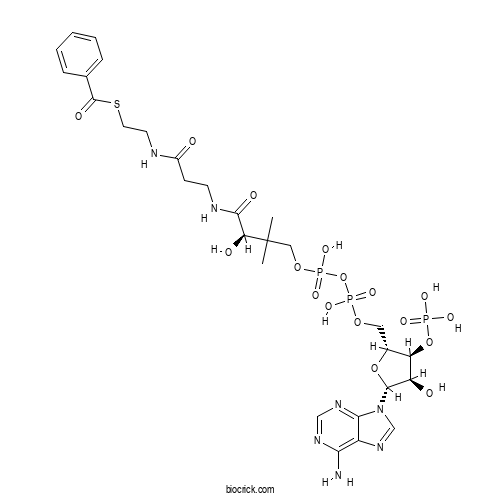 Benzoyl CoACatalog No.: BCX2369CAS No.: 102185-37-5
-
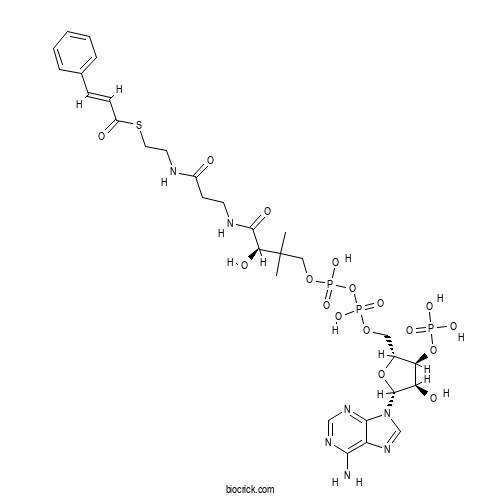 Cinnamoyl CoACatalog No.: BCX2370CAS No.: 76109-04-1
-
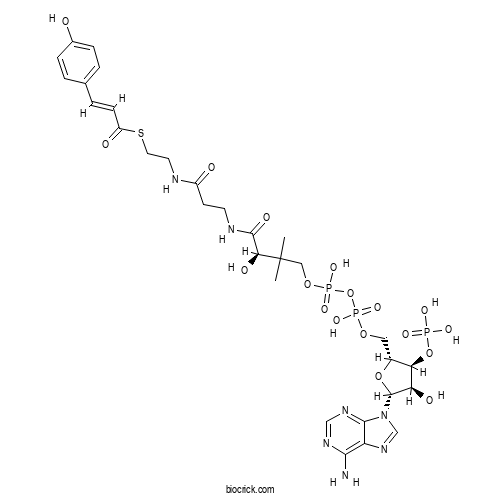 p-Coumaroyl CoACatalog No.: BCX2373CAS No.: 119785-99-8
-
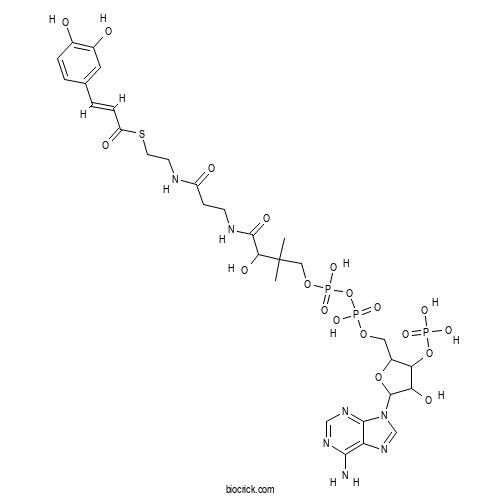 Caffeoyl CoACatalog No.: BCX2365CAS No.: 53034-79-0
-
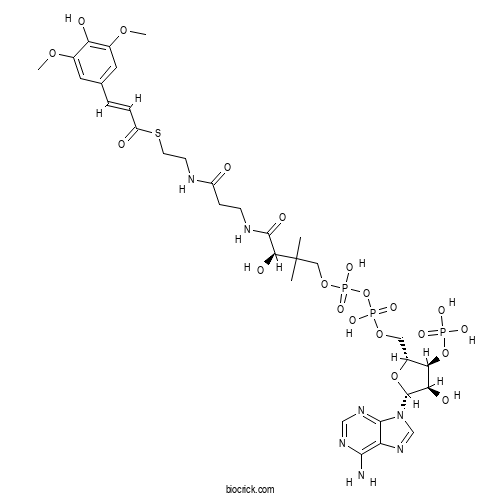 Sinapoyl CoACatalog No.: BCX2371CAS No.: 54429-80-0
-
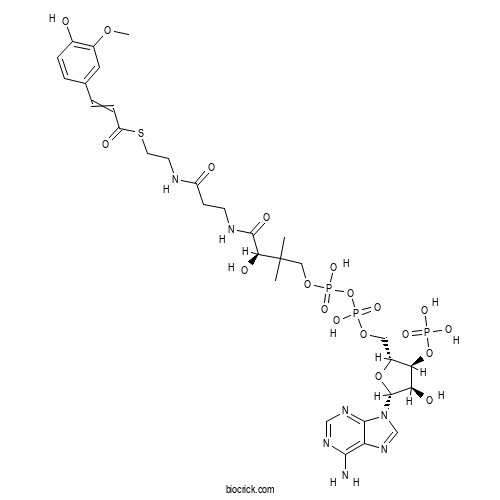 Feruloyl CoACatalog No.: BCX2367CAS No.: 30802-02-9
| 1 mg | 5 mg | 10 mg | 20 mg | 25 mg | |
| 1 mM | 1.3029 mL | 6.5147 mL | 13.0293 mL | 26.0586 mL | 32.5733 mL |
| 5 mM | 0.2606 mL | 1.3029 mL | 2.6059 mL | 5.2117 mL | 6.5147 mL |
| 10 mM | 0.1303 mL | 0.6515 mL | 1.3029 mL | 2.6059 mL | 3.2573 mL |
| 50 mM | 0.0261 mL | 0.1303 mL | 0.2606 mL | 0.5212 mL | 0.6515 mL |
| 100 mM | 0.013 mL | 0.0651 mL | 0.1303 mL | 0.2606 mL | 0.3257 mL |
| * Note: If you are in the process of experiment, it's necessary to make the dilution ratios of the samples. The dilution data above is only for reference. Normally, it's can get a better solubility within lower of Concentrations. | |||||
- Acetyl CoA
Catalog No.:BCX2363
CAS No.:102029-73-2
- 7-Dehydrocholestero
Catalog No.:BCX2362
CAS No.:434-16-2
- Desmosterol
Catalog No.:BCX2361
CAS No.:313-04-2
- 2,2-Dimethyl-2,3-dihydroquinazolin-4(1H )-one
Catalog No.:BCX2360
CAS No.:77726-78-4
- Uridine 5'-diphosphogalactose disodium
Catalog No.:BCX2359
CAS No.:137868-52-1
- Uridine 5'-diphosphoxylose disodium
Catalog No.:BCX2358
CAS No.:108320-89-4
- Adenosine triphosphate
Catalog No.:BCX2357
CAS No.:56-65-5
- Cisplatin
Catalog No.:BCX2356
CAS No.:15663-27-1
- Uridine 5'-diphosphogaluronic acid trisodium
Catalog No.:BCX2355
CAS No.:148407-07-2
- Phenylephrine
Catalog No.:BCX2354
CAS No.:59-42-7
- Dotriacontane
Catalog No.:BCX2353
CAS No.:544-85-4
- 5-Pentadecylresorcinol
Catalog No.:BCX2352
CAS No.:3158-56-3
- Caffeoyl CoA
Catalog No.:BCX2365
CAS No.:53034-79-0
- 22(S)-Hydroxycholesterol
Catalog No.:BCX2366
CAS No.:22348-64-7
- Feruloyl CoA
Catalog No.:BCX2367
CAS No.:30802-02-9
- Palmitoyl CoA
Catalog No.:BCX2368
CAS No.:188174-64-3
- Benzoyl CoA
Catalog No.:BCX2369
CAS No.:102185-37-5
- Cinnamoyl CoA
Catalog No.:BCX2370
CAS No.:76109-04-1
- Sinapoyl CoA
Catalog No.:BCX2371
CAS No.:54429-80-0
- NADPH tetrasodium salt
Catalog No.:BCX2372
CAS No.:2646-71-1
- p-Coumaroyl CoA
Catalog No.:BCX2373
CAS No.:119785-99-8
- L-Ascorbic-1-13C acid
Catalog No.:BCX2374
CAS No.:178101-88-7
- CoA sodium salt
Catalog No.:BCX2375
CAS No.:55672-92-9
- Flavin adenine dinucleotide disodium salt hydrate
Catalog No.:BCX2376
CAS No.:84366-81-4
Palmitate puts ACLY in shape to reprogram macrophages.[Pubmed:42832336]
Cell Rep. 2026 Oct 5;45(10):118061.
Zhao et al.(1) show that palmitate-driven ATP citrate lyase (ACLY) palmitoylation stabilizes nuclear ACLY tetramers, increases acetyl CoA production, and promotes pro-inflammatory macrophage programs. Targeting macrophage SCD1 with palmitate supplementation exploits this pathway to remodel the tumor microenvironment and suppress hepatocellular carcinoma.
Isolation and Characterization of Random Citrate Synthase Variants That Increase Acetate Generation by Escherichia coli.[Pubmed:42831444]
Biotechnol Bioeng. 2026 Oct 5.
A method to select Escherichia coli citrate synthase variants having reduced activity was developed based initially on the increased generation of acid, observed visually by prolonged color change in the pH indicator bromocresol purple. Five hundred fifty-two potential variants were isolated and each were cultured on glucose as sole carbon source. Of this library, 41 variants showed increased duration of the color change, indicating elevated acid formation. These strains were then examined in single shake flasks, and 16 demonstrated at least 2.5x greater acetate production than the wild-type citrate synthase parent strain. These 16 strains were selected for sequencing and quantitative studies. In shake flask studies, an inverse correlation was observed between maximum specific growth rate and acetate yield, with lowered growth rate being an indication of mutation severity. The wild-type citrate synthase and two variant enzymes were purified and their kinetic parameters determined. These three strains were also compared under carbon-limited, steady-state conditions at a growth rate of 0.20 h(-1), where acetate yield and specific glucose uptake were correlated with severity of mutation. The results are explained mathematically in terms of an enzyme partitioning ratio using the relative kinetics of the competing enzymes (modified citrate synthase and phosphotransacetylase). The results demonstrate how partitioning of glycolytic flux between the tricarboxylic acid and other competitive pathways to products derived from acetyl-CoA can be modulated by decreasing citrate synthase activity, a method which complements other methods including those using promoter strength and expression level.
Altered Acylcarnitine Metabolism in cardiac diseases: From molecular mechanisms to translational potential.[Pubmed:42831163]
Int J Cardiol Heart Vasc. 2026 Sep 25;67:102010.
Cardiovascular diseases (CVDs) are a leading global cause of mortality and disease burden, closely associated with the remodeling of myocardial energy metabolism. Acylcarnitines (Acs) are key intermediates in the carnitine shuttle and fatty acid beta-oxidation (FAO) processes. They play a critical role in transporting long-chain fatty acids across the mitochondrial membrane, maintaining the intracellular acyl-CoA/CoA balance, and buffering metabolic flux. Recent metabolomics studies have demonstrated significant abnormalities in acylcarnitine profiles across various cardiac diseases, including coronary artery disease, ischemia-reperfusion injury, heart failure, diabetic cardiomyopathy, and arrhythmias. These abnormalities are closely correlated with disease severity, metabolic disturbances, and poor clinical prognosis. Mechanistically, the pathological accumulation of long-chain acylcarnitines triggers lipotoxicity, exacerbates mitochondrial oxidative stress, and impairs calcium homeostasis, which collectively drive inflammation and cardiomyocyte apoptosis. This review systematically summarizes the physiological roles of the carnitine shuttle, explores the underlying mechanisms of acylcarnitine-induced cardiac injury, and highlights their translational potential as promising diagnostic biomarkers and novel therapeutic targets for cardiovascular metabolic interventions.
Stable Isotope Labeling to Track De Novo Fatty Acid Synthesis in Mouse Cartilage-Enriched Joint Tissue In Vivo: A Practical Workflow.[Pubmed:42830664]
J Orthop Res. 2026 Oct;44(10):e70290.
Cartilage is traditionally viewed as a metabolically quiescent tissue that relies primarily on exogenous lipid uptake to meet its energetic and structural demands. However, increasing evidence suggests that chondrocytes exhibit metabolically active behaviors, particularly under aging and pathological conditions. Here, we developed and applied an in vivo deuterium oxide (D(2)O)-based stable isotope labeling approach to directly quantify de novo fatty-acid synthesis in cartilage. Using gas chromatography-mass spectrometry (GC-MS), we tracked deuterium incorporation into palmitate in serum and articular cartilage from wild-type (WT) and cartilage-specific acetyl-CoA carboxylase 1 (ACC1) knockout mice. Progressive incorporation of deuterium into palmitate confirmed active fatty-acid synthesis in cartilage, with labeling kinetics distinct from those observed in serum, consistent with slower lipid turnover in the matrix-dense cartilage environment. Although fractional new synthesis of palmitate was comparable between genotypes during the labeling window, ACC1-deficient cartilage exhibited reduced palmitate abundance and decreased higher-order isotopomer enrichment at early labeling time points, indicating attenuated lipogenic flux. These findings provide direct in vivo evidence that chondrocytes possess intrinsic lipogenic capacity and that ACC1 contributes to the maintenance of the cartilage lipid pool. Together, this study establishes D(2)O-based isotope tracing as a robust and quantitative framework for assessing cartilage lipid metabolism in vivo and reveals de novo lipogenesis as an active metabolic process in cartilage. CLINICAL SIGNIFICANCE: This approach offers a valuable platform for investigating lipid dysregulation in osteoarthritis and other joint diseases.
NAD and NADPH in Neuronal Injury and Degeneration.[Pubmed:42830098]
Biochemistry (Mosc). 2026 Sep;91(9):1507-1521.
The review focuses on novel targets recently identified in the mechanisms of neuronal death, and specifically in axonal degeneration. Depletion of NAD triggers various death pathways depending on the nature of the NAD degradation trigger. Wallerian degeneration (WD) of axons in the peripheral nervous system follows the specific mechanism activated by NMNAT2/SARM1 - "sarmoptosis", which is also observed in other tissues, and contributes to the chemotherapy-induced neurological effects. An allosteric inhibitor of the NADase activity of SARM1, SIR2501, has been recently approved by FDA for prevention of chemotherapy-induced peripheral neuropathy. Sarmoptosis cross-talks to apoptosis and ferroptosis in the injury-induced axonal degeneration of the central nervous system and, in particular, in spinal cord injury. NADPH plays opposing roles in the cell death. Ferroptosis suppressor protein 1 (FSP1), an NADPH-dependent enzyme, is the key actor generating ubiquinol Q10 to neutralize lipid peroxides. On the other hand, NOX4 activation results in ROS generation from NADPH. NADPH depletion through the polyol pathway activation diminishes antioxidant capacity of the cell and sends pro-death signal through the NADPH sensor in ER - ubiquitin ligase MARCHF6 (Membrane Associated Ring-CH-Type Finger 6). Under the conditions of low NADPH concentrations, MARCHF6 stabilizes pro-death proteins such as p53 and ferroptosis-fueling enzyme ACSL4 (Acyl-CoA synthetase long-chain family member 4). Under the conditions of high NADPH concentration, MARCHF6 ubiquitinates p53 and ACSL4 targeting them for the proteasomal degradation. Regulation of MARCHF6 activity is a promising target for intervention; however, no small molecules mimicking NADPH effect are currently available. In conclusion, the review discusses to what extent the existing NAD supplements could perform the role of targeted medicines.
Immunometabolic alterations in post-traumatic stress disorder.[Pubmed:42829158]
Brain Behav Immun. 2026 Oct 3:107031.
Post-traumatic stress disorder (PTSD) has been linked to various alterations within the immune system, yet the metabolic programming of immune cells remains unexplored. In the current exploratory cross-sectional study, we interrogated immunometabolic function by applying cell-specific metabolic flow cytometry, serum biomarker profiling, and targeted gene expression analysis in peripheral blood mononuclear cells from patients with PTSD (n = 34) compared with healthy controls (n = 32). PTSD was associated with elevated serum IL-6 (p = 0.005) and higher glycolysis- and oxidative pentose phosphate pathway-related markers (identified by CITRUS/SAM using a prespecified FDR threshold of 1%): lactate dehydrogenase (LDH) and glucose-6-phosphate dehydrogenase (G6PD) across adaptive and innate immune cell subsets (CD4(+) T, CD8(+) T, B cells, NK cells, monocytes; Cohen's d = 0.51-0.74). CD4(+) T cells additionally showed elevated glucose transporter 1 (GLUT1, Cohen's d = 0.76), CD8(+) T cells demonstrated enhanced carnitine palmitoyl transferase 1A (CPT1a, Cohen's d = 0.54) expression, and monocytes exhibited increased acetyl-CoA carboxylase (ACAC, Cohen's d = 0.69). Expression of inflammatory- and stress-related genes was largely comparable between groups. Together, these data provide preliminary evidence for immunometabolic alterations in PTSD at both cellular and systemic levels. These results could contribute to understanding potential pathophysiological mechanisms and support further investigation of immunometabolism in PTSD.
Tirzepatide attenuates cardiac microvascular injury and ferroptosis-related lipid peroxidation in diabetic mice: endothelial responses in the context of partial PRKN silencing.[Pubmed:42826814]
Eur J Pharmacol. 2026 Oct 2;1036:179387.
BACKGROUND: Diabetic metabolic stress damages the cardiac microvasculature. We evaluated tirzepatide-associated cardiac and endothelial effects, including endpoint patterns after partial silencing of parkin RBR E3 ubiquitin protein ligase (PRKN) and lipidated microtubule-associated protein 1 light chain 3 beta (LC3B-II) accumulation during lysosomal blockade. METHODS: Male C57BL/6J mice received a normal diet, a high-fat diet (HFD), or HFD/streptozotocin (STZ); HFD and HFD/STZ cohorts received tirzepatide or vehicle for 8 weeks. Metabolic, cardiac, microvascular, lipid-peroxidation, iron, and protein endpoints were assessed; ultrastructure was evaluated descriptively. Human cardiac microvascular endothelial cells (HCMECs) underwent high glucose/palmitic acid (HG/PA), PRKN-silencing, and bafilomycin A1 (BafA1) experiments. RESULTS: In HFD/STZ mice, tirzepatide improved selected glycemic and lipid measures and attenuated ventricular dilation, systolic dysfunction, myocardial fibrosis, and microvascular injury. Myocardial 4-hydroxynonenal, malondialdehyde, and ferrous iron were lower, and mitochondrial quality-control and ferroptosis-related protein profiles shifted toward control levels. In HG/PA-exposed HCMECs, tirzepatide increased the JC-1 aggregate/monomer ratio, decreased 4-hydroxynonenal and acyl-CoA synthetase long-chain family member 4, and increased glutathione peroxidase 4 and ferritin heavy chain 1. Among tirzepatide-treated cultures, endpoints were less favorable with partial PRKN silencing than with control small interfering RNA, although treatment-associated differences remained within the PRKN-silenced background. BafA1 increased LC3B-II in control and HG/PA + tirzepatide cultures; the increase under HG/PA alone was not significant. CONCLUSIONS: Tirzepatide was associated with less cardiac microvascular injury and ferroptosis-related lipid peroxidation. PRKN-silencing status was associated with endothelial endpoint patterns after tirzepatide treatment; effect modification and requirement were not established. Receptor dependence, mitophagic flux, and independence from systemic metabolic improvement remain unresolved.
Alanine aminotransferase-acetyl-CoA carboxylase switching produces starch-rich bioethanol feedstock in Desmodesmus.[Pubmed:42826800]
Bioresour Technol. 2026 Oct 2:135992.
Effective control of intracellular carbon allocation is essential for the production of targeted microalgal feedstocks. This study evaluated the sequential manipulation of alanine aminotransferase (ALT)-mediated alanine-pyruvate metabolism and acetyl CoA carboxylase (ACC)-dependent lipid synthesis in nitrogen-limited Desmodesmus sp. CNW-N. An integrated approach combined physiological analysis, transcriptomics, enzyme assays, inducible CrAAT1 overexpression, pharmacological interventions, [U (13)C(6)]glucose labelling, and simultaneous saccharification and fermentation. Nitrogen depletion initially induced a starch-rich state, followed by lipid accumulation, accompanied by transient increases in alanine and aspartate levels and elevated ALT and ACC activities. Inhibition of aminotransferase activity increased alanine retention and decreased fatty acid accumulation, while clethodim treatment reduced ACC activity and lipid accumulation but enhanced carbohydrate retention. [U-(13)C(6)]glucose labelling demonstrated reciprocal (13)C enrichment in carbohydrate- and lipid-associated pools, although direct tracing of alanine carbon was not observed. The combination of ALT overexpression and ACC inhibition produced 4.78 g/L biomass containing 75.32% glucose plus xylose (approximately 3.60 g/L fermentable sugar), a 37% increase over clethodim-treated wild type. Fermentation produced 378 g/kg dry biomass with 98-99% conversion efficiency. These findings link improved ethanol output to feedstock enrichment and indicate two metabolic control points for directing carbon toward fermentable carbohydrates in Desmodesmus sp. CNW-N.
Caffeic acid phenethyl ester inhibits adipogenic differentiation in association with INSR suppression and AMPK activation.[Pubmed:42826791]
Biochim Biophys Acta Gene Regul Mech. 2026 Oct 2:195186.
BACKGROUND: Adipogenic differentiation of preadipocytes is a tightly regulated process central to adipose tissue development and dysfunction. Caffeic acid phenethyl ester (CAPE), a major bioactive compound in propolis, has been reported to modulate adipogenesis, yet its upstream molecular targets and mechanisms of action remain unclear. METHODS: The impact of CAPE on adipogenic differentiation was investigated in 3T3-L1 preadipocytes using Oil Red O and BODIPY 493/503 staining, Western blot, and RT-qPCR. AICAR and Compound C were used to activate or inhibit AMP-activated protein kinase (AMPK), respectively. Potential targets and regulatory interactions involved in CAPE-mediated signaling were explored through in silico prediction, molecular docking, and protein-protein interaction analysis. Functional validation was performed using insulin receptor (INSR) overexpression and analysis of AMPK and acetyl-CoA carboxylase (ACC) phosphorylation. RESULTS: CAPE inhibited lipid accumulation and suppressed the expression of adipogenic markers peroxisome proliferator-activated receptor gamma (PPARgamma), CCAAT/enhancer-binding protein alpha (C/EBPalpha), and fatty acid synthase (FAS) in a dose-dependent manner. Pharmacological activation of AMPK reproduced the anti-adipogenic effects of CAPE, while AMPK inhibition or INSR overexpression reversed these effects. CAPE treatment enhanced AMPK and ACC phosphorylation, whereas INSR overexpression attenuated this activation and abolished CAPE's inhibitory effect on adipogenesis. CONCLUSION: CAPE suppresses adipogenic differentiation by modulating upstream regulators of the AMPK signaling pathway. These findings provide mechanistic insight into the anti-adipogenic actions of CAPE and highlight its therapeutic potential for metabolic disorders involving adipose tissue dysfunction.

Calcutta University

University of Minnesota

University of Maryland School of Medicine

University of Illinois at Chicago

The Ohio State University

University of Zurich

Harvard University

Colorado State University

Auburn University

Yale University

Worcester Polytechnic Institute

Washington State University

Stanford University

University of Leipzig

Universidade da Beira Interior

The Institute of Cancer Research

Heidelberg University

University of Amsterdam

University of Auckland

TsingHua University

The University of Michigan

Miami University

DRURY University

Jilin University

Fudan University

Wuhan University

Sun Yat-sen University

Universite de Paris

Deemed University

Auckland University

The University of Tokyo

Korea University



