
Sinapoyl CoACAS# 54429-80-0 |
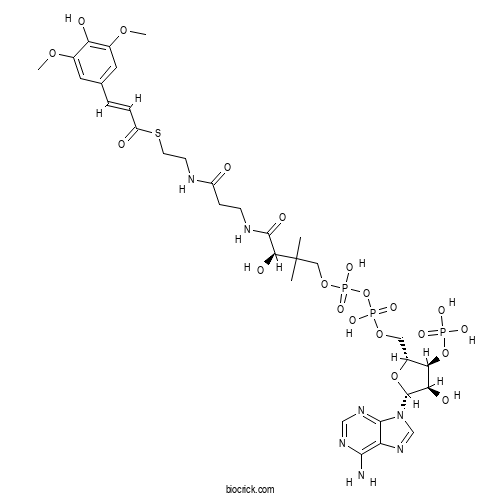
| Cas No. | 54429-80-0 | SDF | File under preparation. |
| PubChem ID | 11966120.0 | Appearance | Powder |
| Formula | C32H46N7O20P3S | M.Wt | 973.7 |
| Type of Compound | N/A | Storage | Desiccate at -20°C |
| Solubility | Soluble in Chloroform,Dichloromethane,Ethyl Acetate,DMSO,Acetone,etc. | ||
| Chemical Name | S-[2-[3-[[(2R)-4-[[[(2R,3S,4R,5R)-5-(6-aminopurin-9-yl)-4-hydroxy-3-phosphonooxyoxolan-2-yl]methoxy-hydroxyphosphoryl]oxy-hydroxyphosphoryl]oxy-2-hydroxy-3,3-dimethylbutanoyl]amino]propanoylamino]ethyl] (E)-3-(4-hydroxy-3,5-dimethoxyphenyl)prop-2-enethioate | ||
| SMILES | CC(C)(COP(=O)(O)OP(=O)(O)OCC1C(C(C(O1)N2C=NC3=C(N=CN=C32)N)O)OP(=O)(O)O)C(C(=O)NCCC(=O)NCCSC(=O)C=CC4=CC(=C(C(=C4)OC)O)OC)O | ||
| Standard InChIKey | RBFUWESMWRUGFY-GSNIOFLCSA-N | ||
| Standard InChI | InChI=1S/C32H46N7O20P3S/c1-32(2,27(44)30(45)35-8-7-21(40)34-9-10-63-22(41)6-5-17-11-18(53-3)24(42)19(12-17)54-4)14-56-62(51,52)59-61(49,50)55-13-20-26(58-60(46,47)48)25(43)31(57-20)39-16-38-23-28(33)36-15-37-29(23)39/h5-6,11-12,15-16,20,25-27,31,42-44H,7-10,13-14H2,1-4H3,(H,34,40)(H,35,45)(H,49,50)(H,51,52)(H2,33,36,37)(H2,46,47,48)/b6-5+/t20-,25-,26-,27+,31-/m1/s1 | ||
| General tips | For obtaining a higher solubility , please warm the tube at 37 ℃ and shake it in the ultrasonic bath for a while.Stock solution can be stored below -20℃ for several months. We recommend that you prepare and use the solution on the same day. However, if the test schedule requires, the stock solutions can be prepared in advance, and the stock solution must be sealed and stored below -20℃. In general, the stock solution can be kept for several months. Before use, we recommend that you leave the vial at room temperature for at least an hour before opening it. |
||
| About Packaging | 1. The packaging of the product may be reversed during transportation, cause the high purity compounds to adhere to the neck or cap of the vial.Take the vail out of its packaging and shake gently until the compounds fall to the bottom of the vial. 2. For liquid products, please centrifuge at 500xg to gather the liquid to the bottom of the vial. 3. Try to avoid loss or contamination during the experiment. |
||
| Shipping Condition | Packaging according to customer requirements(5mg, 10mg, 20mg and more). Ship via FedEx, DHL, UPS, EMS or other couriers with RT, or blue ice upon request. | ||
Quality Control & MSDS
3D structure
Package In Stock

Number of papers citing our products


Sinapoyl CoA Dilution Calculator
Sinapoyl CoA Molarity Calculator
-
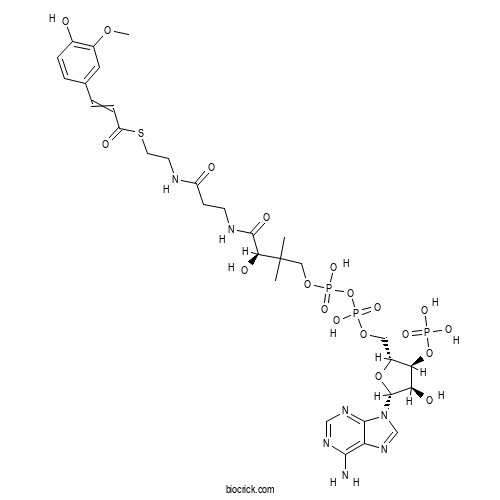 Feruloyl CoACatalog No.: BCX2367CAS No.: 30802-02-9
-
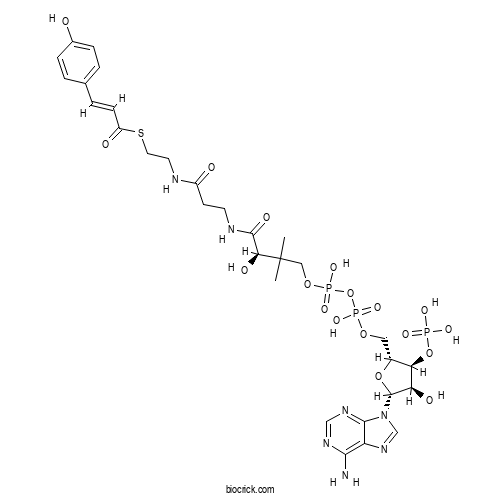 p-Coumaroyl CoACatalog No.: BCX2373CAS No.: 119785-99-8
-
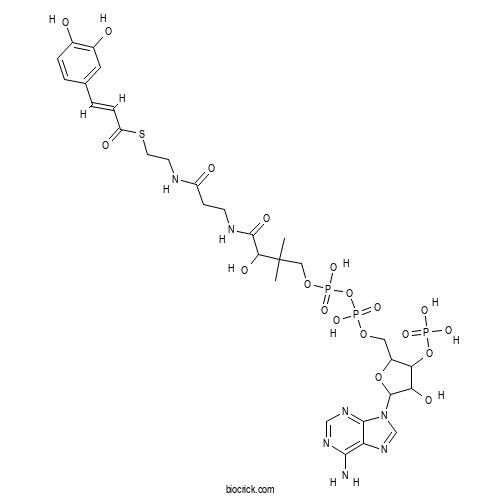 Caffeoyl CoACatalog No.: BCX2365CAS No.: 53034-79-0
-
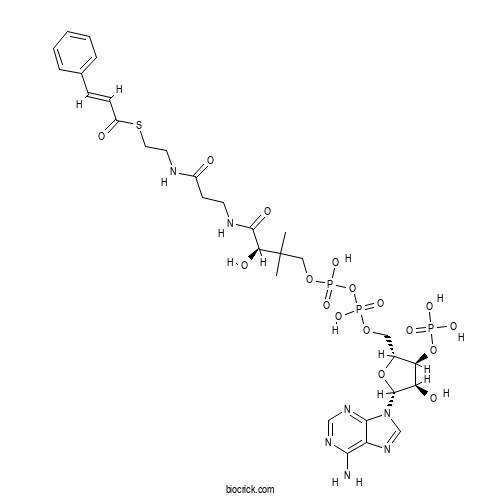 Cinnamoyl CoACatalog No.: BCX2370CAS No.: 76109-04-1
-
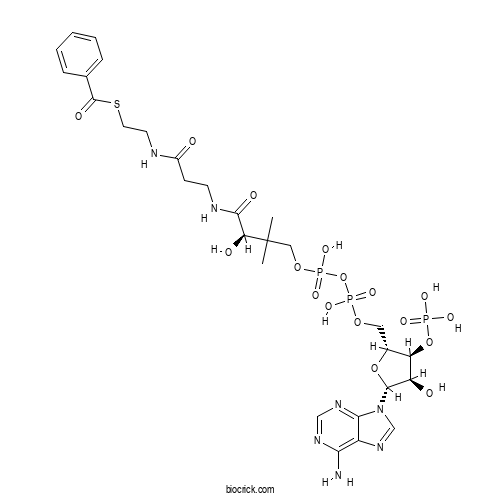 Benzoyl CoACatalog No.: BCX2369CAS No.: 102185-37-5
-
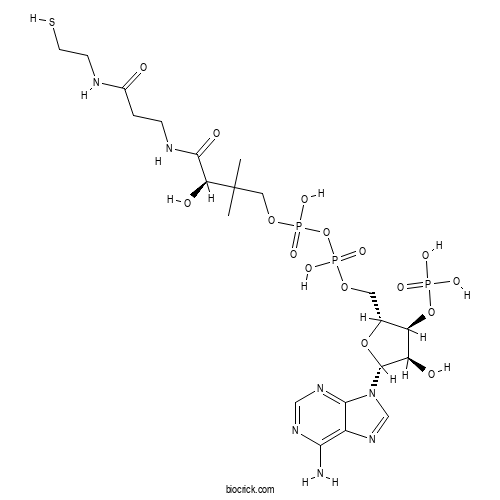 CoACatalog No.: BCX2364CAS No.: 85-61-0
| 1 mg | 5 mg | 10 mg | 20 mg | 25 mg | |
| 1 mM | 1.027 mL | 5.1351 mL | 10.2701 mL | 20.5402 mL | 25.6753 mL |
| 5 mM | 0.2054 mL | 1.027 mL | 2.054 mL | 4.108 mL | 5.1351 mL |
| 10 mM | 0.1027 mL | 0.5135 mL | 1.027 mL | 2.054 mL | 2.5675 mL |
| 50 mM | 0.0205 mL | 0.1027 mL | 0.2054 mL | 0.4108 mL | 0.5135 mL |
| 100 mM | 0.0103 mL | 0.0514 mL | 0.1027 mL | 0.2054 mL | 0.2568 mL |
| * Note: If you are in the process of experiment, it's necessary to make the dilution ratios of the samples. The dilution data above is only for reference. Normally, it's can get a better solubility within lower of Concentrations. | |||||
- Cinnamoyl CoA
Catalog No.:BCX2370
CAS No.:76109-04-1
- Benzoyl CoA
Catalog No.:BCX2369
CAS No.:102185-37-5
- Palmitoyl CoA
Catalog No.:BCX2368
CAS No.:188174-64-3
- Feruloyl CoA
Catalog No.:BCX2367
CAS No.:30802-02-9
- 22(S)-Hydroxycholesterol
Catalog No.:BCX2366
CAS No.:22348-64-7
- Caffeoyl CoA
Catalog No.:BCX2365
CAS No.:53034-79-0
- CoA
Catalog No.:BCX2364
CAS No.:85-61-0
- Acetyl CoA
Catalog No.:BCX2363
CAS No.:102029-73-2
- 7-Dehydrocholestero
Catalog No.:BCX2362
CAS No.:434-16-2
- Desmosterol
Catalog No.:BCX2361
CAS No.:313-04-2
- 2,2-Dimethyl-2,3-dihydroquinazolin-4(1H )-one
Catalog No.:BCX2360
CAS No.:77726-78-4
- Uridine 5'-diphosphogalactose disodium
Catalog No.:BCX2359
CAS No.:137868-52-1
- NADPH tetrasodium salt
Catalog No.:BCX2372
CAS No.:2646-71-1
- p-Coumaroyl CoA
Catalog No.:BCX2373
CAS No.:119785-99-8
- L-Ascorbic-1-13C acid
Catalog No.:BCX2374
CAS No.:178101-88-7
- CoA sodium salt
Catalog No.:BCX2375
CAS No.:55672-92-9
- Flavin adenine dinucleotide disodium salt hydrate
Catalog No.:BCX2376
CAS No.:84366-81-4
- Diplomorphanin A
Catalog No.:BCX2377
CAS No.:1559076-44-6
- cis-Oxyresveratrol 3-O-glucoside
Catalog No.:BCX2378
CAS No.:2493206-35-0
- 3-Methyl-2-butenyl caffeate
Catalog No.:BCX2379
CAS No.:118971-61-2
- 3-Methyl-3-butenyl caffeate
Catalog No.:BCX2380
CAS No.:119644-16-5
- 6''-O-β-D-Apiofuranosylastragalin
Catalog No.:BCX2381
CAS No.:946827-13-0
- Amburoside A
Catalog No.:BCX2382
CAS No.:110978-35-3
- cis-Oxyresveratrol 4'-O-glucoside
Catalog No.:BCX2383
CAS No.:863329-67-3
Sequence analysis, in silico modeling and docking studies of caffeoyl CoA-O-methyltransferase of Populus trichopora.[Pubmed:20169383]
J Mol Model. 2010 Sep;16(9):1461-71.
Caffeoyl coenzyme A-O-methyltransferases (CCoAOMTs) which are characterized under class I plant OMTs, methylates CoA thioesters, with an in vitro kinetic preference for caffeoyl CoA. CCoAOMTs exhibit association with lignin biosynthesis by showing a prime role in the synthesis of guaiacyl lignin and providing the substrates for synthesis of syringyl lignin. The sequence analysis of CCoAOMT from Populus trichopora exhibits 58 nucleotide substitutions, where transitions overcome transversions. Validation of homology models of both CCoAOMT1 and 2 isoforms reveals that 92.4% and 96% residues are falling in the most favorable region respectively in the Ramachandran plot, indicating CCoAOMT2 as the more satisfactory model, and the overall quality factor of both isoforms is 98.174. The structural architecture analysis is showing very good packing of residues similar to protein crystal structures data. The active site residues and substrate-product interactions showed that CCoAOMT2 possesses more affinity toward caffeoyl CoA, feruloyl CoA, 5-hydroxy feruloyl CoA and Sinapoyl CoA than CCoAOMT1, therefore it exist in a more active conformation. The affinity of CCoAOMT2 with feruloyl CoA is highest among all the affinities of both CCoAOMT isoforms with their substrates and products. This information has potential implications to understand the mechanism of CCoAOMT related enzymatic reactions in Populus trichopora, however the approach will be applicable in prediction of substrates and engineering 3D structures of other enzymes as well.
A novel polyamine acyltransferase responsible for the accumulation of spermidine conjugates in Arabidopsis seed.[Pubmed:19168716]
Plant Cell. 2009 Jan;21(1):318-33.
Hydroxycinnamic acid amides are a class of secondary metabolites distributed widely in plants. We have identified two sinapoyl spermidine derivatives, N-((4'-O-glycosyl)-sinapoyl),N'-sinapoylspermidine and N,N'-disinapoylspermidine, which comprise the two major polyamine conjugates that accumulate in Arabidopsis thaliana seed. Using metabolic profiling of knockout mutants to elucidate the functions of members of the BAHD acyltransferase family in Arabidopsis, we have also identified two genes encoding spermidine disinapoyl transferase (SDT) and spermidine dicoumaroyl transferase (SCT) activities. At2g23510, which is expressed mainly in seeds, encodes a spermidine Sinapoyl CoA acyltransferase (SDT) that is required for the production of disinapoyl spermidine and its glucoside in Arabidopsis seed. The structurally related BAHD enzyme encoded by At2g25150 is expressed specifically in roots and has spermidine coumaroyl CoA acyltransferase (SCT) activity both in vitro and in vivo.
Characterization of a cinnamoyl-CoA reductase that is associated with stem development in wheat.[Pubmed:17452751]
J Exp Bot. 2007;58(8):2011-21.
Cinnamoyl-CoA reductase (CCR) is responsible for the CoA ester to aldehyde conversion in monolignol biosynthesis, which diverts phenylpropanoid-derived metabolites into the biosynthesis of lignin. To gain a better understanding of lignin biosynthesis and its biological function, a cDNA encoding CCR was identified from wheat (Triticum aestivum L.), and designated as Ta-CCR1. Phylogenetic analysis indicated that Ta-CCR1 grouped together with other monocot CCR sequences while it diverged from Ta-CCR2. DNA gel-blot and mapping analyses demonstrated that Ta-CCR1 is present as a single copy gene in the wheat genome. Recombinant Ta-CCR1 protein converted feruloyl CoA, 5-OH-feruloyl CoA, Sinapoyl CoA, and caffeoyl CoA, but feruloyl-CoA was the best substrate, suggesting the preferential biosynthesis of G-type lignin. RNA gel-blot analysis indicated that Ta-CCR1 was highly expressed in stem, with lower expression in leaves, and undetectable expression in roots. CCR enzyme activity was increased progressively along with the lignin biosynthesis and stem maturity. During stem development, Ta-CCR1 mRNA levels remained high at elongation, heading, and milky stages in the wheat H4564 cultivar, while they declined dramatically at the heading and milky stages in stems of the C6001 cultivar. Ta-CCR1 mRNA expression paralleled extractable CCR enzyme activity in these two cultivars. Furthermore, high Ta-CCR1 mRNA levels and high CCR enzyme activity in wheat stem were correlated with a higher Klason lignin content and greater stem mechanical strength in the H4564 cultivar. This suggests that Ta-CCR1 and its related CCR enzyme may be involved in the regulation of lignin biosynthesis during stem maturity and then contributes to stem strength support in wheat.
Biochemical characterization of a cinnamoyl-CoA reductase from wheat.[Pubmed:16006242]
Biol Chem. 2005 Jun;386(6):553-60.
Cinnamoyl-CoA reductase (CCR) is responsible for the CoA ester-->aldehyde conversion in monolignol biosynthesis, which can divert phenylpropanoid-derived metabolites into the biosynthesis of lignin. To gain a better understanding of lignin biosynthesis in wheat (Triticum aestivum L.), a cDNA encoding CCR was isolated and named Ta-CCR2. DNA hybridization analyses demonstrated that the Ta-CCR2 gene exists in three copies in the wheat genome. RNA blot hybridization indicated that Ta-CCR2 was expressed most abundantly in root and stem tissues that were in the process of lignification. The secondary and three-dimensional structures of Ta-CCR2 were analyzed by molecular modeling. Recombinant Ta-CCR2 protein purified from E. coli converted feruloyl CoA, 5-OH-feruloyl CoA, Sinapoyl CoA and caffeoyl CoA with almost similar efficiency, suggesting that it is involved in both G and S lignin synthesis. Ta-CCR2 had a very low V max value for 4-coumaroyl CoA, which may serve as a mechanism to control metabolic flux to H lignin in vivo . Furthermore, the reaction mechanism of Ta-CCR2 was analyzed in relation to its possible three-dimensional structure. The activity of Ta-CCR2 in relation to lignin biosynthesis is discussed.
4-Coumarate:coenzyme A ligase in black locust (Robinia pseudoacacia) catalyses the conversion of sinapate to sinapoyl-CoA.[Pubmed:15235922]
J Plant Res. 2004 Aug;117(4):303-10.
4-Coumarate:coenzyme A (CoA) ligase (4CL, EC 6.2.1.12) in crude enzyme preparation from the developing xylem of black locust (Robinia pseudoacacia) converted sinapate to Sinapoyl CoA. The sinapate-converting activity was not inhibited by other cinnamate derivatives, such as p-coumarate, caffeate or ferulate, in the mixed-substrate assay. The crude extract prepared from the developing xylem was separated by anion-exchange chromatography into three different 4CL isoforms. The isoform 4CL1 had a strong substrate preference for p-coumarate, but lacked the activity for ferulate and sinapate. On the other hand, 4CL2 and 4CL3 displayed activity toward sinapate and also possessed high activity toward caffeate as well as p-coumarate. The crude extract from the shoots exhibited a very similar substrate preference to that of the developing xylem; therefore, 4CL2 may be a major isoform in both crude enzyme preparations. These results support the hypothesis that sinapate-converting 4CL isoform is constitutively expressed in lignin-forming cells.

Calcutta University

University of Minnesota

University of Maryland School of Medicine

University of Illinois at Chicago

The Ohio State University

University of Zurich

Harvard University

Colorado State University

Auburn University

Yale University

Worcester Polytechnic Institute

Washington State University

Stanford University

University of Leipzig

Universidade da Beira Interior

The Institute of Cancer Research

Heidelberg University

University of Amsterdam

University of Auckland

TsingHua University

The University of Michigan

Miami University

DRURY University

Jilin University

Fudan University

Wuhan University

Sun Yat-sen University

Universite de Paris

Deemed University

Auckland University

The University of Tokyo

Korea University



