
3-Methyl-2-butenyl caffeateCAS# 118971-61-2 |
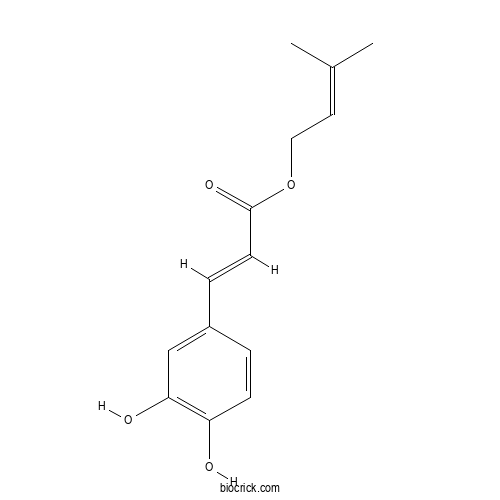
| Cas No. | 118971-61-2 | SDF | File under preparation. |
| PubChem ID | 5281790.0 | Appearance | Powder |
| Formula | C14H16O4 | M.Wt | 248.3 |
| Type of Compound | N/A | Storage | Desiccate at -20°C |
| Solubility | Soluble in Chloroform,Dichloromethane,Ethyl Acetate,DMSO,Acetone,etc. | ||
| Chemical Name | 3-methylbut-2-enyl (E)-3-(3,4-dihydroxyphenyl)prop-2-enoate | ||
| SMILES | CC(=CCOC(=O)C=CC1=CC(=C(C=C1)O)O)C | ||
| Standard InChIKey | TTYOHMFLCXENHR-GQCTYLIASA-N | ||
| Standard InChI | InChI=1S/C14H16O4/c1-10(2)7-8-18-14(17)6-4-11-3-5-12(15)13(16)9-11/h3-7,9,15-16H,8H2,1-2H3/b6-4+ | ||
| General tips | For obtaining a higher solubility , please warm the tube at 37 ℃ and shake it in the ultrasonic bath for a while.Stock solution can be stored below -20℃ for several months. We recommend that you prepare and use the solution on the same day. However, if the test schedule requires, the stock solutions can be prepared in advance, and the stock solution must be sealed and stored below -20℃. In general, the stock solution can be kept for several months. Before use, we recommend that you leave the vial at room temperature for at least an hour before opening it. |
||
| About Packaging | 1. The packaging of the product may be reversed during transportation, cause the high purity compounds to adhere to the neck or cap of the vial.Take the vail out of its packaging and shake gently until the compounds fall to the bottom of the vial. 2. For liquid products, please centrifuge at 500xg to gather the liquid to the bottom of the vial. 3. Try to avoid loss or contamination during the experiment. |
||
| Shipping Condition | Packaging according to customer requirements(5mg, 10mg, 20mg and more). Ship via FedEx, DHL, UPS, EMS or other couriers with RT, or blue ice upon request. | ||
Quality Control & MSDS
3D structure
Package In Stock

Number of papers citing our products


3-Methyl-2-butenyl caffeate Dilution Calculator
3-Methyl-2-butenyl caffeate Molarity Calculator
-
 Prenyl caffeateCatalog No.: BCC8351CAS No.: 100884-13-7
-
 Ethyl caffeateCatalog No.: BCN4214CAS No.: 102-37-4
-
 Ethyl trans-caffeateCatalog No.: BCN0320CAS No.: 66648-50-8
-
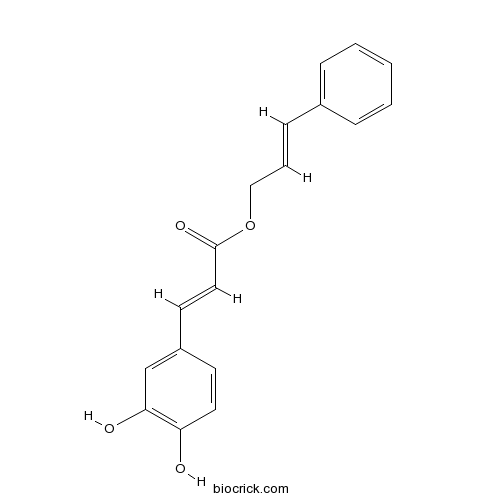 Cinnamyl caffeateCatalog No.: BCN7721CAS No.: 115610-32-7
-
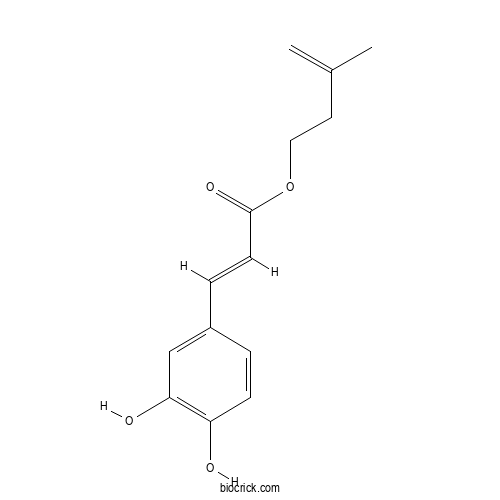 3-Methyl-3-butenyl caffeateCatalog No.: BCX2380CAS No.: 119644-16-5
-
 Geranyl ferulateCatalog No.: BCN7078CAS No.: 1206615-69-1
-
 Methyl caffeate acidCatalog No.: BCN8712CAS No.: 3843-74-1
-
 Caffeic anhydrideCatalog No.: BCN3295CAS No.: 854237-32-4
-
 Docosyl caffeateCatalog No.: BCN5182CAS No.: 28593-92-2
-
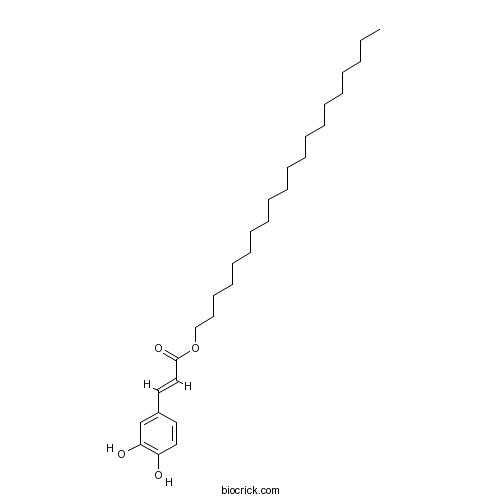 Eicosanyl caffeateCatalog No.: BCN7209CAS No.: 28593-90-0
-
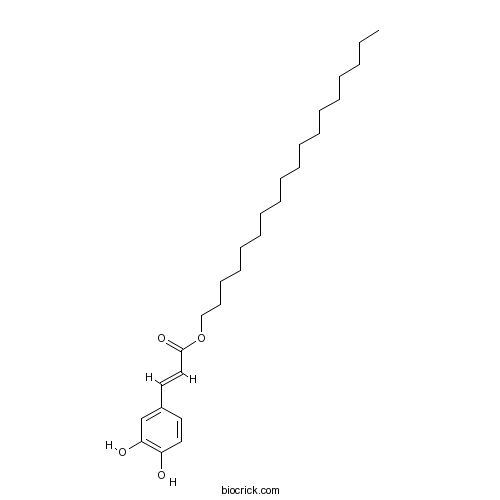 Octadecyl caffeateCatalog No.: BCN6609CAS No.: 69573-60-0
| 1 mg | 5 mg | 10 mg | 20 mg | 25 mg | |
| 1 mM | 4.0274 mL | 20.1369 mL | 40.2739 mL | 80.5477 mL | 100.6847 mL |
| 5 mM | 0.8055 mL | 4.0274 mL | 8.0548 mL | 16.1095 mL | 20.1369 mL |
| 10 mM | 0.4027 mL | 2.0137 mL | 4.0274 mL | 8.0548 mL | 10.0685 mL |
| 50 mM | 0.0805 mL | 0.4027 mL | 0.8055 mL | 1.611 mL | 2.0137 mL |
| 100 mM | 0.0403 mL | 0.2014 mL | 0.4027 mL | 0.8055 mL | 1.0068 mL |
| * Note: If you are in the process of experiment, it's necessary to make the dilution ratios of the samples. The dilution data above is only for reference. Normally, it's can get a better solubility within lower of Concentrations. | |||||
- cis-Oxyresveratrol 3-O-glucoside
Catalog No.:BCX2378
CAS No.:2493206-35-0
- Diplomorphanin A
Catalog No.:BCX2377
CAS No.:1559076-44-6
- Flavin adenine dinucleotide disodium salt hydrate
Catalog No.:BCX2376
CAS No.:84366-81-4
- CoA sodium salt
Catalog No.:BCX2375
CAS No.:55672-92-9
- L-Ascorbic-1-13C acid
Catalog No.:BCX2374
CAS No.:178101-88-7
- p-Coumaroyl CoA
Catalog No.:BCX2373
CAS No.:119785-99-8
- NADPH tetrasodium salt
Catalog No.:BCX2372
CAS No.:2646-71-1
- Sinapoyl CoA
Catalog No.:BCX2371
CAS No.:54429-80-0
- Cinnamoyl CoA
Catalog No.:BCX2370
CAS No.:76109-04-1
- Benzoyl CoA
Catalog No.:BCX2369
CAS No.:102185-37-5
- Palmitoyl CoA
Catalog No.:BCX2368
CAS No.:188174-64-3
- Feruloyl CoA
Catalog No.:BCX2367
CAS No.:30802-02-9
- 3-Methyl-3-butenyl caffeate
Catalog No.:BCX2380
CAS No.:119644-16-5
- 6''-O-β-D-Apiofuranosylastragalin
Catalog No.:BCX2381
CAS No.:946827-13-0
- Amburoside A
Catalog No.:BCX2382
CAS No.:110978-35-3
- cis-Oxyresveratrol 4'-O-glucoside
Catalog No.:BCX2383
CAS No.:863329-67-3
- Foeniculoside II
Catalog No.:BCX2384
CAS No.:168010-11-5
- Umbelliferone 7-O-β-D-xylopyranosyl-(1→6)-β-D-glucopyranoside
Catalog No.:BCX2385
CAS No.:402490-56-6
- 4'-Hydroxy-7,8-methylenedioxyhomoisoflavan
Catalog No.:BCX2386
CAS No.:148461-99-8
- Isopent-3-enyl ferulate
Catalog No.:BCX2387
CAS No.:132335-96-7
- 3'-Deoxyamburoside A
Catalog No.:BCX2388
CAS No.:362668-60-8
- (-)-Lariciresinol 4-O-glucoside
Catalog No.:BCX2389
CAS No.:364081-04-9
- Amburoside B
Catalog No.:BCX2390
CAS No.:221011-65-0
- Steppogenin 5'-C-glucoside
Catalog No.:BCX2391
CAS No.:2082826-38-6
DFT study of the effect of solvent on the H-atom transfer involved in the scavenging of the free radicals (.)HO2 and (.)O2(-) by caffeic acid phenethyl ester and some of its derivatives.[Pubmed:25388279]
J Mol Model. 2014 Nov;20(11):2509.
H-atom transfer from caffeic acid phenethyl ester (CAPE), MBC (3-Methyl-2-butenyl caffeate), BC (benzoic caffeate), P3HC (phenethyl-3-hydroxycinnamate), and P4HC (phenethyl-4-hydroxycinnamate) to the selected free radicals (.)HO2 and (.)O2(-) was studied. Such a transfer can proceed in three different ways: concerted proton-coupled electron transfer (CPCET), electron transfer followed by proton transfer (ET-PT), and proton transfer followed by electron transfer (PT-ET). The latter pathway is sometimes competitive with SPLET (sequential proton loss electron transfer) in polar media. Analyzing the thermodynamic descriptors of the reactions of CAPE and its derivatives with co-reactive species-in particular, the free energies of reactions, the activation barrier to the CPCET mechanism, and their rate constants-appears to be the most realistic method of investigating the H-atom transfers of interest. These analyses were performed via DFT calculations, which agree well with the data acquired from experimental studies (IC50) and from CBS calculations. The CPCM solvation model was used throughout the work, while the SMD model-employed as a reference-was used only for CAPE. The main conclusion drawn from the analysis was that SPLET is the mechanism that governs the reaction of phenolic acids with (.)HO2, while PT-ET governs the reaction of phenols with (.)O2(-). In kinetic investigations of the CPCET process, the rate constant decreases as the solvent polarity increases, so the reaction velocity slows down.
Allergic contact dermatitis from propolis.[Pubmed:16536336]
Dermatitis. 2005 Dec;16(4):209-15.
Propolis is commonly used in cosmetic and medicinal preparations because of its antiseptic, antiinflammatory, and anesthetic properties. Its therapeutic qualities have been well documented. However, 1.2 to 6.6% of patients who are patch-tested for dermatitis are sensitive to propolis. The main allergens are 3-Methyl-2-butenyl caffeate and phenylethyl caffeate. Benzyl salicylate and benzyl cinnamate are less frequent sensitizers. Propolis is found in a number of "natural" products, including lip balms, cosmetics, lotions and ointments, shampoos, conditioners, and toothpastes. Dermatologists should consider patch testing with propolis in users of such remedies.
Evaluation of the main contact allergens in propolis (1995 to 2005).[Pubmed:16242084]
Dermatitis. 2005 Sep;16(3):127-9.
BACKGROUND: Propolis, the bee glue, is increasingly used in biocosmetics and for the self-treatment of various diseases. OBJECTIVE: Patients reacting to propolis were requested to participate in further testing with the breakdown constituents of the bee glue. METHODS: Twenty-seven patients agreed to be tested with 18 constituents, including four caffeates (the typical allergens of propolis) derived from the sticky exudates of poplar buds. RESULTS: Seven patients did not react to the propolis constituents tested. In the remaining 20 patients, the four caffeates produced strong reactions. Phenylethyl caffeate, which produced positive reactions in 20 patients, was the leading contact allergen. Benzyl caffeate elicited strong responses in 18 patients, and 3-Methyl-2-butenyl caffeate produced reactions in 17 patients. Geranyl caffeate produced positive reactions in 11 patients. The flavonoid tectochrysin gave positive results in 2 patients; ferulic acid, coumaric acid, and methyl cinnamate produced weak responses. CONCLUSIONS: In middle Europe, the caffeates are the responsible allergens in propolis allergy. Patients from other countries, where poplar trees do not grow, become allergic to other propolis constituents but not to the caffeates.
Propolis allergy (IV). Studies with further sensitizers from propolis and constituents common to propolis, poplar buds and balsam of Peru.[Pubmed:1600736]
Contact Dermatitis. 1992 Jan;26(1):34-44.
26 different compounds have been investigated experimentally for their sensitizing capacity in guinea pigs. 19 of these occur in propolis as well as in poplar bud exudates, and 14 of them are also found in balsam of Peru. 4 caffeates and benzyl isoferulate were found to be strong sensitizers. 7 compounds were moderate, and 13 compounds showed only weak sensitizing potency. Methyl cinnamate was negative. Patch tests in 11 propolis-sensitive patients once more revealed 3-Methyl-2-butenyl caffeate and phenylethyl caffeate as the major sensitizers. In addition to the 8 compounds already known to occur in propolis as well as in balsam of Peru, we detected 5 further substances that both materials have in common. Among these, benzyl isoferulate is considered a noteworthy sensitizer. Coniferyl benzoate, which was shown to be a moderate sensitizer, is present in fresh samples of balsam of Peru, while in propolis it has been detected only once so far. The flavonoid aglycones occurring in poplar bud exudates, and hence also in propolis, are weak sensitizers which play only a minor role in propolis hypersensitivity.

Calcutta University

University of Minnesota

University of Maryland School of Medicine

University of Illinois at Chicago

The Ohio State University

University of Zurich

Harvard University

Colorado State University

Auburn University

Yale University

Worcester Polytechnic Institute

Washington State University

Stanford University

University of Leipzig

Universidade da Beira Interior

The Institute of Cancer Research

Heidelberg University

University of Amsterdam

University of Auckland

TsingHua University

The University of Michigan

Miami University

DRURY University

Jilin University

Fudan University

Wuhan University

Sun Yat-sen University

Universite de Paris

Deemed University

Auckland University

The University of Tokyo

Korea University



