
3-Methyl-3-butenyl caffeateCAS# 119644-16-5 |
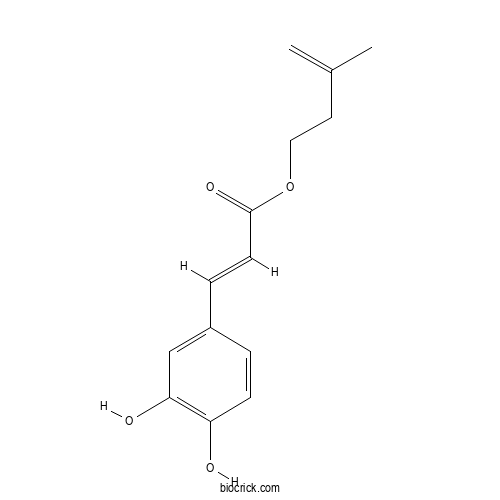
| Cas No. | 119644-16-5 | SDF | File under preparation. |
| PubChem ID | 14237599.0 | Appearance | Powder |
| Formula | C14H16O4 | M.Wt | 248.3 |
| Type of Compound | N/A | Storage | Desiccate at -20°C |
| Solubility | Soluble in Chloroform,Dichloromethane,Ethyl Acetate,DMSO,Acetone,etc. | ||
| Chemical Name | 3-methylbut-3-enyl (E)-3-(3,4-dihydroxyphenyl)prop-2-enoate | ||
| SMILES | CC(=C)CCOC(=O)C=CC1=CC(=C(C=C1)O)O | ||
| Standard InChIKey | APFXJJMDUXKKAG-GQCTYLIASA-N | ||
| Standard InChI | InChI=1S/C14H16O4/c1-10(2)7-8-18-14(17)6-4-11-3-5-12(15)13(16)9-11/h3-6,9,15-16H,1,7-8H2,2H3/b6-4+ | ||
| General tips | For obtaining a higher solubility , please warm the tube at 37 ℃ and shake it in the ultrasonic bath for a while.Stock solution can be stored below -20℃ for several months. We recommend that you prepare and use the solution on the same day. However, if the test schedule requires, the stock solutions can be prepared in advance, and the stock solution must be sealed and stored below -20℃. In general, the stock solution can be kept for several months. Before use, we recommend that you leave the vial at room temperature for at least an hour before opening it. |
||
| About Packaging | 1. The packaging of the product may be reversed during transportation, cause the high purity compounds to adhere to the neck or cap of the vial.Take the vail out of its packaging and shake gently until the compounds fall to the bottom of the vial. 2. For liquid products, please centrifuge at 500xg to gather the liquid to the bottom of the vial. 3. Try to avoid loss or contamination during the experiment. |
||
| Shipping Condition | Packaging according to customer requirements(5mg, 10mg, 20mg and more). Ship via FedEx, DHL, UPS, EMS or other couriers with RT, or blue ice upon request. | ||
Quality Control & MSDS
3D structure
Package In Stock

Number of papers citing our products


3-Methyl-3-butenyl caffeate Dilution Calculator
3-Methyl-3-butenyl caffeate Molarity Calculator
-
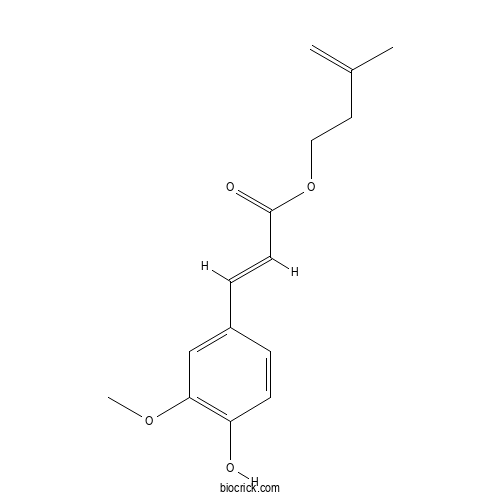 Isopent-3-enyl ferulateCatalog No.: BCX2387CAS No.: 132335-96-7
-
 Ethyl caffeateCatalog No.: BCN4214CAS No.: 102-37-4
-
 Ethyl trans-caffeateCatalog No.: BCN0320CAS No.: 66648-50-8
-
 Docosyl caffeateCatalog No.: BCN5182CAS No.: 28593-92-2
-
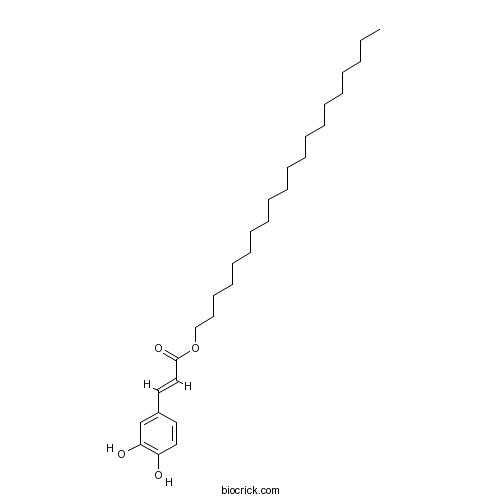 Eicosanyl caffeateCatalog No.: BCN7209CAS No.: 28593-90-0
-
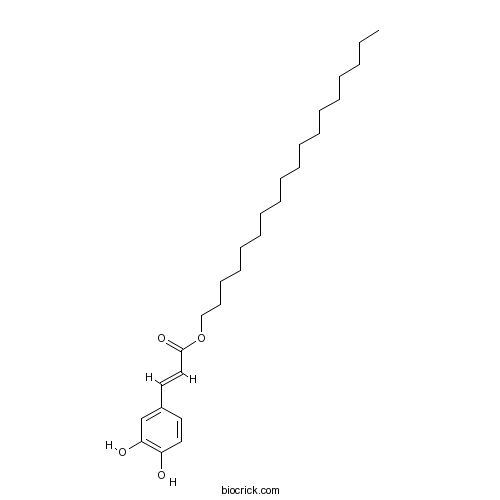 Octadecyl caffeateCatalog No.: BCN6609CAS No.: 69573-60-0
-
 Prenyl caffeateCatalog No.: BCC8351CAS No.: 100884-13-7
-
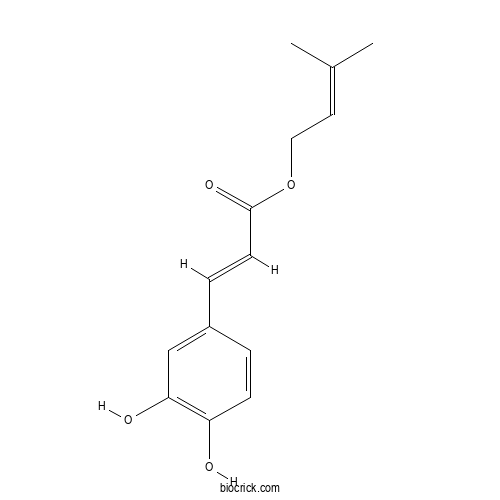 3-Methyl-2-butenyl caffeateCatalog No.: BCX2379CAS No.: 118971-61-2
-
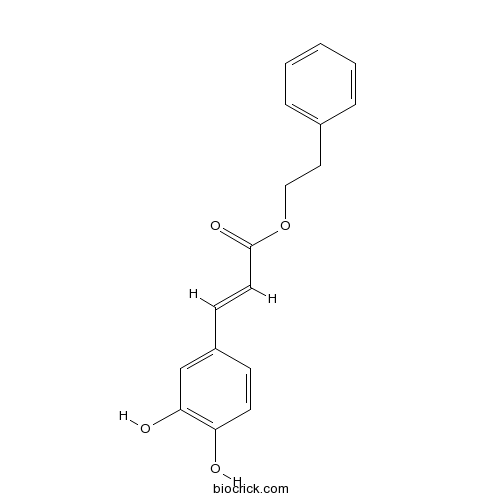 Caffeic acid phenethyl esterCatalog No.: BCN2695CAS No.: 104594-70-9
| 1 mg | 5 mg | 10 mg | 20 mg | 25 mg | |
| 1 mM | 4.0274 mL | 20.1369 mL | 40.2739 mL | 80.5477 mL | 100.6847 mL |
| 5 mM | 0.8055 mL | 4.0274 mL | 8.0548 mL | 16.1095 mL | 20.1369 mL |
| 10 mM | 0.4027 mL | 2.0137 mL | 4.0274 mL | 8.0548 mL | 10.0685 mL |
| 50 mM | 0.0805 mL | 0.4027 mL | 0.8055 mL | 1.611 mL | 2.0137 mL |
| 100 mM | 0.0403 mL | 0.2014 mL | 0.4027 mL | 0.8055 mL | 1.0068 mL |
| * Note: If you are in the process of experiment, it's necessary to make the dilution ratios of the samples. The dilution data above is only for reference. Normally, it's can get a better solubility within lower of Concentrations. | |||||
- 3-Methyl-2-butenyl caffeate
Catalog No.:BCX2379
CAS No.:118971-61-2
- cis-Oxyresveratrol 3-O-glucoside
Catalog No.:BCX2378
CAS No.:2493206-35-0
- Diplomorphanin A
Catalog No.:BCX2377
CAS No.:1559076-44-6
- Flavin adenine dinucleotide disodium salt hydrate
Catalog No.:BCX2376
CAS No.:84366-81-4
- CoA sodium salt
Catalog No.:BCX2375
CAS No.:55672-92-9
- L-Ascorbic-1-13C acid
Catalog No.:BCX2374
CAS No.:178101-88-7
- p-Coumaroyl CoA
Catalog No.:BCX2373
CAS No.:119785-99-8
- NADPH tetrasodium salt
Catalog No.:BCX2372
CAS No.:2646-71-1
- Sinapoyl CoA
Catalog No.:BCX2371
CAS No.:54429-80-0
- Cinnamoyl CoA
Catalog No.:BCX2370
CAS No.:76109-04-1
- Benzoyl CoA
Catalog No.:BCX2369
CAS No.:102185-37-5
- Palmitoyl CoA
Catalog No.:BCX2368
CAS No.:188174-64-3
- 6''-O-β-D-Apiofuranosylastragalin
Catalog No.:BCX2381
CAS No.:946827-13-0
- Amburoside A
Catalog No.:BCX2382
CAS No.:110978-35-3
- cis-Oxyresveratrol 4'-O-glucoside
Catalog No.:BCX2383
CAS No.:863329-67-3
- Foeniculoside II
Catalog No.:BCX2384
CAS No.:168010-11-5
- Umbelliferone 7-O-β-D-xylopyranosyl-(1→6)-β-D-glucopyranoside
Catalog No.:BCX2385
CAS No.:402490-56-6
- 4'-Hydroxy-7,8-methylenedioxyhomoisoflavan
Catalog No.:BCX2386
CAS No.:148461-99-8
- Isopent-3-enyl ferulate
Catalog No.:BCX2387
CAS No.:132335-96-7
- 3'-Deoxyamburoside A
Catalog No.:BCX2388
CAS No.:362668-60-8
- (-)-Lariciresinol 4-O-glucoside
Catalog No.:BCX2389
CAS No.:364081-04-9
- Amburoside B
Catalog No.:BCX2390
CAS No.:221011-65-0
- Steppogenin 5'-C-glucoside
Catalog No.:BCX2391
CAS No.:2082826-38-6
- Heptazoline
Catalog No.:BCX2392
CAS No.:32042-35-6
French Propolis Caffeic Acid Derivatives Protect Skeletal Muscle from Oxidative Damages.[Pubmed:42072671]
Biomolecules. 2026 Apr 8;16(4):550.
Propolis produced by honeybees, Apis mellifera, has been valued since ancient times as a remedy for different ailments for its broad medicinal properties. This wide range of biological activities may arise from the production of distinct propolis types within the hive, each serving specific functions and containing unique molecular compositions. In this study, we investigated the effects of four propolis types-masonry, sealing, brood-protection, and intruder-neutralizing-on hydrogen peroxide (H(2)O(2))-induced oxidative injury in human skeletal muscle cells. Among these, only brood-protection propolis significantly prevented the H(2)O(2)-induced loss of cell viability. Bio-guided fractionation of this active propolis identified five major compounds: benzyl caffeate (BC), caffeic acid phenethyl ester (CAPE), cinnamyl caffeate (CC), prenyl caffeate (PC), and (E)-3-Methyl-3-butenyl caffeate (MBC), all displaying stronger cytoprotective effects than their ferulate equivalents. We finally demonstrated that propolis extract and its active compounds reduced lipid peroxidation in post-mortem minced mouse skeletal muscle and compared their efficacy to other natural compounds. Chemical analysis of resins from neighboring flora suggested that black poplar (Populus nigra) buds are the primary botanical source of these caffeate derivatives. Collectively, these results highlight the functional diversity of hive propolis and its potential applications in food preservation as well as in complementary and preventive medicine.
Antiproliferative activity of New Zealand propolis and phenolic compounds vs human colorectal adenocarcinoma cells.[Pubmed:26347954]
Fitoterapia. 2015 Oct;106:167-74.
New Zealand propolis is a "European" type propolis obtained by honey bees mainly from exudates of poplar. European type propolis is known to have anti-inflammatory and anti-cancer properties and this activity has been attributed to some of the main constituents such as chrysin and CAPE (caffeic acid phenethyl ester). As part of our studies on how New Zealand propolis might benefit gastro-intestinal health, we carried out in vitro bioactivity-guided fractionation of "Bio30" propolis using both anti-inflammatory (TNF-alpha, COX-1, COX-2) and anti-colon cancer (DLD-1 colon cancer cell viability) assays; and determined the phenolic compounds responsible for the activity. The New Zealand wax-free Bio30 propolis tincture solids had very high levels of the dihydroflavonoids pinocembrin and pinobanksin-3-O-acetate, and high levels of the dimethylallyl, benzyl and 3-Methyl-3-butenyl caffeates relative to CAPE. The DLD-1 assays identified strong anti-proliferative activity associated with these components as well as chrysin, galangin and CAPE and a number of lesser known or lower concentration compounds including benzyl ferulate, benzyl isoferulate, pinostrobin, 5-phenylpenta-2,4-dienoic acid and tectochrysin. The phenolic compounds pinocembrin, pinobanksin-3-O-acetate, tectochrysin, dimethylallyl caffeate, 3-Methyl-3-butenyl caffeate, benzyl ferulate and benzyl isoferulate also showed good broad spectrum activity in anti-proliferative assays against three other gastro-intestinal cancer cell lines; HCT-116 colon carcinoma, KYSE-30 oesophageal squamous cancer, and NCI-N87 gastric carcinoma. Activity is also observed in anti-inflammatory assays although it appears to be limited to one of the first cytokines in the inflammatory cascade, TNF-alpha.

Calcutta University

University of Minnesota

University of Maryland School of Medicine

University of Illinois at Chicago

The Ohio State University

University of Zurich

Harvard University

Colorado State University

Auburn University

Yale University

Worcester Polytechnic Institute

Washington State University

Stanford University

University of Leipzig

Universidade da Beira Interior

The Institute of Cancer Research

Heidelberg University

University of Amsterdam

University of Auckland

TsingHua University

The University of Michigan

Miami University

DRURY University

Jilin University

Fudan University

Wuhan University

Sun Yat-sen University

Universite de Paris

Deemed University

Auckland University

The University of Tokyo

Korea University



