
HeptazolineCAS# 32042-35-6 |
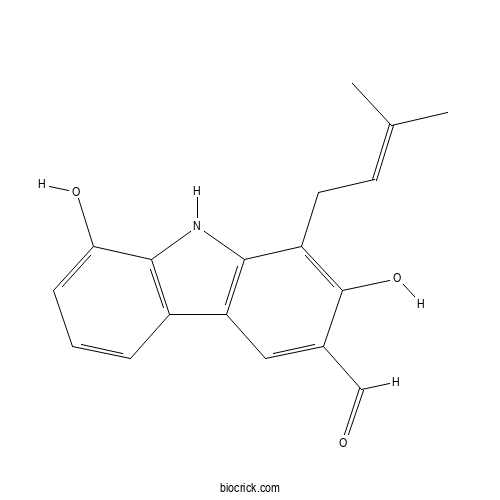
| Cas No. | 32042-35-6 | SDF | File under preparation. |
| PubChem ID | 14282354.0 | Appearance | Yellow powder |
| Formula | C18H17NO3 | M.Wt | 295.3 |
| Type of Compound | N/A | Storage | Desiccate at -20°C |
| Solubility | Soluble in Chloroform,Dichloromethane,Ethyl Acetate,DMSO,Acetone,etc. | ||
| Chemical Name | 2,8-dihydroxy-1-(3-methylbut-2-enyl)-9H-carbazole-3-carbaldehyde | ||
| SMILES | CC(=CCC1=C(C(=CC2=C1NC3=C2C=CC=C3O)C=O)O)C | ||
| Standard InChIKey | LITFGIKRRVPXCE-UHFFFAOYSA-N | ||
| Standard InChI | InChI=1S/C18H17NO3/c1-10(2)6-7-13-16-14(8-11(9-20)18(13)22)12-4-3-5-15(21)17(12)19-16/h3-6,8-9,19,21-22H,7H2,1-2H3 | ||
| General tips | For obtaining a higher solubility , please warm the tube at 37 ℃ and shake it in the ultrasonic bath for a while.Stock solution can be stored below -20℃ for several months. We recommend that you prepare and use the solution on the same day. However, if the test schedule requires, the stock solutions can be prepared in advance, and the stock solution must be sealed and stored below -20℃. In general, the stock solution can be kept for several months. Before use, we recommend that you leave the vial at room temperature for at least an hour before opening it. |
||
| About Packaging | 1. The packaging of the product may be reversed during transportation, cause the high purity compounds to adhere to the neck or cap of the vial.Take the vail out of its packaging and shake gently until the compounds fall to the bottom of the vial. 2. For liquid products, please centrifuge at 500xg to gather the liquid to the bottom of the vial. 3. Try to avoid loss or contamination during the experiment. |
||
| Shipping Condition | Packaging according to customer requirements(5mg, 10mg, 20mg and more). Ship via FedEx, DHL, UPS, EMS or other couriers with RT, or blue ice upon request. | ||
Quality Control & MSDS
3D structure
Package In Stock

Number of papers citing our products


Heptazoline Dilution Calculator
Heptazoline Molarity Calculator

| 1 mg | 5 mg | 10 mg | 20 mg | 25 mg | |
| 1 mM | 3.3864 mL | 16.9319 mL | 33.8639 mL | 67.7277 mL | 84.6597 mL |
| 5 mM | 0.6773 mL | 3.3864 mL | 6.7728 mL | 13.5455 mL | 16.9319 mL |
| 10 mM | 0.3386 mL | 1.6932 mL | 3.3864 mL | 6.7728 mL | 8.466 mL |
| 50 mM | 0.0677 mL | 0.3386 mL | 0.6773 mL | 1.3546 mL | 1.6932 mL |
| 100 mM | 0.0339 mL | 0.1693 mL | 0.3386 mL | 0.6773 mL | 0.8466 mL |
| * Note: If you are in the process of experiment, it's necessary to make the dilution ratios of the samples. The dilution data above is only for reference. Normally, it's can get a better solubility within lower of Concentrations. | |||||
- Steppogenin 5'-C-glucoside
Catalog No.:BCX2391
CAS No.:2082826-38-6
- Amburoside B
Catalog No.:BCX2390
CAS No.:221011-65-0
- (-)-Lariciresinol 4-O-glucoside
Catalog No.:BCX2389
CAS No.:364081-04-9
- 3'-Deoxyamburoside A
Catalog No.:BCX2388
CAS No.:362668-60-8
- Isopent-3-enyl ferulate
Catalog No.:BCX2387
CAS No.:132335-96-7
- 4'-Hydroxy-7,8-methylenedioxyhomoisoflavan
Catalog No.:BCX2386
CAS No.:148461-99-8
- Umbelliferone 7-O-β-D-xylopyranosyl-(1→6)-β-D-glucopyranoside
Catalog No.:BCX2385
CAS No.:402490-56-6
- Foeniculoside II
Catalog No.:BCX2384
CAS No.:168010-11-5
- cis-Oxyresveratrol 4'-O-glucoside
Catalog No.:BCX2383
CAS No.:863329-67-3
- Amburoside A
Catalog No.:BCX2382
CAS No.:110978-35-3
- 6''-O-β-D-Apiofuranosylastragalin
Catalog No.:BCX2381
CAS No.:946827-13-0
- 3-Methyl-3-butenyl caffeate
Catalog No.:BCX2380
CAS No.:119644-16-5
- 1-O-Methylclausenolide
Catalog No.:BCX2393
CAS No.:148763-15-9
- Nordentatin
Catalog No.:BCX2394
CAS No.:1083193-15-0
- Clausenidin
Catalog No.:BCX2395
CAS No.:28384-44-3
- 2-Naphthoxyacetic acid
Catalog No.:BCX2396
CAS No.:120-23-0
- Flubendazole
Catalog No.:BCX2397
CAS No.:31430-15-6
- 3-(4-Hydroxyphenyl)-1-(1H-pyrrol-1-yl)propan-1-one
Catalog No.:BCX2398
CAS No.:1822773-39-6
- Alpinone
Catalog No.:BCX2399
CAS No.:480-13-7
- 9-epi-Blumenol C
Catalog No.:BCX2400
CAS No.:1242672-31-6
- Clausarin
Catalog No.:BCX2401
CAS No.:62770-67-6
- Dentatin
Catalog No.:BCX2402
CAS No.:22980-57-0
- Aesculioside B
Catalog No.:BCX2403
CAS No.:106310-33-2
- Tinoscorside D
Catalog No.:BCX2404
CAS No.:1257394-29-8
Heptazoline exerts antiproliferative effects on human melanoma cells by inducing apoptosis, cell cycle arrest and targeting MAPK signalling pathway.[Pubmed:34269001]
J BUON. 2021 May-Jun;26(3):1184.
The Editors of JBUON issue an Expression of Concern to 'Heptazoline exerts antiproliferative effects on human melanoma cells by inducing apoptosis, cell cycle arrest and targeting MAPK signalling pathway', by Wei Zhou, Ling Zhou, Min Wang, Zeming Liu, Danyang Chen, Liang Guo; JBUON 2020;25(1):479-484; PMID: 32277672. Following the publication of the above article, readers drew to our attention that part of the data was possibly unreliable. We sent emails to the authors with a request to provide the raw data to prove the originality, but received no reply. Therefore, as we continue to work through the issues raised, we advise readers to interpret the information presented in the article with due caution. We thank the readers for bringing this matter to our attention. We apologize for any inconvenience it may cause.
Heptazoline exerts antiproliferative effects on human melanoma cells by inducing apoptosis, cell cycle arrest and targeting MAPK signalling pathway.[Pubmed:32277672]
J BUON. 2020 Jan-Feb;25(1):479-484.
PURPOSE: Melanoma is one of the prevalent types of cancer and ranks 6th major cause of cancer associated mortality. In this study the anticancer effects of the carbazole alkaloid Heptazoline were investigated against a panel of melanoma cells. METHODS: The normal BJ-5TA and melanoma cell lines MEL-CLS-1M MEL-CLS-2, MEL-CLS-3 were used in this study. MTT and colony formation assays were used to determine the proliferation rate of melanoma cells Aciridine orange (AO)/ ethidium bromide (EB) and annexin V/propidium iodide (PI) staining were used to check the apoptotic cell death. Cell cycle analysis was performed by flow cytometry and protein expression was checked by western blotting. RESULTS: Heptazoline inhibited the growth of all the melanoma cell lines, exhibiting an IC50 of 15 to 40 microM against the melanoma cells. However, the normal skin cells had IC50 125 microM. The anticancer effects were found to be due to induction of apoptotic cell death which was associated with the upregulation of Bax, cleaved caspase 3, 9 and PARP and downregulation of Bcl-2. Furthermore, Heptazoline also triggered the G0/G1 arrest of melanoma cells. The effects of Heptazoline on the MAPK signalling pathway revealed that this molecule could inhibit the expression of p-p38 concentration-dependently. CONCLUSION: Taken together, Heptazoline may prove a lead molecule in the development of systemic therapy of melanoma.
Antibacterial Activity of Coumarins and Carbazole Alkaloid from Roots of Clausena anisata.[Pubmed:30863444]
Adv Pharmacol Sci. 2019 Feb 3;2019:5419854.
Clausena anisata is one of the medicinal plants used traditionally for treatment of parasitic infections, irritation (boils, ringworm, and eczema), flatworm infestations, influenza, abdominal cramps, and constipation. Phytochemical screening test of dichloromethane/methanol (1 : 1) roots extract revealed the presence of flavonoids, phytosterols, coumarins, phenols, alkaloids, tannins, terpenoids, and free reducing sugars and the absence of saponins. Silica gel column chromatographic separation of the dichloromethane/methanol (1 : 1) extract afforded a carbazole alkaloid derivative of Heptazoline (1) and three coumarins (2-4), including the known coumarins imperatorin (3) and chalepin (4). Structures of the compounds were elucidated by spectroscopic techniques (IR, (1)H NMR, (13)C NMR, and DEPT-135). Antibacterial activity of the crude extracts and isolated compounds was screened using agar diffusion method against strains of Staphylococcus aureus, Escherichia coli, Pseudomonas aeruginosa, and Bacillus substilis. The results of antibacterial test revealed derivative of heptaphylline (1) and imperatorin (3) exhibited comparable antibacterial activity against S. aureus and B. substilis (14 and 13 mm zone of inhibition, respectively) to that of ciprofloxacin (15 mm zone of inhibition) at a concentration of 20 microg/mL. Chalepin (4) revealed more antibacterial activity against B. substilis (16 mm zone of inhibition) compared to ciprofloxacin (15 mm).

Calcutta University

University of Minnesota

University of Maryland School of Medicine

University of Illinois at Chicago

The Ohio State University

University of Zurich

Harvard University

Colorado State University

Auburn University

Yale University

Worcester Polytechnic Institute

Washington State University

Stanford University

University of Leipzig

Universidade da Beira Interior

The Institute of Cancer Research

Heidelberg University

University of Amsterdam

University of Auckland

TsingHua University

The University of Michigan

Miami University

DRURY University

Jilin University

Fudan University

Wuhan University

Sun Yat-sen University

Universite de Paris

Deemed University

Auckland University

The University of Tokyo

Korea University



