
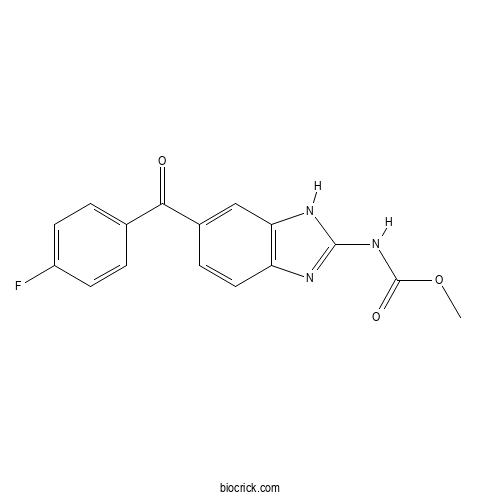
FlubendazoleCAS# 31430-15-6 |
| Cas No. | 31430-15-6 | SDF | File under preparation. |
| PubChem ID | 35802.0 | Appearance | Powder |
| Formula | C16H12FN3O3 | M.Wt | 313.3 |
| Type of Compound | N/A | Storage | Desiccate at -20°C |
| Solubility | Soluble in Chloroform,Dichloromethane,Ethyl Acetate,DMSO,Acetone,etc. | ||
| Chemical Name | methyl N-[6-(4-fluorobenzoyl)-1H-benzimidazol-2-yl]carbamate | ||
| SMILES | COC(=O)NC1=NC2=C(N1)C=C(C=C2)C(=O)C3=CC=C(C=C3)F | ||
| Standard InChIKey | CPEUVMUXAHMANV-UHFFFAOYSA-N | ||
| Standard InChI | InChI=1S/C16H12FN3O3/c1-23-16(22)20-15-18-12-7-4-10(8-13(12)19-15)14(21)9-2-5-11(17)6-3-9/h2-8H,1H3,(H2,18,19,20,22) | ||
| General tips | For obtaining a higher solubility , please warm the tube at 37 ℃ and shake it in the ultrasonic bath for a while.Stock solution can be stored below -20℃ for several months. We recommend that you prepare and use the solution on the same day. However, if the test schedule requires, the stock solutions can be prepared in advance, and the stock solution must be sealed and stored below -20℃. In general, the stock solution can be kept for several months. Before use, we recommend that you leave the vial at room temperature for at least an hour before opening it. |
||
| About Packaging | 1. The packaging of the product may be reversed during transportation, cause the high purity compounds to adhere to the neck or cap of the vial.Take the vail out of its packaging and shake gently until the compounds fall to the bottom of the vial. 2. For liquid products, please centrifuge at 500xg to gather the liquid to the bottom of the vial. 3. Try to avoid loss or contamination during the experiment. |
||
| Shipping Condition | Packaging according to customer requirements(5mg, 10mg, 20mg and more). Ship via FedEx, DHL, UPS, EMS or other couriers with RT, or blue ice upon request. | ||
Quality Control & MSDS
3D structure
Package In Stock

Number of papers citing our products


Flubendazole Dilution Calculator
Flubendazole Molarity Calculator
| 1 mg | 5 mg | 10 mg | 20 mg | 25 mg | |
| 1 mM | 3.1918 mL | 15.9591 mL | 31.9183 mL | 63.8366 mL | 79.7957 mL |
| 5 mM | 0.6384 mL | 3.1918 mL | 6.3837 mL | 12.7673 mL | 15.9591 mL |
| 10 mM | 0.3192 mL | 1.5959 mL | 3.1918 mL | 6.3837 mL | 7.9796 mL |
| 50 mM | 0.0638 mL | 0.3192 mL | 0.6384 mL | 1.2767 mL | 1.5959 mL |
| 100 mM | 0.0319 mL | 0.1596 mL | 0.3192 mL | 0.6384 mL | 0.798 mL |
| * Note: If you are in the process of experiment, it's necessary to make the dilution ratios of the samples. The dilution data above is only for reference. Normally, it's can get a better solubility within lower of Concentrations. | |||||
- 2-Naphthoxyacetic acid
Catalog No.:BCX2396
CAS No.:120-23-0
- Clausenidin
Catalog No.:BCX2395
CAS No.:28384-44-3
- Nordentatin
Catalog No.:BCX2394
CAS No.:1083193-15-0
- 1-O-Methylclausenolide
Catalog No.:BCX2393
CAS No.:148763-15-9
- Heptazoline
Catalog No.:BCX2392
CAS No.:32042-35-6
- Steppogenin 5'-C-glucoside
Catalog No.:BCX2391
CAS No.:2082826-38-6
- Amburoside B
Catalog No.:BCX2390
CAS No.:221011-65-0
- (-)-Lariciresinol 4-O-glucoside
Catalog No.:BCX2389
CAS No.:364081-04-9
- 3'-Deoxyamburoside A
Catalog No.:BCX2388
CAS No.:362668-60-8
- Isopent-3-enyl ferulate
Catalog No.:BCX2387
CAS No.:132335-96-7
- 4'-Hydroxy-7,8-methylenedioxyhomoisoflavan
Catalog No.:BCX2386
CAS No.:148461-99-8
- Umbelliferone 7-O-β-D-xylopyranosyl-(1→6)-β-D-glucopyranoside
Catalog No.:BCX2385
CAS No.:402490-56-6
- 3-(4-Hydroxyphenyl)-1-(1H-pyrrol-1-yl)propan-1-one
Catalog No.:BCX2398
CAS No.:1822773-39-6
- Alpinone
Catalog No.:BCX2399
CAS No.:480-13-7
- 9-epi-Blumenol C
Catalog No.:BCX2400
CAS No.:1242672-31-6
- Clausarin
Catalog No.:BCX2401
CAS No.:62770-67-6
- Dentatin
Catalog No.:BCX2402
CAS No.:22980-57-0
- Aesculioside B
Catalog No.:BCX2403
CAS No.:106310-33-2
- Tinoscorside D
Catalog No.:BCX2404
CAS No.:1257394-29-8
- Blumenol C
Catalog No.:BCX2405
CAS No.:36151-02-7
- Aesculioside A
Catalog No.:BCX2406
CAS No.:254896-53-2
- Zataroside B
Catalog No.:BCX2407
CAS No.:95645-52-6
- (11R)-12-Chloronootkaton-11-ol
Catalog No.:BCX2408
CAS No.:1446439-13-9
- Steppogenin 7,4'-di-O-glucoside
Catalog No.:BCX2409
CAS No.:1193750-99-0
Flubendazole reduces emerging Dracunculus medinensis in dogs in Chad: Results from a two-year study.[Pubmed:42789688]
PLoS Negl Trop Dis. 2026 Sep 25;20(9):e0014763.
Since being targeted for eradication in the 1980s, global human cases of dracunculiasis (Guinea worm disease; GWD) have been reduced by over 99.9% through interventions aimed at interrupting the life cycle of the causative parasite, Dracunculus medinensis. However, the burden of GWD in dogs is higher than in humans and other monitored mammalian host species, threatening eradication of GWD. Expanding on a previous clinical trial of Flubendazole (FLBZ) in dogs in Chad, we conducted a cluster-randomized controlled trial in which half of enrolled villages (N = 29) were assigned to receive FLBZ and the other half (N = 27) to receive no treatment. An annual difference-in-differences analysis revealed that treated villages had 59.3% fewer predicted emerging D. medinensis adult females (95% CI: 53.8% fewer to 69.2% fewer) per village per year during the second year of the study compared to control villages. Analyses examining effects of FLBZ monthly, at the individual dog level, and through histopathology of D. medinensis female reproductive morphology, all support the conclusion that FLBZ inhibits embryogenesis and larval development within the uterus of gravid female worms. Together these data are consistent with a hypothesis that although D. medinensis emerged from individually treated dogs, the L1s released from dogs treated with FLBZ exhibited reduced viability, thus reducing the risk of infection in the next mammalian host. This trial builds the body of knowledge about FLBZ's impacts on D. medinensis in the canine host and provides compelling evidence on the effectiveness of FLBZ in reducing the number of emerging D. medinensis in dogs, which can contribute to the eradication of this parasite. However, additional questions remain regarding the formulation, which need to be addressed in future studies before being deployed at scale.
Characterization and performance of aluminum (III)-complex as an active material for potentiometric sensor.[Pubmed:42637835]
Sci Rep. 2026 Aug 24;16(1):26500.
Aluminum is the third most abundant element in the Earth's crust. It becomes more soluble and available when the soil pH falls below 5. Consequently, elevated aluminum concentrations can severely inhibit plant root growth, causing stunted roots and a reduced ability to absorb water and nutrients. Therefore, monitoring aluminum levels in soil is important, which has led to significant interest in developing sensors for its detection. Al(III)-Flubendazole complex (Al-FLU) was synthesized for the first time and evaluated as a potential electroactive sensing material. This complex was incorporated into a novel, well-defined chemically modified carbon paste electrode (CPE). Tricresyl phosphate (TCP) was selected from three tested plasticizers and used as a solvent mediator in the paste matrix, complementing the Al-FLU complex. This plasticizer improved the electrode's mechanical stability and analytical performance. With an optimal composition, the resulting electrode achieved the intended Nernstian slope of 20.0 +/- 0.683 mV per decade for trivalent cations over the concentration range 1.0 x 10(-)(7) to 1.0 x 10(-)(1) mol L(-1), with a detection limit of 1.0 x 10(-)(7) mole L(-1) and a response time of about 5.0 s. The electrode demonstrated good selectivity, sensitivity, reversibility, repeatability, and reproducibility. Its potential response remained constant across the pH range of 3.4-5.5 at room temperature (25 +/- 1 degrees C). The thermal stability of the electrode was also evaluated between 10 and 60 degrees C. Therefore, this optimally formulated electrode can be used to establish a simple direct potentiometric analytical method for the systematic quantification of Al(III) in both pure solutions and various real samples.
Pharms on farms: Variable impacts of veterinary pharmaceuticals on an arbuscular mycorrhizal symbiosis and soil microorganisms.[Pubmed:42558432]
Plant Soil. 2026;524(2):1077-1097.
BACKGROUND: Circular agriculture promotes the reuse of organic waste, such as animal manures, to reduce reliance on synthetic fertilisers. However, manures can introduce veterinary pharmaceuticals into soils. Arbuscular mycorrhizal (AM) fungi are critical for plant nutrition, yet their responses to manure-associated pharmaceuticals remain poorly understood. We investigated the effects of three commonly used veterinary pharmaceuticals-the antibiotics doxycycline (DOX) and sulfamethoxazole (SMX) and the anthelmintic Flubendazole (FLUB)-applied at environmentally relevant concentrations, on AM structure and function and wider microbial communities. METHODS: Using dwarf runner bean, we quantified AM-mediated transfer of phosphorus ((33)P) and nitrogen ((15)N) to plants and plant carbon (C) allocation to AM fungi. Bacterial (16S) and fungal (partial 18S and total ITS) community compositions were characterised using DNA amplicon sequencing. RESULTS: DOX exposure increased AM abundance and AM-mediated (33)P transfer to plants, and reduced soil bacterial diversity, while plant biomass and N acquisition were unaffected. SMX had no effects on these metrics, despite increasing shoot N content. FLUB reduced AM root colonisation and plant C allocation to AM fungi but did not alter fungal (33)P or (15)N transfer or microbial diversity. CONCLUSIONS: Overall, our results demonstrate compound-specific effects of veterinary pharmaceuticals on AM fungal symbioses and soil microbial communities, with DOX positively impacting AM fungi, while FLUB negatively impacted the symbiosis and SMX did not affect AM fungi. DOX reduced soil bacterial diversity. These findings emphasise the importance of considering microbial functional responses when assessing the sustainability and feasibility of manure reuse in agricultural systems. SUPPLEMENTARY INFORMATION: The online version contains supplementary material available at 10.1007/s11104-026-08706-1.
A Phase IIa, Proof-of-Concept, Placebo-Controlled, Randomised Trial to Investigate the Efficacy and Safety of Oxfendazole as a Macrofilaricidal Drug in Adults Harbouring Lymphatic Filarial Worms.[Pubmed:42545617]
Infect Dis Ther. 2026 Oct;15(10):2805-2816.
INTRODUCTION: Lymphatic filariasis (LF) remains a significant public health concern, with India contributing nearly 55% of the global disease burden and placing approximately 487 million people at risk of infection. Despite the success of mass drug administration (MDA) programs in reducing microfilaraemia, the current regimens have limited macrofilaricidal activity, which hinders the achievement of LF elimination goals. The development of safe and effective drugs targeting adult filarial worms is, therefore, a critical priority. This phase IIa, proof-of-concept study aims to evaluate the efficacy, safety, and pharmacokinetic (PK) profile of oxfendazole in adults with confirmed LF. The primary objective is to estimate the proportion of participants with no detectable adult worm motility on ultrasonography (USG) at 6 months post-treatment, serving as a marker of macrofilaricidal efficacy. Secondary objectives include assessment of safety and tolerability, while exploratory objectives involve the characterization of the PK profile of oxfendazole in the study population. METHODS: The study is designed as a phase IIa, randomised, double-blind, placebo-controlled trial with three arms. Participants will be randomised to receive either 400 mg or 800 mg of oxfendazole, or a matching placebo, administered orally once daily for five consecutive days. Oxfendazole, a benzimidazole and structural analogue of Flubendazole, has shown promising macrofilaricidal activity in preclinical models, demonstrating complete clearance of adult worms in mice. Phase I clinical studies have established its safety and tolerability in humans, supporting its progression to further clinical evaluation. Ethics approval has been obtained by the independent ethics committees (IEC) of all the participating study sites. This study will be performed in accordance with the Helsinki Declaration of 1964 and its later amendments, ICH-GCP, applicable regulatory requirements and approved study protocol. The details of ethics committee approvals are available in the supplementary material. PLANNED OUTCOMES: The findings from this trial will be pivotal in guiding the clinical development of oxfendazole, particularly in defining an optimal dosing regimen for use as a macrofilaricidal agent. If successful, this intervention could represent a significant advancement toward the elimination of LF. This study supports India's national target to eliminate LF by 2027 and aligns with the World Health Organization's global elimination goal by 2030.
Lymphatic Targeting of Flubendazole via Long-Chain Fatty Acid Nanoemulsion: Pharmacokinetic Evidence of Chylomicron-Mediated Uptake in Rats.[Pubmed:42540237]
ACS Omega. 2026 Jul 13;11(29):43763-43769.
Flubendazole (FLZ), a benzimidazole anthelmintic with emerging anticancer potential, exhibits poor aqueous solubility, limited oral bioavailability, and negligible spontaneous lymphatic transport. Building on previous work in which a Maisine CC-based FLZ nanoemulsion (FLZ-NE) was developed and shown to prevent the formation of malignant wounds in a murine model, this study provides a mechanistic pharmacokinetic evaluation of its intestinal lymphatic uptake. We investigated FLZ disposition in rats after oral administration of FLZ-NE, with or without cycloheximide pretreatment (FLZ-NE/b) to inhibit chylomicron secretion. Plasma FLZ concentrations were quantified by a validated HPLC-UV method, and concentration-time data were analyzed by two-way ANOVA and noncompartmental analysis. FLZ-NE produced higher systemic exposure (C_max = 2.42 +/- 0.34 mug/mL; T_max = 4 h; AUC_0 - t = 15.92 +/- 3.78 mug.h/mL) than FLZ-NE/b (C_max = 0.58 +/- 0.13 mug/mL; T_max = 2 h; AUC_0 - t = 4.42 +/- 1.55 mug.h/mL), corresponding to a 76% reduction in C_max and a 72% reduction in AUC_0 - t under chylomicron blockade. These data indicate that FLZ-NE relies predominantly on intestinal lymphatic transport, in line with the notion that long-chain fatty acid-based, nanoscale formulations can favor chylomicron-mediated uptake. By demonstrating in vivo that this nanoemulsion drives FLZ absorption through a lymphatic component, our findings extend the earlier efficacy-focused malignant wound study with mechanistic pharmacokinetic evidence of lymphatic targeting and support nanoemulsion-based delivery as a rational strategy to improve oral absorption and expand the therapeutic potential of FLZ for lymphatic or metastatic diseases.
The Effect of the Combination of Temozolomide and Flubendazole on Glioblastoma Cells.[Pubmed:42505349]
Cells. 2026 Jul 9;15(14):1239.
Glioblastoma multiforme (GBM) is a highly aggressive brain tumor characterized by rapid development of chemoresistance and poor patient survival. Due to the limited efficacy of current therapeutic protocols, alternative approaches are needed. One potential strategy is combined treatment with DNA-damaging and microtubule-targeting agents. This study investigated the biological effects of temozolomide (TMZ) and Flubendazole (FLU) co-treatment in cultured GBM cells. Three GBM cell lines (A172, T98G, and U118MG) with different molecular profiles were treated with TMZ, FLU, or their combination. Treatment effects were evaluated using WST-1 assay, microscopy, flow cytometry, RT-PCR, and Western blotting. Drug accumulation in tumor and brain tissues was additionally analyzed in a nu-nu mouse model using LC/MS. Combined TMZ and FLU treatment reduced cell proliferation compared with untreated control and TMZ monotherapy in the tested GBM cell lines. FLU-containing treatments were associated with morphological alterations, caspase activation, altered microtubule organization, and G2/M cell cycle accumulation. In addition, co-administration of TMZ and FLU affected drug accumulation in vitro and in brain and tumor tissues in vivo. These findings suggest that the microtubule targeting may modulate the response of GBM cells to TMZ. However, the pharmacological interaction and potential relevance of TMZ + FLU co-treatment require further preclinical validation.
Flubendazole 2.0: Designing a large field trial in dogs for a challenging setting.[Pubmed:42391310]
PLoS Negl Trop Dis. 2026 Jul 2;20(7):e0014482.
Dracunculiasis, or Guinea worm disease (GWD), was targeted for eradication in 1986 after which, the annual incidence decreased by over 99.9%. As human cases of GWD near elimination, dogs have become the primary reservoir for the parasite and remain a challenge for eradication efforts. The high burden of GWD in dogs relative to humans highlights the need for therapeutic interventions in conjunction with behavioral interventions. Laboratory experiments in ferrets demonstrated that Flubendazole is partially effective in inhibiting the infectivity of D. medinensis larvae. However, the implementation of large clinical field trials in dogs has proven challenging in settings where access to study areas is unreliable throughout the year and attrition is high. Alternative study design approaches are required to address these challenges. This paper outlines challenges encountered during a previous field trial and ways in which these challenges were addressed in the study design and implementation for a second clinical trial of Flubendazole in dogs. The results of the second clinical trial are outlined in a separate manuscript.
The downregulation of PEPCK mediated cuproptosis is involved in triclosan induced reproductive damage in mouse testes via triggering ROS overproduction.[Pubmed:42264199]
Free Radic Biol Med. 2026 Sep;253:770-784.
Triclosan (TCS) is a widely used broad-spectrum antimicrobial agent that has been demonstrated to induce damage to the male reproductive system. However, the specific mechanisms of testicular injury induced by TCS are not fully understood. In the present study, mice were treated with 0, 20 mg/kg and 40 mg/kg per day TCS from PND 56 to PND 84. Decreased sperm counts, increased sperm deformity rates, downregulation of Phosphoenolpyruvate carboxykinase (PEPCK) and cuproptosis activation were observed. In vitro, TM4 cells were exposed to 0, 5 nM and 10 nM TCS for 24 h, which induced oxidative stress damage, inhibition of PEPCK and cuproptosis activation. Furthermore, inhibition of PEPCK and cuproptosis activation was rescued by reactive oxygen species (ROS) scavengers N-Acetylcysteine (NAC). Besides, cuproptosis activation induced by TCS were rescued after overexpression of PEPCK. Drug prediction with Connectivity Map (cMap) identified Flubendazole and cucurbitacin-i as potential therapeutic drug. In conclusion, this study demonstrated that TCS triggered cuproptosis activation in TM4 cells mediated by ROS storm induced PEPCK inhibition. This research also shed new insight into precise treatment of TCS-related testicular injury.
Antiparasitic agents in oncology: Innovative mechanisms, emerging evidence and clinical potential in cancer treatment.[Pubmed:42217373]
Eur J Med Chem. 2026 Oct 15;316:118987.
The repurpose of established antiparasitic agents for oncological applications represents a promising and cost-effective strategy in the search for novel anticancer therapeutics. Drugs originally developed to treat parasitic infections, including ivermectin, mebendazole, niclosamide, albendazole, artesunate, Flubendazole, and other antiparasitic agents, have demonstrated compelling anticancer properties across a wide range of preclinical models. Their mechanisms of action are multifaceted, encompassing disruption of microtubule dynamics, induction of apoptotic signaling cascades, inhibition of key oncogenic pathways (including Wnt/beta-catenin, PI3K/Akt/mTOR, and Hedgehog signaling), immunomodulation, and targeting cancer stem cell populations. Ivermectin, a macrocyclic lactone, has shown potent activity against breast, ovarian, and colorectal cancer models through modulation of the P-glycoprotein drug efflux pump, activation of chloride ion channels, and inhibition of oncogenic signaling. Mebendazole, a benzimidazole antiparasitic, exerts anticancer effects primarily through inhibition of tubulin polymerization, mirroring mechanisms of conventional taxane and vinca alkaloid chemotherapeutics, and has additionally demonstrated anti-angiogenic and immunostimulatory properties. Emerging preclinical and early clinical data support anticancer activity for niclosamide (STAT3/Wnt inhibitor), artesunate (reactive oxygen species induction), and pyrvinium pamoate (Wnt pathway blockade). Despite substantial in-vitro and in-vivo evidence, the clinical translation of these agents faces significant challenges, including pharmacokinetic limitations, heterogeneous dosing regimens, and the paucity of adequately powered randomized clinical trials. This review systematically examines the current mechanistic understanding, experimental evidence, and clinical data supporting the repositioning of antiparasitic drugs as anticancer agents, while critically evaluating the limitations of existing evidence and outlining future research priorities.
Synthesis of a magnetic covalent organic framework for the extraction and detection of benzimidazole residues in food matrices by UPLC-MS/MS.[Pubmed:41925735]
Mikrochim Acta. 2026 Apr 2;193(5):288.
A novel magnetic covalent organic framework was innovatively developed as a high-performance adsorbent for magnetic solid-phase extraction (MSPE) of benzimidazole veterinary drug residues in food matrices. The synthesized nanocomposite features a well-ordered core-shell architecture with a notable specific surface area and remarkable superparamagnetic behavior, facilitating rapid phase separation within 3 min under a magnetic field. Seven representative benzimidazoles (albendazole sulfoxide, fenbendazole sulfoxide, Flubendazole, fenbendazole, cambendazole, cyclobendazole, albendazole sulfone) were selected to systematically evaluate the extraction efficiency and method performance. The material exhibited superior adsorption capacities (46.2-62.0 mg/g) through synergistic pi-pi conjugation, hydrogen-bonding, and hydrophobic interactions with benzimidazole moieties. Notably, the adsorbent maintained 90% of its initial capacity after six regeneration cycles, demonstrating excellent reusability. An innovative MSPE-UPLC-MS/MS methodology was established for detecting trace-level residual compounds in food matrices (milk and honey), with determination coefficient R(2) >/= 0.991. The method achieved unprecedented sensitivity with detection limits of 0.015-0.131 microg/kg and quantification limits of 0.050-0.436 microg/kg. Validation studies showed satisfactory recoveries (83.67-102.96%) and good precision (RSD < 8.63%) across four spiking levels.
Cloning, expression and characterisation of short-chain dehydrogenase/reductase SDR12 (A0A7I5E7J1) from a parasitic nematode Haemonchus contortus.[Pubmed:41917138]
Sci Rep. 2026 Mar 31;16(1):15539.
Short-chain dehydrogenases/reductases (SDRs) play a crucial role in xenobiotic and eobiotic metabolism in all organisms. In the parasitic nematode Haemonchus contortus, SDRs represent potential contributors to drug resistance and potential drug targets. Among them, Hco_sdr12 (WormBaseAcc: HCON_0049110) seemed to be the most interesting as its constitutive expression was higher in all developmental stages of H. contortus from the benzimidazole-resistant strain in comparison to the drug-susceptible strain. Moreover, Hco_sdr12 was inducible by exposure of H. contortus adult females with the anthelmintic drug Flubendazole (FLU). With an aim to know more about this enzyme, Hco_SDR12 (UniprotAcc: A0A7I5E7J1) was cloned, purified and characterised. The corresponding gene was cloned into the pET22b(+) vector system, the protein was overexpressed in E. coli and purified by Ni-affinity chromatography. The various xenobiotic and eobiotic compounds, including FLU, were tested as potential substrates of Hco_SDR12. Although this enzyme did not reduce FLU, significant reductase activities toward many other substrates were found with a preference for NADPH as a coenzyme. Glyceraldehyde, metyrapone and ketoprofen were used for kinetic studies. According to bioinformatic analysis, Hco_SDR12 shares the highest similarity with hydroxysteroid dehydrogenase-like protein 2, which may indicate its involvement in lipid metabolism. Even though Hco_SDR12 cannot deactivate FLU, it can deactivate other xenobiotics with a carbonyl group. Its higher expression might help nematodes to protect themselves against reactive compounds and to gain energy from lipids more effectively.
Thermal and Kinetic Analysis of Benzimidazole Derivatives: Fenbendazole, Mebendazole, and Flubendazole.[Pubmed:41900104]
Molecules. 2026 Mar 17;31(6):1005.
This study presents a comparative thermal and kinetic analysis of three benzimidazole derivatives used in the pharmaceutical field: fenbendazole, mebendazole, and Flubendazole. The investigations were carried out using thermoanalytical methods, including thermogravimetric analysis (TGA) and differential scanning calorimetry (DSC), in order to evaluate thermal stability, decomposition stages, and to calculate kinetic parameters. The obtained data were processed using isoconversional methods (Ozawa-Flynn-Wall, and Friedman) and non-parametric method (NPK) to determine activation energies and degradation mechanisms. The results revealed significant differences among the three compounds regarding their thermal stability and decomposition behavior, influenced by molecular structure and aromatic substituents. Furthermore, the comparative analysis provides valuable insights for optimizing technological processes, assessing stability in pharmaceutical formulations, and expanding research on the therapeutic potential of these compounds, including in oncological studies. Overall, the study contributes to a deeper understanding of the relationship between chemical structure and thermal stability in benzimidazole derivatives.
Rapid Discovery of CD38 Inhibitor via DNA-Encoded Natural Product Library Screening.[Pubmed:41828851]
Molecules. 2026 Mar 5;31(5):864.
CD38 is a multifunctional enzyme that plays a pivotal role in NAD(+) metabolism and calcium signaling, and its abnormal activity is closely associated with multiple myeloma, age-related metabolic decline, neurodegenerative diseases, and other disorders. Although monoclonal antibodies such as daratumumab have been approved for clinical application, their inherent limitations necessitate the development of novel small-molecule CD38 inhibitors. In this study, we employed DNA-encoded library (DEL) technology for the high-throughput screening of CD38 inhibitors, using a DEL library containing more than 100,000 unique compounds to screen against recombinant human CD38. A total of 1043 enriched compounds were initially identified, and after rigorous validation and screening to exclude non-specific binding and previously reported active compounds, eight hit compounds with diverse chemical scaffolds were obtained, among which Fenbendazole-a clinically approved antiparasitic drug-was included. Surface plasmon resonance (SPR) assays confirmed the direct binding of these hit compounds to CD38, with dissociation constants (KD) ranging from 7.74 x 10(-5) M to 2.15 x 10(-4) M. Fluorescence-based enzymatic activity assays demonstrated that these compounds exert dose-dependent inhibitory effects on both the hydrolase (with epsilon-NAD as substrate) and cyclase (with NGD as substrate) activities of CD38. Further structure-activity relationship (SAR) analysis of Fenbendazole analogues revealed the critical structural features that regulate CD38 inhibitory potency, and Flubendazole was found to exhibit excellent inhibitory activity, with an IC(50) of 14.78 +/- 4.21 muM against CD38 hydrolase and 26.31 +/- 3.40 muM against cyclase. Molecular docking and 100 ns molecular dynamics (MD) simulations further elucidated the molecular mechanism of CD38 inhibition by lead compounds, confirming that van der Waals interactions are the main driving force for the binding of small-molecule ligands to CD38, with conserved aromatic residues in the active site mediating ligand recognition. This study validates DEL technology as an efficient and reliable platform for the discovery of CD38 inhibitors, and the identified lead compounds-especially Fenbendazole and its analog Flubendazole-provide valuable molecular scaffolds for the further structural optimization of CD38 inhibitors. These findings lay a solid foundation for the development of novel therapeutic agents for the treatment of CD38-associated diseases.
Integrated regulation of ferroptosis in prostate cancer covering mechanisms, resistance, and translational opportunities.[Pubmed:41639281]
J Mol Med (Berl). 2026 Feb 4;104(1):40.
Ferroptosis, an iron dependent form of regulated cell death driven by lipid peroxidation, has emerged as a pivotal process in prostate cancer biology and therapy. This review summarizes the multifaceted regulation of ferroptosis in prostate cancer from molecular, metabolic, and microenvironmental perspectives. Core regulators such as GPX4, SLC7A11, and ACSL4 coordinate redox balance, glutathione metabolism, and lipid peroxidation, together determining ferroptotic sensitivity. Transcriptional, epigenetic, and post translational mechanisms including STAT3, the JMJD6 ATF4 axis, and TRIM family proteins further refine ferroptosis regulation. Metabolic reprogramming involving APOC1, SLC25A10, and BCAT2, as well as mitochondrial dynamics governed by VSTM2L and RPS6KC1, establishes metabolic dependencies that influence resistance or susceptibility to ferroptosis. Within the tumor microenvironment, cancer-associated fibroblasts and extracellular matrix components modulate ferroptosis through lactate signaling, exosomal microRNAs, and detachment resistance. Clinically, ferroptosis-related gene signatures provide valuable prognostic tools and predict responses to radiotherapy, antiandrogen therapy, and immunotherapy, linking ferroptotic dysregulation with immune suppression and treatment resistance. Emerging therapeutic strategies that inhibit GPX4 or system Xc-, modulate iron metabolism, and employ PSMA-targeted nanoplatforms have shown potent antitumor efficacy, especially in castration resistant disease. Repurposed drugs such as Flubendazole and the ezetimibe derivative L14-8, along with natural compounds including evodiamine and luteolin, demonstrate translational potential for ferroptosis induction. Collectively, ferroptosis represents a promising therapeutic vulnerability for precision treatment of advanced prostate cancer.

Calcutta University

University of Minnesota

University of Maryland School of Medicine

University of Illinois at Chicago

The Ohio State University

University of Zurich

Harvard University

Colorado State University

Auburn University

Yale University

Worcester Polytechnic Institute

Washington State University

Stanford University

University of Leipzig

Universidade da Beira Interior

The Institute of Cancer Research

Heidelberg University

University of Amsterdam

University of Auckland

TsingHua University

The University of Michigan

Miami University

DRURY University

Jilin University

Fudan University

Wuhan University

Sun Yat-sen University

Universite de Paris

Deemed University

Auckland University

The University of Tokyo

Korea University



