
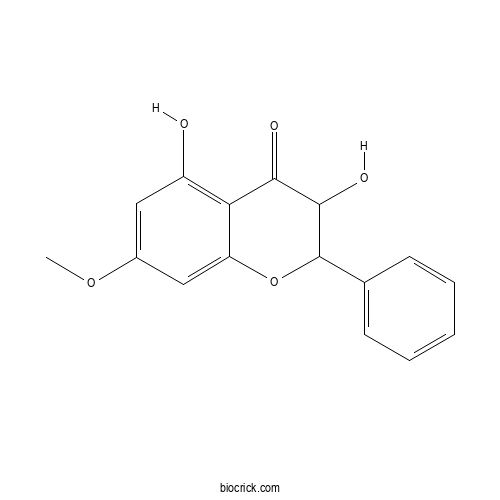
AlpinoneCAS# 480-13-7 |
| Cas No. | 480-13-7 | SDF | File under preparation. |
| PubChem ID | 5317747.0 | Appearance | Powder |
| Formula | C16H14O5 | M.Wt | 286.3 |
| Type of Compound | N/A | Storage | Desiccate at -20°C |
| Solubility | Soluble in Chloroform,Dichloromethane,Ethyl Acetate,DMSO,Acetone,etc. | ||
| Chemical Name | 3,5-dihydroxy-7-methoxy-2-phenyl-2,3-dihydrochromen-4-one | ||
| SMILES | COC1=CC(=C2C(=C1)OC(C(C2=O)O)C3=CC=CC=C3)O | ||
| Standard InChIKey | QPOCKDYYXFOBCM-UHFFFAOYSA-N | ||
| Standard InChI | InChI=1S/C16H14O5/c1-20-10-7-11(17)13-12(8-10)21-16(15(19)14(13)18)9-5-3-2-4-6-9/h2-8,15-17,19H,1H3 | ||
| General tips | For obtaining a higher solubility , please warm the tube at 37 ℃ and shake it in the ultrasonic bath for a while.Stock solution can be stored below -20℃ for several months. We recommend that you prepare and use the solution on the same day. However, if the test schedule requires, the stock solutions can be prepared in advance, and the stock solution must be sealed and stored below -20℃. In general, the stock solution can be kept for several months. Before use, we recommend that you leave the vial at room temperature for at least an hour before opening it. |
||
| About Packaging | 1. The packaging of the product may be reversed during transportation, cause the high purity compounds to adhere to the neck or cap of the vial.Take the vail out of its packaging and shake gently until the compounds fall to the bottom of the vial. 2. For liquid products, please centrifuge at 500xg to gather the liquid to the bottom of the vial. 3. Try to avoid loss or contamination during the experiment. |
||
| Shipping Condition | Packaging according to customer requirements(5mg, 10mg, 20mg and more). Ship via FedEx, DHL, UPS, EMS or other couriers with RT, or blue ice upon request. | ||
Quality Control & MSDS
3D structure
Package In Stock

Number of papers citing our products


Alpinone Dilution Calculator
Alpinone Molarity Calculator
-
 4-Formylphenyl(tetra-O-acetyl)-β-D-glucopyranosideCatalog No.: BCN0510CAS No.: 31873-42-4
-
 PadmatinCatalog No.: BCN4340CAS No.: 80453-44-7
-
 DihydrokaempferideCatalog No.: BCN0524CAS No.: 137225-59-3
-
 Blumeatin BCatalog No.: BCN4335CAS No.: 79995-67-8
-
 PinobanksinCatalog No.: BCN5729CAS No.: 548-82-3
-
 Pinobanksin 5-methyl etherCatalog No.: BCN7775CAS No.: 119309-36-3
-
 Alpinone 3-acetateCatalog No.: BCN7768CAS No.: 139906-49-3
-
 3-Hydroxy-4',5,7-trimethoxyflavanoneCatalog No.: BCN4316CAS No.: 76792-94-4
-
 7-Methoxyneochamaejasmine ACatalog No.: BCN3134CAS No.: 402828-38-0
-
 Chamaejasmenin CCatalog No.: BCN3043CAS No.: 89595-70-0
-
 Ruixianglangdusu BCatalog No.: BCN6869CAS No.: 447454-49-1
-
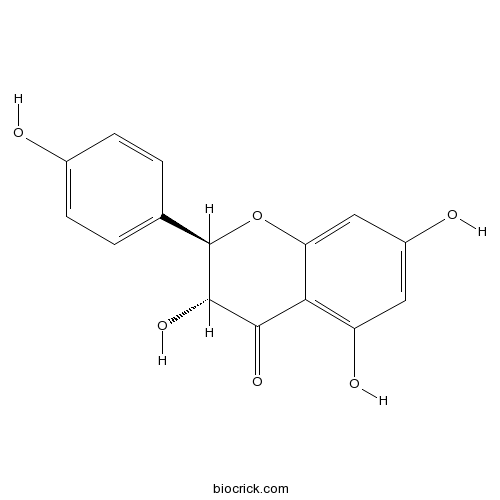 AromadendrinCatalog No.: BCN5552CAS No.: 480-20-6
-
 dihydrokaempferolCatalog No.: BCC8191CAS No.: 5150-32-3
-
 (±)-DihydrokaempferolCatalog No.: BCX1526CAS No.: 104486-98-8
-
 DihydrotamarixetinCatalog No.: BCN4268CAS No.: 70411-27-7
-
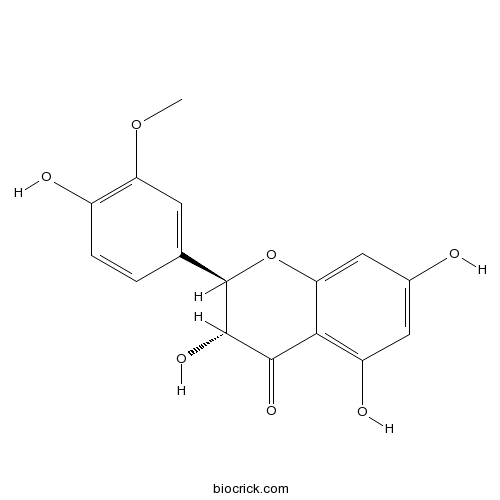 3'-O-MethyltaxifolinCatalog No.: BCN9215CAS No.: 55812-91-4
-
 PinostrobinCatalog No.: BCN5555CAS No.: 480-37-5
-
 Chamaejasmenin DCatalog No.: BCN3046CAS No.: 865852-47-7
| 1 mg | 5 mg | 10 mg | 20 mg | 25 mg | |
| 1 mM | 3.4928 mL | 17.4642 mL | 34.9284 mL | 69.8568 mL | 87.321 mL |
| 5 mM | 0.6986 mL | 3.4928 mL | 6.9857 mL | 13.9714 mL | 17.4642 mL |
| 10 mM | 0.3493 mL | 1.7464 mL | 3.4928 mL | 6.9857 mL | 8.7321 mL |
| 50 mM | 0.0699 mL | 0.3493 mL | 0.6986 mL | 1.3971 mL | 1.7464 mL |
| 100 mM | 0.0349 mL | 0.1746 mL | 0.3493 mL | 0.6986 mL | 0.8732 mL |
| * Note: If you are in the process of experiment, it's necessary to make the dilution ratios of the samples. The dilution data above is only for reference. Normally, it's can get a better solubility within lower of Concentrations. | |||||
- 3-(4-Hydroxyphenyl)-1-(1H-pyrrol-1-yl)propan-1-one
Catalog No.:BCX2398
CAS No.:1822773-39-6
- Flubendazole
Catalog No.:BCX2397
CAS No.:31430-15-6
- 2-Naphthoxyacetic acid
Catalog No.:BCX2396
CAS No.:120-23-0
- Clausenidin
Catalog No.:BCX2395
CAS No.:28384-44-3
- Nordentatin
Catalog No.:BCX2394
CAS No.:1083193-15-0
- 1-O-Methylclausenolide
Catalog No.:BCX2393
CAS No.:148763-15-9
- Heptazoline
Catalog No.:BCX2392
CAS No.:32042-35-6
- Steppogenin 5'-C-glucoside
Catalog No.:BCX2391
CAS No.:2082826-38-6
- Amburoside B
Catalog No.:BCX2390
CAS No.:221011-65-0
- (-)-Lariciresinol 4-O-glucoside
Catalog No.:BCX2389
CAS No.:364081-04-9
- 3'-Deoxyamburoside A
Catalog No.:BCX2388
CAS No.:362668-60-8
- Isopent-3-enyl ferulate
Catalog No.:BCX2387
CAS No.:132335-96-7
- 9-epi-Blumenol C
Catalog No.:BCX2400
CAS No.:1242672-31-6
- Clausarin
Catalog No.:BCX2401
CAS No.:62770-67-6
- Dentatin
Catalog No.:BCX2402
CAS No.:22980-57-0
- Aesculioside B
Catalog No.:BCX2403
CAS No.:106310-33-2
- Tinoscorside D
Catalog No.:BCX2404
CAS No.:1257394-29-8
- Blumenol C
Catalog No.:BCX2405
CAS No.:36151-02-7
- Aesculioside A
Catalog No.:BCX2406
CAS No.:254896-53-2
- Zataroside B
Catalog No.:BCX2407
CAS No.:95645-52-6
- (11R)-12-Chloronootkaton-11-ol
Catalog No.:BCX2408
CAS No.:1446439-13-9
- Steppogenin 7,4'-di-O-glucoside
Catalog No.:BCX2409
CAS No.:1193750-99-0
- cis-Pterostilbene
Catalog No.:BCX2410
CAS No.:441351-32-2
- Aesculioside H
Catalog No.:BCX2411
CAS No.:254896-72-5
Alpinone: A positive regulator molecule of immune antiviral response in Atlantic salmon kidney cells.[Pubmed:34543663]
Dev Comp Immunol. 2022 Jan;126:104262.
Alpinone is a flavonoid obtained from the resinous exudate of Heliotropium huascoense. This flavonoid shows antiviral activity against the infectious salmon anemia virus (ISAV), which causes severe disease in farmed Atlantic salmon. Here, we aim to elucidate mechanisms underlying the antiviral effects of the flavonoid. In this regard, we evaluated whether Alpinone can act upregulating the pattern-recognition receptor genes, i.e., the RIG-I-like, TLR3, and TLR9 genes, and the genes of the downstream signaling pathways. Transcriptional expression of the genes was analyzed using real-time PCR after 8, 24, and 48 h treatment of salmon kidney adherent cells with 15 mug/mL of Alpinone. First, we showed that Alpinone induced IFNa expression in the kidney adherent cells, indicating that this type of salmon cells is in part responsible for the effects previously reported in vivo. Upregulation of the IFN-induced myxovirus resistance (Mx) gene was also observed in the head kidney cells in response to the treatment. Overexpression reached a maximum level at 24 h post-treatment. Interestingly, Alpinone also induced upregulation of the cytosolic receptors of ssRNA, named Retinoic acid-inducible gene I (RIG-I) and Melanoma Differentiation-Associated protein 5 (MDA5), but there were no effects on the transcriptional expression of the TLR3 and TLR9 endosomal receptors. In addition, Alpinone upregulated the expression of genes encoding the main components of the RIG-I/MDA5 signaling pathways, such as the mitochondrial antiviral-signaling protein (MAVS), TNF Receptor Associated Factor 3 (TRAF3), TANK-binding kinase 1 (TBK1), I-kappaB kinase epsilon (IKKepsilon), the transcription factors IRF-3, and IRF7. The increased expression of all these genes is consistent with the upregulation of IFNa and Mx mRNAs. Because BX795 completely prevents Alpinone-dependent upregulation of IFNa and IRF3, the flavonoid targets seem to be upstream of the kinases TBK1 and IKKepsilon. Altogether, this study contributes to elucidating the mechanisms involved in Alpinone antiviral activity in fish. Alpinone can be used to counteract virus mechanisms of evasion where the onset of interferon-mediated response is prevented or delayed.
Alpinone exhibited immunomodulatory and antiviral activities in Atlantic salmon.[Pubmed:29292197]
Fish Shellfish Immunol. 2018 Mar;74:76-83.
In this study, we seek to identify flavonoids able to regulate the gene expression of a group of cytokines important for the control of infections in Atlantic salmon (Salmo salar). Particularly, we studied the potential immunomodulatory effects of two flavonoids, Alpinone and Pinocembrine, which were isolated and purified from resinous exudates of Heliotropium huascoense and Heliotropium sinuatum, respectively. The transcript levels of TNF-alpha and IL-1 (inflammatory cytokines), IFN-gamma and IL-12 (T helper 1 type cytokines), IL4/13A (Th2-type cytokine), IL-17 (Th17 type cytokine) TGF-beta1 (regulatory cytokine) and IFN-alpha (antiviral cytokine) were quantified by qRT-PCR in kidneys of flavonoid-treated and control fish. We demonstrated that the administration of a single intramuscular dose of purified Alpinone increased the transcriptional expression of five cytokines, named TNF-alpha, IL-1, IFN-alpha, IFN-gamma and TGF-beta1 in treated fish compared to untreated fish. Conversely, administration of purified Pinocembrine reduced the transcriptional expression of TNF-alpha, IL-1 and IL-12 in the kidney of treated fish. No other changes were observed. Interestingly, Alpinone also induced in vitro antiviral effects against Infectious Salmon Anaemia virus. Results showed that Alpinone but not Pinocembrine induces the expression of cytokines, which in vertebrates are essential to control viral infections while Pinocembrine reduces pro-inflammatory cytokines. Altogether results suggest that Alpinone is a good candidate to be further tested as immunostimulant and antiviral drug.
Anti-inflammatory effects of alpinone 3-acetate from Alpinia japonica seeds.[Pubmed:27137785]
J Nat Med. 2016 Jul;70(3):653-60.
We aimed to investigate the bioactive components of Alpinia japonica as anti-inflammatory compounds using searches of the Alpinia genus, and subsequently demonstrated that Alpinone 3-acetate markedly inhibits 12-O-tetradecanoyiphorbol 13-acetate-induced inflammation in a mouse model of ear edema. To assess other bioactivities of Alpinone 3-acetate, we performed translatome analyses and compared them with those of hydrocortisone. Polysome-associated mRNAs were prepared from Alpinone 3-acetate- or hydrocortisone-treated and control cells from 12-O-tetradecanoyiphorbol 13-acetate-induced THP-1-derived macrophages cultured in the presence of Escherichia coli O-111 lipopolysaccharide. Subsequent microarray analysis revealed that Alpinone 3-acetate and hydrocortisone upregulated and downregulated the same 155 and 41 genes, respectively. Moreover, direct comparisons of translationally regulated genes indicated 5 and 10 gene probes that were upregulated and downregulated by Alpinone 3-acetate and hydrocortisone, respectively. In conclusion, assays of 12-O-tetradecanoyiphorbol 13-acetate-induced inflammation ear edema in mice and polysome profiling of Alpinone 3-acetate bioactivities indicated similar medicinal possibilities to those of hydrocortisone.
A benzil and isoflavone from Iris tenuifolia.[Pubmed:18472117]
Phytochemistry. 2008 Jun;69(9):1880-5.
Two compounds, tenuifodione (1) and tenuifone (2), and 12 known compounds, izalpinin (3), Alpinone (4), arborinone (5), irilin B (6), irisone A (7), irisone B (8), betavulgarin (9), beta-sitosterol (10), 5,7-dihydroxy-2',6-dimethoxyisoflavone (11), 2',5-dihdroxy-6,7-methylenedioxy flavanone (12), irisoid A (13) and ethyl-beta-d-glucopyranoside (14) were isolated from the whole plant of Iris tenuifolia Pall. All compounds, except 12, were isolated for the first time from this plant. Compounds 2, 3 and 11 have shown a considerable DPPH radical scavenging activity. Structures of these compounds were identified on the basis of spectroscopic techniques, including 2D NMR. Compounds 3, 5 and 7 were also subjected to single-crystal X-ray diffraction analysis and their structures were unambiguously deduced.
Heliotropium huascoense resin exudate: chemical constituents and defensive properties.[Pubmed:11575941]
J Nat Prod. 2001 Sep;64(9):1123-6.
From the resinous exudate of Heliotropium huascoense a new compound, rel-(8R,9R)-carrizaloic acid, (1) (3-[rel-(8R,9R-9-hydroxy-9,13,13-trimethyl-12-oxo-10-cyclohexenyl)methyl]-4-methoxybenzoic acid), and three known flavonoids, [3-methylgalangin, 3,7-dimethylgalangin, and (-)-Alpinone] have been isolated. The structure of 1 was determined by spectral and chemical methods. Several plant defensive properties of 1 (insecticidal and antifungal) have been evaluated.

Calcutta University

University of Minnesota

University of Maryland School of Medicine

University of Illinois at Chicago

The Ohio State University

University of Zurich

Harvard University

Colorado State University

Auburn University

Yale University

Worcester Polytechnic Institute

Washington State University

Stanford University

University of Leipzig

Universidade da Beira Interior

The Institute of Cancer Research

Heidelberg University

University of Amsterdam

University of Auckland

TsingHua University

The University of Michigan

Miami University

DRURY University

Jilin University

Fudan University

Wuhan University

Sun Yat-sen University

Universite de Paris

Deemed University

Auckland University

The University of Tokyo

Korea University



