
Blumenol CCAS# 36151-02-7 |
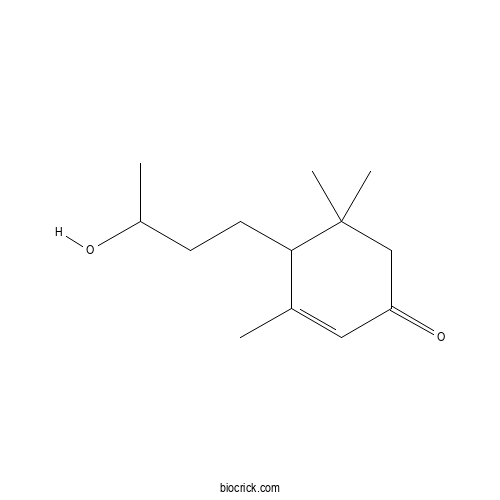
| Cas No. | 36151-02-7 | SDF | File under preparation. |
| PubChem ID | 118284.0 | Appearance | Oil |
| Formula | C13H22O2 | M.Wt | 210.3 |
| Type of Compound | N/A | Storage | Desiccate at -20°C |
| Solubility | Soluble in Chloroform,Dichloromethane,Ethyl Acetate,DMSO,Acetone,etc. | ||
| Chemical Name | 4-(3-hydroxybutyl)-3,5,5-trimethylcyclohex-2-en-1-one | ||
| SMILES | CC1=CC(=O)CC(C1CCC(C)O)(C)C | ||
| Standard InChIKey | UEEJDIUOCUCVHN-UHFFFAOYSA-N | ||
| Standard InChI | InChI=1S/C13H22O2/c1-9-7-11(15)8-13(3,4)12(9)6-5-10(2)14/h7,10,12,14H,5-6,8H2,1-4H3 | ||
| General tips | For obtaining a higher solubility , please warm the tube at 37 ℃ and shake it in the ultrasonic bath for a while.Stock solution can be stored below -20℃ for several months. We recommend that you prepare and use the solution on the same day. However, if the test schedule requires, the stock solutions can be prepared in advance, and the stock solution must be sealed and stored below -20℃. In general, the stock solution can be kept for several months. Before use, we recommend that you leave the vial at room temperature for at least an hour before opening it. |
||
| About Packaging | 1. The packaging of the product may be reversed during transportation, cause the high purity compounds to adhere to the neck or cap of the vial.Take the vail out of its packaging and shake gently until the compounds fall to the bottom of the vial. 2. For liquid products, please centrifuge at 500xg to gather the liquid to the bottom of the vial. 3. Try to avoid loss or contamination during the experiment. |
||
| Shipping Condition | Packaging according to customer requirements(5mg, 10mg, 20mg and more). Ship via FedEx, DHL, UPS, EMS or other couriers with RT, or blue ice upon request. | ||
Quality Control & MSDS
3D structure
Package In Stock

Number of papers citing our products


Blumenol C Dilution Calculator
Blumenol C Molarity Calculator
| 1 mg | 5 mg | 10 mg | 20 mg | 25 mg | |
| 1 mM | 4.7551 mL | 23.7756 mL | 47.5511 mL | 95.1022 mL | 118.8778 mL |
| 5 mM | 0.951 mL | 4.7551 mL | 9.5102 mL | 19.0204 mL | 23.7756 mL |
| 10 mM | 0.4755 mL | 2.3776 mL | 4.7551 mL | 9.5102 mL | 11.8878 mL |
| 50 mM | 0.0951 mL | 0.4755 mL | 0.951 mL | 1.902 mL | 2.3776 mL |
| 100 mM | 0.0476 mL | 0.2378 mL | 0.4755 mL | 0.951 mL | 1.1888 mL |
| * Note: If you are in the process of experiment, it's necessary to make the dilution ratios of the samples. The dilution data above is only for reference. Normally, it's can get a better solubility within lower of Concentrations. | |||||
- Tinoscorside D
Catalog No.:BCX2404
CAS No.:1257394-29-8
- Aesculioside B
Catalog No.:BCX2403
CAS No.:106310-33-2
- Dentatin
Catalog No.:BCX2402
CAS No.:22980-57-0
- Clausarin
Catalog No.:BCX2401
CAS No.:62770-67-6
- 9-epi-Blumenol C
Catalog No.:BCX2400
CAS No.:1242672-31-6
- Alpinone
Catalog No.:BCX2399
CAS No.:480-13-7
- 3-(4-Hydroxyphenyl)-1-(1H-pyrrol-1-yl)propan-1-one
Catalog No.:BCX2398
CAS No.:1822773-39-6
- Flubendazole
Catalog No.:BCX2397
CAS No.:31430-15-6
- 2-Naphthoxyacetic acid
Catalog No.:BCX2396
CAS No.:120-23-0
- Clausenidin
Catalog No.:BCX2395
CAS No.:28384-44-3
- Nordentatin
Catalog No.:BCX2394
CAS No.:1083193-15-0
- 1-O-Methylclausenolide
Catalog No.:BCX2393
CAS No.:148763-15-9
- Aesculioside A
Catalog No.:BCX2406
CAS No.:254896-53-2
- Zataroside B
Catalog No.:BCX2407
CAS No.:95645-52-6
- (11R)-12-Chloronootkaton-11-ol
Catalog No.:BCX2408
CAS No.:1446439-13-9
- Steppogenin 7,4'-di-O-glucoside
Catalog No.:BCX2409
CAS No.:1193750-99-0
- cis-Pterostilbene
Catalog No.:BCX2410
CAS No.:441351-32-2
- Aesculioside H
Catalog No.:BCX2411
CAS No.:254896-72-5
- 7,4'-Dihydroxyflavan
Catalog No.:BCX2412
CAS No.:82925-54-0
- 7,4'-Dihydroxyhomoisoflavan
Catalog No.:BCX2413
CAS No.:84638-49-3
- 5,7-Dimethoxy-4'-hydroxyflavan
Catalog No.:BCX2414
CAS No.:103963-45-7
- 2',4'-Dihydroxychalcone
Catalog No.:BCX2415
CAS No.:25515-43-9
- Didendronbiline A
Catalog No.:BCX2416
CAS No.:2267991-55-7
- Esculetin 6-O-β-D-apiofuranosyl-(1→6)-β-D-glucopyranoside
Catalog No.:BCX2417
CAS No.:163017-13-8
Bioactivity-Guided Evaluation of Extracts and Fractions of Seagrass (Enhalus acoroides): In vitro Antimicrobial and Anti-Inflammatory Activities with LC-MS/MS Characterization.[Pubmed:42831400]
Pak J Biol Sci. 2026 Oct;29(7):319-327.
<b>Background and Objective:</b> The seagrass <i>Enhalus acoroides</i> is a marine plant species widely distributed in the waters of Southeast Sulawesi. It is considered a potential source of bioactive compounds with pharmaceutical relevance. This study aimed to characterize the chemical constituents of <i>E. acoroides</i> rhizomes and evaluate their antimicrobial and anti-inflammatory activities. <b>Materials and Methods:</b> Phytochemical profiling of the extract and ethyl acetate fraction was performed using Liquid Chromatography-Mass Spectrometry/Mass Spectrometry (LC-MS/MS). Antimicrobial activity was assessed using the microdilution method against <i>Staphylococcus aureus</i>, <i>Escherichia coli</i>, and <i>Candida albicans</i>. Anti-inflammatory activity was evaluated using a protein denaturation assay. The statistical analysis was conducted using SPSS, with a one-way ANOVA at a significance level of p<0.05 (95% CI). <b>Results:</b> LC-MS/MS analysis identified twelve compounds in the extract and ethyl acetate fraction, including hecogenone, periploca side N, Blumenol C glucoside, alpha-D-glucopyranose-1-hexadecanoate, kushenol R, procyanidin A2, physalin L, Delta5-pregnene-3beta,17alpha,20alpha-diol, verticiol, quercimeritrin, pterodontoside F, and vitamin K1. Fractions D and E exhibited strong antibacterial activity against <i>S. aureus</i>, with minimum inhibitory concentrations (MICs) of 2 and 1 mug/mL, respectively, and both showed activity against <i>E. coli</i> (MIC = 2 mug/mL). Fraction E also demonstrated antifungal activity against <i>C. albicans</i> (MIC = 4 mug/mL). In the anti-inflammatory assay, fraction E exhibited the highest activity, with an IC<sub>50</sub> of 29.48 mug/mL. <b>Conclusion:</b> The findings indicate that <i>E. acoroides</i> rhizomes are a promising source of bioactive compounds with significant antimicrobial and anti-inflammatory potential.
Antiglycation and Amyloid-beta Inhibitory Activities of Pandanus odorifer Extracts and Isolated Constituents: In Vitro and Molecular Docking Insights.[Pubmed:42672905]
Chem Biodivers. 2026 Sep;23(9):e71641.
Alzheimer's disease (AD) is a neurodegenerative disorder associated with amyloid-beta (Abeta) aggregation, advanced glycation end products (AGEs), and oxidative stress. This study investigated the antiglycation, antioxidant, anti-amyloidogenic, and predicted drug-likeness properties of Pandanus odorifer (Forssk.) Kuntze. The methanolic crude extract showed high total flavonoid content (121.7 +/- 2.50 mg QE/g), moderate total phenolic content (16.61 +/- 1.50 mg GAE/g), and strong AGE inhibition (IC(50) = 57.30 microg/mL), with moderate radical scavenging activity. Chromatographic separation yielded syringaresinol (1), dehydrovomifoliol (2), and Blumenol C glucoside (3), identified through spectroscopic analysis and comparison with published data. In the Thioflavin T assay, compounds 1-3 reduced Abeta-associated fluorescence, with compound 3 producing the largest reduction (71.20% +/- 4.42%) under the tested conditions. Molecular docking suggested interactions with Abeta42 oligomers and AD-related enzymes, particularly acetylcholinesterase and beta-secretase, while in silico prediction indicated acceptable drug-likeness without Lipinski violations. Overall, the findings identify P. odorifer as a source of constituents with antiglycation activity and preliminary Abeta-associated ThT responses that warrant confirmation using orthogonal biophysical and biological assays.
Genetic and environmental regulation of arbuscular mycorrhizal responsiveness in petunia: Implications for breeding and trait selection.[Pubmed:41607111]
Plant Biol (Stuttg). 2026 Jun;28(4):1145-1158.
Arbuscular mycorrhizal (AM) fungi enhance plant nutrition and stress tolerance, yet their agricultural use remains limited because symbiotic outcomes are unpredictable. Mycorrhizal responsiveness (AM-responsiveness)-the host's growth response to AMF inoculation-offers a potential breeding target. We investigated variation in AM-responsiveness among Petunia hybrida, P. axillaris, P. exserta and P. inflata, and explored its genetic and environmental determinants. Plants were inoculated with Rhizoglomus irregulare and analysed for biomass, AMF colonization, phosphate uptake, phosphate transporter expression and accumulation of the foliar biomarker 11-carboxyBlumenol C-glucoside. Species differed strongly in colonization intensity, biomass and biomarker accumulation. Based on contrasting AM-responses between P. axillaris and P. exserta, a recombinant inbred line (RIL) population derived from these parents was used to assess AM-responsiveness as a quantitative trait under variable environmental conditions. The RILs showed transgressive segregation for biomass responses, confirming a heritable component, while strong genotype x environment (G x E) interactions demonstrated environmental dependency. These results highlight AM-responsiveness as a genetic trait suitable for breeding but emphasize the need to account for environmental variation. Foliar blumenols proved effective non-destructive indicators of colonization, supporting their potential in high-throughput screening for mycorrhizal traits.
[Two new glycosides from Hypericum elatoides].[Pubmed:39041085]
Zhongguo Zhong Yao Za Zhi. 2024 Jun;49(12):3242-3251.
The column chromatography with silica gel, reversed-phase C_(18), and Sephadex LH-20 was employed to separate the methanol extract of the aerial parts of Hypericum elatoides. The compounds were identified by the comprehensive analysis of IR, NMR, and MS data as methyl 8-O-beta-D-glucopyranosyl-(Z)-5-octenoate(1), methyl 3-O-beta-D-glucopyranosyl-4-methylhexanoate(2), byzantionoside B(3), 9-epi-Blumenol C glucoside(4), corchoionoside C(5),(6S,9R)-roseoside(6), cis-p-coumaric acid 4-O-beta-D-glucopyranoside(7), trans-p-coumaric acid 4-O-beta-D-glucopyranoside(8), methyl 3-(4-hydroxyphenyl)propanoate(9),(E)-chlorogenic acid methyl ester(10), quercetin-3-O-beta-D-glucopyranoside(11), beta-sitosterol(12), stigmasterol(13), stigmast-4-en-3-one(14), beta-amyrin(15), daucosterol(16), sitoindoside Ⅰ(17), oleic acid(18), methyl alpha-linolenate(19), trilinolein(20), and cassipourol(21). Among them, compounds 1 and 2 were identified as new glycosides and named hyperelatosides G and H. Compounds 3-5, 7-9, 17, and 20-21 were isolated from the genus Hypericum for the first time. The remaining compounds were isolated from H. elatoides for the first time. The results of biological assays revealed that compound 11 exhibited significant anti-neuroinflammatory activity, and compounds 1, 3, and 19 displayed certain neuroprotective effects.
UHPLC-MS metabolomic profile and in silico pharmacokinetic approach of Kalanchoe daigremontiana Raym.-Hamet & H. Perrier aqueous extracts.[Pubmed:37951139]
J Pharm Biomed Anal. 2024 Jan 20;238:115827.
Throughout humanity's development, the medicinal use of plants has evolved as an observational and empirical matter; Yoruba culture uses Kalanchoe sp. as universal antidotes. They are believed to be "ewe odundun" or plants of goodness and are traditionally and religiously used in preparations to treat diseases and physiological disorders. Our main goals were to determine the comparative phytochemical composition panel of two Kalanchoe daigremontiana Raym.-Hamet & H. Perrier aqueous extracts through UHPLC-MS metabolomic approaches and highlight the drug-likeness properties of the most abundant compounds in the complex mixture prepared according to its traditional uses. K. daigremontiana leaf aqueous extracts were prepared by cold water maceration (Kd1) or decoction (Kd2). The metabolomics analysis of the extracts was performed through UHPLC-ESI-MS/MS acquisition in positive and negative modes. An in-house database was built with molecules found in plants from the Crassulaceae family and was applied to the annotation step. Our analysis identified 132 compounds, showcasing variations between negative (ESI(-)) and positive (ESI(+)) ionization modes. Notably, flavonoids such as quercetin and kaempferol glycosides, known for their potent antioxidant properties, were abundant in both extracts. Additionally, bufadienolides, associated with diverse biological activities, were present. Both extracts presented similar phytochemical compositions in terms of the number of compounds. Differential analysis revealed significantly higher intensities for specific molecules in both Kd1 and Kd2 extracts. Considering the relative abundance, Kd1 showed a significant amount of Fatty Acids and Steroids concerning Kd2. Additionally, the 15 most abundant compounds were analyzed using in silico pharmacokinetic and toxicity algorithms (SwissADME, pkCSM, and LAZAR) to predict their drug-likeness profile. The fifteen most abundant molecules (Corchorifatty acid F; 9,12,13-TriHOME; Acetylsagittatin A; Apiin; Kaempferol; L-Malic acid; 19-Oxodesacetylcinobufagin; Lucyoside Q; (12 S,13 S)-Epoxylinolenic acid; Isocitric acid; 4''-O-Acetylafzelin; Hellebrigenin; Senedigitalene; Blumenol C and Sativoside R2) had their ADMET in silico profiles predicted using computational tools. Importantly, our in silico assessments pinpointed six promising compounds with favorable absorption, pharmacokinetics, and drug-likeness properties, suggesting their potential as bioactive agents. This finding underscores the significance of these traditional aqueous extracts in folk medicine. In conclusion, our study not only supports the traditional use of Kalanchoe spp. but also sheds light on the safety and pharmacological potential of these extracts. By exploring different extraction methods and employing metabolomics, we have gained valuable insights into the bioactivity and safety of plant extracts, which can guide future research in this field.
Chemical composition and cardiotropic activity of Ziziphora clinopodioides subsp. bungeana (Juz.) Rech.f.[Pubmed:37253397]
J Ethnopharmacol. 2023 Oct 28;315:116660.
ETHNOPHARMACOLOGICAL RELEVANCE: Ziziphora clinopodioides subsp. bungeana (Juz.) Rech.f. is a subshrub that is widely distributed in China, Kazakhstan, Kyrgyzstan, Mongolia, Russia, Tajikistan, Turkmenistan, and Uzbekistan. The species is used in traditional medicine for the relief of symptoms connected to cardiovascular diseases like coronary heart disease or hypertension. AIM OF THE STUDY: was to validate traditional use of Z. clinopodioides subsp. bungeana for the treatment of coronary hearth diseases using in vivo models and to find active compounds responsible for the activity. MATERIALS AND METHODS: Multiple extracts were obtained from the aerial parts of Z. clinopodioides subsp. bungeana using maceration, liquid-liquid extraction, CO2 extraction and ultrasound-assisted extraction. Preliminary screening studies for the evaluation of the efficacy of Z. clinopodioides subsp. bungeana extracts on the model of hemic hypoxia were performed. The most effective samples were selected and included in the main study. Stage 2 of the study evaluated the cardiotropic activity of the selected extracts on a model of chronic heart failure. Preparations were administered to animals intragastrically once a day for 28 days. For the isolation of individual compounds plant material was extracted with 96% ethanol. The obtained crude extract was sequentially extracted with n-hexane and dichloromethane and separated by chromatography on a Diaion HP-20 column. The obtained fractions were further subjected to Sephadex LH-20 column chromatography and eluted isocratically with 96% ethanol (EtOH) to yield subfractions, which were further separated by preparative HPLC to obtain 13 individual compounds. RESULTS: Extracts obtained from Ziziphora clinopodioides subsp. bungeana (Juz.) Rech.f. herb were subjected to pharmacological screening for the evaluation of their efficacy on hemic hypoxia. Based on the obtained results, out of the sixteen tested extracts two (AR and US 60%) were selected for further evaluation of their cardiotropic activity. Modeling of chronic heart failure was carried out in accordance with the following stages: 1) anesthesia with chloral hydrate at a dose of 450 mg/kg, intraperitoneally, 2) artificial ventilation of the lungs, 3) thoracotomy, 4) modeling of permanent ischemic or ischemic-reperfusion damage. Both extracts effected the indicators of contraction and output, comparable to the reference drug - Monopril. Based on the extraction methods used to obtain RAF and US60 and data from the literature, it can be assumed that they contain compounds with medium polarity, including polyphenols and terpenoids. At the next stage three previously undescribed monoterpenoid derivatives - Ziziphoric acid (1), Ziziphoroside D (2) and 6'-malonylziziphoroside A (3), along with two previously described megastigmane glucosides - Blumenol C glucoside (4), Blumenol C 9-O-(6'-O-malonyl-beta-D-glucopyranoside (5) and two previously described monoterpenoids 7a-hydroxymintlactone (6), 7-hydroxypiperitone (7) together with six polyphenols - pinocembrine-7-O-rutinoside (8), chrysine-7-O-rutinoside (9), acacetin-7-O-rutinoside (10), luteolin-7-O-rutinoside (11), rutin (12) and rosmarinic acid (13) were isolated from Z. clinopodioides subsp. bungeana extracts. CONCLUSION: Our results support the traditional use of Z. clinopodioides subsp. bungeana for the treatment of coronary diseases. As a result of Z. clinopodioides subsp. bungeana extracts screening in vivo, two extracts were selected as potential cardiotropic agents. Phytochemical analysis of the plant material led to the isolation of five terpenoid derivatives, two megastigmane glycosides, five flavonoids and one cinnamic acid derivative, which could be responsible for the reported biological activity. Future experiments are required to understand the mechanisms of action for the isolated compounds.
Arbuscular mycorrhizal fungi-indicative blumenol-C-glucosides predict lipid accumulations and fitness in plants grown without competitors.[Pubmed:36866959]
New Phytol. 2023 Jun;238(5):2159-2174.
Hydroxy- and carboxyBlumenol C-glucosides specifically accumulate in roots and leaves of plants harboring arbuscular mycorrhizal fungi (AMF). To explore blumenol function in AMF relationships, we silenced an early key-gene in blumenol biosynthesis, CCD1 (carotenoid cleavage dioxygenase 1), in the ecological model plant, Nicotiana attenuata, and analyzed whole-plant performance in comparison with control and CCaMK-silenced plants, unable to form AMF associations. Root blumenol accumulations reflected a plant's Darwinian fitness, as estimated by capsule production, and were positively correlated with AMF-specific lipid accumulations in roots, with relationships that changed as plants matured when grown without competitors. When grown with wild-type competitors, transformed plants with decreased photosynthetic capacity or increased carbon flux to roots had blumenol accumulations that predicted plant fitness and genotype trends in AMF-specific lipids, but had similar levels of AMF-specific lipids between competing plants, likely reflecting AMF-networks. We propose that when grown in isolation, blumenol accumulations reflect AMF-specific lipid allocations and plant fitness. When grown with competitors, blumenol accumulations predict fitness outcomes, but not the more complicated AMF-specific lipid accumulations. RNA-seq analysis provided candidates for the final biosynthetic steps of these AMF-indicative Blumenol C-glucosides; abrogation of these steps will provide valuable tools for understanding blumenol function in this context-dependent mutualism.
Achyranbidens A-C: three new compounds from Achyranthes bidentata Blume.[Pubmed:36722288]
Nat Prod Res. 2024 Jul;38(14):2363-2372.
Phytochemical study on the roots of Achyranthes bidentata Blume led to the isolation of sixteen compounds including three new ones (1-3). Their chemical structures were determined as oleanolic acid 28-O-beta-D-glucopyranoside-3-O-[beta-D-glucopyranosyl-(1-->3)-beta-D-galactopyranoside) (1), methyl (8Z,11Z)-5,6,7-trihydroxytetradeca-8,11-dienoate (2), methyl (6E,11Z)-5,8,9-trihydroxytetradeca-6,11-dienoate (3), fulgidic acid (4), (9E,11E)-13-oxooctadeca-9,11-dienoic acid (5), (9Z,11E,15Z)-13-hydroxyoctadeca-9,11,15-trienoic acid (6), oleanolic acid 28-O-beta-D-glucopyranoside-3-O-alpha-L-rhamnopyranosyl-(1-->4)-beta-D-glucuronopyranoside (7), oleanolic acid 28-O-beta-D-glucopyranoside-3-O-beta-D-glucopyranosyl-(1-->2)-[alpha-L-rhamnopyranosyl-(1-->3)]-beta-D-glucuronopyranoside (8), oleanolic acid 3-O-beta-D-glucopyranosyl-(1-->2)-[alpha-L-rhamnopyranosyl-(1-->3)]-beta-D-glucuronopyranoside (9), oleanolic acid 3-O-alpha-L-rhamnopyranosyl-(1-->3)-beta-D-glucuronopyranoside (10), Blumenol C glucoside (11), citroside A (12), 6S,9S-roseoside (13), ginsenoside Rg1 (14), 20-hydroxyecdysone (15), and benzyl alpha-L-rhamnopyranosyl-(1-->6)]-beta-D-glucopyranoside (16) by spectroscopic analysis. Compounds 1, 7 and 11-16 inhibited NO production in LPS-activated RAW264.7 cells with IC(50) values in the range from 28.03 to 54.23 microM (positive control, L-NMMA: IC(50) = 35.52 microM). Compounds 14 and 15 showed anti alpha-glucosidase activity with IC(50) values of 176.24 and 156.92 microM, respectively, compared with the positive control, acarbose, IC(50) = 160.99 muM.
Phytochemistry Meets Geochemistry-Blumenol C Sulfate: A New Megastigmane Sulfate from Palicourea luxurians (Rubiaceae: Palicoureeae).[Pubmed:36364108]
Molecules. 2022 Oct 26;27(21):7284.
There is a previously neglected influence of geochemical conditions on plant phytochemistry. In particular, high concentrations of dissolved salts can affect their biosynthesis of natural products. Detoxification is most likely an important aspect for the plant, but additional natural products can also give it an expanded range of bioactivities. During the phytochemical analysis a Palicourea luxurians plant collected in a sulfate-rich environment (near the Rio Sucio, Costa Rica) showed an interesting natural product in this regard. The structure of this compound was determined using spectroscopic and computational methods (NMR, MS, UV, IR, CD, optical rotation, quantum chemical calculations) and resulted in a megastigmane sulfate ester possessing a beta-ionone core structure, namely Blumenol C sulfate (1, C(13)H(22)O(5)S). The levels of sulfur and sulfate ions in the leaves of the plant were determined using elemental analysis and compared to the corresponding levels in comparable plant leaves from a less sulfate-rich environments. The analyses show the leaves from which we isolated Blumenol C sulfate (1) to contain 35% more sulfur and 80% more sulfate than the other samples. Antimicrobial and antioxidant activities of compound 1 were tested against Escherichia coli, E. coli ampR and Bacillus subtilis as well as measured using complementary in vitro FRAP and ATBS assays, respectively. These bioactivities are comparable to those determined for structurally related megastigmanes. The sulfur and sulfate content of the plant leaves from the sulfate-rich environment was significantly higher than that of the other plants. Against this background of salt stress, we discuss a possible biosynthesis of Blumenol C sulfate (1). Furthermore, there appears to be no benefit for the plant in terms of extended bioactivities. Hence, the formation of Blumenol C sulfate (1) probably primarily serves the plant detoxification process.

Calcutta University

University of Minnesota

University of Maryland School of Medicine

University of Illinois at Chicago

The Ohio State University

University of Zurich

Harvard University

Colorado State University

Auburn University

Yale University

Worcester Polytechnic Institute

Washington State University

Stanford University

University of Leipzig

Universidade da Beira Interior

The Institute of Cancer Research

Heidelberg University

University of Amsterdam

University of Auckland

TsingHua University

The University of Michigan

Miami University

DRURY University

Jilin University

Fudan University

Wuhan University

Sun Yat-sen University

Universite de Paris

Deemed University

Auckland University

The University of Tokyo

Korea University



