
ClausarinCAS# 62770-67-6 |
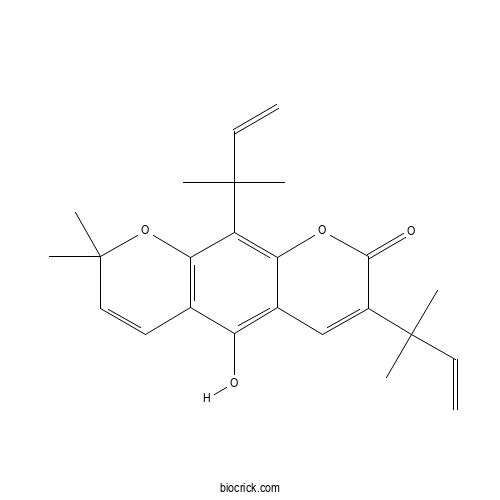
| Cas No. | 62770-67-6 | SDF | File under preparation. |
| PubChem ID | 5315945.0 | Appearance | Yellow powder |
| Formula | C24H28O4 | M.Wt | 380.5 |
| Type of Compound | N/A | Storage | Desiccate at -20°C |
| Solubility | Soluble in Chloroform,Dichloromethane,Ethyl Acetate,DMSO,Acetone,etc. | ||
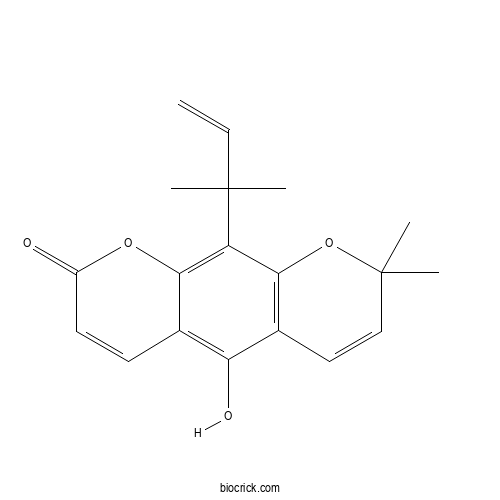
| Chemical Name | 5-hydroxy-2,2-dimethyl-7,10-bis(2-methylbut-3-en-2-yl)pyrano[3,2-g]chromen-8-one | ||
| SMILES | CC1(C=CC2=C(O1)C(=C3C(=C2O)C=C(C(=O)O3)C(C)(C)C=C)C(C)(C)C=C)C | ||
| Standard InChIKey | LMEKIDFKWUPZGE-UHFFFAOYSA-N | ||
| Standard InChI | InChI=1S/C24H28O4/c1-9-22(3,4)16-13-15-18(25)14-11-12-24(7,8)28-20(14)17(23(5,6)10-2)19(15)27-21(16)26/h9-13,25H,1-2H2,3-8H3 | ||
| General tips | For obtaining a higher solubility , please warm the tube at 37 ℃ and shake it in the ultrasonic bath for a while.Stock solution can be stored below -20℃ for several months. We recommend that you prepare and use the solution on the same day. However, if the test schedule requires, the stock solutions can be prepared in advance, and the stock solution must be sealed and stored below -20℃. In general, the stock solution can be kept for several months. Before use, we recommend that you leave the vial at room temperature for at least an hour before opening it. |
||
| About Packaging | 1. The packaging of the product may be reversed during transportation, cause the high purity compounds to adhere to the neck or cap of the vial.Take the vail out of its packaging and shake gently until the compounds fall to the bottom of the vial. 2. For liquid products, please centrifuge at 500xg to gather the liquid to the bottom of the vial. 3. Try to avoid loss or contamination during the experiment. |
||
| Shipping Condition | Packaging according to customer requirements(5mg, 10mg, 20mg and more). Ship via FedEx, DHL, UPS, EMS or other couriers with RT, or blue ice upon request. | ||
Quality Control & MSDS
3D structure
Package In Stock

Number of papers citing our products


Clausarin Dilution Calculator
Clausarin Molarity Calculator
| 1 mg | 5 mg | 10 mg | 20 mg | 25 mg | |
| 1 mM | 2.6281 mL | 13.1406 mL | 26.2812 mL | 52.5624 mL | 65.703 mL |
| 5 mM | 0.5256 mL | 2.6281 mL | 5.2562 mL | 10.5125 mL | 13.1406 mL |
| 10 mM | 0.2628 mL | 1.3141 mL | 2.6281 mL | 5.2562 mL | 6.5703 mL |
| 50 mM | 0.0526 mL | 0.2628 mL | 0.5256 mL | 1.0512 mL | 1.3141 mL |
| 100 mM | 0.0263 mL | 0.1314 mL | 0.2628 mL | 0.5256 mL | 0.657 mL |
| * Note: If you are in the process of experiment, it's necessary to make the dilution ratios of the samples. The dilution data above is only for reference. Normally, it's can get a better solubility within lower of Concentrations. | |||||
- 9-epi-Blumenol C
Catalog No.:BCX2400
CAS No.:1242672-31-6
- Alpinone
Catalog No.:BCX2399
CAS No.:480-13-7
- 3-(4-Hydroxyphenyl)-1-(1H-pyrrol-1-yl)propan-1-one
Catalog No.:BCX2398
CAS No.:1822773-39-6
- Flubendazole
Catalog No.:BCX2397
CAS No.:31430-15-6
- 2-Naphthoxyacetic acid
Catalog No.:BCX2396
CAS No.:120-23-0
- Clausenidin
Catalog No.:BCX2395
CAS No.:28384-44-3
- Nordentatin
Catalog No.:BCX2394
CAS No.:1083193-15-0
- 1-O-Methylclausenolide
Catalog No.:BCX2393
CAS No.:148763-15-9
- Heptazoline
Catalog No.:BCX2392
CAS No.:32042-35-6
- Steppogenin 5'-C-glucoside
Catalog No.:BCX2391
CAS No.:2082826-38-6
- Amburoside B
Catalog No.:BCX2390
CAS No.:221011-65-0
- (-)-Lariciresinol 4-O-glucoside
Catalog No.:BCX2389
CAS No.:364081-04-9
- Dentatin
Catalog No.:BCX2402
CAS No.:22980-57-0
- Aesculioside B
Catalog No.:BCX2403
CAS No.:106310-33-2
- Tinoscorside D
Catalog No.:BCX2404
CAS No.:1257394-29-8
- Blumenol C
Catalog No.:BCX2405
CAS No.:36151-02-7
- Aesculioside A
Catalog No.:BCX2406
CAS No.:254896-53-2
- Zataroside B
Catalog No.:BCX2407
CAS No.:95645-52-6
- (11R)-12-Chloronootkaton-11-ol
Catalog No.:BCX2408
CAS No.:1446439-13-9
- Steppogenin 7,4'-di-O-glucoside
Catalog No.:BCX2409
CAS No.:1193750-99-0
- cis-Pterostilbene
Catalog No.:BCX2410
CAS No.:441351-32-2
- Aesculioside H
Catalog No.:BCX2411
CAS No.:254896-72-5
- 7,4'-Dihydroxyflavan
Catalog No.:BCX2412
CAS No.:82925-54-0
- 7,4'-Dihydroxyhomoisoflavan
Catalog No.:BCX2413
CAS No.:84638-49-3
alpha-Glucosidase and Nitric Oxide Inhibitory Activities of Pyranocoumarins and Carbazoles From the Roots of Clausena excavata and the Semisynthetic Analogs of Clausarin and Nordentatin.[Pubmed:40720625]
Chem Biodivers. 2025 Nov;22(11):e00510.
Phytochemical investigation of the methanol extract of Clausena excavata roots led to the isolation of six pyranocoumarin derivatives, including xanthyletin (1), kinocoumarin (2), Clausarin (3), nordentatin (4), dentatin (4a), and citrusarin A (5), and three carbazole alkaloids, that is, heptaphylline (6), 7-methoxymukonal (7), and clausine K (8). Seven new semisynthetic analogs of compounds 2, 3, and 4 (2a, 3b-3d, and 4b-4d) were prepared through methylation, etherification, and basic hydrolysis for biological assays. Compounds 2, 6, 3b, 3c, 4b, and 4c displayed stronger alpha-glucosidase inhibitory activity than the positive control, acarbose (IC(50) 391.47 microM), with IC(50) values in the range of 32.89-92.55 microM. Molecular docking suggested that these compounds bind near the enzyme's active site via van der Waals forces, hydrogen bonds, and hydrophobic interactions. Compound 3 showed the strongest nitric oxide (NO) inhibitory activity (IC(50) = 27.95 microM), followed by 3d (IC(50) = 33.62 microM) and 4 (IC(50) = 35.41 microM). For the two compounds tested for cytotoxicity against A549 cells, 3b (IC(50) = 11.71 microM) was more potent than cisplatin (IC(50) = 21.56 microM), whereas 4b (IC(50) = 22.39 microM) showed similar activity to cisplatin. Drug-likeness and pharmacokinetic properties of the isolated and semisynthetic compounds were also evaluated.
alpha-Glucosidase Inhibitory Activity of Prenylated Pyranocoumarins from Clausena excavata: Mechanism of Action, ADMET and Molecular Docking.[Pubmed:38923383]
Chem Biodivers. 2024 Sep;21(9):e202401141.
Three naturally occurring prenylated pyranocoumarins, nordentatin (1), dentatin (2), and Clausarin (3), isolated from the roots of Clausena excavata (Family Rutaceae), and O-methylClausarin (4) which was obtained by methylation of 3, were investigated for their alpha-glucosidase inhibitory activity. The mechanism of action and the in silico prediction of their physicochemical and ADMET properties as well as the molecular docking were also studied. Compounds 1-4 exhibited stronger alpha-glucosidase inhibitory activity than the positive control, acarbose, through a non-competitive mechanism. Among them, 3 exhibited the highest activity, with an IC(50) of 8.36 muM, which is significantly stronger than that of acarbose (IC(50)=430.35 muM). The prenyl group on C-3 and the hydroxyl group on C-5 in 3 may play important roles in enhancing the activity. Calculated physicochemical and ADMET parameters of 1-4 satisfied the Lipinski's and Veber's rules. Molecular simulation analysis indicated they are promising drug candidates with no hepatotoxicity. Compound 3 exhibited potent activity in the experiment and demonstrated good drug properties based on the calculations. A molecular docking study revealed that 3 showed H-bonding and pi-pi stacking interactions with selective Phe321, as well as interactions with thirteen other amino acid residues of the alpha-glucosidase.
Bioassay-Guided Isolation and Identification of Antiplasmodial Compounds from the Stem Bark of Clausena excavata.[Pubmed:37414059]
Planta Med. 2023 Oct;89(12):1165-1169.
Clausena excavata is a medicinal plant widely distributed in Southeast Asia. It is used for a variety of indications, including to treat malaria. In our present study, a phytochemical study of the methanol extract from the stem bark of C. excavata led to the isolation of five pyranocoumarins, nordentatin (1: ), dentatin (2: ), kinocoumarin (3: ), Clausarin (4: ), and clausenidin (5: ), and a coumarin, 8-hydroxy-3'',4''-dihydrocapnolactone-2',3'-diol (6: ). The isolation of compound 6: from C. excavata and the antiplasmodial activities against a multidrug-resistant K1 strain of Plasmodium falciparum of 1, 3: , and 5: were reported for the first time. Compounds 3: and 4: exhibited potent antiplasmodial activities with EC(50) values of 1.10 and 0.58 microM, respectively, while 1: and 5: had EC(50) values of 5.62 and 7.15 microM, respectively. A prenyl group attached to the C-3 or C-12 position on the pyranocoumarin ring probably plays an important role on the activity. A hydroxyl group at the C-10 position is also likely to enhance the activity.
Cytotoxicity and Apoptosis Induction of Coumarins and Carbazole Alkaloids from Clausena harmandiana.[Pubmed:31540345]
Molecules. 2019 Sep 18;24(18):3385.
Seven compounds, carbazole alkaloids (heptaphylline, 7-methoxyheptaphylline, 7-methoxymukonal) and coumarins (Clausarin, dentatin, nordentatin, and xanthoxyletin), were isolated from the root bark of Clausena harmandiana. Antioxidation, cytotoxicity and apoptosis induction were evaluated in vitro. Results showed that Clausarin exerted the highest DPPH radical scavenging and 7-methoxymukonal had the highest ferric reducing antioxidant power. In contrary, dentatin was the least DPPH radical scavenger, and heptaphylline was the least reducing antioxidant power. The isolated compounds showed different cytotoxicity. The hepatocellular carcinoma (HepG2) was generally more sensitive to the isolated compounds than lung cancer (SK-LU-1), colon cancer (HCT-116), and noncancerous (Vero) cell lines, respectively. Clausarin possessed the highest cytotoxicity selectively against cancer cell lines tested. 7-Methoxymukonal and 7-methoxyheptaphylline exhibited less cytotoxicity only in HepG2 cells and were inactive in the SK-LU-1 and HCT116 cells. Despite xantoxyletin possessing low antioxidant and low cytotoxic activity, it induced the highest apoptosis percentage with the lowest necrosis percentage of HepG2 cells after 24 h. In conclusion, xantoxyletin primarily show potential anticancer activity. The root bark of C. harmandiana is a good source of bioactive compounds or the lead for the development of new pharmaceutical agent.
Anti-HBV and cytotoxic activities of pyranocoumarin derivatives.[Pubmed:19635670]
Bioorg Med Chem. 2009 Aug 15;17(16):6137-43.
Four natural pyranocoumarins clausenidin (1), nordentatin (2), Clausarin (3), and xanthoxyletin (4) were isolated from the medicinal plant Clausena excavata. Recently, we found that 1 and 2 suppressed hepatitis B virus surface antigen in HepA2 cells, and in addition, 1-3 showed cytotoxic activity against four human cancer cell lines (A549, MCF7, KB, and KB-VIN). To explore the SAR of 1-4, 17 pyranocoumarin analogues (5-21) were designed and synthesized. Among these analogues, 5 and 10 were the most potent against hepatitis B virus with EC(50) values of 1.14 and 1.34microM, respectively. The most interesting result in the cytotoxicity assay was the significant activity of 1, 5, and 6 against the multi-drug resistant cell line, KB-VIN, without activity against the KB cell line. These data suggest that these three compounds could be useful hits for developing MDR-inverse drugs.
Modulation of P-glycoprotein activity by acridones and coumarins from Citrus sinensis.[Pubmed:17236173]
Phytother Res. 2007 Apr;21(4):386-90.
Bioguided fractionation of the roots of Citrus sinensis (Rutaceae) led to the isolation and identification of five coumarins, namely, Clausarin, suberosin, poncitrin, xanthyletin and thamnosmonin, seven acridones, namely, acrimarine B, 2-methoxycitpressine I, citpressine I, buntanine, acrimarine E, honyumine and acrimarine C, and one terpenoid, namely, limonin. Among these compounds, Clausarin, 2-methoxycitpressine I and acrimarine E inhibited P-glycoprotein-mediated drug efflux in K562/R7 human leukemic cells over-expressing P-glycoprotein.
Antiproliferative effect of isopentenylated coumarins on several cancer cell lines.[Pubmed:11497276]
Anticancer Res. 2001 May-Jun;21(3B):1905-11.
33 coumarins, mainly the simple isopentenylated coumarins and derived pyrano- and furanocoumarins, were examined for their antiproliferative activity towards several cancer and normal human cell lines. The pyrano- and furanocoumarins showed strong activity against the cancer cell lines, whereas they had weak antiproliferative activity against the normal human cell lines. The decreasing rank order of potency was osthenone (10), Clausarin (25), clausenidin (26), dentatin (24), nordentatin (23), imperatorin (29), seselin (27), xanthyletin (21), suberosin (17), phebalosin (8) and osthol (12). The structure-activity relationship established from the results revealed that the 1,1-dimethylallyl and isopentenyl groups have an important role for antiproliferative activity.
Coumarins and carbazoles with antiplasmodial activity from Clausena harmandiana.[Pubmed:10821058]
Planta Med. 2000 Apr;66(3):277-9.
Activity guided fractionation of extracts from Clausena harmandiana have led to the identification of four known compounds, heptaphylline (1), clausine K (2), dentatin (5), and Clausarin (6). All these compounds, except clausine K (2), exhibited antiplasmodial activity against Plasmodium falciparum. While the new dimethylated derivative 4, derived from 2, showed no antiplasmodial activity, the monomethylated product 3 (clausine H) exhibited activity comparable to that observed for compounds 1 and 5.

Calcutta University

University of Minnesota

University of Maryland School of Medicine

University of Illinois at Chicago

The Ohio State University

University of Zurich

Harvard University

Colorado State University

Auburn University

Yale University

Worcester Polytechnic Institute

Washington State University

Stanford University

University of Leipzig

Universidade da Beira Interior

The Institute of Cancer Research

Heidelberg University

University of Amsterdam

University of Auckland

TsingHua University

The University of Michigan

Miami University

DRURY University

Jilin University

Fudan University

Wuhan University

Sun Yat-sen University

Universite de Paris

Deemed University

Auckland University

The University of Tokyo

Korea University



