
Tinoscorside DCAS# 1257394-29-8 |
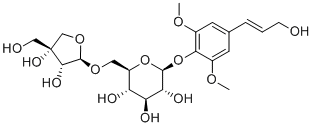
| Cas No. | 1257394-29-8 | SDF | File under preparation. |
| PubChem ID | N/A | Appearance | Powder |
| Formula | C22H32O13 | M.Wt | 504.5 |
| Type of Compound | N/A | Storage | Desiccate at -20°C |
| Solubility | Soluble in Chloroform,Dichloromethane,Ethyl Acetate,DMSO,Acetone,etc. | ||
| General tips | For obtaining a higher solubility , please warm the tube at 37 ℃ and shake it in the ultrasonic bath for a while.Stock solution can be stored below -20℃ for several months. We recommend that you prepare and use the solution on the same day. However, if the test schedule requires, the stock solutions can be prepared in advance, and the stock solution must be sealed and stored below -20℃. In general, the stock solution can be kept for several months. Before use, we recommend that you leave the vial at room temperature for at least an hour before opening it. |
||
| About Packaging | 1. The packaging of the product may be reversed during transportation, cause the high purity compounds to adhere to the neck or cap of the vial.Take the vail out of its packaging and shake gently until the compounds fall to the bottom of the vial. 2. For liquid products, please centrifuge at 500xg to gather the liquid to the bottom of the vial. 3. Try to avoid loss or contamination during the experiment. |
||
| Shipping Condition | Packaging according to customer requirements(5mg, 10mg, 20mg and more). Ship via FedEx, DHL, UPS, EMS or other couriers with RT, or blue ice upon request. | ||
Quality Control & MSDS
Package In Stock

Number of papers citing our products


Tinoscorside D Dilution Calculator
Tinoscorside D Molarity Calculator
| 1 mg | 5 mg | 10 mg | 20 mg | 25 mg | |
| 1 mM | 1.9822 mL | 9.9108 mL | 19.8216 mL | 39.6432 mL | 49.554 mL |
| 5 mM | 0.3964 mL | 1.9822 mL | 3.9643 mL | 7.9286 mL | 9.9108 mL |
| 10 mM | 0.1982 mL | 0.9911 mL | 1.9822 mL | 3.9643 mL | 4.9554 mL |
| 50 mM | 0.0396 mL | 0.1982 mL | 0.3964 mL | 0.7929 mL | 0.9911 mL |
| 100 mM | 0.0198 mL | 0.0991 mL | 0.1982 mL | 0.3964 mL | 0.4955 mL |
| * Note: If you are in the process of experiment, it's necessary to make the dilution ratios of the samples. The dilution data above is only for reference. Normally, it's can get a better solubility within lower of Concentrations. | |||||
- Aesculioside B
Catalog No.:BCX2403
CAS No.:106310-33-2
- Dentatin
Catalog No.:BCX2402
CAS No.:22980-57-0
- Clausarin
Catalog No.:BCX2401
CAS No.:62770-67-6
- 9-epi-Blumenol C
Catalog No.:BCX2400
CAS No.:1242672-31-6
- Alpinone
Catalog No.:BCX2399
CAS No.:480-13-7
- 3-(4-Hydroxyphenyl)-1-(1H-pyrrol-1-yl)propan-1-one
Catalog No.:BCX2398
CAS No.:1822773-39-6
- Flubendazole
Catalog No.:BCX2397
CAS No.:31430-15-6
- 2-Naphthoxyacetic acid
Catalog No.:BCX2396
CAS No.:120-23-0
- Clausenidin
Catalog No.:BCX2395
CAS No.:28384-44-3
- Nordentatin
Catalog No.:BCX2394
CAS No.:1083193-15-0
- 1-O-Methylclausenolide
Catalog No.:BCX2393
CAS No.:148763-15-9
- Heptazoline
Catalog No.:BCX2392
CAS No.:32042-35-6
- Blumenol C
Catalog No.:BCX2405
CAS No.:36151-02-7
- Aesculioside A
Catalog No.:BCX2406
CAS No.:254896-53-2
- Zataroside B
Catalog No.:BCX2407
CAS No.:95645-52-6
- (11R)-12-Chloronootkaton-11-ol
Catalog No.:BCX2408
CAS No.:1446439-13-9
- Steppogenin 7,4'-di-O-glucoside
Catalog No.:BCX2409
CAS No.:1193750-99-0
- cis-Pterostilbene
Catalog No.:BCX2410
CAS No.:441351-32-2
- Aesculioside H
Catalog No.:BCX2411
CAS No.:254896-72-5
- 7,4'-Dihydroxyflavan
Catalog No.:BCX2412
CAS No.:82925-54-0
- 7,4'-Dihydroxyhomoisoflavan
Catalog No.:BCX2413
CAS No.:84638-49-3
- 5,7-Dimethoxy-4'-hydroxyflavan
Catalog No.:BCX2414
CAS No.:103963-45-7
- 2',4'-Dihydroxychalcone
Catalog No.:BCX2415
CAS No.:25515-43-9
- Didendronbiline A
Catalog No.:BCX2416
CAS No.:2267991-55-7
Exploration of the main active metabolites from Tinospora crispa (L.) Hook. f. & Thomson stem as insulin sensitizer in L6.C11 skeletal muscle cell by integrating in vitro, metabolomics, and molecular docking.[Pubmed:37820996]
J Ethnopharmacol. 2024 Jan 30;319(Pt 3):117296.
ETHNOPHARMACOLOGICAL RELEVANCE: Tinospora crispa (L.) Hook. f. & Thomson stem (TCS) has long been used as folk medicine for the treatment of diabetes mellitus. Previous study revealed that TCS possesses multi-ingredients and multi-targets characteristic potential as insulin sensitizer activity. However, its mechanisms of action and molecular targets are still obscure. AIM OF THE STUDY: In the present study, we investigated the effects of TCS against insulin resistance in muscle cells through integrating in vitro experiment and identifying its active biomarker using metabolomics and in molecular docking validation. MATERIALS AND METHODS: We used centrifugal partition chromatography (CPC) to isolate 33 fractions from methanolic extract of TCS, and then used UHPLC-Orbitrap-HRMS to identify the detectable metabolites in each fraction. We assessed the insulin sensitization activity of each fraction using enzyme-linked immunosorbent assay (ELISA), and then used confocal immunocytochemistry microscopy to measure the translocation of glucose transporter 4 (GLUT4) to the cell membrane. The identified active metabolites were further simulated for its molecular docking interaction using Autodock Tools. RESULTS: The polar fractions of TCS significantly increased insulin sensitivity, as measured by the inhibition of phosphorylated insulin receptor substrate-1 (pIRS1) at serine-312 residue (ser312) also the increasing number of translocated GLUT4 and glycogen content. We identified 58 metabolites of TCS, including glycosides, flavonoids, alkaloids, coumarins, and nucleotides groups. The metabolomics and molecular docking simulations showed the presence of minor metabolites consisting of Tinoscorside D, higenamine, and tinoscorside A as the active compounds. CONCLUSIONS: Our findings suggest that TCS is a promising new treatment for insulin resistance and the identification of the active metabolites in TCS could lead to the development of new drugs therapies for diabetes that target these pathways.
Aporphine alkaloids, clerodane diterpenes, and other constituents from Tinospora cordifolia.[Pubmed:20080155]
Fitoterapia. 2010 Sep;81(6):485-9.
Phytochemical investigation of the methanol extract of Tinospora cordifolia aerial parts led to the isolation of four new and seven known compounds. The structures of two new aporphine alkaloids, N-formylasimilobine 2-O-beta-D-glucopyranosyl-(1-->2)-beta-D-glucopyranoside (tinoscorside A, 1) and N-acetylasimilobine 2-O-beta-D-glucopyranosyl-(1-->2)-beta-D-glucopyranoside (tinoscorside B, 2), a new clerodane diterpene, tinoscorside C (3), and a new phenylpropanoid, sinapyl 4-O-beta-D-apiofuranosyl-(1-->6)-O-beta-D-glucopyranoside (Tinoscorside D, 6) were determined by extensive spectroscopic methods including FTICR-MS and 1D and 2D NMR.

Calcutta University

University of Minnesota

University of Maryland School of Medicine

University of Illinois at Chicago

The Ohio State University

University of Zurich

Harvard University

Colorado State University

Auburn University

Yale University

Worcester Polytechnic Institute

Washington State University

Stanford University

University of Leipzig

Universidade da Beira Interior

The Institute of Cancer Research

Heidelberg University

University of Amsterdam

University of Auckland

TsingHua University

The University of Michigan

Miami University

DRURY University

Jilin University

Fudan University

Wuhan University

Sun Yat-sen University

Universite de Paris

Deemed University

Auckland University

The University of Tokyo

Korea University



