
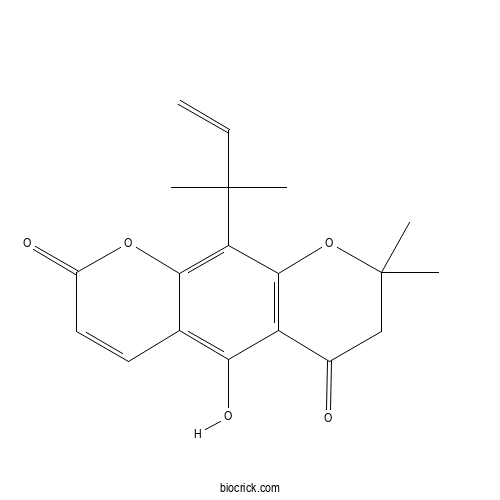
NordentatinCAS# 1083193-15-0 |
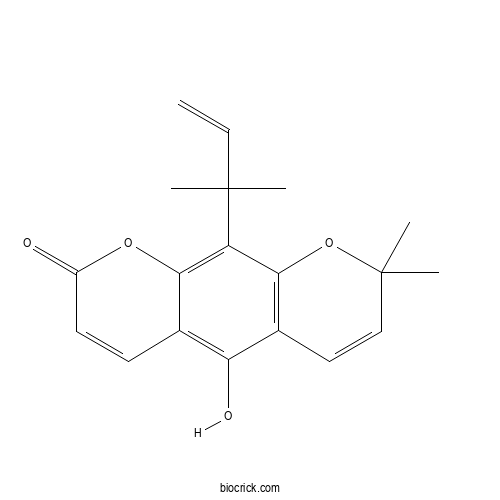
| Cas No. | 1083193-15-0 | SDF | File under preparation. |
| PubChem ID | 5495613.0 | Appearance | Powder |
| Formula | C19H20O4 | M.Wt | 312.4 |
| Type of Compound | N/A | Storage | Desiccate at -20°C |
| Solubility | Soluble in Chloroform,Dichloromethane,Ethyl Acetate,DMSO,Acetone,etc. | ||
| Chemical Name | 5-hydroxy-2,2-dimethyl-10-(2-methylbut-3-en-2-yl)pyrano[3,2-g]chromen-8-one | ||
| SMILES | CC1(C=CC2=C(O1)C(=C3C(=C2O)C=CC(=O)O3)C(C)(C)C=C)C | ||
| Standard InChIKey | WYMMNGQSPNWCIK-UHFFFAOYSA-N | ||
| Standard InChI | InChI=1S/C19H20O4/c1-6-18(2,3)14-16-11(7-8-13(20)22-16)15(21)12-9-10-19(4,5)23-17(12)14/h6-10,21H,1H2,2-5H3 | ||
| General tips | For obtaining a higher solubility , please warm the tube at 37 ℃ and shake it in the ultrasonic bath for a while.Stock solution can be stored below -20℃ for several months. We recommend that you prepare and use the solution on the same day. However, if the test schedule requires, the stock solutions can be prepared in advance, and the stock solution must be sealed and stored below -20℃. In general, the stock solution can be kept for several months. Before use, we recommend that you leave the vial at room temperature for at least an hour before opening it. |
||
| About Packaging | 1. The packaging of the product may be reversed during transportation, cause the high purity compounds to adhere to the neck or cap of the vial.Take the vail out of its packaging and shake gently until the compounds fall to the bottom of the vial. 2. For liquid products, please centrifuge at 500xg to gather the liquid to the bottom of the vial. 3. Try to avoid loss or contamination during the experiment. |
||
| Shipping Condition | Packaging according to customer requirements(5mg, 10mg, 20mg and more). Ship via FedEx, DHL, UPS, EMS or other couriers with RT, or blue ice upon request. | ||
Quality Control & MSDS
3D structure
Package In Stock

Number of papers citing our products


Nordentatin Dilution Calculator
Nordentatin Molarity Calculator
| 1 mg | 5 mg | 10 mg | 20 mg | 25 mg | |
| 1 mM | 3.201 mL | 16.0051 mL | 32.0102 mL | 64.0205 mL | 80.0256 mL |
| 5 mM | 0.6402 mL | 3.201 mL | 6.402 mL | 12.8041 mL | 16.0051 mL |
| 10 mM | 0.3201 mL | 1.6005 mL | 3.201 mL | 6.402 mL | 8.0026 mL |
| 50 mM | 0.064 mL | 0.3201 mL | 0.6402 mL | 1.2804 mL | 1.6005 mL |
| 100 mM | 0.032 mL | 0.1601 mL | 0.3201 mL | 0.6402 mL | 0.8003 mL |
| * Note: If you are in the process of experiment, it's necessary to make the dilution ratios of the samples. The dilution data above is only for reference. Normally, it's can get a better solubility within lower of Concentrations. | |||||
- 1-O-Methylclausenolide
Catalog No.:BCX2393
CAS No.:148763-15-9
- Heptazoline
Catalog No.:BCX2392
CAS No.:32042-35-6
- Steppogenin 5'-C-glucoside
Catalog No.:BCX2391
CAS No.:2082826-38-6
- Amburoside B
Catalog No.:BCX2390
CAS No.:221011-65-0
- (-)-Lariciresinol 4-O-glucoside
Catalog No.:BCX2389
CAS No.:364081-04-9
- 3'-Deoxyamburoside A
Catalog No.:BCX2388
CAS No.:362668-60-8
- Isopent-3-enyl ferulate
Catalog No.:BCX2387
CAS No.:132335-96-7
- 4'-Hydroxy-7,8-methylenedioxyhomoisoflavan
Catalog No.:BCX2386
CAS No.:148461-99-8
- Umbelliferone 7-O-β-D-xylopyranosyl-(1→6)-β-D-glucopyranoside
Catalog No.:BCX2385
CAS No.:402490-56-6
- Foeniculoside II
Catalog No.:BCX2384
CAS No.:168010-11-5
- cis-Oxyresveratrol 4'-O-glucoside
Catalog No.:BCX2383
CAS No.:863329-67-3
- Amburoside A
Catalog No.:BCX2382
CAS No.:110978-35-3
- Clausenidin
Catalog No.:BCX2395
CAS No.:28384-44-3
- 2-Naphthoxyacetic acid
Catalog No.:BCX2396
CAS No.:120-23-0
- Flubendazole
Catalog No.:BCX2397
CAS No.:31430-15-6
- 3-(4-Hydroxyphenyl)-1-(1H-pyrrol-1-yl)propan-1-one
Catalog No.:BCX2398
CAS No.:1822773-39-6
- Alpinone
Catalog No.:BCX2399
CAS No.:480-13-7
- 9-epi-Blumenol C
Catalog No.:BCX2400
CAS No.:1242672-31-6
- Clausarin
Catalog No.:BCX2401
CAS No.:62770-67-6
- Dentatin
Catalog No.:BCX2402
CAS No.:22980-57-0
- Aesculioside B
Catalog No.:BCX2403
CAS No.:106310-33-2
- Tinoscorside D
Catalog No.:BCX2404
CAS No.:1257394-29-8
- Blumenol C
Catalog No.:BCX2405
CAS No.:36151-02-7
- Aesculioside A
Catalog No.:BCX2406
CAS No.:254896-53-2
alpha-Glucosidase and Nitric Oxide Inhibitory Activities of Pyranocoumarins and Carbazoles From the Roots of Clausena excavata and the Semisynthetic Analogs of Clausarin and Nordentatin.[Pubmed:40720625]
Chem Biodivers. 2025 Nov;22(11):e00510.
Phytochemical investigation of the methanol extract of Clausena excavata roots led to the isolation of six pyranocoumarin derivatives, including xanthyletin (1), kinocoumarin (2), clausarin (3), Nordentatin (4), dentatin (4a), and citrusarin A (5), and three carbazole alkaloids, that is, heptaphylline (6), 7-methoxymukonal (7), and clausine K (8). Seven new semisynthetic analogs of compounds 2, 3, and 4 (2a, 3b-3d, and 4b-4d) were prepared through methylation, etherification, and basic hydrolysis for biological assays. Compounds 2, 6, 3b, 3c, 4b, and 4c displayed stronger alpha-glucosidase inhibitory activity than the positive control, acarbose (IC(50) 391.47 microM), with IC(50) values in the range of 32.89-92.55 microM. Molecular docking suggested that these compounds bind near the enzyme's active site via van der Waals forces, hydrogen bonds, and hydrophobic interactions. Compound 3 showed the strongest nitric oxide (NO) inhibitory activity (IC(50) = 27.95 microM), followed by 3d (IC(50) = 33.62 microM) and 4 (IC(50) = 35.41 microM). For the two compounds tested for cytotoxicity against A549 cells, 3b (IC(50) = 11.71 microM) was more potent than cisplatin (IC(50) = 21.56 microM), whereas 4b (IC(50) = 22.39 microM) showed similar activity to cisplatin. Drug-likeness and pharmacokinetic properties of the isolated and semisynthetic compounds were also evaluated.
Bioassay-Guided Isolation and Identification of Antiplasmodial Compounds from the Stem Bark of Clausena excavata.[Pubmed:37414059]
Planta Med. 2023 Oct;89(12):1165-1169.
Clausena excavata is a medicinal plant widely distributed in Southeast Asia. It is used for a variety of indications, including to treat malaria. In our present study, a phytochemical study of the methanol extract from the stem bark of C. excavata led to the isolation of five pyranocoumarins, Nordentatin (1: ), dentatin (2: ), kinocoumarin (3: ), clausarin (4: ), and clausenidin (5: ), and a coumarin, 8-hydroxy-3'',4''-dihydrocapnolactone-2',3'-diol (6: ). The isolation of compound 6: from C. excavata and the antiplasmodial activities against a multidrug-resistant K1 strain of Plasmodium falciparum of 1, 3: , and 5: were reported for the first time. Compounds 3: and 4: exhibited potent antiplasmodial activities with EC(50) values of 1.10 and 0.58 microM, respectively, while 1: and 5: had EC(50) values of 5.62 and 7.15 microM, respectively. A prenyl group attached to the C-3 or C-12 position on the pyranocoumarin ring probably plays an important role on the activity. A hydroxyl group at the C-10 position is also likely to enhance the activity.
Multifunctionality of Clausena harmandiana Extract and Its Active Constituents against Alzheimer's Disease.[Pubmed:36005148]
Curr Issues Mol Biol. 2022 Aug 15;44(8):3681-3694.
This study was designed to investigate the effects of the root-bark extract of Clausena harmandiana (CH) and its active constituents (Nordentatin and 7-methoxyheptaphylline) on pharmacological activities regarding selected targets associated with AD, namely, its antioxidant activity, inhibition of Abeta aggregation, acetylcholinesterase (AChE) activity, and neuroprotective effects. The effect of the CH extract on the cognitive impairment induced by scopolamine was also evaluated in mice. The effects of the CH extract and its active constituents on radical scavenging, Abeta aggregation, and AChE activity were investigated with a 2,2'-azino-bis(3-ethylbenzthiazoline-6-sulfonic acid (ABTS) assay, a thioflavin-T assay, and Ellman's method. The neuroprotective effects of the extract against hydrogen-peroxide and Abeta toxicity were evaluated with a 3-(4,5-dimethylthiazol-2-yl)-2,5-diphenyl tetrazolium bromide (MTT) assay. In addition, the effects on cognitive impairment induced by scopolamine in mice were evaluated using Morris-water-maze and modified-Y-maze test models. The results of the present study demonstrate that the root-bark extract of CH shows multimodal actions relevant to the AD pathological cascade, including antioxidant effects, the inhibition of Abeta aggregation, the inhibition of AChE function, and neuroprotection against oxidative stress and Abeta toxicity. The extracts could improve both the short- and long-term memory deficits induced by scopolamine in mice.
Nordentatin Inhibits Neuroblastoma Cell Proliferation and Migration through Regulation of GSK-3 Pathway.[Pubmed:35723293]
Curr Issues Mol Biol. 2022 Feb 24;44(3):1062-1074.
Cancer is caused by abnormal cell changes leading to uncontrolled cell growth. The specific characteristics of cancer cells, including the loss of apoptotic control and the ability to migrate into and invade the surrounding tissue, result in cancer cell metastasis to other parts of the body. Therefore, the inhibition of the proliferation, migration, and invasion of cancer cells are the principal goals in the treatment of cancer. This study aimed to investigate the inhibitory activity of Nordentatin, a coumarin derivative isolated from Clausena harmandiana, regarding the proliferation and migration of human neuroblastoma cells (SH-SY5Y). Nordentatin at a concentration of 100 microM showed cell cytotoxicity toward SH-SY5Y that was significantly different from that of the control group (p < 0.01) at 24, 48, and 72 h. Moreover, Nordentatin inhibited SH-SY5Y proliferation by inhibiting the antiapoptotic protein Mcl-1, leading to the cleavage of caspase-3 and resulting in the inhibition of a migratory protein, MMP-9, through the GSK-3 pathway (compared with cells treated with a GSK inhibitor). These results suggest that Nordentatin inhibited the proliferation and migration of neuroblastoma cells through the GSK-3 pathway.
In silico approach: biological prediction of nordentatin derivatives as anticancer agent inhibitors in the cAMP pathway.[Pubmed:35514899]
RSC Adv. 2020 Nov 25;10(70):42733-42743.
A combination of computational techniques has been carried out to predict the binding of Nordentatin derivatives based on pyranocoumarin semi-synthesis with the target protein from the expression of the PDE4B gene. The inhibition of the cAMP pathway is the main target of anti-cancer drugs, which is responsible for uncontrolled cell division in cancer. Modeling was done using a combination of semi-empirical methods and the density functional theory (PM3-DFT/6-31G*/B3LYP) to obtain the optimal structure of a small ligand that could be modeled. Studies on the interaction of the ligands and amino acid residues on protein targets were carried out using a combination of molecular docking and molecular dynamic simulation. Molecular docking based on functional grid scores showed a very good native ligand pose with an RMSD of 0.93 A in determining the initial coordinates of the ligand-receptor interactions. Furthermore, the amino acid residues responsible for interaction through H-bonds were Tyr103, His104, His177, Met217, and Gln313. The binding free energy (kcal mol(-1)) results of the candidates were PS-1 (-36.84 +/- 0.31), PS-2 (-35.34 +/- 0.28), PS-3 (-26.65 +/- 0.30), PS-5 (-42.66 +/- 0.26), PS-7 (-35.33 +/- 0.23), and PS-9 (-32.57 +/- 0.20), which are smaller than that of the native ligand Z72 (-24.20 +/- 0.19), and thus these have good potential as drugs that can inhibit the cAMP pathway. These results provide theoretical information for the efficient inhibition of the cAMP pathway in the future.
Bio-Guided Isolation of Prospective Bioactive Constituents from Roots of Clausena indica (Dalzell) Oliv.[Pubmed:31817276]
Molecules. 2019 Dec 4;24(24):4442.
Clausena indica fruits are routinely used for the culinary purpose as natural spices, whereas leaves and roots are folk medicine with various health benefits in southern China, South and Southeast Asia. In this study, the bioassay-guided fractionation by column chromatography yielded three pure compounds including dentatin, Nordentatin, and clausine K and five active fractions (Re1-5) from C. indica roots. These known anticancer compounds were confirmed by X-ray diffraction, (1)H-, (13)C-nuclear magnetic resonance (NMR), and electrospray ionization tandem mass spectrometric (ESI-MS-MS) analyses. Meanwhile, the phytochemical constituents from fractions were identified by gas chromatography-mass spectrometry (GC-MS). The isolates, fractions' components and their biological activities were first time investigated on C. indica. By in vitro DPPH and ABTS scavenging assays, Nordentatin (IC(50) = 49.2 and 69.9 microg/mL, respectively) and the fraction Re4 (32.4 and 38.5 microg/mL, respectively) showed the strongest antiradical activities, whereas clausine K presented a moderate and dentatin had negligible antioxidant activity, respectively. The anti-alpha-amylase activity of C. indica root extracts was mainly attributed to the fraction Re2 which inactivated the enzymatic assay with IC(50) of 573.8 microg/mL. Among tested samples, only Nordentatin and clausine K were effective in the pancreatic elastase inhibition, however, their influences were trivial. Markedly, clausine K and Re4 performed the most remarkable tyrosinase inhibition with IC(50) values of 179.5 and 243.8 microg/mL, respectively, which were in turn 4 and 3 times stronger than myricetin (IC(50) = 735.6 microg/mL), a well-known tyrosinase inhibitor. This is the first report affirming clausine K to be a new strong tyrosinase inhibitor. Isolated compounds from C. indica roots were quantified by high-performance liquid chromatography (HPLC), of which, dentatin, Nordentatin, and clausine K accounted for 14.74, 6.14, and 1.28 mg/g dry weight. The findings suggest that bioactive constituents from C. indica roots may be potentially employed for the development of antidiabetic, antiaging and cosmetic agents.
Cytotoxicity and Apoptosis Induction of Coumarins and Carbazole Alkaloids from Clausena harmandiana.[Pubmed:31540345]
Molecules. 2019 Sep 18;24(18):3385.
Seven compounds, carbazole alkaloids (heptaphylline, 7-methoxyheptaphylline, 7-methoxymukonal) and coumarins (clausarin, dentatin, Nordentatin, and xanthoxyletin), were isolated from the root bark of Clausena harmandiana. Antioxidation, cytotoxicity and apoptosis induction were evaluated in vitro. Results showed that clausarin exerted the highest DPPH radical scavenging and 7-methoxymukonal had the highest ferric reducing antioxidant power. In contrary, dentatin was the least DPPH radical scavenger, and heptaphylline was the least reducing antioxidant power. The isolated compounds showed different cytotoxicity. The hepatocellular carcinoma (HepG2) was generally more sensitive to the isolated compounds than lung cancer (SK-LU-1), colon cancer (HCT-116), and noncancerous (Vero) cell lines, respectively. Clausarin possessed the highest cytotoxicity selectively against cancer cell lines tested. 7-Methoxymukonal and 7-methoxyheptaphylline exhibited less cytotoxicity only in HepG2 cells and were inactive in the SK-LU-1 and HCT116 cells. Despite xantoxyletin possessing low antioxidant and low cytotoxic activity, it induced the highest apoptosis percentage with the lowest necrosis percentage of HepG2 cells after 24 h. In conclusion, xantoxyletin primarily show potential anticancer activity. The root bark of C. harmandiana is a good source of bioactive compounds or the lead for the development of new pharmaceutical agent.
[Chemical constituents from stems and leaves of Clausena emarginata].[Pubmed:31355567]
Zhongguo Zhong Yao Za Zhi. 2019 May;44(10):2096-2101.
The chemical constituents from the stems and leaves of Clausena emarginata were separated and purified by column chromatographies on silica gel,ODS,Sephadex LH-20,and PR-HPLC. The structures of the isolated compounds were identified on the basis of physicochemical properties and spectroscopic analysis,as well as comparisons with the data reported in the literature. Sixteen compounds were isolated from the 90% ethanol extract of the stems and leaves of C. emarginata,which were identified as siamenol( 1),murrastanine A( 2),3-formyl-1,6-dimethoxycarbazole( 3),3-methoxymethylcarbazole( 4),3-methylcarbazole( 5),murrayafoline A( 6),3-formylcarbazole( 7),3-formyl-1-hydroxycarbazole( 8),3-formyl-6-methoxycarbazole( 9),murrayanine( 10),murrayacine( 11),girinimbine( 12),Nordentatin( 13),chalepin( 14),8-hydroxy-6-methoxy-3-pentylisocoumarin( 15) and ethyl orsellinate( 16). Compounds 1-4,14-16 were isolated from C. emarginata for the first time. Among them,compounds 1,2,15 and 16 were isolated from the genus Clausena for the first time. All isolated compounds were evaluated for their cytotoxic activities against five human cancer cell lines: HL-60,SMMC-7721,A-549,MCF-7 and SW480 in vitro. Compounds 12 and 14 showed significant inhibitory effects against various human cancer cell lines with IC_(50) values comparable to those of doxorubicin.
Whole Genome Sequencing and Metabolomic Study of Cave Streptomyces Isolates ICC1 and ICC4.[Pubmed:31134037]
Front Microbiol. 2019 May 10;10:1020.
The terrestrial subsurface microbiome has gained considerable amount of interests in the recent years because of its rich potential resource for biomining novel genes coding for metabolites possessing antimicrobial activities. In our previous study, we identified two Streptomyces isolates, designated as ICC1 and ICC4, from the Iron Curtain Cave, Chilliwack, Canada that exhibited antagonistic activities against the multidrug resistant strains of Escherichia coli. In this study, the genomes of these two isolates were sequenced by Illumina MiSeq, assembled and annotated. The genes associated with secondary metabolite production were identified and annotated using the bioinformatics platforms antiSMASH and BAGEL. ICC1 and ICC4 were then cultivated and ICC1 metabolome characterized by UHPLC-ESI-HRMS. The Global Natural Products Social Molecular Networking was used to identify metabolites based on the MS/MS spectral data. ICC1 and ICC4 showed a high level of sequence identity with the terrestrial bacteria Streptomyces lavendulae; however, they possess a greater secondary metabolite potential as estimated by the total number of identified biosynthetic gene clusters (BGCs). In particular, ICC1 and ICC4 had a greater number of polyketide and non-ribosomal peptide BGCs. The most frequently detected BGCs were those predicted to generate terpenes, small and low complexity dipeptides and lipids. Spectral analysis clearly identified a number of diketopiperazine products through matched reference spectra for cyclo (Leu-Pro), cyclo (Pro-Val) and cyclo [(4-hydroxyPro)-Leu]. One of the terpenes gene clusters predicted by antiSMASH possesses a seven-gene pathway consistent with diazepinomicin biosynthesis. This molecule contains a very rare core structure and its BGC, to date, has only been identified from a single bacterial genome. The tetrapeptide siderophore coelichelin BGC was unambiguously identified in the genome, however, the metabolite could not be identified from the culture extracts. Two type III polyketides, 2', 5' - dimethoxyflavone and Nordentatin, were identified from the UHPLC-HRMS data of the aqueous and n-butanolic fractions of Streptomyces sp. ICC1, respectively. A BGC likely encoding these metabolites was predicted in both genomes. The predicted similarities in molecule production and genome shared by these two strains could be an indicative of a cooperative mode of living in extreme habitats instead of a competitive one. This secondary metabolite potential may contribute to the fitness of ICC1 and ICC4 in the Iron Curtain Cave.
A new pyrano coumarin from Clausena excavata roots displaying dual inhibition against alpha-glucosidase and free radical.[Pubmed:30908081]
Nat Prod Res. 2021 Feb;35(4):556-561.
A new pyrano coumarin, identified as excavatin A (1) together with two known compounds Nordentatin (2) and binorpocitrin (3) was isolated from the 95% EtOH extract of Clausena excavata. All structures were elucidated by using spectroscopy methods such as extensive NMR and HR-FAB-MS spectrometry. All the isolated compounds were tested on antidiabetes activity by using alpha-glucosidase inhibition assay and the antioxidant activity by DPPH assay. Compounds 1-3 showed antioxidant activity with IC(50) values 0.286, 0.02, 0.278 mM. Among them, 2 exhibited inhibition activity against maltase (IC(50) 5.45 microM) and sucrase (IC(50) 43.57 microM). However, compounds (1) and (3) displayed inhibition on yeast alpha-glucosidase with IC(50) values 1.92 and 5.58 mM.[Figure: see text].
Carbazole-pyranocoumarin conjugate and two carbazole alkaloids from the stems of Clausena excavata.[Pubmed:26824689]
Nat Prod Res. 2016 Aug;30(15):1690-7.
A carbazole-pyranocoumarin conjugate, carbazomarin B (1), and two carbazole alkaloids, 6-methoxymukonidine (2) and 2-hydroxy-3-methoxycarbazole (3), together with 27 known compounds (4-30), were isolated from the stems of Clausena excavata. Their structures have been elucidated by spectroscopic analyses. Compound 2 showed moderate cytotoxicity to HuCCA-1, MOLT-3 and HepG2 cancer cell lines with IC50 values of 15.09-28.50 mug/mL, but none to A549 cell line. Heptaphylline (6) and Nordentatin (23) were found to show moderate cytotoxic activity against HepG2 cell line with IC50 values of 12.33 and 11.33, respectively, while clausine K (27) exhibited strong cytotoxicity with IC50 value of 1.05 mug/mL, better than a standard drug (etoposide, IC50 13.40 mug/mL).
[Chemical constituents from stems of Clausena excavata].[Pubmed:26027123]
Zhong Yao Cai. 2014 Nov;37(11):2012-5.
OBJECTIVE: To study the chemical constituents from the stems of Clausena excavata. METHODS: The constituents were isolated by various chromatographic techniques(silica gel, RP-MPLC and PHPLC) and their structures were determined on the basis of their spectroscopic data, as well as literatures. RESULTS: Eleven compounds were separated and identified as adicardin(1),7-[O-alpha-L-rh-amnopyranosyl-(1-->6)-O-beta-D-glucopyranosyloxy]coumarin(2), 6-methoxy-7-[O-alpha-L-rhamnopyranosyl-(1-->6)-O-beta-D-glucopyranosyloxy] coumarin (3), alloisoimperatorin (4), isopentenoyloxypsoralen (5), Nordentatin (6), xanthyletin (7), 7-hydroxycoumarin (8), 3-formylcarbazole(9), 3-formyl-6-methoxy carbazole(10), and murrayanine(11). CONCLUSION: compounds 2-4 and 10 are isolated from this plant for the first time, and compounds 1 and 5 are isolated from Clausena genus for the first time.
Simultaneous determination of nine analytes in Clausena harmandiana Pierre. by new developed high-performance liquid chromatography method and the influence of locations in Thailand on level of nordentatin and dentatin.[Pubmed:25709203]
Pharmacogn Mag. 2015 Jan-Mar;11(41):1-7.
BACKGROUND: Clausena harmandiana Pierre. (CH) contains various bioactive analytes with pharmacological benefits. Most researches were focused on carbazole analytes determined by isocratic high-performance liquid chromatography (HPLC), only few were focused on coumarin analytes and harvested location. OBJECTIVE: To develop and validate gradient HPLC method to analyze the variance of nine target analytes contained in roots of CH grown naturally in four different provinces of Thailand. MATERIALS AND METHODS: The analytical method was undertaken by gradient HPLC with 3% tetrahydrofuran in acetonitrile, and 0.05% phosphoric acid in water as mobile phases, on Hypersil ODS column (4.0 x 250 mm, 5 mum), at flow rate 1.0 mL/min and detected at wavelength 280 nm. The method was validated for system linearity, limit of detection, limit of quantitation, precision and accuracy. RESULTS: The new-developed method was able to detect the nine target analytes in CH root. The validation showed the reliability of the method. All system suitability parameters were within the satisfied limits. The linear responses of method were observed at r (2) >/= 0.999 for all analytes. The obtained amount of nine analytes showed the biodiversity of contents in different provinces. Of the nine target analytes, the level of Nordentatin and dentatin in coumarin groups were considerably high in plants collected from one specific province of Thailand. CONCLUSION: This study has shown that the new-developed method is reliable, precise, accurate and sensitive to determine and quantify the nine target analytes in CH. Nordentatin and dentatin obviously show the higher level in one specific province of Thailand.
Anti-inflammatory principles from the stem and root barks of Citrus medica.[Pubmed:20045968]
Chem Pharm Bull (Tokyo). 2010 Jan;58(1):61-5.
Bioassay-guided investigation of the anti-inflammatory principles from the stem and root barks of Citrus medica L. var. sarcodactylis SWINGLE has led to the isolation of a new coumarin, namely citrumedin-B (1) and thirty known compounds. The anti-inflammatory components were xanthyletin (2), Nordentatin (3), atalantoflavon (4) and lonchocarpol A (5) which displayed potent nitric oxide (NO)-reducing activity in microglial cells. The structure of this new compound was completely elucidated using a combination of 2D NMR techniques (correlation spectroscopy (COSY), nuclear Overhauser effect spectroscopy (NOESY), heteronuclear multiple quantum coherence (HMQC) and heteronuclear multiple bond connectivity (HMBC)) and HR-electrospray ionization (ESI)-MS analyses. The known compounds were identified by comparison of their spectroscopic and physical data with those reported in the literature. These results can be inferred from the treatment of allergic response and inflammatory properties of Citrus medica L. var. sarcodactylis SWINGLE in traditional Chinese medicine.

Calcutta University

University of Minnesota

University of Maryland School of Medicine

University of Illinois at Chicago

The Ohio State University

University of Zurich

Harvard University

Colorado State University

Auburn University

Yale University

Worcester Polytechnic Institute

Washington State University

Stanford University

University of Leipzig

Universidade da Beira Interior

The Institute of Cancer Research

Heidelberg University

University of Amsterdam

University of Auckland

TsingHua University

The University of Michigan

Miami University

DRURY University

Jilin University

Fudan University

Wuhan University

Sun Yat-sen University

Universite de Paris

Deemed University

Auckland University

The University of Tokyo

Korea University



