
DentatinCAS# 22980-57-0 |
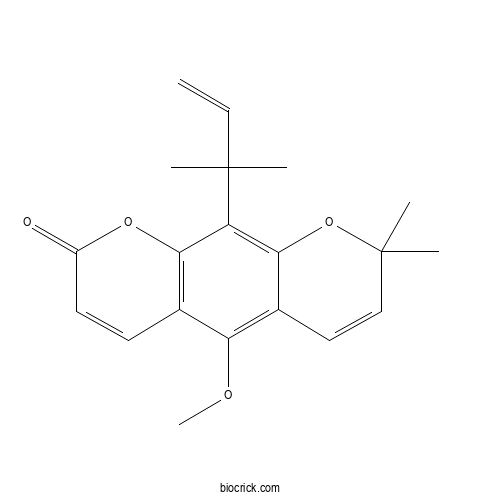
| Cas No. | 22980-57-0 | SDF | File under preparation. |
| PubChem ID | 342801.0 | Appearance | Yellow powder |
| Formula | C20H22O4 | M.Wt | 326.4 |
| Type of Compound | N/A | Storage | Desiccate at -20°C |
| Solubility | Soluble in Chloroform,Dichloromethane,Ethyl Acetate,DMSO,Acetone,etc. | ||
| Chemical Name | 5-methoxy-2,2-dimethyl-10-(2-methylbut-3-en-2-yl)pyrano[3,2-g]chromen-8-one | ||
| SMILES | CC1(C=CC2=C(C3=C(C(=C2O1)C(C)(C)C=C)OC(=O)C=C3)OC)C | ||
| Standard InChIKey | QBFYQVZGIDUNIY-UHFFFAOYSA-N | ||
| Standard InChI | InChI=1S/C20H22O4/c1-7-19(2,3)15-17-12(8-9-14(21)23-17)16(22-6)13-10-11-20(4,5)24-18(13)15/h7-11H,1H2,2-6H3 | ||
| General tips | For obtaining a higher solubility , please warm the tube at 37 ℃ and shake it in the ultrasonic bath for a while.Stock solution can be stored below -20℃ for several months. We recommend that you prepare and use the solution on the same day. However, if the test schedule requires, the stock solutions can be prepared in advance, and the stock solution must be sealed and stored below -20℃. In general, the stock solution can be kept for several months. Before use, we recommend that you leave the vial at room temperature for at least an hour before opening it. |
||
| About Packaging | 1. The packaging of the product may be reversed during transportation, cause the high purity compounds to adhere to the neck or cap of the vial.Take the vail out of its packaging and shake gently until the compounds fall to the bottom of the vial. 2. For liquid products, please centrifuge at 500xg to gather the liquid to the bottom of the vial. 3. Try to avoid loss or contamination during the experiment. |
||
| Shipping Condition | Packaging according to customer requirements(5mg, 10mg, 20mg and more). Ship via FedEx, DHL, UPS, EMS or other couriers with RT, or blue ice upon request. | ||
Quality Control & MSDS
3D structure
Package In Stock

Number of papers citing our products


Dentatin Dilution Calculator
Dentatin Molarity Calculator
| 1 mg | 5 mg | 10 mg | 20 mg | 25 mg | |
| 1 mM | 3.0637 mL | 15.3186 mL | 30.6373 mL | 61.2745 mL | 76.5931 mL |
| 5 mM | 0.6127 mL | 3.0637 mL | 6.1275 mL | 12.2549 mL | 15.3186 mL |
| 10 mM | 0.3064 mL | 1.5319 mL | 3.0637 mL | 6.1275 mL | 7.6593 mL |
| 50 mM | 0.0613 mL | 0.3064 mL | 0.6127 mL | 1.2255 mL | 1.5319 mL |
| 100 mM | 0.0306 mL | 0.1532 mL | 0.3064 mL | 0.6127 mL | 0.7659 mL |
| * Note: If you are in the process of experiment, it's necessary to make the dilution ratios of the samples. The dilution data above is only for reference. Normally, it's can get a better solubility within lower of Concentrations. | |||||
- Clausarin
Catalog No.:BCX2401
CAS No.:62770-67-6
- 9-epi-Blumenol C
Catalog No.:BCX2400
CAS No.:1242672-31-6
- Alpinone
Catalog No.:BCX2399
CAS No.:480-13-7
- 3-(4-Hydroxyphenyl)-1-(1H-pyrrol-1-yl)propan-1-one
Catalog No.:BCX2398
CAS No.:1822773-39-6
- Flubendazole
Catalog No.:BCX2397
CAS No.:31430-15-6
- 2-Naphthoxyacetic acid
Catalog No.:BCX2396
CAS No.:120-23-0
- Clausenidin
Catalog No.:BCX2395
CAS No.:28384-44-3
- Nordentatin
Catalog No.:BCX2394
CAS No.:1083193-15-0
- 1-O-Methylclausenolide
Catalog No.:BCX2393
CAS No.:148763-15-9
- Heptazoline
Catalog No.:BCX2392
CAS No.:32042-35-6
- Steppogenin 5'-C-glucoside
Catalog No.:BCX2391
CAS No.:2082826-38-6
- Amburoside B
Catalog No.:BCX2390
CAS No.:221011-65-0
- Aesculioside B
Catalog No.:BCX2403
CAS No.:106310-33-2
- Tinoscorside D
Catalog No.:BCX2404
CAS No.:1257394-29-8
- Blumenol C
Catalog No.:BCX2405
CAS No.:36151-02-7
- Aesculioside A
Catalog No.:BCX2406
CAS No.:254896-53-2
- Zataroside B
Catalog No.:BCX2407
CAS No.:95645-52-6
- (11R)-12-Chloronootkaton-11-ol
Catalog No.:BCX2408
CAS No.:1446439-13-9
- Steppogenin 7,4'-di-O-glucoside
Catalog No.:BCX2409
CAS No.:1193750-99-0
- cis-Pterostilbene
Catalog No.:BCX2410
CAS No.:441351-32-2
- Aesculioside H
Catalog No.:BCX2411
CAS No.:254896-72-5
- 7,4'-Dihydroxyflavan
Catalog No.:BCX2412
CAS No.:82925-54-0
- 7,4'-Dihydroxyhomoisoflavan
Catalog No.:BCX2413
CAS No.:84638-49-3
- 5,7-Dimethoxy-4'-hydroxyflavan
Catalog No.:BCX2414
CAS No.:103963-45-7
RETRACTION: Dentatin Induces Apoptosis in Prostate Cancer Cells via Bcl-2, Bcl-xL, Survivin Downregulation, Caspase-9, -3/7 Activation, and NF-kappaB Inhibition.[Pubmed:42109922]
Evid Based Complement Alternat Med. 2026 May 7;2026:9806757.
[This retracts the article DOI: 10.1155/2012/856029.].
alpha-Glucosidase and Nitric Oxide Inhibitory Activities of Pyranocoumarins and Carbazoles From the Roots of Clausena excavata and the Semisynthetic Analogs of Clausarin and Nordentatin.[Pubmed:40720625]
Chem Biodivers. 2025 Nov;22(11):e00510.
Phytochemical investigation of the methanol extract of Clausena excavata roots led to the isolation of six pyranocoumarin derivatives, including xanthyletin (1), kinocoumarin (2), clausarin (3), norDentatin (4), Dentatin (4a), and citrusarin A (5), and three carbazole alkaloids, that is, heptaphylline (6), 7-methoxymukonal (7), and clausine K (8). Seven new semisynthetic analogs of compounds 2, 3, and 4 (2a, 3b-3d, and 4b-4d) were prepared through methylation, etherification, and basic hydrolysis for biological assays. Compounds 2, 6, 3b, 3c, 4b, and 4c displayed stronger alpha-glucosidase inhibitory activity than the positive control, acarbose (IC(50) 391.47 microM), with IC(50) values in the range of 32.89-92.55 microM. Molecular docking suggested that these compounds bind near the enzyme's active site via van der Waals forces, hydrogen bonds, and hydrophobic interactions. Compound 3 showed the strongest nitric oxide (NO) inhibitory activity (IC(50) = 27.95 microM), followed by 3d (IC(50) = 33.62 microM) and 4 (IC(50) = 35.41 microM). For the two compounds tested for cytotoxicity against A549 cells, 3b (IC(50) = 11.71 microM) was more potent than cisplatin (IC(50) = 21.56 microM), whereas 4b (IC(50) = 22.39 microM) showed similar activity to cisplatin. Drug-likeness and pharmacokinetic properties of the isolated and semisynthetic compounds were also evaluated.
alpha-Glucosidase Inhibitory Activity of Prenylated Pyranocoumarins from Clausena excavata: Mechanism of Action, ADMET and Molecular Docking.[Pubmed:38923383]
Chem Biodivers. 2024 Sep;21(9):e202401141.
Three naturally occurring prenylated pyranocoumarins, norDentatin (1), Dentatin (2), and clausarin (3), isolated from the roots of Clausena excavata (Family Rutaceae), and O-methylclausarin (4) which was obtained by methylation of 3, were investigated for their alpha-glucosidase inhibitory activity. The mechanism of action and the in silico prediction of their physicochemical and ADMET properties as well as the molecular docking were also studied. Compounds 1-4 exhibited stronger alpha-glucosidase inhibitory activity than the positive control, acarbose, through a non-competitive mechanism. Among them, 3 exhibited the highest activity, with an IC(50) of 8.36 muM, which is significantly stronger than that of acarbose (IC(50)=430.35 muM). The prenyl group on C-3 and the hydroxyl group on C-5 in 3 may play important roles in enhancing the activity. Calculated physicochemical and ADMET parameters of 1-4 satisfied the Lipinski's and Veber's rules. Molecular simulation analysis indicated they are promising drug candidates with no hepatotoxicity. Compound 3 exhibited potent activity in the experiment and demonstrated good drug properties based on the calculations. A molecular docking study revealed that 3 showed H-bonding and pi-pi stacking interactions with selective Phe321, as well as interactions with thirteen other amino acid residues of the alpha-glucosidase.
Bioassay-Guided Isolation and Identification of Antiplasmodial Compounds from the Stem Bark of Clausena excavata.[Pubmed:37414059]
Planta Med. 2023 Oct;89(12):1165-1169.
Clausena excavata is a medicinal plant widely distributed in Southeast Asia. It is used for a variety of indications, including to treat malaria. In our present study, a phytochemical study of the methanol extract from the stem bark of C. excavata led to the isolation of five pyranocoumarins, norDentatin (1: ), Dentatin (2: ), kinocoumarin (3: ), clausarin (4: ), and clausenidin (5: ), and a coumarin, 8-hydroxy-3'',4''-dihydrocapnolactone-2',3'-diol (6: ). The isolation of compound 6: from C. excavata and the antiplasmodial activities against a multidrug-resistant K1 strain of Plasmodium falciparum of 1, 3: , and 5: were reported for the first time. Compounds 3: and 4: exhibited potent antiplasmodial activities with EC(50) values of 1.10 and 0.58 microM, respectively, while 1: and 5: had EC(50) values of 5.62 and 7.15 microM, respectively. A prenyl group attached to the C-3 or C-12 position on the pyranocoumarin ring probably plays an important role on the activity. A hydroxyl group at the C-10 position is also likely to enhance the activity.
Antioxidant and a-amylase Inhibitory Activities and Phytocompounds of Clausena indica Fruits.[Pubmed:32121132]
Medicines (Basel). 2020 Feb 28;7(3):10.
Background: Clausena indica fruit is commonly used for food ingredients and traditional medicines in tropical countries, however, information about its biological activities and chemical profiles has been inadequately reported. Methods: In this study, a bio-guided fractionation of antioxidants and alpha-amylase inhibitors from hexane (MH) and ethyl acetate (ME) extracts of C. indica fruit (pericarp and seed) was carried out. Eleven fractions from MH (D1-D11) and 17 fractions from ME (T1-T17) were obtained from column chromatography over silica gel, which were then examined for anti-radical capacity by 2,2-diphenyl-1-picrylhydrazyl (DPPH) and 2,2'-azinobis-(3-ethylbenzothiazoline-6-sulfonic acid) (ABTS) assays, and pancreatic alpha-amylase inhibition, a key enzyme linked to type 2 diabetes. Results: Of isolated fractions, the fraction T4 revealed the most potent anti-DPPH activity (IC(50) = 0.13 mg/mL), whereas T2 exhibits the strongest ABTS cation scavenging ability (IC(50) = 0.31 mg/mL). In the enzymatic assay, the fractions D3 and T4 significantly inhibit the alpha-amylase reaction with IC(50) values of 0.34 and 0.86 mg/mL, respectively. Remarkably, alpha-amylase suppression of T4 is close to acarbose and over four times stronger than palmitic acid, which are the well-known alpha-amylase inhibitors (IC(50) = 0.07 and 1.52 mg/mL, respectively). The active constituents from fractions were identified by gas chromatography-mass spectrometry (GC-MS). The results show that the fraction D3 contains five major compounds, which are grouped in five classes consisting of fatty acids, phenols, benzodioxoles, alcohols, and sesquiterpenes. Among them, palmitic acid is the most dominant compound (32.64%), followed by 2R-acetoxymethyl-1,3,3-trimethyl-4t-(3-methyl-2-buten-1-yl)-1t-cyclohexanol (16.69%). Whilst, six major compounds belonging to fatty acid and coumarin classes are identified in the fraction T4. The most abundant compound in T4 is Dentatin (47.32%), followed by palmitic acid (15.11%). Conclusions: This is the first finding that C. indica fruit can be a promising source for the development of natural antioxidant and antidiabetic agents. Additionally, the outcome reveals that Dentatin, a known natural antineoplastic agent, can be feasibly exploited from C. indica fruit.
Bio-Guided Isolation of Prospective Bioactive Constituents from Roots of Clausena indica (Dalzell) Oliv.[Pubmed:31817276]
Molecules. 2019 Dec 4;24(24):4442.
Clausena indica fruits are routinely used for the culinary purpose as natural spices, whereas leaves and roots are folk medicine with various health benefits in southern China, South and Southeast Asia. In this study, the bioassay-guided fractionation by column chromatography yielded three pure compounds including Dentatin, norDentatin, and clausine K and five active fractions (Re1-5) from C. indica roots. These known anticancer compounds were confirmed by X-ray diffraction, (1)H-, (13)C-nuclear magnetic resonance (NMR), and electrospray ionization tandem mass spectrometric (ESI-MS-MS) analyses. Meanwhile, the phytochemical constituents from fractions were identified by gas chromatography-mass spectrometry (GC-MS). The isolates, fractions' components and their biological activities were first time investigated on C. indica. By in vitro DPPH and ABTS scavenging assays, norDentatin (IC(50) = 49.2 and 69.9 microg/mL, respectively) and the fraction Re4 (32.4 and 38.5 microg/mL, respectively) showed the strongest antiradical activities, whereas clausine K presented a moderate and Dentatin had negligible antioxidant activity, respectively. The anti-alpha-amylase activity of C. indica root extracts was mainly attributed to the fraction Re2 which inactivated the enzymatic assay with IC(50) of 573.8 microg/mL. Among tested samples, only norDentatin and clausine K were effective in the pancreatic elastase inhibition, however, their influences were trivial. Markedly, clausine K and Re4 performed the most remarkable tyrosinase inhibition with IC(50) values of 179.5 and 243.8 microg/mL, respectively, which were in turn 4 and 3 times stronger than myricetin (IC(50) = 735.6 microg/mL), a well-known tyrosinase inhibitor. This is the first report affirming clausine K to be a new strong tyrosinase inhibitor. Isolated compounds from C. indica roots were quantified by high-performance liquid chromatography (HPLC), of which, Dentatin, norDentatin, and clausine K accounted for 14.74, 6.14, and 1.28 mg/g dry weight. The findings suggest that bioactive constituents from C. indica roots may be potentially employed for the development of antidiabetic, antiaging and cosmetic agents.
Dentatin exerts anticancer effects on human colon cancer cell lines via cell cycle arrest, autophagy, inhibition of cell migration and JAK/STAT signalling pathway.[Pubmed:31646796]
J BUON. 2019 Jul-Aug;24(4):1488-1493.
PURPOSE: Colon cancer is a malignant disease with significant mortality. In the present study the anticancer effects of a carbazole alkaloid, Dentatin, were examined against colon cancer cells. METHODS: The colon cancer HT-29 cell line and the normal CCD-18 CO colon cell line were used in the present study. MTT assay was used to check the proliferation rate of the cancer cells. Autophagy was detected by electron microscopy. DNA damage was checked by alkaline comet assay. Cell cycle analysis was performed by flow cytometry. Cell migration was monitored by wound healing assay. Protein expression was checked by western blot analysis. RESULTS: The results showed that Dentatin inhibited the growth of HT-29 cancer cells in a concentration-dependent manner and with IC50 of 25 microM. However, the IC50 of Dentatin against the normal CCD-18CO colon cells was four times higher (ie.,100 microM). Dentatin inhibited the proliferation of the HT-29 cancer cells by triggering S-phase arrest. This was also accompanied with increase in the expression of cyclin D1 and decrease in the expression of Cyclin A and B1. Moreover, Dentatin also induced autophagy in the HT-29 cells which was associated with upregulation of LC3 II and downregulation of Beclin-1 expression. Comet assay revealed that Dentatin induced DNA damage in the HT-29 cells. Dentatin also significantly inhibited the migration of the HT-29 cells. Finally the effects of Dentatin were examined on the JAK/STAT signalling pathway and it was found that Dentatin inhibited this pathway. CONCLUSION: Dentatin may prove to be an essential lead molecule for the management of colon cancer.
Cytotoxicity and Apoptosis Induction of Coumarins and Carbazole Alkaloids from Clausena harmandiana.[Pubmed:31540345]
Molecules. 2019 Sep 18;24(18):3385.
Seven compounds, carbazole alkaloids (heptaphylline, 7-methoxyheptaphylline, 7-methoxymukonal) and coumarins (clausarin, Dentatin, norDentatin, and xanthoxyletin), were isolated from the root bark of Clausena harmandiana. Antioxidation, cytotoxicity and apoptosis induction were evaluated in vitro. Results showed that clausarin exerted the highest DPPH radical scavenging and 7-methoxymukonal had the highest ferric reducing antioxidant power. In contrary, Dentatin was the least DPPH radical scavenger, and heptaphylline was the least reducing antioxidant power. The isolated compounds showed different cytotoxicity. The hepatocellular carcinoma (HepG2) was generally more sensitive to the isolated compounds than lung cancer (SK-LU-1), colon cancer (HCT-116), and noncancerous (Vero) cell lines, respectively. Clausarin possessed the highest cytotoxicity selectively against cancer cell lines tested. 7-Methoxymukonal and 7-methoxyheptaphylline exhibited less cytotoxicity only in HepG2 cells and were inactive in the SK-LU-1 and HCT116 cells. Despite xantoxyletin possessing low antioxidant and low cytotoxic activity, it induced the highest apoptosis percentage with the lowest necrosis percentage of HepG2 cells after 24 h. In conclusion, xantoxyletin primarily show potential anticancer activity. The root bark of C. harmandiana is a good source of bioactive compounds or the lead for the development of new pharmaceutical agent.
Anti-ulcerogenic activity of dentatin from clausena excavata Burm.f. against ethanol-induced gastric ulcer in rats: Possible role of mucus and anti-oxidant effect.[Pubmed:30668441]
Phytomedicine. 2019 Mar 1;55:31-39.
BACKGROUND: Clausena excavata Burm.f. (Rutaceae) has been used for the treatment of stomach disorders including peptic ulcer. PURPOSE: In this study, we aimed to investigate Dentatin isolated from C. excavata Burm.f., for anti-ulcer activity against ethanol ulcer model in rats. METHODS: Gastric acid output, ulcer index, serum profile, histological evaluation using Hematoxylin and eosin (HE), periodic acid Schiff base stainings and immunohistochemical localization for heat shock proteins 70 (HSP70) were all investigated. Possible involvement of reduced glutathione (GSH), lipid peroxidation, prostaglandin E(2) (PGE(2)), superoxide dismutase (SOD) enzymes, radical scavenging, and anti-Helicobacter pylori activity were investigated. RESULTS: Dentatin showed anti-secretory activity against the pylorus ligature model and protected the gastric mucosa from ethanol ulceration, as revealed by the improved macroscopic and histological appearance. Dentatin significantly increased the gastric homogenate content of PGE(2) GSH and SOD. Dentatin inhibited the lipid peroxidation as revealed by the reduced gastric content of malondialdehyde (MDA). Moreover, Dentatin up-regulated HSP70 expression. However, Dentatin showed insignificant anti-H. pylori activity. CONCLUSION: Dentatin possesses gastro-protective activity, which could be attributed to the anti-secretory, mucus production, anti-oxidant, and HSP70 activities.
Anticancer effect of dentatin and dentatin-hydroxypropyl-beta-cyclodextrin complex on human colon cancer (HT-29) cell line.[Pubmed:29200826]
Drug Des Devel Ther. 2017 Nov 23;11:3309-3319.
INTRODUCTION: Dentatin (DEN) (5-methoxy-2, 2-dimethyl-10-(1, 1-dimethyl-2propenyl) dipyran-2-one), a natural compound present in the roots of Clausena excavata Burm f, possesses pro-apoptotic and antiproliferative effects in various cancer cells. Because of its hydrophobicity, it is believed that its complexation with hydroxy-beta-cyclodextrin (HPbetaCD) will make it a potent inhibitor of cancer cell growth. In the current work, the molecular mechanisms of apoptosis induced by DEN and DEN-HPbetaCD complex were demonstrated in human colon HT-29 cancer cells. MATERIALS AND METHODS: After the human colon HT-29 cancer cells were treated with DEN and DEN-HPbetaCD complex, their effects on the expression of apoptotic-regulated gene markers in mitochondria-mediated apoptotic and death receptor pathways were detected by Western blot analysis and reverse transcription polymerase chain reaction. These markers included caspases-9, 3, and 8, cytochrome c, poly (ADP-ribose) polymerase, p53, p21, cyclin A as well as the Bcl-2 family of proteins. RESULTS: At 3, 6, 12, and 24 microg/mL exposure, DEN and DEN-HPbetaCD complex significantly affected apoptosis in HT-29 cells through the down-regulation of Bcl-2 and cyclin A in turn, and up-regulation of Bax, p53, p21, cytochrome c at both protein and mRNA levels. DEN and DEN-HPbetaCD complex also decreased cleaved poly (ADP-ribose) polymerase and induced caspases-3, -8, and -9. CONCLUSION: Results of this study indicate that the apoptotic pathway caused by DEN and DEN-HPbetaCD complex are mediated by the regulation of caspases and Bcl-2 families in human colon HT-29 cancer cells. The results also suggest that DEN-HPbetaCD complex may have chemotherapeutic benefits for colon cancer patients.
A new coruleoellagic acid derivative from stems of Rhodamnia dumetorum.[Pubmed:29073789]
Nat Prod Res. 2018 Jul;32(14):1653-1659.
A new coruleoellagic acid derivative, 3,3',4,4',5'-pentamethylcoruleoellagic acid (1) together with nine known compounds, hexamethylcoruleoellagic acid (2), 3,4,3'-tri-O-methylellagic acid (3), heptaphylline (4), 7-methoxymukonal (5), Dentatin (6), sinapaldehyde (7), gallic acid (8), 2,6-dimethoxy-4H-pyran-4-one (9) and beta-sitosterol (10) were isolated from the stems of Rhodamnia dumetorum. Their structures were identified by physical and spectroscopic data (IR, 1D and 2D NMR, and MS). Compounds 1, 2 and 7-10 were tested for antibacterial activity against six pathogenic bacterial strains (Bacillus cereus, Escherichia coli, Pseudomonas aeruginosa, Salmonella enterica serovar Typhimurium, Staphylococcus aureus, and Methicillin resistant S. aureus (MRSA)).
Inducing G2/M Cell Cycle Arrest and Apoptosis through Generation Reactive Oxygen Species (ROS)-Mediated Mitochondria Pathway in HT-29 Cells by Dentatin (DEN) and Dentatin Incorporated in Hydroxypropyl-beta-Cyclodextrin (DEN-HPbetaCD).[Pubmed:27763535]
Int J Mol Sci. 2016 Oct 18;17(10):1653.
Dentatin (DEN), purified from the roots of Clausena excavata Burm f., has poor aqueous solubility that reduces its therapeutic application. The aim of this study was to assess the effects of DEN-HPbetaCD (hydroxypropyl-beta-cyclodextrin) complex as an anticancer agent in HT29 cancer cell line and compare with a crystal DEN in dimethyl sulfoxide (DMSO). The exposure of the cancer cells to DEN or DEN-HPbetaCD complex leads to cell growth inhibition as determined by MTT (3-(4,5-dimethylthiazol-2-yl)-2,5-diphenyltetrazolium bromide) assay. To analyze the mechanism, in which DEN or DEN-HPbetaCD complex causes the death in human colon HT29 cancer cells, was evaluated by the enzyme-linked immunosorbent assay (ELIZA)-based assays for caspase-3, 8, 9, and reactive oxygen species (ROS). The findings showed that an anti-proliferative effect of DEN or DEN-HPbetaCD complex were via cell cycle arrest at the G2/M phase and eventually induced apoptosis through both mitochondrial and extrinsic pathways. The down-regulation of poly(ADP-ribose) polymerase (PARP) which leaded to apoptosis upon treatment, was investigated by Western-blotting. Hence, complexation between DEN and HPbetaCD did not diminish or eliminate the effective properties of DEN as anticancer agent. Therefore, it would be possible to resolve the conventional and current issues associated with the development and commercialization of antineoplastic agents in the future.
Dentatin from Clausena excavata Induces Apoptosis in HepG2 Cells via Mitochondrial Mediated Signaling.[Pubmed:26028091]
Asian Pac J Cancer Prev. 2015;16(10):4311-6.
Hepatocellular carcinoma (HCC) is a primary liver cancer with high global incidence and mortality rates. Current candidate drugs to treat HCC remain lacking and those in use possess undesirable side effects. In this investigation, the antiproliferative effects of Dentatin (DTN), a natural coumarin, were evaluated on HepG2 cells and DTN's probable preliminary molecular mechanisms in apoptosis induction were further investigated. DTN significantly (p<0.05) suppressed proliferation of HepG2 cells with an IC50 value of 12.0 mug/mL, without affecting human normal liver cells, WRL-68 (IC50>50 mug/mL) causing G0/G1 cell cycle arrest via apoptosis induction. Caspase colorimetric assays showed markedly increased levels of caspase-3 and caspase-9 activities throughout the treatment period. Western blotting of treated HepG2 cells revealed inhibition of NF-kappaB that triggers the mitochondrial-mediated apoptotic signaling pathway by up-regulating cytoplasmic cytochrome c and Bax, and down-regulating Bcl-2 and Bcl-xL. The current findings suggest DTN has the potential to be developed further as an anticancer compound targeting human HCC.
Simultaneous determination of nine analytes in Clausena harmandiana Pierre. by new developed high-performance liquid chromatography method and the influence of locations in Thailand on level of nordentatin and dentatin.[Pubmed:25709203]
Pharmacogn Mag. 2015 Jan-Mar;11(41):1-7.
BACKGROUND: Clausena harmandiana Pierre. (CH) contains various bioactive analytes with pharmacological benefits. Most researches were focused on carbazole analytes determined by isocratic high-performance liquid chromatography (HPLC), only few were focused on coumarin analytes and harvested location. OBJECTIVE: To develop and validate gradient HPLC method to analyze the variance of nine target analytes contained in roots of CH grown naturally in four different provinces of Thailand. MATERIALS AND METHODS: The analytical method was undertaken by gradient HPLC with 3% tetrahydrofuran in acetonitrile, and 0.05% phosphoric acid in water as mobile phases, on Hypersil ODS column (4.0 x 250 mm, 5 mum), at flow rate 1.0 mL/min and detected at wavelength 280 nm. The method was validated for system linearity, limit of detection, limit of quantitation, precision and accuracy. RESULTS: The new-developed method was able to detect the nine target analytes in CH root. The validation showed the reliability of the method. All system suitability parameters were within the satisfied limits. The linear responses of method were observed at r (2) >/= 0.999 for all analytes. The obtained amount of nine analytes showed the biodiversity of contents in different provinces. Of the nine target analytes, the level of norDentatin and Dentatin in coumarin groups were considerably high in plants collected from one specific province of Thailand. CONCLUSION: This study has shown that the new-developed method is reliable, precise, accurate and sensitive to determine and quantify the nine target analytes in CH. NorDentatin and Dentatin obviously show the higher level in one specific province of Thailand.
Dentatin isolated from Clausena excavata induces apoptosis in MCF-7 cells through the intrinsic pathway with involvement of NF-kappaB signalling and G0/G1 cell cycle arrest: a bioassay-guided approach.[Pubmed:23178663]
J Ethnopharmacol. 2013 Jan 9;145(1):343-54.
ETHNOPHARMACOLOGICAL RELEVANCE: Clausena excavata Burm. f. has been used in folk medicines in eastern Thailand for the treatment of cancer. MATERIALS AND METHODS: To investigate the apoptosis mechanism, we isolated Dentatin (DTN) from this plant using a bioassay-guided approach. DTN-induced cytotoxicity was observed with the MTT assay. Acridine orange/propidium iodide staining was used to detect cells in early apoptosis and high content screening (HCS) to observe nuclear condensation, cell permeability, mitochondrial membrane potential (MMP) and cytochrome c release. Apoptosis was confirmed with a clonogenic assay, DNA laddering and caspase 3/7 and 9 assays. Reactive oxygen species (ROS) formation, Bcl-2 and Bax expression, and cell cycle arrest were also investigated. The involvement of nuclear factor-kappa B (NF-kappaB) was analysed with the HCS assay. RESULTS: A significant increase in chromatin condensation in the cell nucleus was observed by fluorescence analysis. Apoptosis was confirmed by the reduced number of colonies in the clonogenic assay and the increased number of cellular DNA breaks in treated cells observed as a DNA ladder. Treatment of MCF-7 cells with DTN encouraged apoptosis with cell death-transducing signals that reduced MMP by down-regulation of Bcl-2 and up-regulation of Bax, triggering cytochrome c release from the mitochondria to the cytosol. The released cytochrome c triggered the activation of caspase 9 followed by the executioner caspase 3/7. DTN treatment significantly arrested MCF-7 cells at the G0/G1 phase (p<0.05) and ROS was significantly elevated. Moreover, DTN significantly blocked the induced translocation of NF-kappaB from cytoplasm to nucleus. CONCLUSION: Together, the results demonstrated that the DTN isolated from Clausena excavata inhibited the proliferation of MCF-7 cells, leading to cell cycle arrest and programmed cell death, which was confirmed to occur through the mitochondrial pathway with involvement of the NF-kappaB signalling pathway.

Calcutta University

University of Minnesota

University of Maryland School of Medicine

University of Illinois at Chicago

The Ohio State University

University of Zurich

Harvard University

Colorado State University

Auburn University

Yale University

Worcester Polytechnic Institute

Washington State University

Stanford University

University of Leipzig

Universidade da Beira Interior

The Institute of Cancer Research

Heidelberg University

University of Amsterdam

University of Auckland

TsingHua University

The University of Michigan

Miami University

DRURY University

Jilin University

Fudan University

Wuhan University

Sun Yat-sen University

Universite de Paris

Deemed University

Auckland University

The University of Tokyo

Korea University



