
ClausenidinCAS# 28384-44-3 |
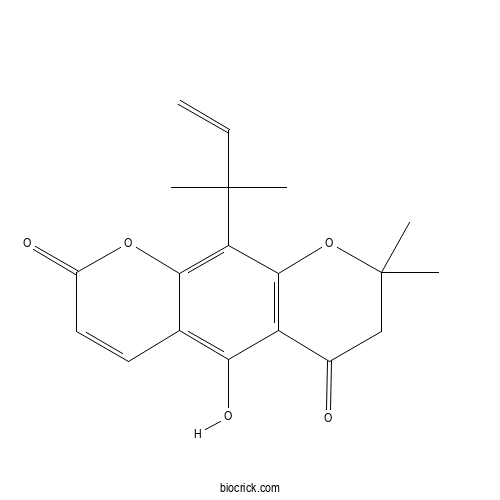
| Cas No. | 28384-44-3 | SDF | File under preparation. |
| PubChem ID | 5315947.0 | Appearance | Powder |
| Formula | C19H20O5 | M.Wt | 328.4 |
| Type of Compound | N/A | Storage | Desiccate at -20°C |
| Solubility | Soluble in Chloroform,Dichloromethane,Ethyl Acetate,DMSO,Acetone,etc. | ||
| Chemical Name | 5-hydroxy-2,2-dimethyl-10-(2-methylbut-3-en-2-yl)-3H-pyrano[3,2-g]chromene-4,8-dione | ||
| SMILES | CC1(CC(=O)C2=C(O1)C(=C3C(=C2O)C=CC(=O)O3)C(C)(C)C=C)C | ||
| Standard InChIKey | RDROOFQFFWIIDK-UHFFFAOYSA-N | ||
| Standard InChI | InChI=1S/C19H20O5/c1-6-18(2,3)14-16-10(7-8-12(21)23-16)15(22)13-11(20)9-19(4,5)24-17(13)14/h6-8,22H,1,9H2,2-5H3 | ||
| General tips | For obtaining a higher solubility , please warm the tube at 37 ℃ and shake it in the ultrasonic bath for a while.Stock solution can be stored below -20℃ for several months. We recommend that you prepare and use the solution on the same day. However, if the test schedule requires, the stock solutions can be prepared in advance, and the stock solution must be sealed and stored below -20℃. In general, the stock solution can be kept for several months. Before use, we recommend that you leave the vial at room temperature for at least an hour before opening it. |
||
| About Packaging | 1. The packaging of the product may be reversed during transportation, cause the high purity compounds to adhere to the neck or cap of the vial.Take the vail out of its packaging and shake gently until the compounds fall to the bottom of the vial. 2. For liquid products, please centrifuge at 500xg to gather the liquid to the bottom of the vial. 3. Try to avoid loss or contamination during the experiment. |
||
| Shipping Condition | Packaging according to customer requirements(5mg, 10mg, 20mg and more). Ship via FedEx, DHL, UPS, EMS or other couriers with RT, or blue ice upon request. | ||
Quality Control & MSDS
3D structure
Package In Stock

Number of papers citing our products


Clausenidin Dilution Calculator
Clausenidin Molarity Calculator
| 1 mg | 5 mg | 10 mg | 20 mg | 25 mg | |
| 1 mM | 3.0451 mL | 15.2253 mL | 30.4507 mL | 60.9013 mL | 76.1267 mL |
| 5 mM | 0.609 mL | 3.0451 mL | 6.0901 mL | 12.1803 mL | 15.2253 mL |
| 10 mM | 0.3045 mL | 1.5225 mL | 3.0451 mL | 6.0901 mL | 7.6127 mL |
| 50 mM | 0.0609 mL | 0.3045 mL | 0.609 mL | 1.218 mL | 1.5225 mL |
| 100 mM | 0.0305 mL | 0.1523 mL | 0.3045 mL | 0.609 mL | 0.7613 mL |
| * Note: If you are in the process of experiment, it's necessary to make the dilution ratios of the samples. The dilution data above is only for reference. Normally, it's can get a better solubility within lower of Concentrations. | |||||
- Nordentatin
Catalog No.:BCX2394
CAS No.:1083193-15-0
- 1-O-Methylclausenolide
Catalog No.:BCX2393
CAS No.:148763-15-9
- Heptazoline
Catalog No.:BCX2392
CAS No.:32042-35-6
- Steppogenin 5'-C-glucoside
Catalog No.:BCX2391
CAS No.:2082826-38-6
- Amburoside B
Catalog No.:BCX2390
CAS No.:221011-65-0
- (-)-Lariciresinol 4-O-glucoside
Catalog No.:BCX2389
CAS No.:364081-04-9
- 3'-Deoxyamburoside A
Catalog No.:BCX2388
CAS No.:362668-60-8
- Isopent-3-enyl ferulate
Catalog No.:BCX2387
CAS No.:132335-96-7
- 4'-Hydroxy-7,8-methylenedioxyhomoisoflavan
Catalog No.:BCX2386
CAS No.:148461-99-8
- Umbelliferone 7-O-β-D-xylopyranosyl-(1→6)-β-D-glucopyranoside
Catalog No.:BCX2385
CAS No.:402490-56-6
- Foeniculoside II
Catalog No.:BCX2384
CAS No.:168010-11-5
- cis-Oxyresveratrol 4'-O-glucoside
Catalog No.:BCX2383
CAS No.:863329-67-3
- 2-Naphthoxyacetic acid
Catalog No.:BCX2396
CAS No.:120-23-0
- Flubendazole
Catalog No.:BCX2397
CAS No.:31430-15-6
- 3-(4-Hydroxyphenyl)-1-(1H-pyrrol-1-yl)propan-1-one
Catalog No.:BCX2398
CAS No.:1822773-39-6
- Alpinone
Catalog No.:BCX2399
CAS No.:480-13-7
- 9-epi-Blumenol C
Catalog No.:BCX2400
CAS No.:1242672-31-6
- Clausarin
Catalog No.:BCX2401
CAS No.:62770-67-6
- Dentatin
Catalog No.:BCX2402
CAS No.:22980-57-0
- Aesculioside B
Catalog No.:BCX2403
CAS No.:106310-33-2
- Tinoscorside D
Catalog No.:BCX2404
CAS No.:1257394-29-8
- Blumenol C
Catalog No.:BCX2405
CAS No.:36151-02-7
- Aesculioside A
Catalog No.:BCX2406
CAS No.:254896-53-2
- Zataroside B
Catalog No.:BCX2407
CAS No.:95645-52-6
Clausenidin from Clausena excavata Burm. causes Apoptosis of Liver Cancer in Mice.[Pubmed:41660905]
Asian Pac J Cancer Prev. 2026 Feb 1;27(2):481-489.
BACKGROUND: Clausenidin is a pyranocoumarin that was isolated from the roots of Clausena excavata Burm. Previously, the pure Clausenidin crystals were successfully used to treat HepG2 cells (liver cancer) in vitro; however, no in vivo study had been conducted to support these findings. Therefore, the current study was designed to investigate the in vivo anti-liver cancer effect of pure Clausenidin in hepatocellular carcinoma-induced BALB/c mice. METHOD: DNA fragmentation, caspases, and histological assays were conducted to evaluate the cytotoxic effect of the pure Clausenidin, while real-time qPCR was performed to monitor the expression of apoptosis-inducing genes in the Clausenidin-treated mice. RESULT: Clausenidin significantly (p<0.05) decreased the liver damage-induced levels of alanine and aspartate aminotransferases and also caused fragmentation of the genomic DNA of the tumors. This was followed by a significant increase (p<0.05) in the expression of caspases 3, 8 and 9 proteins in the Clausenidin-treated mice. In addition, Clausenidin upregulated the expression of pro-apoptotic genes associated with the extrinsic and intrinsic pathways. However, it was observed that Clausenidin may have inhibited angiogenesis by downregulating the expression of the VEGF gene in the treated mice. CONCLUSION: Therefore, Clausenidin can be potentially used as an anti-liver cancer agent.
Natural products and mitochondrial allies in colorectal cancer therapy.[Pubmed:37713992]
Biomed Pharmacother. 2023 Nov;167:115473.
Colorectal cancer (CRC) is a globally prevalent malignancy with a high potential for metastasis. Existing cancer treatments have limitations, including drug resistance and adverse effects. Researchers are striving to develop effective therapies to address these challenges. Impressively, contemporary research has discovered that many natural products derived from foods, plants, insects, and marine invertebrates can suppress the progression, metastasis, and invasion of CRC. In this review, we conducted a comprehensive search of the CNKI, PubMed, Embase, and Web of Science databases from inception to April 2023 to evaluate the efficacy of natural products targeting mitochondria to fight against CRC. Mitochondria are intracellular energy factories involved in cell differentiation, signal transduction, cell cycle regulation, apoptosis, and tumorigenesis. The identified natural products have been classified and summarized based on their mechanisms of action. These findings indicate that natural products can induce apoptosis in colorectal cancer cells by inhibiting the mitochondrial respiratory chain, ROS elevation, disruption of mitochondrial membrane potential, the release of pro-apoptotic factors, modulation of the Bcl-2 protein family to facilitate cytochrome c release, induction of apoptotic vesicle activity by activating the caspase protein family, and selective targeting of mitochondrial division. Furthermore, diverse apoptotic signaling pathways targeting mitochondria, such as the MAPK, p53, STAT3, JNK and AKT pathway, have been triggered by natural products. Natural products such as diosgenin, allopurinol, and Clausenidin have demonstrated low toxicity, high efficacy, and multi-targeted properties. Mitochondria-targeting natural products have great potential for overcoming the challenges of CRC therapy.
Bioassay-Guided Isolation and Identification of Antiplasmodial Compounds from the Stem Bark of Clausena excavata.[Pubmed:37414059]
Planta Med. 2023 Oct;89(12):1165-1169.
Clausena excavata is a medicinal plant widely distributed in Southeast Asia. It is used for a variety of indications, including to treat malaria. In our present study, a phytochemical study of the methanol extract from the stem bark of C. excavata led to the isolation of five pyranocoumarins, nordentatin (1: ), dentatin (2: ), kinocoumarin (3: ), clausarin (4: ), and Clausenidin (5: ), and a coumarin, 8-hydroxy-3'',4''-dihydrocapnolactone-2',3'-diol (6: ). The isolation of compound 6: from C. excavata and the antiplasmodial activities against a multidrug-resistant K1 strain of Plasmodium falciparum of 1, 3: , and 5: were reported for the first time. Compounds 3: and 4: exhibited potent antiplasmodial activities with EC(50) values of 1.10 and 0.58 microM, respectively, while 1: and 5: had EC(50) values of 5.62 and 7.15 microM, respectively. A prenyl group attached to the C-3 or C-12 position on the pyranocoumarin ring probably plays an important role on the activity. A hydroxyl group at the C-10 position is also likely to enhance the activity.
Inclusion complex of clausenidin with hydroxypropyl-beta-cyclodextrin: Improved physicochemical properties and anti-colon cancer activity.[Pubmed:33981171]
Saudi Pharm J. 2021 Mar;29(3):223-235.
The long-term objective of the present study was to prepare, physicochemically characterize and determine the anticancer of Clausenidin/hydroxypropyl-beta-cyclodextrin (Clu/HPbetaCD) inclusion complex. We used differential scanning calorimetry, X-ray diffractometer, fourier transform infrared spectroscopy, ultraviolet-visible spectrophotometer and (13)C and (1)H nuclear magnetic resonance followed by in vitro anticancer assays. The orientation and intermolecular interactions of Clausenidin within cyclodextrin cavity were also ascertained by molecular docking simulation accomplished by AutoDock Vina. The guest molecule was welcomed by the hydrophobic cavity of the host molecule and sustained by hydrogen bond between host/guest molecules. The constant drug release with time, and increased solubility were found after successful complexation with HPbetaCD as confirmed by physicochemical characterizations. Clausenidin had greater cytotoxic effect on colon cancer HT29 cells when incorporated into HPbetaCD cavity than dissolved in DMSO. Also, from a comparison of cell viability between normal and cancer cells, a reduced side effect was observed. The Clu/HPbetaCD inclusion complex triggered reactive oxygen species-mediated cytotoxicity in HT29 cells. The inclusion complex-treated HT29 cells showed cell cycle arrest and death by apoptosis associated with caspases activation. The presence of HPbetaCD seems to aid the anticancer activity of Clausenidin.
Clausenidin Induces Caspase 8-Dependent Apoptosis and Suppresses Production of VEGF in Liver Cancer Cells.[Pubmed:29693341]
Asian Pac J Cancer Prev. 2018 Apr 25;19(4):917-922.
Clausena excavata Burm f. is used by traditional healers to treat cancer patients in South East Asia. The use of the plant and its compounds is based on Asian folklore with little or no scientific evidence supporting the therapeutic efficacy The current study aimed to determine the effect of pure Clausenidin isolated from C. excavata on caspase-8-induced cell death as well as angiogenesis in the HepG2 hepatocellular carcinoma cell line. Caspase-8 and extrinsic death receptor protein expression was determined using spectrophotometry and protein profile arrays, respectively. Ultrastructural analysis of Clausenidin-treated cells was conducted using transmission electron microscopy. In addition, anti-angiogenic effects of Clausenidin were investigated by Western blot analysis. Clausenidin significantly (p<0.05) increased the activity of caspase-8 and expression of protein components of the death inducing signaling complex (DISC) in HepG2 cells. Ultrastructural analysis of the Clausenidin-treated HepG2 cells revealed morphological abnormalities typical of apoptosis. Furthermore, Clausenidin significantly (p<0.05) decreased the expression of vascular endothelial growth factor (VEGF). Therefore, Clausenidin is a potential anti-angiogenic agent which may induce apoptosis of hepatocellular carcinoma cells.
Clausenidin from Clausena excavata induces apoptosis in hepG2 cells via the mitochondrial pathway.[Pubmed:27729282]
J Ethnopharmacol. 2016 Dec 24;194:549-558.
ETHNOPHARMACOLOGICAL RELEVANCE: Clausena excavata Burm.f. is used locally in folk medicine for the treatment of cancer in South East Asia. AIM OF THE STUDY: To determine the mechanism of action of pure Clausenidin crystals in the induction of hepatocellular carcinoma (hepG2) cells apoptosis. MATERIALS AND METHODS: Pure Clausenidin was isolated from Clausena excavata Burm.f. and characterized using (1)H and (13)C NMR spectra. Clausenidin-induced cytotoxicity was determined by MTT assay. The morphology of hepG2 after treatment with Clausenidin was determined by fluorescence and Scanning Electron Microscopy. The effect of Clausenidin on the apoptotic genes and proteins were determined by real-time qPCR and protein array profiling, respectively. The involvement of the mitochondria in Clausenidin-induced apoptosis was investigated using MMP, caspase 3 and 9 assays. RESULTS: Clausenidin induced significant (p<0.05) and dose-dependent apoptosis of hepG2 cells. Cell cycle assay showed that Clausenidin induced a G2/M phase arrest, caused mitochondrial membrane depolarization and significantly (p<0.05) increased expression of caspases 3 and 9, which suggest the involvement of the mitochondria in the apoptotic signals. In addition, Clausenidin caused decreased expression of the anti-apoptotic protein, Bcl 2 and increased expression of the pro-apoptotic protein, Bax. This finding was confirmed by the downregulation of Bcl-2 gene and upregulation of the Bax gene in the treated hepG2 cells. CONCLUSION: Clausenidin extracted from Clausena excavata Burm.f. is an anti-hepG2 cell compound as shown by its ability to induce apoptosis through the mitochondrial pathway of apoptosis. Clausenidin can potentially be developed into an anticancer compound.
Clausenidin induces caspase-dependent apoptosis in colon cancer.[Pubmed:27473055]
BMC Complement Altern Med. 2016 Jul 29;16:256.
BACKGROUND: Clausena excavata Burm.f. is a shrub traditionally used to treat cancer patients in Asia. The main bioactive chemical components of the plant are alkaloids and coumarins. In this study, we isolated Clausenidin from the roots of C. excavata to determine its apoptotic effect on the colon cancer (HT-29) cell line. METHOD: We examined the effect of Clausenidin on cell viability, ROS generation, DNA fragmentation, mitochondrial membrane potential in HT-29 cells. Ultrastructural analysis was conducted for morphological evidence of apoptosis in the treated HT-29 cells. In addition, we also evaluated the effect of Clausenidin treatment on the expression of caspase 3 and 9 genes and proteins in HT-29 cells. RESULT: Clausenidin induced a G0/G1 cell cycle arrest in HT-29 cells with significant (p < 0.05) dose-dependent increase in apoptotic cell population. The DNA fragmentation assay also showed apoptotic features in the Clausenidin-treated HT-29 cells. Clausenidin treatment had caused significant (p < 0.05) increases in the expression of caspase 9 protein and gene in HT-29 cells and mitochondrial ROS and mitochondrial membrane depolarization. The results suggest the involvement of the mitochondria in the caspase-dependent apoptosis in Clausenidin-treated colon cancer cells. CONCLUSION: Clausenidin induces a caspase-dependent apoptosis in colon cancers through the stimulation of the mitochondria. The study demonstrates the potential of Clausenidin for use in the treatment of colon cancers.
Determination of a pyranocoumarin and three carbazole compounds in Clausena excavata by RP-HPLC.[Pubmed:20822658]
J Chromatogr Sci. 2010 Jul;48(6):445-9.
Clausenidin, O-methylmukonal, 3-formyl-2,7-dimethoxycarbazole, and clauszoline-J, isolated from the rhizomes and roots of Clausena excavata, exhibit anti-HIV-1 activity in a syncytial assay with EC(50) values of 5.3, 12.0, 29.1, and 34.2 microM, respectively. Due to the highly active anti-HIV-1 property, quantitative analysis of four compounds are investigated. The direct analysis of these four compounds in the crude extracts of the combined rhizomes and roots of Clausena excavata from ten various sources in Thailand by high-performance liquid chromatography is accomplished. Chromatographic separation is achieved on a C(18) column, and the mobile phase is a mixture of methanol and distilled water in a mode of isocratic or gradient elution detected at 254 nm at a flow rate of 0.6 mL/min for Clausenidin, at 274 nm at a flow rate of 0.6 mL/min for O-methylmukonal, at 298 nm at a flow rate of 0.4 mL/min for 3-formyl-2,7-dimethoxycarbazole, and at 242 nm at a flow rate of 0.4 mL/min for clauszoline-J. This is the first quantitative analysis of these four anti-HIV-1 compounds from the crude extract without prior isolation and purification steps.
Anti-HBV and cytotoxic activities of pyranocoumarin derivatives.[Pubmed:19635670]
Bioorg Med Chem. 2009 Aug 15;17(16):6137-43.
Four natural pyranocoumarins Clausenidin (1), nordentatin (2), clausarin (3), and xanthoxyletin (4) were isolated from the medicinal plant Clausena excavata. Recently, we found that 1 and 2 suppressed hepatitis B virus surface antigen in HepA2 cells, and in addition, 1-3 showed cytotoxic activity against four human cancer cell lines (A549, MCF7, KB, and KB-VIN). To explore the SAR of 1-4, 17 pyranocoumarin analogues (5-21) were designed and synthesized. Among these analogues, 5 and 10 were the most potent against hepatitis B virus with EC(50) values of 1.14 and 1.34microM, respectively. The most interesting result in the cytotoxicity assay was the significant activity of 1, 5, and 6 against the multi-drug resistant cell line, KB-VIN, without activity against the KB cell line. These data suggest that these three compounds could be useful hits for developing MDR-inverse drugs.
Anti-HIV-1 constituents from Clausena excavata: Part II. Carbazoles and a pyranocoumarin.[Pubmed:16177980]
Phytother Res. 2005 Aug;19(8):728-31.
Three carbazole derivatives, O-methylmukonal (1), 3-formyl-2,7-dimethoxycarbazole (2) and clauszoline J (3), and a pyranocoumarin, Clausenidin (4), were isolated from the rhizomes and roots of Clausena excavata. Compound 1, isolated from this plant for the first time, has not been reported previously as having anti-HIV-1 activity. Compounds 1-4 displayed anti-HIV-1 activity in a syncytial assay with EC(50) values of 12, 29.1, 34.2 and 5.3 microm, respectively, and thus exhibited potential therapeutic index (PTI) values of 56.7, 8.0, 1.6 and 7.0, respectively. All isolated compounds demonstrated a lack of cytotoxicity against the KB and BC-1 cancer cell lines.
Coumarins and carbazoles from Clausena excavata exhibited antimycobacterial and antifungal activities.[Pubmed:12624822]
Planta Med. 2003 Feb;69(2):155-7.
Four known coumarins, dentatin (1), nor-dentatin (2), Clausenidin (3) and xanthoxyletin (5), and six known carbazole derivatives, 3-formylcarbazole (6), mukonal (7), 3-methoxycarbonylcarbazole (8), murrayanine (9), 2-hydroxy-3-formyl-7-methoxycarbazole (10) and clauszoline J (11) were isolated from Clausena excavata. Compounds 1 and 6 were first isolated from the crude chloroform extract of the rhizomes. Compounds 1, 2, 3, 6, 7, 8, 10 and 11 showed antimycobacterial activity at a minimum inhibitory concentration (MIC) of 50, 100, 200, 100, 200, 50, 100 and 100 microg/mL, respectively. O-Methylated Clausenidin ( 4), prepared from 3, exhibited antimycobacterial activity at MIC 50 microg/mL. Compounds 6, 7, 8 and 10 showed antifungal activity with IC 50 values of 13.6, 29.3, 9.5 and 2.8 microg/mL, respectively. All compounds demonstrated no cytotoxicity against KB and BC-1 cell lines.
Antiproliferative effect of isopentenylated coumarins on several cancer cell lines.[Pubmed:11497276]
Anticancer Res. 2001 May-Jun;21(3B):1905-11.
33 coumarins, mainly the simple isopentenylated coumarins and derived pyrano- and furanocoumarins, were examined for their antiproliferative activity towards several cancer and normal human cell lines. The pyrano- and furanocoumarins showed strong activity against the cancer cell lines, whereas they had weak antiproliferative activity against the normal human cell lines. The decreasing rank order of potency was osthenone (10), clausarin (25), Clausenidin (26), dentatin (24), nordentatin (23), imperatorin (29), seselin (27), xanthyletin (21), suberosin (17), phebalosin (8) and osthol (12). The structure-activity relationship established from the results revealed that the 1,1-dimethylallyl and isopentenyl groups have an important role for antiproliferative activity.

Calcutta University

University of Minnesota

University of Maryland School of Medicine

University of Illinois at Chicago

The Ohio State University

University of Zurich

Harvard University

Colorado State University

Auburn University

Yale University

Worcester Polytechnic Institute

Washington State University

Stanford University

University of Leipzig

Universidade da Beira Interior

The Institute of Cancer Research

Heidelberg University

University of Amsterdam

University of Auckland

TsingHua University

The University of Michigan

Miami University

DRURY University

Jilin University

Fudan University

Wuhan University

Sun Yat-sen University

Universite de Paris

Deemed University

Auckland University

The University of Tokyo

Korea University



