
2-Naphthoxyacetic acidCAS# 120-23-0 |
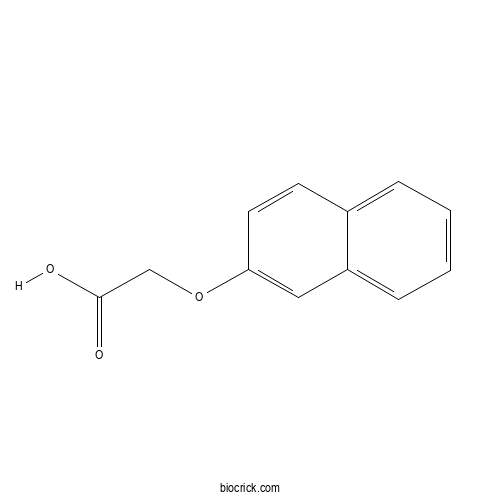
| Cas No. | 120-23-0 | SDF | File under preparation. |
| PubChem ID | 8422.0 | Appearance | Powder |
| Formula | C12H10O3 | M.Wt | 202.2 |
| Type of Compound | N/A | Storage | Desiccate at -20°C |
| Solubility | Soluble in Chloroform,Dichloromethane,Ethyl Acetate,DMSO,Acetone,etc. | ||
| Chemical Name | 2-naphthalen-2-yloxyacetic acid | ||
| SMILES | C1=CC=C2C=C(C=CC2=C1)OCC(=O)O | ||
| Standard InChIKey | RZCJYMOBWVJQGV-UHFFFAOYSA-N | ||
| Standard InChI | InChI=1S/C12H10O3/c13-12(14)8-15-11-6-5-9-3-1-2-4-10(9)7-11/h1-7H,8H2,(H,13,14) | ||
| General tips | For obtaining a higher solubility , please warm the tube at 37 ℃ and shake it in the ultrasonic bath for a while.Stock solution can be stored below -20℃ for several months. We recommend that you prepare and use the solution on the same day. However, if the test schedule requires, the stock solutions can be prepared in advance, and the stock solution must be sealed and stored below -20℃. In general, the stock solution can be kept for several months. Before use, we recommend that you leave the vial at room temperature for at least an hour before opening it. |
||
| About Packaging | 1. The packaging of the product may be reversed during transportation, cause the high purity compounds to adhere to the neck or cap of the vial.Take the vail out of its packaging and shake gently until the compounds fall to the bottom of the vial. 2. For liquid products, please centrifuge at 500xg to gather the liquid to the bottom of the vial. 3. Try to avoid loss or contamination during the experiment. |
||
| Shipping Condition | Packaging according to customer requirements(5mg, 10mg, 20mg and more). Ship via FedEx, DHL, UPS, EMS or other couriers with RT, or blue ice upon request. | ||
Quality Control & MSDS
3D structure
Package In Stock

Number of papers citing our products


2-Naphthoxyacetic acid Dilution Calculator
2-Naphthoxyacetic acid Molarity Calculator
| 1 mg | 5 mg | 10 mg | 20 mg | 25 mg | |
| 1 mM | 4.9456 mL | 24.728 mL | 49.456 mL | 98.912 mL | 123.64 mL |
| 5 mM | 0.9891 mL | 4.9456 mL | 9.8912 mL | 19.7824 mL | 24.728 mL |
| 10 mM | 0.4946 mL | 2.4728 mL | 4.9456 mL | 9.8912 mL | 12.364 mL |
| 50 mM | 0.0989 mL | 0.4946 mL | 0.9891 mL | 1.9782 mL | 2.4728 mL |
| 100 mM | 0.0495 mL | 0.2473 mL | 0.4946 mL | 0.9891 mL | 1.2364 mL |
| * Note: If you are in the process of experiment, it's necessary to make the dilution ratios of the samples. The dilution data above is only for reference. Normally, it's can get a better solubility within lower of Concentrations. | |||||
- Clausenidin
Catalog No.:BCX2395
CAS No.:28384-44-3
- Nordentatin
Catalog No.:BCX2394
CAS No.:1083193-15-0
- 1-O-Methylclausenolide
Catalog No.:BCX2393
CAS No.:148763-15-9
- Heptazoline
Catalog No.:BCX2392
CAS No.:32042-35-6
- Steppogenin 5'-C-glucoside
Catalog No.:BCX2391
CAS No.:2082826-38-6
- Amburoside B
Catalog No.:BCX2390
CAS No.:221011-65-0
- (-)-Lariciresinol 4-O-glucoside
Catalog No.:BCX2389
CAS No.:364081-04-9
- 3'-Deoxyamburoside A
Catalog No.:BCX2388
CAS No.:362668-60-8
- Isopent-3-enyl ferulate
Catalog No.:BCX2387
CAS No.:132335-96-7
- 4'-Hydroxy-7,8-methylenedioxyhomoisoflavan
Catalog No.:BCX2386
CAS No.:148461-99-8
- Umbelliferone 7-O-β-D-xylopyranosyl-(1→6)-β-D-glucopyranoside
Catalog No.:BCX2385
CAS No.:402490-56-6
- Foeniculoside II
Catalog No.:BCX2384
CAS No.:168010-11-5
- Flubendazole
Catalog No.:BCX2397
CAS No.:31430-15-6
- 3-(4-Hydroxyphenyl)-1-(1H-pyrrol-1-yl)propan-1-one
Catalog No.:BCX2398
CAS No.:1822773-39-6
- Alpinone
Catalog No.:BCX2399
CAS No.:480-13-7
- 9-epi-Blumenol C
Catalog No.:BCX2400
CAS No.:1242672-31-6
- Clausarin
Catalog No.:BCX2401
CAS No.:62770-67-6
- Dentatin
Catalog No.:BCX2402
CAS No.:22980-57-0
- Aesculioside B
Catalog No.:BCX2403
CAS No.:106310-33-2
- Tinoscorside D
Catalog No.:BCX2404
CAS No.:1257394-29-8
- Blumenol C
Catalog No.:BCX2405
CAS No.:36151-02-7
- Aesculioside A
Catalog No.:BCX2406
CAS No.:254896-53-2
- Zataroside B
Catalog No.:BCX2407
CAS No.:95645-52-6
- (11R)-12-Chloronootkaton-11-ol
Catalog No.:BCX2408
CAS No.:1446439-13-9
Structures and mechanism of the AUX/LAX transporters involved in auxin import.[Pubmed:40759769]
Nat Plants. 2025 Aug;11(8):1670-1680.
Auxins are plant hormones that direct the growth and development of organisms on the basis of environmental cues. Indole-3-acetic acid (IAA) is the most abundant auxin in most plants. A variety of membrane transport proteins work together to distribute auxins. These include the AUX/LAX protein family that mediate auxin import from the apoplast to the cytosol. Here we use structural and biophysical approaches combined with molecular dynamics to study transport by Arabidopsis thaliana LAX3, which is essential for plant root formation. Transport assays document high-affinity transport of IAA, as well as competitive behaviour of the synthetic phenoxyacetic acid auxin herbicide 2,4-dichlorophenoxyacetic acid and the auxin transport inhibitors 1-naphthoxyacetic acid and 2-Naphthoxyacetic acid. Four cryo-EM structures were solved with resolutions of 2.9-3.4 A: an inward open apo structure, two inward semi-occluded structures in complex with IAA and 2,4-dichlorophenoxyacetic acid, and a fully occluded structure in complex with 2-Naphthoxyacetic acid. Structurally, LAX3 consists of a bundle and a scaffold domain. The ligand-binding site is sandwiched between these domains with two histidines occupying positions analogous to the sodium-binding sites in distantly related sodium:neurotransmitter transporters. This architecture suggests that these histidines couple transport to the proton motive force. Molecular dynamics simulations are used to explore substrate binding and release, including their dependence on specific protonation states. This study advances our understanding of auxin recognition and transport by AUX/LAX, providing insights into a fundamental aspect of plant physiology and development.
Isolation of the isopropanol extract components of the leaves of Ailanthus glandulosa by a new method.[Pubmed:37215867]
Heliyon. 2023 Apr 30;9(5):e15881.
The leaves of Ailanthus glandulosa were extracted with the Soxhlet apparatus using isopropanol. A new method was used to separate and isolate eleven chemical compounds present in the leaves of bird's tongue. The separation was carried out by column chromatography using displacement solvents (petroleum ether, chloroform, dichloromethane, methanol) and four eluates were obtained. The four eluates were treated with a number of solvents, yielding thirty-four compounds. The chemical content of the mordants was determined using GC/MS technology. The samples tested contained six ester compounds, three aldehyde compounds, three ketone compounds, two alcoholic compounds, eight carboxylic acid compounds, five silicone compounds, five aromatic compounds and one phosphate compound. Eleven compounds were isolated, the most important of which are: 2-Naphthoxyacetic acid, 2,6-bis (1,1-dimethylethyl)-4-ethylphenol, 2,5-tert-butylnitrobenzene, 5-hexyl-2-furaldehyde, 16-nitrobicyclo [10.4.0] hexadecan-1-ol-13-one, cyclooctasiloxan hexadecamethyl.
Indole-3-Acetic Acid Is Synthesized by the Endophyte Cyanodermella asteris via a Tryptophan-Dependent and -Independent Way and Mediates the Interaction with a Non-Host Plant.[Pubmed:33800748]
Int J Mol Sci. 2021 Mar 6;22(5):2651.
The plant hormone indole-3-acetic acid (IAA) is one of the main signals playing a role in the communication between host and endophytes. Endophytes can synthesize IAA de novo to influence the IAA homeostasis in plants. Although much is known about IAA biosynthesis in microorganisms, there is still less known about the pathway by which IAA is synthesized in fungal endophytes. The aim of this study is to examine a possible IAA biosynthesis pathway in Cyanodermella asteris. In vitro cultures of C. asteris were incubated with the IAA precursors tryptophan (Trp) and indole, as well as possible intermediates, and they were additionally treated with IAA biosynthesis inhibitors (2-mercaptobenzimidazole and yucasin DF) to elucidate possible IAA biosynthesis pathways. It was shown that (a) C. asteris synthesized IAA without adding precursors; (b) indole-3-acetonitrile (IAN), indole-3-acetamide (IAM), and indole-3-acetaldehyde (IAD) increased IAA biosynthesis; and (c) C. asteris synthesized IAA also by a Trp-independent pathway. Together with the genome information of C. asteris, the possible IAA biosynthesis pathways found can improve the understanding of IAA biosynthesis in fungal endophytes. The uptake of fungal IAA into Arabidopsis thaliana is necessary for the induction of lateral roots and other fungus-related growth phenotypes, since the application of the influx inhibitor 2-Naphthoxyacetic acid (NOA) but not the efflux inhibitor N-1-naphtylphthalamic acid (NPA) were altering these parameters. In addition, the root phenotype of the mutation in an influx carrier, aux1, was partially rescued by C. asteris.
1,3,4-Thiadiazolo (3,2-Alpha) Pyrimidine-6-Carbonitrile Scaffold as PARP1 Inhibitors.[Pubmed:33327923]
Anticancer Agents Med Chem. 2021;21(15):2050-2065.
BACKGROUND: 1,3,4-thiadiazolo pyrimidine is a lead molecule that is versatile for a wide variety of biological activities and in continuation of our interest in establishing some novel heterocyclic compounds for antitumor activity. OBJECTIVE: The objective of the study was to synthesize a series of 5-amino-7-(substituted aldehyde)-2[(naphthalene- 2-yloxy)methyl] -[1,3,4]thiadiazolo-[3,2-alpha]-pyrimidine-6- carbonitrile derivatives and evaluate their possible in vitro and in vivo anticancer activity. METHODS: Herein, we report the synthetic scheme, which was followed for the preparation of a series of title compounds B1- B9 outlined in scheme 1. The intermediate 5-[(naphthalen-2- yloxy)methyl]-1,3,4-thiadiazolo- 2-amine was prepared by heating 2-Naphthoxyacetic acid and thiosemicarbazide in the presence of phosphoryl chloride at a temperature of 65-75 degrees C. The obtained compound reacted with malononitrile and an appropriate amount of aromatic and heteroaromatic aldehydes in refluxing ethanol yielded 5-amino-7-(substituted aldehyde)-2[(naphthalene-2-yloxy)methyl] -[1,3,4]thiadiazolo-[3,2-alpha]-pyrimidine-6- carbonitrile derivatives (B1 - B9). The purity of the synthesized compounds was ensured by various spectral analyses. RESULTS: In in silico molecular docking studies, compounds B3 and B9 show binding affinity like known PARP1 inhibitor olaparib. The cellular evaluation indicates that the anticancer profile of compounds B1, B3, and B9 is significant when compared to the standard drug (olaparib) against MDA-MB-232 cell line and compounds B3, B6, and B7 are the most active against MCF-7 cell lines. The most active compound B3 was subjected to acute oral toxicity studies by OECD 423 guidelines and in vivo anti-cancer studies were carried out using DMBA induced model. CONCLUSION: The in silico docking study of the newly synthesized compounds was performed; the results showed good binding mode in the active site of PARP1 enzyme. In silico ADME properties of synthesized compounds were also studied and showed good drug-like properties.
Small molecules restore the function of mutant CLC5 associated with Dent disease.[Pubmed:33200471]
J Cell Mol Med. 2021 Jan;25(2):1319-1322.
Dent disease type 1 is caused by mutations in the CLCN5 gene that encodes CLC5, a 2Cl(-) /H(+) exchanger. The CLC5 mutants that have been functionally analysed constitute three major classes based on protein expression, cellular localization and channel function. We tested two small molecules, 4-phenylbutyrate (4PBA) and its analogue 2-Naphthoxyacetic acid (2-NOAA), for their effect on mutant CLC5 function and expression by whole-cell patch-clamp and Western blot, respectively. The expression and function of non-Class I CLC5 mutants that have reduced function could be restored by either treatment. Cell viability was reduced in cells treated with 2-NOAA. 4PBA is a FDA-approved drug for the treatment of urea cycle disorders and offers a potential therapy for Dent disease.
One pot green synthesis of m-aminophenol-urea-glyoxal resin as pipette tip solid-phase extraction adsorbent for simultaneous determination of four plant hormones in watermelon juice.[Pubmed:32505267]
J Chromatogr A. 2020 Jul 19;1623:461214.
Plant hormones (PHs) are a type of pesticide that can potentially affect human health. Therefore, their quantitative detection is particularly important. In this study, a green and economic method for the simultaneous extraction and determination of four PHs, namely thidiazuron, forchlorfenuron, 1-naphthylacetic acid, and 2-Naphthoxyacetic acid, in watermelon juice was developed by using m-aminophenol-urea-glyoxal resin as the adsorbent for pipette tip solid phase extraction (PT-SPE) coupled with liquid chromatography. The resin was synthesized via a simple (one pot hydrothermal synthesis) and green (ethanol as the solvent and glyoxal as crosslinking agent) process. The synthesized resin possesses multiple functional groups (hydroxyl, amino, and imino, among others), high adsorption capacity, larger specific surface area than the urea-glyoxal resin and m-aminophenol-glyoxal resin, and can be regenerated easily. The PT-SPE device is simple, cheap, and easy to obtain, and the adsorbent dosage is only 5.0 mg. The proposed method has a wide linear detection range, high recovery, good precision, and high sensitivity, and satisfies the measurement requirements for detecting trace levels of PHs in fruits and vegetables.
Small Molecules Restore Bestrophin 1 Expression and Function of Both Dominant and Recessive Bestrophinopathies in Patient-Derived Retinal Pigment Epithelium.[Pubmed:32421148]
Invest Ophthalmol Vis Sci. 2020 May 11;61(5):28.
PURPOSE: Bestrophinopathies are a group of untreatable inherited retinal dystrophies caused by mutations in the retinal pigment epithelium (RPE) Cl- channel bestrophin 1. We tested whether sodium phenylbutyrate (4PBA) could rescue the function of mutant bestrophin 1 associated with autosomal dominant and recessive disease. We then sought analogues of 4PBA with increased potency and determined the mode of action for 4PBA and a lead compound 2-Naphthoxyacetic acid (2-NOAA). Lastly, we tested if 4PBA and 2-NOAA could functionally rescue bestrophin 1 function in RPE generated from induced pluripotent stem cells (iPSC-RPEs) derived from patients with a dominant or recessive bestrophinopathy. METHODS: Global and plasma membrane expression was determined by Western blot and immunofluorescent microscopy, respectively. The effect of 4PBA and 2-NOAA on transcription was measured by quantitative RT-PCR and the rate of protein turnover by cycloheximide chase and Western blot. Channel function was measured by whole-cell patch clamp. RESULTS: 4PBA and 2-NOAA can rescue the global and membrane expression of mutant bestrophin 1 associated with autosomal dominant disease (Best vitelliform macular dystrophy [BVMD]) and autosome recessive bestrophinopathy (ARB), and these small molecules have different modes of action. Both 4PBA and 2-NOAA significantly increased the channel function of mutant BVMD and ARB bestrophin 1 in HEK293T and iPSC-RPE cells derived from patients with BVMD and ARB. For 4PBA, the increased mutant channel function in BVMD and ARB iPSC-RPE was equal to that of wild-type iPSC-RPE bestrophin 1. CONCLUSIONS: The restoration of bestrophin 1 function in patient-derived RPE confirms the US Food and Drug Administration-approved drug 4PBA as a promising therapeutic treatment for bestrophinopathies.
N-doped carbon nanotubes-reinforced hollow fiber solid-phase microextraction coupled with high performance liquid chromatography for the determination of phytohormones in tomatoes.[Pubmed:29759179]
Talanta. 2018 Aug 1;185:132-140.
A N-doped carbon nanotubes-reinforced hollow fiber solid-phase microextraction (N-doped CNTs-HF-SPME) method was developed for determination of two naphthalene-derived phytohormones, 1-naphthalene acetic acid (NAA) and 2-Naphthoxyacetic acid (2-NOA), at trace levels in tomatoes. N-doped CNTs were dispersed in ultrapure water with the assistance of surfactant, and then immobilized into the pores of hollow fiber by capillary forces and sonification. The resultant N-doped CNTs-HF was wetted with 1-octanol, subsequently immersed into the tomato samples to extract the target analytes under a magnetic stirring, and then desorbed with methanol by sonication prior to chromatographic analysis. Compared with CNTs, the surface hydrophilicity of N-doped CNTs was improved owing to the doping of nitrogen atoms, and a uniform dispersion was formed, thus greatly simplifying the preparation process and reducing waste of materials. In addition, N-doped CNTs-HF exhibits a more effective extraction performance for NAA and 2-NOA on account of the introduction of Lewis-basic nitrogen. It is worth to mention that owing to the clean-up function of HF, there are not any complicated sample pretreatment procedures prior to the microextraction. To achieve the highest extraction efficiency, important microextraction parameters including the length and the concentration level of N-doped CNTs in surfactant solution, extraction time, desorption conditions such as the type and volume of solvents, pH value, stirring rate and volume of the donor phase were thoroughly investigated and optimized. Under the optimal conditions, the method showed 165- and 123-fold enrichment factors of NAA and 2-NOA, good inter-fiber repeatability and batch-to-batch reproducibility, good linearity with correlation coefficients higher than 0.9990, low limits of detection and quantification (at ng g(-1) levels), and satisfactory recoveries in the range of 83.10-108.32% at three spiked levels. The proposed method taking advantages of both excellent adsorption performance of N-doped CNTs and the clean-up function of HF, was a simple, green, efficient and cost-effective enrichment procedure for the determination of trace NAA and 2-NOA in tomatoes.
Modified QuEChERS method for 24 plant growth regulators in grapes using LC-MS/MS.[Pubmed:29567233]
J Food Drug Anal. 2018 Apr;26(2):637-648.
A multiresidue analytical method was developed for grapes for the following 24 plant growth regulators: 1-naphthylacetamide, 2,3,5-triiodobenzoic acid, 2,4,5-T, 2-Naphthoxyacetic acid, 3-indolylacetic acid, 4-(3-indolyl)-butyric acid, 4-chlorophenoxyacetic acid, 4-nitrophenol, 6-benzylaminopurine, N6-isopentenyladenine, butralin, chlormequat chloride, chlorphonim-Cl, cloprop, forchlorfenuron, gibberellic acid 3, gibberellic acid 4, gibberellic acid 7, inabenfide, mepiquat chloride, paclobutrazol, prohydrojasmon, thidiazuron and uniconizole-P. The compounds were extracted from grape samples using an extraction method modified from the Quick, Easy, Cheap, Effective, Rugged and Safe (QuEChERS) method. Liquid chromatography - tandem mass spectrometry was used for the detection and quantification of the compounds. Validation of the method was performed by using recovery studies at both intra-day and inter-day intervals, as well as by evaluation of the matrix effect, limit of quantification, trueness and precision. We used matrix-matched calibrations for the quantification of the compounds, which all resulted in determination coefficients (r(2)) higher than 0.995. The limit of quantification ranged from 0.1 to 5 ng/mL. Recovery studies using three spiking concentrations at varying levels showed recoveries of 70.2-112.6% and 67.5-101.8% at intra-day and inter-day intervals, respectively. Relative standard deviations were below 20% for the recovery studies. The extraction method were further validated by performing recovery study and matrix effect test in six different grape varieties from Taiwan and the United States and all resulted in comparable results. Application of the established method to 50 grape samples, resulted in the detection of chlormequat chloride and forchlorfenuron residues in the tested grapes. The results of the method validation and real sample analysis shows the extraction method is therefore suitable for routine monitoring of residue in grapes.
UV/Peracetic Acid for Degradation of Pharmaceuticals and Reactive Species Evaluation.[Pubmed:29148739]
Environ Sci Technol. 2017 Dec 19;51(24):14217-14224.
Peracetic acid (PAA) is a widely used disinfectant, and combined UV light with PAA (i.e., UV/PAA) can be a novel advanced oxidation process for elimination of water contaminants. This study is among the first to evaluate the photolysis of PAA under UV irradiation (254 nm) and degradation of pharmaceuticals by UV/PAA. PAA exhibited high quantum yields (Phi(254 nm) = 1.20 and 2.09 mol.Einstein(-1) for the neutral (PAA(0)) and anionic (PAA(-)) species, respectively) and also showed scavenging effects on hydroxyl radicals (k((*)OH/PAA(0)) = (9.33 +/- 0.3) x 10(8) M(-1).s(-1) and k((*)OH/PAA(-)) = (9.97 +/- 2.3) x 10(9) M(-1).s(-1)). The pharmaceuticals were persistent with PAA alone but degraded rapidly by UV/PAA. The contributions of direct photolysis, hydroxyl radicals, and other radicals to pharmaceutical degradation under UV/PAA were systematically evaluated. Results revealed that (*)OH was the primary radical responsible for the degradation of carbamazepine and ibuprofen by UV/PAA, whereas CH(3)C( horizontal lineO)O(*) and/or CH(3)C( horizontal lineO)O(2)(*) contributed significantly to the degradation of naproxen and 2-Naphthoxyacetic acid by UV/PAA in addition to (*)OH. The carbon-centered radicals generated from UV/PAA showed strong reactivity to oxidize certain naphthyl compounds. The new knowledge obtained in this study will facilitate further research and development of UV/PAA as a new degradation strategy for water contaminants.
Phytohormone Behavior in the Model Environment of Plant and Human Lipid Membranes.[Pubmed:28582619]
J Phys Chem B. 2017 Jun 29;121(25):6175-6183.
Interactions between three auxins (indole-3-acetic acid (IAA), 2-Naphthoxyacetic acid (BNOA), and 2,4-dichlorophenoxyacetic acid (2,4-D)) and model two-dimensional lipid systems mimicking plant and human cell membranes were investigated in monolayers formed at the air/water solution interface. The analysis was based on the recorded pi-A isotherm characteristics complemented with Brewster angle microscopy. The influence of auxins on model membranes was discussed on the basis of condensation changes, modification of mutual lipid-lipid interactions in the mixed films, and morphological alteration of the surface domains on the microscopic scale. It was demonstrated that the lipid composition and mutual proportion of the artificial membranes together with sterol to main the phospholipid ratio play a crucial role in the context of auxin behavior in the membrane-mimicking environment. Apart from specific molecular interactions between studied phytohormones represented by auxins and lipids, the condensation of the investigated monolayers was found to be a regulative factor of model systems' susceptibility toward auxin action. Two effects were recognized: fluidizing of monolayers being in the liquid state (model membranes) and initialization of the three-dimensional structure formation in ordered sterol films at high surface pressure. The influence of auxin molecules on lipid interactions in the monolayer and diminishing of the film condensation was the largest for BNOA, due to the presence of the most bulky nonpolar, aromatic fragment in the molecule. It was also demonstrated that auxins interact with model plant membranes more selectively, stronger, and at markedly lower concentration than with the human membrane models.
Somatic embryogenesis from bud and leaf explants of date palm (Phoenix dactylifera L.) cv. Najda.[Pubmed:28444601]
3 Biotech. 2017 May;7(1):58.
An efficient regeneration system through somatic embryogenesis was developed for date palm cv. Najda. Adventitious bud and proximal leaf segments cultured on Murashige and Skoog (MS) medium supplemented with various combinations of auxins and cytokinins induced embryogenesis after at least 6 months of culture. Somatic embryogenesis induction seemed correlated with the type of the explant, the induction period and the auxin used. The highest rate of somatic embryogenesis (86.0%) was obtained on bud explants cultured on MS medium supplemented with 45.0 microM 2,4-dichlorophenoxyacetic acid (2,4-D), and 4.5 microM kinetin or 4.5 microM 6-(dimethylallylamino) purine (2iP). Whereas, low levels of embryogenesis were obtained on media supplemented with 1-naphthalene acetic acid (NAA) or 2-Naphthoxyacetic acid (NOA). Proximal leaf segments showed somatic embryogenesis only when cultured on media supplemented with 2,4-D or picloram. Statistical analysis revealed significant effects of explant type and plant growth regulators (PGRs) combination on somatic embryogenesis. Somatic embryos were germinated successfully on PGR-free MS medium with or without activated charcoal (50.0-60.0 and 26.6-36.6%, respectively), and 80.0% of plantlets survived after transferring to a glasshouse for 6 months. Our results will be useful for large-scale propagation of date palm cv. Najda, characterized by high fruit quality and bayoud disease resistance.
Self-Assembled and Cross-Linked Animal and Plant-Based Polysaccharides: Chitosan-Cellulose Composites and Their Anion Uptake Properties.[Pubmed:27802018]
ACS Appl Mater Interfaces. 2016 Dec 7;8(48):33197-33209.
Self-assembled and cross-linked chitosan/cellulose glutaraldehyde composite materials (CGC) were prepared with enhanced surface area and variable morphology. FTIR, CHN, and (13)C solid state NMR studies provided support for the cross-linking reaction between the amine groups of chitosan and glutaraldehyde; whereas, XRD and TGA studies provided evidence of cellulose-chitosan interactions for the composites. SEM, equilibrium swelling, and nitrogen adsorption studies corroborate the enhanced surface area and variable morphology of the cross-linked biopolymers. Equilibrium sorption studies at alkaline conditions with phenolic dyes, along with single component and mixed naphthenates in aqueous solution revealed variable uptake properties with the composites. The Freundlich isotherm model revealed that the composite at the highest levels of cross-linker, CGC3, had the highest sorption affinity (K(F); L mmol/g) for phenolphthalein (phth) followed by ortho-nitrophenyl acetic acid (ONPAA) and para-nitrophenol (PNP), as follows: Phth (5.03 x 10(-1)) > ONPAA (2.28 x 10(-1)) > PNP (8.49 x 10(-2)). The Sips isotherm model provided a good description of the sorption profile of single component and naphthenate mixtures. The monolayer uptake capacity (Q(m); mg g(-1)) is given in parentheses: 2-hexyldecanoic acid (S1; 115 mg/g) > 2-Naphthoxyacetic acid (S3; 40.5 mg/g) > trans-4-pentylcyclohexylcarboxylic acid (S2; 13.7 mg/g). By comparison, the Q(m) values for CGC3 with naphthenate mixtures (24.1 and 27.4 mg/g) according to UV spectroscopy and electrospray ionization mass spectrometry (ESI-HRMS). The sorbent materials generally show greater uptake with naphthenates that possess lower vs higher double bond equivalence (DBE) values. Kinetic studies revealed that the sorption of phth adopted behavior described by the pseudo-second order model, while uptake for S3 and naphthenate mixtures adopted pseudo-first order behavior. This study contributes to a greater understanding of the sorption properties of the two types of abundant biopolymers and their composites by illustrating their tunable sorption properties. The key role of hydrophobic interactions for CGC materials was evidenced by the controlled sorptive uptake of carboxylate anions with variable molecular structure.

Calcutta University

University of Minnesota

University of Maryland School of Medicine

University of Illinois at Chicago

The Ohio State University

University of Zurich

Harvard University

Colorado State University

Auburn University

Yale University

Worcester Polytechnic Institute

Washington State University

Stanford University

University of Leipzig

Universidade da Beira Interior

The Institute of Cancer Research

Heidelberg University

University of Amsterdam

University of Auckland

TsingHua University

The University of Michigan

Miami University

DRURY University

Jilin University

Fudan University

Wuhan University

Sun Yat-sen University

Universite de Paris

Deemed University

Auckland University

The University of Tokyo

Korea University



