
HeptaphyllineCAS# 17750-35-5 |
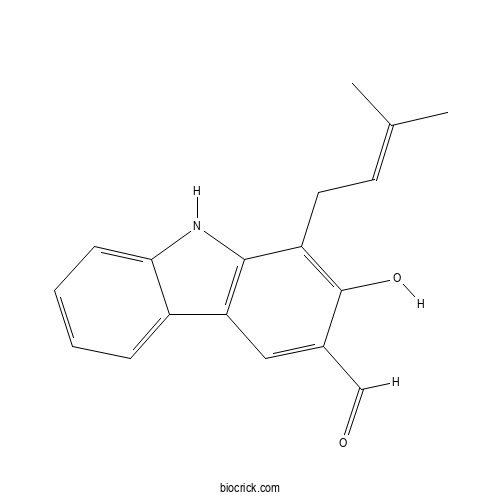
| Cas No. | 17750-35-5 | SDF | File under preparation. |
| PubChem ID | 5318015.0 | Appearance | Yellow powder |
| Formula | C18H17NO2 | M.Wt | 279.3 |
| Type of Compound | N/A | Storage | Desiccate at -20°C |
| Solubility | Soluble in Chloroform,Dichloromethane,Ethyl Acetate,DMSO,Acetone,etc. | ||
| Chemical Name | 2-hydroxy-1-(3-methylbut-2-enyl)-9H-carbazole-3-carbaldehyde | ||
| SMILES | CC(=CCC1=C(C(=CC2=C1NC3=CC=CC=C32)C=O)O)C | ||
| Standard InChIKey | ICYHRFZZQCYWNF-UHFFFAOYSA-N | ||
| Standard InChI | InChI=1S/C18H17NO2/c1-11(2)7-8-14-17-15(9-12(10-20)18(14)21)13-5-3-4-6-16(13)19-17/h3-7,9-10,19,21H,8H2,1-2H3 | ||
| General tips | For obtaining a higher solubility , please warm the tube at 37 ℃ and shake it in the ultrasonic bath for a while.Stock solution can be stored below -20℃ for several months. We recommend that you prepare and use the solution on the same day. However, if the test schedule requires, the stock solutions can be prepared in advance, and the stock solution must be sealed and stored below -20℃. In general, the stock solution can be kept for several months. Before use, we recommend that you leave the vial at room temperature for at least an hour before opening it. |
||
| About Packaging | 1. The packaging of the product may be reversed during transportation, cause the high purity compounds to adhere to the neck or cap of the vial.Take the vail out of its packaging and shake gently until the compounds fall to the bottom of the vial. 2. For liquid products, please centrifuge at 500xg to gather the liquid to the bottom of the vial. 3. Try to avoid loss or contamination during the experiment. |
||
| Shipping Condition | Packaging according to customer requirements(5mg, 10mg, 20mg and more). Ship via FedEx, DHL, UPS, EMS or other couriers with RT, or blue ice upon request. | ||
Quality Control & MSDS
3D structure
Package In Stock

Number of papers citing our products


Heptaphylline Dilution Calculator
Heptaphylline Molarity Calculator


| 1 mg | 5 mg | 10 mg | 20 mg | 25 mg | |
| 1 mM | 3.5804 mL | 17.9019 mL | 35.8038 mL | 71.6076 mL | 89.5095 mL |
| 5 mM | 0.7161 mL | 3.5804 mL | 7.1608 mL | 14.3215 mL | 17.9019 mL |
| 10 mM | 0.358 mL | 1.7902 mL | 3.5804 mL | 7.1608 mL | 8.9509 mL |
| 50 mM | 0.0716 mL | 0.358 mL | 0.7161 mL | 1.4322 mL | 1.7902 mL |
| 100 mM | 0.0358 mL | 0.179 mL | 0.358 mL | 0.7161 mL | 0.8951 mL |
| * Note: If you are in the process of experiment, it's necessary to make the dilution ratios of the samples. The dilution data above is only for reference. Normally, it's can get a better solubility within lower of Concentrations. | |||||
- 3-Methylcarbazole
Catalog No.:BCX2429
CAS No.:4630-20-0
- 7-Methoxymukonal
Catalog No.:BCX2428
CAS No.:119736-83-3
- Aesculioside E
Catalog No.:BCX2427
CAS No.:254896-68-9
- Artemorin
Catalog No.:BCX2426
CAS No.:64845-92-7
- Aesculioside F
Catalog No.:BCX2425
CAS No.:254896-69-0
- Kuwanon D
Catalog No.:BCX2424
CAS No.:67172-84-3
- Spiradine G
Catalog No.:BCX2423
CAS No.:21040-66-4
- Morusalnol B
Catalog No.:BCX2422
CAS No.:1941207-44-8
- Sanggenon I
Catalog No.:BCX2421
CAS No.:86450-79-5
- Kuwanon F
Catalog No.:BCX2420
CAS No.:71344-07-5
- Aesculioside G
Catalog No.:BCX2419
CAS No.:254896-70-3
- Escin Ia methyl ester
Catalog No.:BCX2418
CAS No.:26339-91-3
- Monardic acid A
Catalog No.:BCX2431
CAS No.:1607436-76-9
- Mukonine
Catalog No.:BCX2432
CAS No.:23523-94-6
- Spiramine B
Catalog No.:BCX2433
CAS No.:114485-96-0
- Scutebarbolide A
Catalog No.:BCX2434
CAS No.:2691860-41-8
- Sanggenon G
Catalog No.:BCX2435
CAS No.:85698-31-3
- 7-Hydroxyheptaphylline
Catalog No.:BCX2436
CAS No.:170663-15-7
- Clauszoline K
Catalog No.:BCX2437
CAS No.:187110-71-0
- Clausine K
Catalog No.:BCX2438
CAS No.:182261-96-7
- 2-Phenyl-2-norkhellin
Catalog No.:BCX2439
CAS No.:2549-25-9
- Mukonal
Catalog No.:BCX2440
CAS No.:20323-67-5
- Maltol 3-O-β-D-apiofuranosyl-(1→2)-β-D-glucopyranoside
Catalog No.:BCX2441
CAS No.:1449315-07-4
- Embigenin
Catalog No.:BCX2442
CAS No.:21089-34-9
Oxygenated 9H-carbazole-3-carbaldehyde scaffolds as cerebral cavernous malformation-relevant protein-protein interaction disruptors of the HEG1-KRIT1 interface.[Pubmed:42611115]
J Comput Aided Mol Des. 2026 Aug 18;40(1):206.
The HEG1-KRIT1 protein-protein interaction is a central component of endothelial CCM-complex organization, linking junctional KRIT1 recruitment to signaling pathways implicated in cerebral cavernous malformation pathobiology, and represents a structurally defined target for small-molecule disruption. In this study, a focused library of 127 oxygenated 9H-carbazole-3-carbaldehyde derivatives was screened to identify candidate inhibitors of the HEG1-KRIT1 interface. Structure-based virtual screening against the HEG1/HKi2-recognition pocket of the KRIT1 FERM domain prioritized Heptaphylline, mukoenine B, and murrayacine for further evaluation. Docking analysis showed that all three candidates occupied the KRIT1 interfacial pocket, while 1000 ns molecular dynamics simulations revealed compound-specific effects on ligand retention, interface stability, and KRIT1 conformational dynamics. MM/PBSA-based PPI disruption analysis showed that murrayacine was the only carbazole candidate with a positive DeltaDeltaG(PPI) value (+ 3.07 kcal/mol), indicating predicted weakening of the HEG1-KRIT1 interface, whereas Heptaphylline and mukoenine B showed negative DeltaDeltaG(PPI) values consistent with non-disruptive or stabilizing behavior. Protein-ligand MM/PBSA analysis identified mukoenine B as the most energetically stable KRIT1 binder, while dynamic interface metrics and free energy landscape analysis supported murrayacine as the strongest functional disruptor. Experimental validation using a bead-based flow-cytometry competition assay confirmed dose-dependent inhibition of HEG1-KRIT1 binding, with murrayacine showing HKi2-like potency (IC(50) = 3.85 +/- 0.30 microM) and outperforming mukoenine B and Heptaphylline. In silico ADMET profiling further supported murrayacine as the most drug-like candidate. Collectively, these findings identify murrayacine as a promising functional carbazole-based HEG1-KRIT1 competition inhibitor. Because noncovalent MD showed substantial ligand-pose displacement for HKi2 and murrayacine, the computational results are interpreted as exploratory and pose-dependent, and direct KRIT1-binding validation will be required in future studies.
alpha-Glucosidase and Nitric Oxide Inhibitory Activities of Pyranocoumarins and Carbazoles From the Roots of Clausena excavata and the Semisynthetic Analogs of Clausarin and Nordentatin.[Pubmed:40720625]
Chem Biodivers. 2025 Nov;22(11):e00510.
Phytochemical investigation of the methanol extract of Clausena excavata roots led to the isolation of six pyranocoumarin derivatives, including xanthyletin (1), kinocoumarin (2), clausarin (3), nordentatin (4), dentatin (4a), and citrusarin A (5), and three carbazole alkaloids, that is, Heptaphylline (6), 7-methoxymukonal (7), and clausine K (8). Seven new semisynthetic analogs of compounds 2, 3, and 4 (2a, 3b-3d, and 4b-4d) were prepared through methylation, etherification, and basic hydrolysis for biological assays. Compounds 2, 6, 3b, 3c, 4b, and 4c displayed stronger alpha-glucosidase inhibitory activity than the positive control, acarbose (IC(50) 391.47 microM), with IC(50) values in the range of 32.89-92.55 microM. Molecular docking suggested that these compounds bind near the enzyme's active site via van der Waals forces, hydrogen bonds, and hydrophobic interactions. Compound 3 showed the strongest nitric oxide (NO) inhibitory activity (IC(50) = 27.95 microM), followed by 3d (IC(50) = 33.62 microM) and 4 (IC(50) = 35.41 microM). For the two compounds tested for cytotoxicity against A549 cells, 3b (IC(50) = 11.71 microM) was more potent than cisplatin (IC(50) = 21.56 microM), whereas 4b (IC(50) = 22.39 microM) showed similar activity to cisplatin. Drug-likeness and pharmacokinetic properties of the isolated and semisynthetic compounds were also evaluated.
Anti-malarial activity of the alkaloid, heptaphylline, and the furanocoumarin, imperatorin, from Clausena anisata against human Plasmodium falciparum malaria parasites: ex vivo trophozoitocidal, schizonticidal and gametocytocidal approach.[Pubmed:37689679]
Malar J. 2023 Sep 9;22(1):264.
BACKGROUND: The erythrocytic stage of the life cycle of the malaria parasite, Plasmodium falciparum, consists of trophozoite, schizont and gametocyte stages in humans. Various anti-malarial agents target different stages of the parasite to produce treatment outcomes. This study reports on the stage-specific anti-malarial activity of Heptaphylline and imperatorin against human P. falciparum in addition to their cytotoxicity and selectivity indices (SI). METHODS: The compounds were isolated from Clausena anisata using column chromatography and their structures elucidated using NMR spectroscopy. The anti-malarial activity was determined by measuring the trophozoitocidal, schizonticidal and gametocytocidal activities of the compounds using the SYBR green assay. Cytotoxicity was evaluated using the tetrazolium-based colorimetric assay. RESULTS: Heptaphylline and imperatorin produced trophozoitocidal, schizonticidal and gametocytocidal activities with IC(50)s of 1.57 (0.2317)-26.92 (0.3144) microM with those of artesunate (the standard drug) being 0.00024 (0.0036)-0.0070 (0.0013) microM. In the cytotoxicity assay, the compounds produced CC(50S) greater than 350 microM and SI of 13.76-235.90. Also, the trophozoitocidal and schizonticidal activities of the compounds were more pronounced than their gametocytocidal activity. Imperatorin was 42.04% more trophozoitocidal than hepthaphyline. However, hepthaphyline has more schizonticidal and gametocytocidal properties than imperatorin. CONCLUSION: Heptaphylline and imperatorin are promising anti-malarial agents, since they possess potent anti-malarial activity with weak cytotoxicity on RBCs. However, imperatorin is a better anti-malarial prophylactic agent whereas Heptaphylline is a better malaria treatment agent.
7-Methoxyheptaphylline Enhances TRAIL-Induced Apoptosis of Colorectal Adenocarcinoma Cell via JNK-Mediated DR5 Expression.[Pubmed:37331805]
Biol Pharm Bull. 2023 Aug 1;46(8):1072-1078.
A cytokine known as tumor necrosis factor (TNF)-related apoptosis-inducing ligand (TRAIL) has the ability to precisely cause the death of cancer cells, while normal cells are left undisturbed. Recent studies show that certain cancer cells are sensitive to the apoptotic effect of TRAIL. In this study, HT29 colorectal adenocarcinoma cells exposed to TRAIL were treated with Heptaphylline and 7-methoxyHeptaphylline from Clausena harmandiana in an effort to comprehend the mechanisms involved behind this activity. The 3-(4,5-dimethylthiazol-2-yl)-2,5-diphenyl tetrazolium bromide (MTT) test was utilized to determine cell survival, and phase contrast microscopy was used to examine cell morphology. Through using real-time RT-PCR, Western blotting, and RT-PCR, the molecular mechanisms were investigated. According to the findings, whilst hepataphylline caused cytotoxicity in normal colon FHC cells, in comparison to healthy colon FHC cells, 7-methoxyHeptaphylline inhibited cancer cells in a concentration-dependent manner. Heptaphylline alone or in conjunction with TRAIL showed no discernible effect on TRAIL-induced HT29 cell death, but 7-methoxyHeptaphylline boosted caspase-3 cleavage. The study showed that the c-Jun N-terminal kinase (JNK) pathway was responsible for the 7-methoxyHeptaphylline's enhancement of the death receptor 5 (DR5) mRNA, TRAIL receptor, and protein. The results demonstrated that the 7-methoxyHeptaphylline of Clausena harmandiana increased the expression of DR5 via the JNK pathway, intensifying TRAIL-induced HT29 cell death.
Visualizing the spatial distribution of metabolites in Clausena lansium (Lour.) skeels using matrix-assisted laser desorption/ionization mass spectrometry imaging.[Pubmed:34481177]
Phytochemistry. 2021 Dec;192:112930.
Clausena lansium (Lour.) Skeels (Rutaceae) is a natural bioactive plant. Its roots, stems, leaves, and seeds are widely used in Chinese traditional and folk medicine. Although the characterization and functional analysis of bioactive components in Clausena lansium (Lour.) Skeels has been widely reported, the spatial distribution of these compounds within the main plant tissues remains undefined. Here, we adopted matrix-assisted laser desorption/ionization-mass spectrometry imaging (MALDI-MSI) to reveal the spatial distribution of active alkaloids, coumarins, sugars and organic acids in C. lansium. Using a combined wet and dry matrix covering method to enhance sensitivity, we detected alkaloids throughout the fruit including 3-methylcarbazole and murrastinine which were especially rich in the kernel tissues but were restricted to the stem xylem and medulla and in the leaf epidermal region. Interestingly, murrayanine and Heptaphylline were mainly found in pulp tissues with very low content in the stems and leaves while girinimbine was only distributed within the outer kernel skin. Coumarins were mainly distributed in the fruit pericarp and leaf vein tissues but with no clear spatial specificity in stems. Lastly, hexoses were mainly evident in the fruit pulp, although sucrose was also found in the pericarp, pulp, and pulp fibers with citric acid being distributed throughout the fruit. The accurate spatial and chemical information obtained provides new insights into the specific accumulation of metabolites in individual tissues.
Construction of N-Heterocycles Fused with a Highly Substituted Benzene Ring by a Benzyne-Mediated Cyclization/Functionalization Cascade Reaction and Its Application to the Total Synthesis of Marine Natural Products.[Pubmed:34334514]
Chem Pharm Bull (Tokyo). 2021;69(8):707-716.
This account summarizes the development of a benzyne-mediated cyclization/functionalization protocol for the versatile construction of highly substituted benzene derivatives fused with an N-heterocyclic ring such as indolines, indoles, and related nitrogen-containing heterocycles. The protocol comprises sequential reactions initiated by generating a benzyne species and subsequent cyclization via addition of magnesium amide to the benzyne, followed by trapping of the resultant magnesium compound in situ with various electrophiles. The substituent scope was expanded by conducting a transmetalation on a copper species to introduce alkyl, aryl, and alkenyl substituents. The utility of the sequential reaction was demonstrated in the synthesis of a carbazole natural product (Heptaphylline), pyrrolo[4,3,2-de]quinoline alkaloids (batzellines), and pyrrolo[2,3-c]carbazole alkaloids (dictyodendrines).
Heptaphylline suppresses the proliferation and migration of human bladder cancer cells via induction of intrinsic apoptosis, autophagy and inhibition of beta-catenin signalling pathway.[Pubmed:34077030]
J BUON. 2021 Mar-Apr;26(2):646.
The Editors of JBUON issue an Expression of Concern to 'Heptaphylline suppresses the proliferation and migration of human bladder cancer cells via induction of intrinsic apoptosis, autophagy and inhibition of beta-catenin signalling pathway', by An Xu, Gang-Gang Yang, Yu Zhang, Shu-Tian Zhao, JBUON 2020;25(1):274-279; PMID: 32277642. Following the publication of the above article, readers drew to our attention that part of the data was possibly unreliable. We sent emails to the authors with a request to provide the raw data to prove the originality, but received no reply. Therefore, as we continue to work through the issues raised, we advise readers to interpret the information presented in the article with due caution. We thank the readers for bringing this matter to our attention. We apologize for any inconvenience it may cause.
Semi-Synthesis of Small Molecules of Aminocarbazoles: Tumor Growth Inhibition and Potential Impact on p53.[Pubmed:33804175]
Molecules. 2021 Mar 15;26(6):1637.
The tumor suppressor p53 is inactivated by mutation in approximately 50% of human cancers. Small molecules that bind and stabilize those mutants may represent effective anticancer drugs. Herein, we report the tumor cell growth inhibitory activity of carbazole alkaloids and amino derivatives, as well as their potential activation of p53. Twelve aminocarbazole alkaloids were semi-synthesized from Heptaphylline (1), 7-methoxy Heptaphylline (2), and 7-methoxymukonal (3), isolated from Clausena harmandiana, using a reductive amination protocol. Naturally-occurring carbazoles 1-3 and their amino derivatives were evaluated for their potential effect on wild-type and mutant p53 activity using a yeast screening assay and on human tumor cell lines. Naturally-occurring carbazoles 1-3 showed the most potent growth inhibitory effects on wild-type p53-expressing cells, being Heptaphylline (1) the most promising in all the investigated cell lines. However, compound 1 also showed growth inhibition against non-tumor cells. Conversely, semi-synthetic aminocarbazole 1d showed an interesting growth inhibitory activity in tumor cells expressing both wild-type and mutant p53, exhibiting low growth inhibition on non-tumor cells. The yeast assay showed a potential reactivation of mutant p53 by Heptaphylline derivatives, including compound 1d. The results obtained indicate that carbazole alkaloids may represent a promising starting point to search for new mutp53-reactivating agents with promising applications in cancer therapy.
Heptaphylline suppresses the proliferation and migration of human bladder cancer cells via induction of intrinsic apoptosis, autophagy and inhibition of beta-catenin signalling pathway.[Pubmed:32277642]
J BUON. 2020 Jan-Feb;25(1):274-279.
PURPOSE: Heptaphylline has been shown to suppress the growth of different types of cancer cells. Nonetheless, the anticancer effects of Heptaphylline have not been examined against human bladder cancer cells. Against this backdrop, this study was undertaken to investigate the anticancer effects of the carbazole alkaloid Heptaphylline against human bladder cancer cells. METHODS: Proliferation rate was determined by MTT assay. Apoptosis was demonstrated by DAPI and annexin V/propidium iodide (PI) assay. Electron microscopy was used for autophagy detection. Western blot analysis was used to determine protein expression. RESULTS: The results showed that Heptaphylline suppressed the proliferation of the RT4 bladder cancer cells and exhibited an IC50 of 25 microM. The toxic effects of Heptaphylline were comparatively lower on the normal Hs172.T cells, as evidenced from the IC50 of 95 microM. The wound healing assay showed that Heptaphylline suppressed the migration of the RT4 bladder cancer cells. The DAPI and annexin V/PI staining showed that Heptaphylline induced apoptosis in the RT4 bladder cancer cells which was also accompanied by enhancement in the cleavage of PARP, caspase-3 and caspase-9. Additionally, Heptaphylline caused increase in Bax and decrease in Bcl-2 expression. Electron microscopic analysis showed that Heptaphylline also caused autophagy in the RT4 cells which was associated with increase in LC3, Atg5, Atg7 and Beclin-1 expression and decrease in p62 expression. This molecule also blocked the beta-catenin signalling pathway in the RT4 bladder cancer cells. CONCLUSION: Taken together, Heptaphylline suppressed the proliferation of the bladder cancer cells and may prove beneficial in the bladder cancer treatment.
Cytotoxicity and Apoptosis Induction of Coumarins and Carbazole Alkaloids from Clausena harmandiana.[Pubmed:31540345]
Molecules. 2019 Sep 18;24(18):3385.
Seven compounds, carbazole alkaloids (Heptaphylline, 7-methoxyHeptaphylline, 7-methoxymukonal) and coumarins (clausarin, dentatin, nordentatin, and xanthoxyletin), were isolated from the root bark of Clausena harmandiana. Antioxidation, cytotoxicity and apoptosis induction were evaluated in vitro. Results showed that clausarin exerted the highest DPPH radical scavenging and 7-methoxymukonal had the highest ferric reducing antioxidant power. In contrary, dentatin was the least DPPH radical scavenger, and Heptaphylline was the least reducing antioxidant power. The isolated compounds showed different cytotoxicity. The hepatocellular carcinoma (HepG2) was generally more sensitive to the isolated compounds than lung cancer (SK-LU-1), colon cancer (HCT-116), and noncancerous (Vero) cell lines, respectively. Clausarin possessed the highest cytotoxicity selectively against cancer cell lines tested. 7-Methoxymukonal and 7-methoxyHeptaphylline exhibited less cytotoxicity only in HepG2 cells and were inactive in the SK-LU-1 and HCT116 cells. Despite xantoxyletin possessing low antioxidant and low cytotoxic activity, it induced the highest apoptosis percentage with the lowest necrosis percentage of HepG2 cells after 24 h. In conclusion, xantoxyletin primarily show potential anticancer activity. The root bark of C. harmandiana is a good source of bioactive compounds or the lead for the development of new pharmaceutical agent.
Antibacterial Activity of Coumarins and Carbazole Alkaloid from Roots of Clausena anisata.[Pubmed:30863444]
Adv Pharmacol Sci. 2019 Feb 3;2019:5419854.
Clausena anisata is one of the medicinal plants used traditionally for treatment of parasitic infections, irritation (boils, ringworm, and eczema), flatworm infestations, influenza, abdominal cramps, and constipation. Phytochemical screening test of dichloromethane/methanol (1 : 1) roots extract revealed the presence of flavonoids, phytosterols, coumarins, phenols, alkaloids, tannins, terpenoids, and free reducing sugars and the absence of saponins. Silica gel column chromatographic separation of the dichloromethane/methanol (1 : 1) extract afforded a carbazole alkaloid derivative of heptazoline (1) and three coumarins (2-4), including the known coumarins imperatorin (3) and chalepin (4). Structures of the compounds were elucidated by spectroscopic techniques (IR, (1)H NMR, (13)C NMR, and DEPT-135). Antibacterial activity of the crude extracts and isolated compounds was screened using agar diffusion method against strains of Staphylococcus aureus, Escherichia coli, Pseudomonas aeruginosa, and Bacillus substilis. The results of antibacterial test revealed derivative of Heptaphylline (1) and imperatorin (3) exhibited comparable antibacterial activity against S. aureus and B. substilis (14 and 13 mm zone of inhibition, respectively) to that of ciprofloxacin (15 mm zone of inhibition) at a concentration of 20 microg/mL. Chalepin (4) revealed more antibacterial activity against B. substilis (16 mm zone of inhibition) compared to ciprofloxacin (15 mm).
A new coruleoellagic acid derivative from stems of Rhodamnia dumetorum.[Pubmed:29073789]
Nat Prod Res. 2018 Jul;32(14):1653-1659.
A new coruleoellagic acid derivative, 3,3',4,4',5'-pentamethylcoruleoellagic acid (1) together with nine known compounds, hexamethylcoruleoellagic acid (2), 3,4,3'-tri-O-methylellagic acid (3), Heptaphylline (4), 7-methoxymukonal (5), dentatin (6), sinapaldehyde (7), gallic acid (8), 2,6-dimethoxy-4H-pyran-4-one (9) and beta-sitosterol (10) were isolated from the stems of Rhodamnia dumetorum. Their structures were identified by physical and spectroscopic data (IR, 1D and 2D NMR, and MS). Compounds 1, 2 and 7-10 were tested for antibacterial activity against six pathogenic bacterial strains (Bacillus cereus, Escherichia coli, Pseudomonas aeruginosa, Salmonella enterica serovar Typhimurium, Staphylococcus aureus, and Methicillin resistant S. aureus (MRSA)).
Antinflammatory and Analgesic Effects in Rodent Models of Ethanol Extract of Clausena anisata Roots and their Chemical Constituents.[Pubmed:30549828]
Nat Prod Commun. 2017 Jan;12(1):67-72.
The in vivo antiinflammatory and analgesic activities of the crude ethanol extract and chemical constituents of Clausena anisata roots were investigated. The crude extract, which was devoid of any visible acute toxicity, displayed significant antiinflammatory effect at the dose of 1000 mg/kg (p.o.) when assessed using the carrageenan-induced oedema model. In the acetic acid-induced writhing and hot plate tests, it produced a very significant (p < 0.001); dose- dependent analgesic effect, with maximum analgesic activity of 72.1% at 1000 mg/kg (p.o.). Phytochemical analysis of the crude extract resulted in the isolation of four coumarins (anisocoumarin B, osthol, imperatorin and xanthotoxol) and a carbazole alkaloid, Heptaphylline. Among the isolated compounds, osthol and anisocournarin B produced the highest antiinflammatory activity at 9 mg/kg (p.o.): slightly better than the positive control, indomethacin. Except for xanthotoxol, all the isolated compounds administered at 6 mg/kg (p.o.) produced significant analgesic activity and higher than diclofenac; with- Heptaphylline being the most potent (48.7%). The analgesic activity of anisocoumarin B (50.4%) was the highest among the isolates tested and the standard, tramadol, in the hot plate test. The nonselective opioid receptor antagonist, naloxone, abolished the analgesic effect of the crude extract and the tested isolates (anisocoumarin B and xanthotoxol) in the hot plate test suggesting an effect via the central opioidergic system. These findings provide the scientific basis for the use of C. anisata roots in traditional medicine as antiinflammatory and analgesic agents.
Carbazole-pyranocoumarin conjugate and two carbazole alkaloids from the stems of Clausena excavata.[Pubmed:26824689]
Nat Prod Res. 2016 Aug;30(15):1690-7.
A carbazole-pyranocoumarin conjugate, carbazomarin B (1), and two carbazole alkaloids, 6-methoxymukonidine (2) and 2-hydroxy-3-methoxycarbazole (3), together with 27 known compounds (4-30), were isolated from the stems of Clausena excavata. Their structures have been elucidated by spectroscopic analyses. Compound 2 showed moderate cytotoxicity to HuCCA-1, MOLT-3 and HepG2 cancer cell lines with IC50 values of 15.09-28.50 mug/mL, but none to A549 cell line. Heptaphylline (6) and nordentatin (23) were found to show moderate cytotoxic activity against HepG2 cell line with IC50 values of 12.33 and 11.33, respectively, while clausine K (27) exhibited strong cytotoxicity with IC50 value of 1.05 mug/mL, better than a standard drug (etoposide, IC50 13.40 mug/mL).
Synthesis of Carbazole Alkaloids by Ring-Closing Metathesis and Ring Rearrangement-Aromatization.[Pubmed:26768698]
Angew Chem Int Ed Engl. 2015 Dec 21;54(52):15831-5.
Aprocess for the assembly of carbazole alkaloids has been developed on the basis of ring-closing metathesis (RCM) and ringrearrangement-aromatization (RRA) as the key steps. This method is based on allyl Grignard addition to isatin derivatives to provide smooth access to 2,2-diallyl 3-oxindole derivatives through a 1,2-allyl shift. The diallyl derivatives were used as RCM precursors to afford a novel class of spirocyclopentene-3-oxindole derivatives, which underwent a novel RRA reaction to afford carbazole derivatives. The synthetic sequence to carbazoles was shortened by combining the RCM and RRA steps in an orthogonal tandem catalytic process. The utility of this methodology was further demonstrated by the straightforward synthesis of carbazole alkaloids, including amukonal derivative, girinimbilol, Heptaphylline, and bis(2-hydroxy-3-methylcarbazole).

Calcutta University

University of Minnesota

University of Maryland School of Medicine

University of Illinois at Chicago

The Ohio State University

University of Zurich

Harvard University

Colorado State University

Auburn University

Yale University

Worcester Polytechnic Institute

Washington State University

Stanford University

University of Leipzig

Universidade da Beira Interior

The Institute of Cancer Research

Heidelberg University

University of Amsterdam

University of Auckland

TsingHua University

The University of Michigan

Miami University

DRURY University

Jilin University

Fudan University

Wuhan University

Sun Yat-sen University

Universite de Paris

Deemed University

Auckland University

The University of Tokyo

Korea University



