
Kuwanon DCAS# 67172-84-3 |
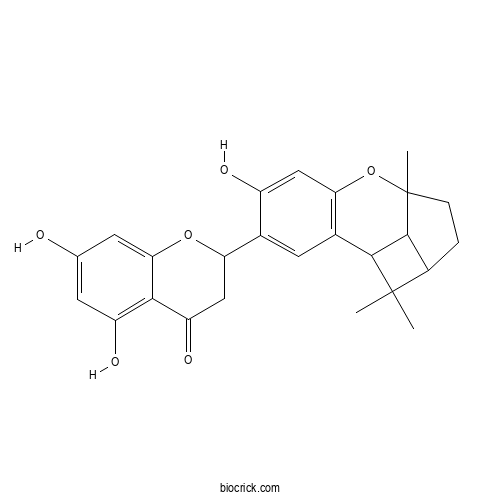
| Cas No. | 67172-84-3 | SDF | File under preparation. |
| PubChem ID | 3081548.0 | Appearance | Powder |
| Formula | C25H26O6 | M.Wt | 422.5 |
| Type of Compound | N/A | Storage | Desiccate at -20°C |
| Solubility | Soluble in Chloroform,Dichloromethane,Ethyl Acetate,DMSO,Acetone,etc. | ||
| Chemical Name | 5,7-dihydroxy-2-(5-hydroxy-9,13,13-trimethyl-8-oxatetracyclo[7.4.1.02,7.012,14]tetradeca-2(7),3,5-trien-4-yl)-2,3-dihydrochromen-4-one | ||
| SMILES | CC1(C2CCC3(C2C1C4=C(O3)C=C(C(=C4)C5CC(=O)C6=C(C=C(C=C6O5)O)O)O)C)C | ||
| Standard InChIKey | IJVOVAHXZFALHZ-UHFFFAOYSA-N | ||
| Standard InChI | InChI=1S/C25H26O6/c1-24(2)14-4-5-25(3)23(14)22(24)13-8-12(15(27)9-19(13)31-25)18-10-17(29)21-16(28)6-11(26)7-20(21)30-18/h6-9,14,18,22-23,26-28H,4-5,10H2,1-3H3 | ||
| General tips | For obtaining a higher solubility , please warm the tube at 37 ℃ and shake it in the ultrasonic bath for a while.Stock solution can be stored below -20℃ for several months. We recommend that you prepare and use the solution on the same day. However, if the test schedule requires, the stock solutions can be prepared in advance, and the stock solution must be sealed and stored below -20℃. In general, the stock solution can be kept for several months. Before use, we recommend that you leave the vial at room temperature for at least an hour before opening it. |
||
| About Packaging | 1. The packaging of the product may be reversed during transportation, cause the high purity compounds to adhere to the neck or cap of the vial.Take the vail out of its packaging and shake gently until the compounds fall to the bottom of the vial. 2. For liquid products, please centrifuge at 500xg to gather the liquid to the bottom of the vial. 3. Try to avoid loss or contamination during the experiment. |
||
| Shipping Condition | Packaging according to customer requirements(5mg, 10mg, 20mg and more). Ship via FedEx, DHL, UPS, EMS or other couriers with RT, or blue ice upon request. | ||
Quality Control & MSDS
3D structure
Package In Stock

Number of papers citing our products


Kuwanon D Dilution Calculator
Kuwanon D Molarity Calculator
| 1 mg | 5 mg | 10 mg | 20 mg | 25 mg | |
| 1 mM | 2.3669 mL | 11.8343 mL | 23.6686 mL | 47.3373 mL | 59.1716 mL |
| 5 mM | 0.4734 mL | 2.3669 mL | 4.7337 mL | 9.4675 mL | 11.8343 mL |
| 10 mM | 0.2367 mL | 1.1834 mL | 2.3669 mL | 4.7337 mL | 5.9172 mL |
| 50 mM | 0.0473 mL | 0.2367 mL | 0.4734 mL | 0.9467 mL | 1.1834 mL |
| 100 mM | 0.0237 mL | 0.1183 mL | 0.2367 mL | 0.4734 mL | 0.5917 mL |
| * Note: If you are in the process of experiment, it's necessary to make the dilution ratios of the samples. The dilution data above is only for reference. Normally, it's can get a better solubility within lower of Concentrations. | |||||
- Spiradine G
Catalog No.:BCX2423
CAS No.:21040-66-4
- Morusalnol B
Catalog No.:BCX2422
CAS No.:1941207-44-8
- Sanggenon I
Catalog No.:BCX2421
CAS No.:86450-79-5
- Kuwanon F
Catalog No.:BCX2420
CAS No.:71344-07-5
- Aesculioside G
Catalog No.:BCX2419
CAS No.:254896-70-3
- Escin Ia methyl ester
Catalog No.:BCX2418
CAS No.:26339-91-3
- Esculetin 6-O-β-D-apiofuranosyl-(1→6)-β-D-glucopyranoside
Catalog No.:BCX2417
CAS No.:163017-13-8
- Didendronbiline A
Catalog No.:BCX2416
CAS No.:2267991-55-7
- 2',4'-Dihydroxychalcone
Catalog No.:BCX2415
CAS No.:25515-43-9
- 5,7-Dimethoxy-4'-hydroxyflavan
Catalog No.:BCX2414
CAS No.:103963-45-7
- 7,4'-Dihydroxyhomoisoflavan
Catalog No.:BCX2413
CAS No.:84638-49-3
- 7,4'-Dihydroxyflavan
Catalog No.:BCX2412
CAS No.:82925-54-0
- Aesculioside F
Catalog No.:BCX2425
CAS No.:254896-69-0
- Artemorin
Catalog No.:BCX2426
CAS No.:64845-92-7
- Aesculioside E
Catalog No.:BCX2427
CAS No.:254896-68-9
- 7-Methoxymukonal
Catalog No.:BCX2428
CAS No.:119736-83-3
- 3-Methylcarbazole
Catalog No.:BCX2429
CAS No.:4630-20-0
- Heptaphylline
Catalog No.:BCX2430
CAS No.:17750-35-5
- Monardic acid A
Catalog No.:BCX2431
CAS No.:1607436-76-9
- Mukonine
Catalog No.:BCX2432
CAS No.:23523-94-6
- Spiramine B
Catalog No.:BCX2433
CAS No.:114485-96-0
- Scutebarbolide A
Catalog No.:BCX2434
CAS No.:2691860-41-8
- Sanggenon G
Catalog No.:BCX2435
CAS No.:85698-31-3
- 7-Hydroxyheptaphylline
Catalog No.:BCX2436
CAS No.:170663-15-7
Molecular targets and mechanisms of cortex mori for lung cancer treatment: a network pharmacology study, molecular docking and in vitro and in vivo experimental validation.[Pubmed:40510163]
Front Oncol. 2025 May 29;15:1587856.
INTRODUCTION: The cortex mori comes from the white endothelium of the young root of Morus alba L., and its medical value was first described in Shen Nong Ben Cao Jing (Classic on Materia Medical of Shennong). It was originally intended to purge lung, relieve asthma and reduce swelling. More and more studies reported that its pharmacological effects include analgesic, anti-inflammatory, antitussive, antiasthmatic, hypoglycemic, hypolipidemic and anti-diabetic peripheral neuropathy. Accumulating clinical evidences exhibited that it can treat asthma, pneumonia and lung cancer. However, a comprehensive mechanism of cortex mori in the treatment of lung cancer needs to be further elucidated.To investigate the effect of cortex mori and its active components against lung cancer and explore its action and mechanism through network pharmacological analysis combined with biological experiments in vitro and In vivo. METHODS: GeneCards database was searched for the disease targets of lung cancer, and a Chinese medicine database, Traditional Chinese Medicine Systems Pharmacology (TCMSP), was used to screen cortex mori for its active components and targets. Targets related to lung cancer and action targets related to cortex mori were crossed. Protein-protein interactions (PPI) and gene ontologies (GO) and Kyoto Encyclopedia of Genes and Genomes (KEGG) were analyzed for intersection genes. In order to determine whether cortex mori affects lung cancer, MTS, wound healing, Western-blot, Hoechst assay, apoptosis assay and animal experiments were performed. RESULTS: 32 active ingredients and 434 targets of Chinese medicine cortex mori were obtained. Totally 2,3107 lung cancer related targets were collected, and 163 Chinese medicine-disease targets were derived from the intersection. The regulatory network of Chinese medicine-active ingredient-disease-targets showed that cortex mori acted on 163 disease targets of lung cancer mainly by cyclomolorusin, Kuwanon D and Moracin A, etc. The core genes involving cortex mori treating lung cancer might consist of JUN, AKT1, etc. The core targets involved 162 biological processes, mainly including nuclear receptor activity, ligand-actived transcription factor activity, etc. The core study targeted 160 pathways, including AGE-RAGE signaling pathways associated with diabetes complications, fluid stress and atherosclerosis. Biologic cytological experiments showed that the effective active component cyclomorusin inhibited proliferation, inhibited migration and induced apoptosis of lung cancer through AKT-PI3K pathway. In vivo antitumor assay demonstrated that cyclomolorusin suppressed the tumor growth in mice. DISCUSSION: Cortex mori acts on AKT and other related disease targets of lung cancer cells through effective components such as cyclomolorusin, and plays a role in the treatment of lung cancer by inhibiting the signaling pathway associated with lung cancer occurrence and development.
Computational assessment of herbal medicine-derived compounds as potential inhibitors of SARS-CoV-2 main protease.[Pubmed:36373329]
J Biomol Struct Dyn. 2023 Nov;41(19):9602-9613.
Since the main protease (Mpro) is crucial for the COVID-19 virus replication and transcription, searching for Mpro inhibitors is one possible treatment option. In our study, 258 small molecules were collected from lung-related herbal medicines, and their structures were optimized with the B3LYP-D3/6-31G* method. After the molecular docking with Mpro, we selected the top 20 compounds for the further geometry optimization with the larger basis sets. After the further molecular docking, the top eight compounds were screened out. Then we performed molecular dynamics simulations and binding free energy calculations to determine stability of the complexes. Our results show that mulberrofuran G, Xambioona, and Kuwanon D can bind Mpro well. In quantum chemistry studies, such as ESP and CDFT analyses, the compounds properties are predicted. Additionally, the drug-likeness analyses and ADME studies on these three candidate compounds verified that all of them conform to Libinski's rule and may be drug-like compounds.

Calcutta University

University of Minnesota

University of Maryland School of Medicine

University of Illinois at Chicago

The Ohio State University

University of Zurich

Harvard University

Colorado State University

Auburn University

Yale University

Worcester Polytechnic Institute

Washington State University

Stanford University

University of Leipzig

Universidade da Beira Interior

The Institute of Cancer Research

Heidelberg University

University of Amsterdam

University of Auckland

TsingHua University

The University of Michigan

Miami University

DRURY University

Jilin University

Fudan University

Wuhan University

Sun Yat-sen University

Universite de Paris

Deemed University

Auckland University

The University of Tokyo

Korea University



