
3-MethylcarbazoleCAS# 4630-20-0 |
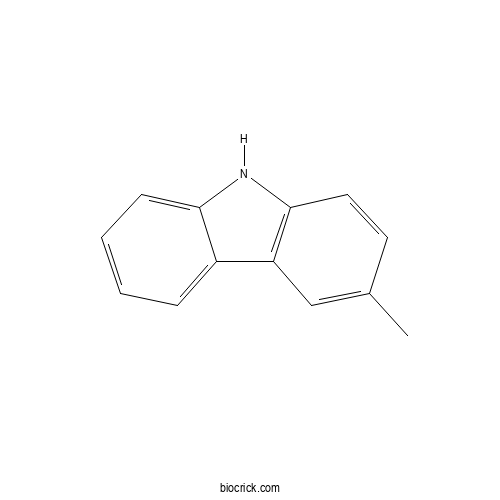
| Cas No. | 4630-20-0 | SDF | File under preparation. |
| PubChem ID | 20746.0 | Appearance | Powder |
| Formula | C13H11N | M.Wt | 181.2 |
| Type of Compound | N/A | Storage | Desiccate at -20°C |
| Solubility | Soluble in Chloroform,Dichloromethane,Ethyl Acetate,DMSO,Acetone,etc. | ||
| Chemical Name | 3-methyl-9H-carbazole | ||
| SMILES | CC1=CC2=C(C=C1)NC3=CC=CC=C32 | ||
| Standard InChIKey | PHKYYUQQYARDIU-UHFFFAOYSA-N | ||
| Standard InChI | InChI=1S/C13H11N/c1-9-6-7-13-11(8-9)10-4-2-3-5-12(10)14-13/h2-8,14H,1H3 | ||
| General tips | For obtaining a higher solubility , please warm the tube at 37 ℃ and shake it in the ultrasonic bath for a while.Stock solution can be stored below -20℃ for several months. We recommend that you prepare and use the solution on the same day. However, if the test schedule requires, the stock solutions can be prepared in advance, and the stock solution must be sealed and stored below -20℃. In general, the stock solution can be kept for several months. Before use, we recommend that you leave the vial at room temperature for at least an hour before opening it. |
||
| About Packaging | 1. The packaging of the product may be reversed during transportation, cause the high purity compounds to adhere to the neck or cap of the vial.Take the vail out of its packaging and shake gently until the compounds fall to the bottom of the vial. 2. For liquid products, please centrifuge at 500xg to gather the liquid to the bottom of the vial. 3. Try to avoid loss or contamination during the experiment. |
||
| Shipping Condition | Packaging according to customer requirements(5mg, 10mg, 20mg and more). Ship via FedEx, DHL, UPS, EMS or other couriers with RT, or blue ice upon request. | ||
Quality Control & MSDS
3D structure
Package In Stock

Number of papers citing our products


3-Methylcarbazole Dilution Calculator
3-Methylcarbazole Molarity Calculator

| 1 mg | 5 mg | 10 mg | 20 mg | 25 mg | |
| 1 mM | 5.5188 mL | 27.5938 mL | 55.1876 mL | 110.3753 mL | 137.9691 mL |
| 5 mM | 1.1038 mL | 5.5188 mL | 11.0375 mL | 22.0751 mL | 27.5938 mL |
| 10 mM | 0.5519 mL | 2.7594 mL | 5.5188 mL | 11.0375 mL | 13.7969 mL |
| 50 mM | 0.1104 mL | 0.5519 mL | 1.1038 mL | 2.2075 mL | 2.7594 mL |
| 100 mM | 0.0552 mL | 0.2759 mL | 0.5519 mL | 1.1038 mL | 1.3797 mL |
| * Note: If you are in the process of experiment, it's necessary to make the dilution ratios of the samples. The dilution data above is only for reference. Normally, it's can get a better solubility within lower of Concentrations. | |||||
- 7-Methoxymukonal
Catalog No.:BCX2428
CAS No.:119736-83-3
- Aesculioside E
Catalog No.:BCX2427
CAS No.:254896-68-9
- Artemorin
Catalog No.:BCX2426
CAS No.:64845-92-7
- Aesculioside F
Catalog No.:BCX2425
CAS No.:254896-69-0
- Kuwanon D
Catalog No.:BCX2424
CAS No.:67172-84-3
- Spiradine G
Catalog No.:BCX2423
CAS No.:21040-66-4
- Morusalnol B
Catalog No.:BCX2422
CAS No.:1941207-44-8
- Sanggenon I
Catalog No.:BCX2421
CAS No.:86450-79-5
- Kuwanon F
Catalog No.:BCX2420
CAS No.:71344-07-5
- Aesculioside G
Catalog No.:BCX2419
CAS No.:254896-70-3
- Escin Ia methyl ester
Catalog No.:BCX2418
CAS No.:26339-91-3
- Esculetin 6-O-β-D-apiofuranosyl-(1→6)-β-D-glucopyranoside
Catalog No.:BCX2417
CAS No.:163017-13-8
- Heptaphylline
Catalog No.:BCX2430
CAS No.:17750-35-5
- Monardic acid A
Catalog No.:BCX2431
CAS No.:1607436-76-9
- Mukonine
Catalog No.:BCX2432
CAS No.:23523-94-6
- Spiramine B
Catalog No.:BCX2433
CAS No.:114485-96-0
- Scutebarbolide A
Catalog No.:BCX2434
CAS No.:2691860-41-8
- Sanggenon G
Catalog No.:BCX2435
CAS No.:85698-31-3
- 7-Hydroxyheptaphylline
Catalog No.:BCX2436
CAS No.:170663-15-7
- Clauszoline K
Catalog No.:BCX2437
CAS No.:187110-71-0
- Clausine K
Catalog No.:BCX2438
CAS No.:182261-96-7
- 2-Phenyl-2-norkhellin
Catalog No.:BCX2439
CAS No.:2549-25-9
- Mukonal
Catalog No.:BCX2440
CAS No.:20323-67-5
- Maltol 3-O-β-D-apiofuranosyl-(1→2)-β-D-glucopyranoside
Catalog No.:BCX2441
CAS No.:1449315-07-4
The radical scavenging activity of glycozolidol in physiological environments: a quantum chemical study.[Pubmed:36425687]
RSC Adv. 2022 Nov 17;12(50):32693-32699.
Glycozolidol was isolated from the root of Glycosmis pentaphylla (6-hydroxy-2-methoxy-3-Methylcarbazole, GLD). This molecule attracted considerable interest due to its beneficial biological activities that likely stem from its antioxidant activity; yet, the radical scavenging action of GLD has not been investigated thus far. In this study, DFT calculations were used to estimate the radical scavenging activity of GLD against a variety of biologically significant radical species in physiological environments. The findings demonstrated that GLD exerts significant antiradical activity in water at pH = 7.40 and in pentyl ethanoate (as a model of lipidic media) with k (overall) = 8.23 x 10(6) and 3.53 x 10(4) M(-1) s(-1), respectively. In aqueous solution, the sequential proton-loss electron transfer mechanism made the highest contribution to the activity, whereas in nonpolar solvents the formal hydrogen transfer mechanism dominated the activity. GLD is predicted to have strong antiradical activity against CH(3)O , CH(3)OO , CCl(3)OO , NO(2), SO(4) (-), DPPH and ABTS(+) k (app) approximately 10(9) M(-1) s(-1) and k (f) approximately 10(6) M(-1) s(-1). The results suggest that GLD is a good radical scavenger in physiological environments.
Phyto-Carbazole Alkaloids from the Rutaceae Family as Potential Protective Agents against Neurodegenerative Diseases.[Pubmed:35326143]
Antioxidants (Basel). 2022 Mar 1;11(3):493.
Plant-derived (phyto) carbazole alkaloids are an important class of compounds, presented in the family of Rutaceae (Genera Murraya, Clausena, Glycosmis, Micromelum and Zanthoxylum). Due to several significant biological activities, such as antitumor, antibacterial, antiviral, antidiabetic, anti-HIV and neuroprotective activities of the parent skeleton (3-Methylcarbazole), carbazole alkaloids are recognized as an important class of potential therapeutic agents. Neurodegenerative diseases (NDs) may exhibit a vast range of conditions, affecting neurons primarily and leading ultimately to the progressive losses of normal motor and cognitive functions. The main pathophysiological indicators of NDs comprise increasing atypical protein folding, oxidative stresses, mitochondrial dysfunctions, deranged neurotransmissions and neuronal losses. Phyto-carbazole alkaloids can be investigated for exerting multitarget approaches to ameliorating NDs. This review presents a comprehensive evaluation of the available scientific literature on the neuroprotective mechanisms of phyto-carbazole alkaloids from the Rutaceae family in ameliorating NDs.
Clausanisumine, a Prenylated Bicarbazole Alkaloid from the Fruits of Clausena anisum-olens and Its Potential Anti-HIV Activity.[Pubmed:34817178]
J Org Chem. 2021 Dec 17;86(24):17722-17726.
A unique prenylated bicarbazole alkaloid, clausanisumine (1), and two biogenetically related known monomer carbazole alkaloids, mukonal (2) and 3-Methylcarbazole (3), were isolated from the fruits of Clausena anisum-olens. Clausanisumine (1) was an uncommon prenylated bicarbazole alkaloid, possessing an unprecedented carbon skeleton, which was composed of a simple carbazole alkaloid and a prenylated carbazole alkaloid. The chemical structure of 1 was established by a combination of comprehensive spectral methods. A plausible biosynthetic pathway of 1 was also proposed. Additionally, the potential anti-HIV activities of all isolates 1-3 in vitro were evaluated. Compound 1 exhibited remarkable anti-HIV-1 reverse transcriptase effects showing an EC(50) value of 18.58 nM. The discovery of the prenylated bicarbazole alkaloid from C. anisum-olens with notable anti-HIV activity would be meaningful to discovering and developing new anti-HIV drugs.
Visualizing the spatial distribution of metabolites in Clausena lansium (Lour.) skeels using matrix-assisted laser desorption/ionization mass spectrometry imaging.[Pubmed:34481177]
Phytochemistry. 2021 Dec;192:112930.
Clausena lansium (Lour.) Skeels (Rutaceae) is a natural bioactive plant. Its roots, stems, leaves, and seeds are widely used in Chinese traditional and folk medicine. Although the characterization and functional analysis of bioactive components in Clausena lansium (Lour.) Skeels has been widely reported, the spatial distribution of these compounds within the main plant tissues remains undefined. Here, we adopted matrix-assisted laser desorption/ionization-mass spectrometry imaging (MALDI-MSI) to reveal the spatial distribution of active alkaloids, coumarins, sugars and organic acids in C. lansium. Using a combined wet and dry matrix covering method to enhance sensitivity, we detected alkaloids throughout the fruit including 3-Methylcarbazole and murrastinine which were especially rich in the kernel tissues but were restricted to the stem xylem and medulla and in the leaf epidermal region. Interestingly, murrayanine and heptaphylline were mainly found in pulp tissues with very low content in the stems and leaves while girinimbine was only distributed within the outer kernel skin. Coumarins were mainly distributed in the fruit pericarp and leaf vein tissues but with no clear spatial specificity in stems. Lastly, hexoses were mainly evident in the fruit pulp, although sucrose was also found in the pericarp, pulp, and pulp fibers with citric acid being distributed throughout the fruit. The accurate spatial and chemical information obtained provides new insights into the specific accumulation of metabolites in individual tissues.
[Chemical constituents from stems and leaves of Clausena emarginata].[Pubmed:31355567]
Zhongguo Zhong Yao Za Zhi. 2019 May;44(10):2096-2101.
The chemical constituents from the stems and leaves of Clausena emarginata were separated and purified by column chromatographies on silica gel,ODS,Sephadex LH-20,and PR-HPLC. The structures of the isolated compounds were identified on the basis of physicochemical properties and spectroscopic analysis,as well as comparisons with the data reported in the literature. Sixteen compounds were isolated from the 90% ethanol extract of the stems and leaves of C. emarginata,which were identified as siamenol( 1),murrastanine A( 2),3-formyl-1,6-dimethoxycarbazole( 3),3-methoxymethylcarbazole( 4),3-Methylcarbazole( 5),murrayafoline A( 6),3-formylcarbazole( 7),3-formyl-1-hydroxycarbazole( 8),3-formyl-6-methoxycarbazole( 9),murrayanine( 10),murrayacine( 11),girinimbine( 12),nordentatin( 13),chalepin( 14),8-hydroxy-6-methoxy-3-pentylisocoumarin( 15) and ethyl orsellinate( 16). Compounds 1-4,14-16 were isolated from C. emarginata for the first time. Among them,compounds 1,2,15 and 16 were isolated from the genus Clausena for the first time. All isolated compounds were evaluated for their cytotoxic activities against five human cancer cell lines: HL-60,SMMC-7721,A-549,MCF-7 and SW480 in vitro. Compounds 12 and 14 showed significant inhibitory effects against various human cancer cell lines with IC_(50) values comparable to those of doxorubicin.
Asymmetric oxidative coupling of hydroxycarbazoles: Facile synthesis of (+)-bi-2-hydroxy-3-methylcarbazole.[Pubmed:29503021]
Bioorg Med Chem Lett. 2018 Sep 1;28(16):2751-2753.
Asymmetric oxidative coupling reactions of hydroxycarbazoles have been established using a chiral dinuclear vanadium complex. To demonstrate the utility of vanadium-catalyzed reactions, we have used them to synthesize (+)-bi-2-hydroxy-3-carbazole in three steps from cyclohexanone and commercially available aniline derivatives.
Synthesis of Carbazole Alkaloids by Ring-Closing Metathesis and Ring Rearrangement-Aromatization.[Pubmed:26768698]
Angew Chem Int Ed Engl. 2015 Dec 21;54(52):15831-5.
Aprocess for the assembly of carbazole alkaloids has been developed on the basis of ring-closing metathesis (RCM) and ringrearrangement-aromatization (RRA) as the key steps. This method is based on allyl Grignard addition to isatin derivatives to provide smooth access to 2,2-diallyl 3-oxindole derivatives through a 1,2-allyl shift. The diallyl derivatives were used as RCM precursors to afford a novel class of spirocyclopentene-3-oxindole derivatives, which underwent a novel RRA reaction to afford carbazole derivatives. The synthetic sequence to carbazoles was shortened by combining the RCM and RRA steps in an orthogonal tandem catalytic process. The utility of this methodology was further demonstrated by the straightforward synthesis of carbazole alkaloids, including amukonal derivative, girinimbilol, heptaphylline, and bis(2-hydroxy-3-Methylcarbazole).
Sensitization of cardiac Ca(2)(+) release sites by protein kinase C signaling: evidence from action of murrayafoline A.[Pubmed:25095987]
Pflugers Arch. 2015 Jul;467(7):1607-1621.
In the present study, we explored the effects of a plant alkaloid compound, 1-methoxy-3-Methylcarbazole (murrayafoline A, Mu-A), on focal and global Ca(2+) signaling, and the underlying cellular mechanisms. Rapid two-dimensional confocal Ca(2+) imaging and image analysis were used to measure Ca(2+) signals in rat ventricular myocytes. Application of Mu-A (10-100 muM) significantly enhanced the magnitude and rate of Ca(2+) release on depolarization with no change in Ca(2+) transient decay. Focal Ca(2+) release events (Ca(2+) sparks) occurred more often, and their duration and size were greater after the application of Mu-A. In addition, sarcoplasmic reticulum (SR) Ca(2+) loading and fractional release were increased by exposure to Mu-A. All these effects reached steady state within 2-3 min after Mu-A application. The higher occurrence of Ca(2+) sparks in the presence of Mu-A was resistant to SR Ca(2+) clamping, removal of extracellular Ca(2+) and Na(+), and blockade of either protein kinase A, Ca(2+)/calmodulin-dependent protein kinase II, phospholipase C, or inositol 1,4,5-trisphosphate receptors, but it was abolished by the inhibition of protein kinase C (PKC). SR Ca(2+) clamping prevented the Mu-A-induced Ca(2+) spark prolongation and enlargement. The Mu-A-induced enhancement of Ca(2+) transients was also eliminated by PKC blockade. Mu-A enhanced PKC activity in vitro. These results suggest that Mu-A may increase spark occurrence via its direct enhancement of PKC activity and subsequent sensitization of ryanodine receptor clusters and that this mechanism, as well as increased SR Ca(2+) loading, may partly explain larger and more rapid global Ca(2+) releases in the presence of Mu-A during depolarization.
Alterations of contractions and L-type Ca2+ currents by murrayafoline-A in rat ventricular myocytes.[Pubmed:25016086]
Eur J Pharmacol. 2014 Oct 5;740:81-7.
We examined the effects of murrayafoline-A (1-methoxy-3-Methylcarbazole, Mu-A), which is isolated from the dried roots of Glycosmis stenocarpa, on cell shortenings and L-type Ca2+ currents (ICa,L) in rat ventricular myocytes. Cell shortenings and ICa,L were measured using the video edge detection method and patch-clamp techniques, respectively. Mu-A transiently increased cell shortenings in a concentration-dependent manner with an EC50 of ~20 muM. The maximal effect of Mu-A, approximately 175% of the control, was observed at >/=100 muM. The positive inotropic effect of Mu-A (25 muM) reached a maximum after ~2-min exposures, and then decayed after a ~1-min steady-state. During the Mu-A-induced positive inotropy, the rate of contraction was accelerated, whereas the rate of relaxation was not significantly altered. To understand the possible mechanism for the Mu-A-induced positive inotropy, the ICa,L was assessed. Mu-A transiently enhanced the ICa,L. Concentration-dependence of the increase in ICa,L by Mu-A was similar to that of positive inotropic effect of Mu-A. The maximal effect of Mu-A (25 muM) on ICa,L was observed at 2-3 min after the application of Mu-A. A partial inhibition of ICa,L using verapamil (1 muM) induced a right shift of concentration-response curve of the positive inotropic effect of Mu-A and significantly attenuated the effect. These results suggest that Mu-A may transiently enhance contractility, at least in part, by increasing the Ca2+ influx through the L-type Ca2+ channels in rat ventricular myocytes.
Efficient construction of pyrano[3,2-a]carbazoles: application to a biomimetic total synthesis of cyclized monoterpenoid pyrano[3,2-a]carbazole alkaloids.[Pubmed:24030919]
Chemistry. 2013 Oct 11;19(42):14098-111.
We have developed a highly efficient route to 2-hydroxy-3-Methylcarbazole (1) via a palladium-catalyzed construction of the carbazole skeleton. Using 1 as relay compound, different methods for annulations of pyran rings by reaction with terpenoid building blocks have been tested. The Lewis acid promoted reaction of 1 with prenal (21) opened up an efficient route to girinimbine (3) and the corresponding reaction with citral (25) afforded mahanimbine (5). Oxidation of compounds 3 and 5 provided murrayacine (4) and murrayacinine (6). Following the biogenetic proposal, mahanimbine (5) has been exploited for efficient biomimetic syntheses of the cyclized monoterpenoid pyrano[3,2-a]carbazole alkaloids cyclomahanimbine (7), mahanimbidine (8) and bicyclomahanimbine (9). The interconversions of 5, 7, 8 and 9 are described and mechanistic implications are discussed. Structural assignments are unambiguously verified by X-ray crystal structure determinations. Moreover, cyclomahanimbine (7) was transformed into murrayazolinine (10) and exozoline (11).
Isolation and characterization of Pseudomonas sp. STM 997 from soil sample having potentiality to degrade 3,6-dimethyl-1-keto-1,2,3,4-tetrahydrocarbazole: a novel approach.[Pubmed:22987067]
Appl Biochem Biotechnol. 2012 Dec;168(7):1765-77.
A pure colony of a bacterium from contaminated soil was isolated by exploiting 3,6-dimethyl-1-keto-1,2,3,4-tetrahydrocarbazole, a novel carbazole derivative, having indole moiety as well as 3-methyl functionality both in aromatic and hydro-aromatic moiety, as a sole source of carbon and energy. Taxonomical studies, biochemical analysis, and 16S rDNA sequence analysis indicated that the isolated strain has close similarity with Pseudomonas sp. Thin-layer chromatography followed by HPLC and mass spectroscopic study indicates that the isolated Pseudomonas sp. STM 997 degrades 3,6-dimethyl-1-keto-1,2,3,4-tetrahydrocarbazole, and this strain may be useful in the bioremediation of environments contaminated by the compounds containing carbazole moiety with methyl substituents at various reactive sites. This study also provides an evidence in favor of the suggested biodegradation of 3-Methylcarbazole to carbazole in plants.
Anti-tuberculosis constituents from the stem bark of Micromelum hirsutum.[Pubmed:15770548]
Planta Med. 2005 Mar;71(3):261-7.
Anti-TB bioassay-directed fractionation led to the isolation of six carbazole alkaloids, as well as the gamma-lactone derivative of oleic acid, from the CH (2)Cl (2) extract of the stem bark of Micromelum hirsutum. The carbazoles include the new micromeline ( 2) and five known alkaloids: lansine ( 3), 3-Methylcarbazole ( 4), methyl carbazole-3-carboxylate ( 5), 3-formylcarbazole ( 6), and 3-formyl-6-methoxycarbazole ( 7). Compound 1 was identified as the lactone derivative of oleic acid, (-)- Z-9-octadecene-4-olide, for which the trivial name micromolide ( 1) is suggested. It showed potent in vitro anti-TB activity against H37R v (MIC: 1.5 microg/mL), a selectivity index (SI) of 63, and exhibited activity against the Erdman strain of M. tuberculosis in a J774 mouse macrophage model (EC (90) : 5.6 microg/mL). Thus, 1 appears worthy of further evaluation as a potential new anti-TB agent. Isolates 2, 3, 6 and 7 had anti-TB MIC values between 14.3 and 42.3 microg/mL, while compounds 4 and 5 were considered inactive (MIC > 128 microg/mL). Structure elucidation and identification were based on spectroscopic analysis, including MS, 1D/2D NMR, and a full (1)H spin system analysis of 1.
Carbazole alkaloids as new cell cycle inhibitor and apoptosis inducers from Clausena dunniana Levl.[Pubmed:12450250]
J Asian Nat Prod Res. 2002 Dec;4(4):233-41.
Carbazole alkaloids, 3-Methylcarbazole (1), murrayafoline A (2), girinimbine (3), mahanimbine (4) and bicyclomahanimbine (5), were isolated for the first time from Clausena dunniana Levl. by bioassay-guided separation procedure and were identified by spectroscopic methods. Compounds 1-5 showed growth inhibitory activity (1, IC50 25 microg/ml) on human fibrosarcoma HT-1080 cells and cell cycle M-phase inhibitory (2, MIC 0.78 microg/ml) and apoptosis inducing (2, MIC 1.56 microg/ml; 3, MIC 25 microg/ml; 4, MIC 20 microg/ml; 5, MIC 30 microg/ml) activities on mouse tsFT210 cells, respectively, and 2-5 provided the first examples of carbazole alkaloids as new cell cycle inhibitors and apoptosis inducers.
Biarylic biscarbazole alkaloids: occurrence, stereochemistry, synthesis, and bioactivity.[Pubmed:12001210]
Chem Rec. 2002;2(2):113-26.
The structurally and pharmacologically intriguing but stereochemically initially disregarded small class of biarylic biscarbazole alkaloids is presented, starting with an introduction of the different structural patterns found in nature. For the construction of the biaryl bond, mainly biomimetic oxidative coupling reactions were used, as shown for the natural products bismurrayaquinone-A, bis-2-hydroxy-3-Methylcarbazole, clausenamine-A, and murrastifoline-F. For most of these compounds, a resolution of the respective atropo-enantiomers succeeded either directly, by high-performance liquid chromatography by HPLC on a chiral phase, or via atropo-diastereomers, after derivatization with a chiral auxiliary. The absolute configurations of the pure enantiomers were assigned by comparison of experimental (CD) spectra with those quantum chemi-cally calculated, or, for atropo-diastereomeric derivatives, by means of ROESY investigations and X-ray crystallography. Ullmann-type coupling conditions were also found to be feasible for the construction of the 2,2'-biscarbazole core, necessitating a completely regioselective 2-bromination protocol. The first atroposelective synthesis of such a basic target structure was achieved by application of the "lactone methodology," giving rise to an atropisomeric ratio of 85 : 15. Some of the biscarbazole alkaloids and their derivatives were found to have interesting bioactivities, and for the first time, the natural atropo-enantiomeric ratio in the plants was determined for one of these compounds, murrastifoline-F.
Stress induced carbazole phytoalexins in Glycosmis species.[Pubmed:11524122]
Phytochemistry. 2001 Sep;58(1):129-35.
Induced formation of a series of carbazole alkaloids was observed in leaves of Glycosmis parviflora and G. pentaphylla after wounding, UV-irradiation, and particularly after inoculation with the fungus Botrytis cinerea. Chemical variation between different provenances and even individuals of G. parviflora led to an accumulation of different derivatives from which three proved to be undescribed natural products. Their structures were identified by spectroscopic methods and named carbalexins A, B, and C. Bioautographic tests on TLC plates with Cladosporium herbarum exhibited strong antifungal activity for the new carbalexins as well as for the already known 2-hydroxy-3-Methylcarbazole, but only weak effects for the pyranocarbazole glycoborinine. Detailed experiments with marked infection areas confirmed the restricted accumulation of carbazole derivatives which could not be detected in non-infected areas of the same leaf. Apart from carbazoles, in some individuals of G. parviflora an additional accumulation of the pyranoquinolones flindersine and methylflindersine was induced, which supports the already previously discussed biogenetic connections between carbazoles and prenylated quinolones.

Calcutta University

University of Minnesota

University of Maryland School of Medicine

University of Illinois at Chicago

The Ohio State University

University of Zurich

Harvard University

Colorado State University

Auburn University

Yale University

Worcester Polytechnic Institute

Washington State University

Stanford University

University of Leipzig

Universidade da Beira Interior

The Institute of Cancer Research

Heidelberg University

University of Amsterdam

University of Auckland

TsingHua University

The University of Michigan

Miami University

DRURY University

Jilin University

Fudan University

Wuhan University

Sun Yat-sen University

Universite de Paris

Deemed University

Auckland University

The University of Tokyo

Korea University



