
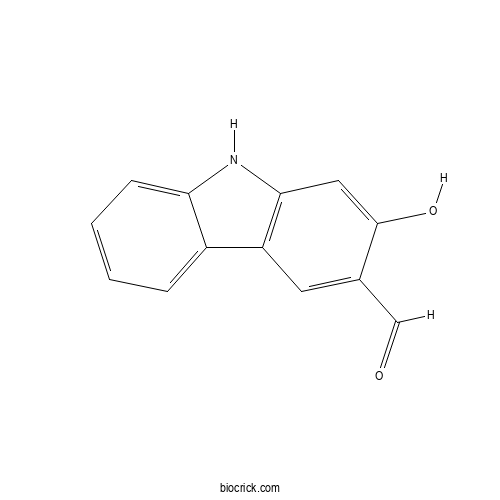
MukonalCAS# 20323-67-5 |
| Cas No. | 20323-67-5 | SDF | File under preparation. |
| PubChem ID | 504068.0 | Appearance | Yellow powder |
| Formula | C13H9NO2 | M.Wt | 211.2 |
| Type of Compound | N/A | Storage | Desiccate at -20°C |
| Solubility | Soluble in Chloroform,Dichloromethane,Ethyl Acetate,DMSO,Acetone,etc. | ||
| Chemical Name | 2-hydroxy-9H-carbazole-3-carbaldehyde | ||
| SMILES | C1=CC=C2C(=C1)C3=C(N2)C=C(C(=C3)C=O)O | ||
| Standard InChIKey | NEAHWGSQUXSRNW-UHFFFAOYSA-N | ||
| Standard InChI | InChI=1S/C13H9NO2/c15-7-8-5-10-9-3-1-2-4-11(9)14-12(10)6-13(8)16/h1-7,14,16H | ||
| General tips | For obtaining a higher solubility , please warm the tube at 37 ℃ and shake it in the ultrasonic bath for a while.Stock solution can be stored below -20℃ for several months. We recommend that you prepare and use the solution on the same day. However, if the test schedule requires, the stock solutions can be prepared in advance, and the stock solution must be sealed and stored below -20℃. In general, the stock solution can be kept for several months. Before use, we recommend that you leave the vial at room temperature for at least an hour before opening it. |
||
| About Packaging | 1. The packaging of the product may be reversed during transportation, cause the high purity compounds to adhere to the neck or cap of the vial.Take the vail out of its packaging and shake gently until the compounds fall to the bottom of the vial. 2. For liquid products, please centrifuge at 500xg to gather the liquid to the bottom of the vial. 3. Try to avoid loss or contamination during the experiment. |
||
| Shipping Condition | Packaging according to customer requirements(5mg, 10mg, 20mg and more). Ship via FedEx, DHL, UPS, EMS or other couriers with RT, or blue ice upon request. | ||
Quality Control & MSDS
3D structure
Package In Stock

Number of papers citing our products


Mukonal Dilution Calculator
Mukonal Molarity Calculator

| 1 mg | 5 mg | 10 mg | 20 mg | 25 mg | |
| 1 mM | 4.7348 mL | 23.6742 mL | 47.3485 mL | 94.697 mL | 118.3712 mL |
| 5 mM | 0.947 mL | 4.7348 mL | 9.4697 mL | 18.9394 mL | 23.6742 mL |
| 10 mM | 0.4735 mL | 2.3674 mL | 4.7348 mL | 9.4697 mL | 11.8371 mL |
| 50 mM | 0.0947 mL | 0.4735 mL | 0.947 mL | 1.8939 mL | 2.3674 mL |
| 100 mM | 0.0473 mL | 0.2367 mL | 0.4735 mL | 0.947 mL | 1.1837 mL |
| * Note: If you are in the process of experiment, it's necessary to make the dilution ratios of the samples. The dilution data above is only for reference. Normally, it's can get a better solubility within lower of Concentrations. | |||||
- 2-Phenyl-2-norkhellin
Catalog No.:BCX2439
CAS No.:2549-25-9
- Clausine K
Catalog No.:BCX2438
CAS No.:182261-96-7
- Clauszoline K
Catalog No.:BCX2437
CAS No.:187110-71-0
- 7-Hydroxyheptaphylline
Catalog No.:BCX2436
CAS No.:170663-15-7
- Sanggenon G
Catalog No.:BCX2435
CAS No.:85698-31-3
- Scutebarbolide A
Catalog No.:BCX2434
CAS No.:2691860-41-8
- Spiramine B
Catalog No.:BCX2433
CAS No.:114485-96-0
- Mukonine
Catalog No.:BCX2432
CAS No.:23523-94-6
- Monardic acid A
Catalog No.:BCX2431
CAS No.:1607436-76-9
- Heptaphylline
Catalog No.:BCX2430
CAS No.:17750-35-5
- 3-Methylcarbazole
Catalog No.:BCX2429
CAS No.:4630-20-0
- 7-Methoxymukonal
Catalog No.:BCX2428
CAS No.:119736-83-3
- Maltol 3-O-β-D-apiofuranosyl-(1→2)-β-D-glucopyranoside
Catalog No.:BCX2441
CAS No.:1449315-07-4
- Embigenin
Catalog No.:BCX2442
CAS No.:21089-34-9
- Velutone A
Catalog No.:BCX2443
CAS No.:2716080-96-3
- 12-Hydroxy-2,6,10-trimethyldodeca-2,6,10-trienoic acid
Catalog No.:BCX2444
CAS No.:156415-81-5
- 3,6-Dimethoxy-8,8-dimethyl-2-phenyl-4H,8H-pyrano[2,3-f]chromen-4-one
Catalog No.:BCX2445
CAS No.:61755-75-7
- 3'-Deoxyhispolon
Catalog No.:BCX2446
CAS No.:117930-30-0
- (10E,12Z)-9-Oxooctadeca-10,12-dienoic acid
Catalog No.:BCX2447
CAS No.:54232-59-6
- Spiredine
Catalog No.:BCX2448
CAS No.:60062-45-5
- Spiradine D
Catalog No.:BCX2449
CAS No.:20071-93-6
- Rabdoternin E
Catalog No.:BCX2450
CAS No.:155969-82-7
- β-Hydroxy-2',4',5'-trimethoxychalcone
Catalog No.:BCX2451
CAS No.:861074-67-1
- Galanginin
Catalog No.:BCX2452
CAS No.:68592-14-3
Integrated density functional theory, molecular docking, and pharmacokinetic modeling of mukonal and its derivatives as inhibitors of the Plasmodium falciparum TFIIH complex (Tfb5 subunit).[Pubmed:42322572]
Cell Mol Biol (Noisy-le-grand). 2026 Mar 31;72(3):54-62.
Plasmodium falciparum is the most dangerous malaria parasite affecting humans. Compounds such as Mukonal, 7-hydroxyMukonal, and 7-methoxyMukonal have shown potential for the treatment of this disease. Density Functional Theory (DFT), molecular docking, and pharmacokinetic analyses are valuable computational approaches for predicting potential drug candidates against P. falciparum. In this study, three compounds Mukonal, 7-hydroxyMukonal, and 7-methoxyMukonal were optimized and evaluated through molecular docking and pharmacokinetic analysis against the target protein PF3D7_1441900 (transcription factor TFIIH complex subunit Tfb5, putative) from P. falciparum isolate 3D7. Frontier molecular orbital and density of states analyses revealed that 7-methoxyMukonal has a relatively smaller energy gap compared with the other two compounds. In addition, 7-methoxyMukonal exhibited the strongest binding affinity toward the target protein. The ADME results indicated favorable drug-like properties and low toxicity, further supporting the therapeutic potential of these compounds. Overall, our theoretical findings suggest that compound 3, namely 7-methoxyMukonal, is the most promising candidate against the selected protein, in agreement with the other computed parameters.
Investigating the potential of monocyclic B(9)N(9) and C(18) rings for the electrochemical sensing, and adsorption of carbazole-based anti-cancer drug derivatives: DFT-based first-principle study.[Pubmed:38960925]
J Mol Model. 2024 Jul 3;30(8):245.
CONTEXT: For the first time, the use of monocyclic rings C(18) and B(9)N(9) as sensors for the sensing of carbazole-based anti-cancer drugs, such as tetrahydrocarbazole (THC), Mukonal (MKN), murrayanine (MRY), and ellipticine (EPT), is described using DFT simulations and computational characterization. The geometries, electronic properties, stability studies, sensitivity, and adsorption capabilities of C(18) and B(9)N(9) counterparts towards the selected compounds confirm that the analytes interact through active cavities of the C(18) and B(9)N(9) rings of the complexes. METHODS: Based on the interaction energies, the sensitivity of surfaces towards EPT, MKN, MRY, and THC analytes is observed. The interaction energy of EPT@B(9)N(9), MKN@B(9)N(9), MRY@B(9)N(9,) and THC@B(9)N(9) complexes are observed - 20.40, - 19.49, - 20.07, and - 18.27 kcal/mol respectively which is more exothermic than EPT@C(18), MKN@C(18), MRY@C(18), and THC@C(18) complexes are - 16.37, - 13.97, - 13.96, and - 11.39 kcal/mol respectively. According to findings from the quantum theory of atoms in molecules (QTAIM) and the reduced density gradient (RDG), dispersion forces play a significant role in maintaining the stability of these complexes. The electronic properties including FMOs, density of states (DOS), natural bond orbitals (NBO), charge transfer, and absorption studies are carried out. In comparison of B(9)N(9) and C(18), the analyte recovery time for C(18) is much shorter (9.91 x 10(-11) for THC@C(18)) than that for B(9)N(9) shorter recovery time value of 3.75 x 10(-9) for EPT@B(9)N(9). These results suggest that our reported sensors B(9)N(9) and C(18) make it faster to detect adsorbed molecules at room temperature. The sensor response is more prominent in B(9)N(9) due to its fine energy gap and high adsorption energy. Consequently, it is possible to think of these monocyclic systems as a potential material for sensor applications.
Retracted: Anticancer Activity of Mukonal Against Human Laryngeal Cancer Cells Involves Apoptosis, Cell Cycle Arrest, and Inhibition of PI3K/AKT and MEK/ERK Signalling Pathways.[Pubmed:35850997]
Med Sci Monit. 2022 Jul 19;28:e937840.
An editorial decision has been made to retract this manuscript due to breach of publishing guidelines, following the identification of non-original and manipulated figures. Reference: Liu Li, Lu Huizhi, Wang Binu, Deng Xinxin, Wu Longjun, Yang Liping, Zhang Yingying. Anticancer Activity of Mukonal Against Human Laryngeal Cancer Cells Involves Apoptosis, Cell Cycle Arrest, and Inhibition of PI3K/AKT and MEK/ERK Signalling Pathways. Med Sci Monit, 2018; 24: 7295-7302. DOI: 10.12659/MSM.910702.
Clausanisumine, a Prenylated Bicarbazole Alkaloid from the Fruits of Clausena anisum-olens and Its Potential Anti-HIV Activity.[Pubmed:34817178]
J Org Chem. 2021 Dec 17;86(24):17722-17726.
A unique prenylated bicarbazole alkaloid, clausanisumine (1), and two biogenetically related known monomer carbazole alkaloids, Mukonal (2) and 3-methylcarbazole (3), were isolated from the fruits of Clausena anisum-olens. Clausanisumine (1) was an uncommon prenylated bicarbazole alkaloid, possessing an unprecedented carbon skeleton, which was composed of a simple carbazole alkaloid and a prenylated carbazole alkaloid. The chemical structure of 1 was established by a combination of comprehensive spectral methods. A plausible biosynthetic pathway of 1 was also proposed. Additionally, the potential anti-HIV activities of all isolates 1-3 in vitro were evaluated. Compound 1 exhibited remarkable anti-HIV-1 reverse transcriptase effects showing an EC(50) value of 18.58 nM. The discovery of the prenylated bicarbazole alkaloid from C. anisum-olens with notable anti-HIV activity would be meaningful to discovering and developing new anti-HIV drugs.
Retracted: Mukonal Inhibits Cell Proliferation, Alters Mitochondrial Membrane Potential and Induces Apoptosis and Autophagy in Human CNE1 Nasopharyngeal Carcinoma Cells.[Pubmed:33762561]
Med Sci Monit. 2021 Mar 25;27:e932337.
Retracted, due to breach of publishing guidelines, following the identification of non-original content. Reference: Mukonal Inhibits Cell Proliferation, Alters Mitochondrial Membrane Potential and Induces Apoptosis and Autophagy in Human CNE1 Nasopharyngeal Carcinoma Cells Yingyuan Guo, Yanru Hao, Guofang Guan, Shuaishuai Ma, Zhiling Zhu, Fang Guo, Jie Bai Med Sci Monit 2019; 25:1976-1983 10.12659/MSM.913915.
Mukonal exerts anticancer effects on the human breast cancer cells by inducing autophagy and apoptosis and inhibits the tumor growth in vivo.[Pubmed:32809085]
AMB Express. 2020 Aug 18;10(1):148.
Mukonal is an active member of carbazole alkaloids isolated from Murraya koenigii. It has been shown to possess remarkable biological and pharmacological activities including anticancer activity. Therefore, the aim of current investigation was to explore anti-breast cancer activity of Mukonal and to explore the underlying mechanism. Results indicate that Mukonal has potential to induce antiproliferative effects against MDA-MB-231 and SK-BR-3 cells with an IC(50) of 7.5 microM. No significant toxicity of Mukonal was observed in case of normal breast cells. The antiproliferative effects of Mukonal were found to proceed via apoptosis, which was further supported by increased cleavage of PARP and caspase-3 and reduced expression of Bcl-2. Mukonal induced autophagic cells death in breast cancer cells as was evidenced by formation of autophagosomes and enhanced expressions of Beclin-1, LC3B-I and LC3B-II proteins. In vivo examination of anti-breast cancer property of Mukonal indicated that it could potentially reduce tumor weight and volume in xenografted mice models. In conclusion, Mukonal has a remarkable potential of inhibiting breast cancer via induction of apoptosis and autophagy. Mukonal also inhibited xenografted tumors models in a dose-dependent manner. Therefore, Mukonal may prove lead molecule in breast cancer drug discovery and treatment provided further investigations are recommended.
Mukonal Inhibits Cell Proliferation, Alters Mitochondrial Membrane Potential and Induces Apoptosis and Autophagy in Human CNE1 Nasopharyngeal Carcinoma Cells.[Pubmed:30877718]
Med Sci Monit. 2019 Mar 16;25:1976-1983.
BACKGROUND Nasopharyngeal carcinoma results in high patient morbidity and mortality, due to early metastasis, and toxicity due to chemotherapy. Mukonal is plant-derived carbazole alkaloid that has been used in traditional Chinese medicine to treat several types of cancer. This study aimed to investigate the effects of Mukonal on cell proliferation, apoptosis, autophagy, and the mitochondrial membrane potential of nasopharyngeal carcinoma cells in vitro. MATERIAL AND METHODS CNE1 human nasopharyngeal carcinoma cells and NP69 normal nasopharyngeal epithelial cells were cultured with and without treatment with increasing doses of Mukonal. Cell viability was determined by the MTT assay. Fluorescence microscopy was used to detect reactive oxygen species (ROS), mitochondrial membrane potential, and the release of cytochrome C. Flow cytometry was used to examine changes in the cell cycle, electron microscopy examined cell autophagy, and Western blot was performed to measure levels of proteins associated with autophagy and apoptosis. RESULTS Mukonal had an antiproliferative effect on CNE1 cells, with an IC(5)(0) of 9 microM and there were effects of toxicity on normal NP69 cells. Mukonal triggered ROS-mediated changes in mitochondrial membrane potential which was also accompanied by the discharge of cytochrome C in the CNE1 cells. Mukonal activated autophagy and apoptosis in CNE1 cells, which was also associated with upregulation of the autophagy-related proteins, LC3 II and beclin-1, as well as apoptosis-associated proteins, Bax, cleaved caspase-3 and -9. Mukonal treatment also resulted in CNE1 cells cycle arrest at G(2)/M. CONCLUSIONS Mukonal inhibited the growth of human CNE1 nasopharyngeal carcinoma cells in vitro.
Anticancer Activity of Mukonal Against Human Laryngeal Cancer Cells Involves Apoptosis, Cell Cycle Arrest, and Inhibition of PI3K/AKT and MEK/ERK Signalling Pathways.[Pubmed:30312287]
Med Sci Monit. 2018 Oct 12;24:7295-7302.
BACKGROUND Laryngeal cancer is one of the major malignancies of the neck and head and is responsible for considerable mortality across the globe. The treatments for laryngeal cancer mainly involve surgical interventions followed by chemotherapy. However, due to unsatisfactory results, constant relapses and the adverse effects associated with the currently used drugs, there is pressing need to develop effective drug options for treatment of laryngeal cancer. Therefore, this study was undertaken to investigate the anticancer effects of a plant-derived alkaloid, Mukonal, against human AMC-HN-8 laryngeal cancer cells. MATERIAL AND METHODS The WST-1 and clonogenic assays were employed to determine the cell viability. Apoptosis was detected by Hoechst and AO/EB staining. Cell migration and cell cycle analysis was performed by Transwell assay and flow cytometry, respectively. Protein expression was examined by Western blotting. RESULTS The results revealed that Mukonal reduced the viability of laryngeal cancer cells dose-dependently. The IC50 of Mukonal was found to be 10 microM. However, the effects of Mukonal on the normal HuLa-PC cells was found to be 140 microM. The decrease in the viability of the AMC-HN-8 laryngeal cancer cells was found to be due to the induction of apoptosis and G2/M cell cycle arrest. Mukonal also suppressed the cell migration and of the AMC-HN-8 laryngeal cancer cells. Mukonal could also inhibit the PI3K/AKT and MEK/ERK signalling pathways in a concentration-dependent manner. CONCLUSIONS Taken together, we conclude that Mukonal could prove a beneficial lead molecule for the treatment of laryngeal cancer.
Axially chiral biscarbazoles and biological evaluation of the constituents from Murraya koenigii.[Pubmed:24444889]
Fitoterapia. 2014 Apr;94:10-20.
Chemical investigation of the fruit pulp of Murraya koenigii resulted in the identification of two new dimeric carbazole alkaloids, bisgerayafoline D (1) and bismahanimbinol (2) along with four known alkaloids, bispyrayafoline (3), O-methyl mahanine (4), O-methyl Mukonal (5), and mahanine (6). Structures of 1-6 were determined with the aid of UV, IR, Mass and extensive NMR spectroscopic studies. Absolute configurations of biaryls in 1 and 2 were assigned using a combination of computational Circular Dichroism (CD) and experimental electronic CD spectroscopic data. Compounds 1-6 were evaluated for anti-oxidant, anti-alpha-glucosidase, DNA binding, protein interactions and cytotoxic activities. Among all the isolates, mahanine (6) was found to exhibit significant radical scavenging and alpha-glucosidase inhibitory activities. Compound 6 was also found to be active in cytotoxicity assay against three human cancer cell lines HeLa, HCT116, AGS and this compound was weakly active against normal mouse embryonic fibroblasts (NIH3T3).
An efficient Au-catalyzed synthesis of isomukonidine, clausine L, mukonidine, glycosinine, mukonal, and clausine V from propadienyl methyl ether.[Pubmed:23358535]
Org Biomol Chem. 2013 Feb 13;11(10):1666-71.
Naturally occurring carbazole alkaloids such as isomukonidine, clausine L, mukonidine, glycosinine, Mukonal, and clausine V have been synthesized through a gold-catalyzed cyclization reaction of 1-(indol-2-yl)-2-methoxy-2,3-allenols, which are readily available from indolecarbaldehydes and methoxypropadiene. Compared to the reported procedures, our approach is general, atom economic, highly selective, and the starting materials are easily available.
Coumarins and carbazoles from Clausena excavata exhibited antimycobacterial and antifungal activities.[Pubmed:12624822]
Planta Med. 2003 Feb;69(2):155-7.
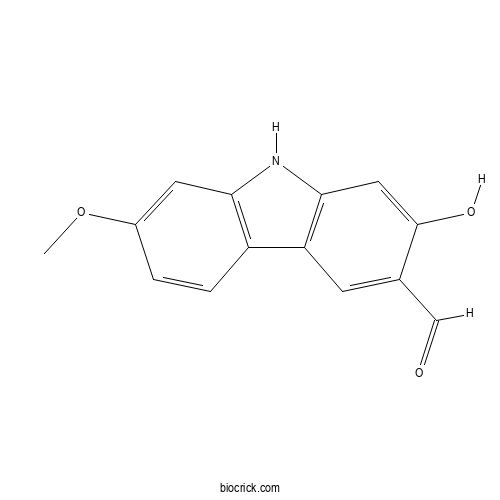
Four known coumarins, dentatin (1), nor-dentatin (2), clausenidin (3) and xanthoxyletin (5), and six known carbazole derivatives, 3-formylcarbazole (6), Mukonal (7), 3-methoxycarbonylcarbazole (8), murrayanine (9), 2-hydroxy-3-formyl-7-methoxycarbazole (10) and clauszoline J (11) were isolated from Clausena excavata. Compounds 1 and 6 were first isolated from the crude chloroform extract of the rhizomes. Compounds 1, 2, 3, 6, 7, 8, 10 and 11 showed antimycobacterial activity at a minimum inhibitory concentration (MIC) of 50, 100, 200, 100, 200, 50, 100 and 100 microg/mL, respectively. O-Methylated clausenidin ( 4), prepared from 3, exhibited antimycobacterial activity at MIC 50 microg/mL. Compounds 6, 7, 8 and 10 showed antifungal activity with IC 50 values of 13.6, 29.3, 9.5 and 2.8 microg/mL, respectively. All compounds demonstrated no cytotoxicity against KB and BC-1 cell lines.
Substituted 7H-pyrido[4,3-c]carbazoles with potent anti-HIV activity.[Pubmed:10021911]
Bioorg Med Chem Lett. 1999 Jan 18;9(2):119-22.
Several substituted 7H-pyrido[4,3-c]carbazoles were synthesized from the natural product Mukonal and tested for inhibition of HIV replication in H9 lymphocytes. 5-Methoxy-7-methyl-7H-pyrido[4,3-c]carbazole (7) had an EC50 value of 0.0054 microgram/mL and the highest therapeutic index (TI = 503) in the series.

Calcutta University

University of Minnesota

University of Maryland School of Medicine

University of Illinois at Chicago

The Ohio State University

University of Zurich

Harvard University

Colorado State University

Auburn University

Yale University

Worcester Polytechnic Institute

Washington State University

Stanford University

University of Leipzig

Universidade da Beira Interior

The Institute of Cancer Research

Heidelberg University

University of Amsterdam

University of Auckland

TsingHua University

The University of Michigan

Miami University

DRURY University

Jilin University

Fudan University

Wuhan University

Sun Yat-sen University

Universite de Paris

Deemed University

Auckland University

The University of Tokyo

Korea University



