
Sanggenon GCAS# 85698-31-3 |
| Cas No. | 85698-31-3 | SDF | File under preparation. |
| PubChem ID | 42608053.0 | Appearance | Powder |
| Formula | C40H38O11 | M.Wt | 694.7 |
| Type of Compound | N/A | Storage | Desiccate at -20°C |
| Solubility | Soluble in Chloroform,Dichloromethane,Ethyl Acetate,DMSO,Acetone,etc. | ||
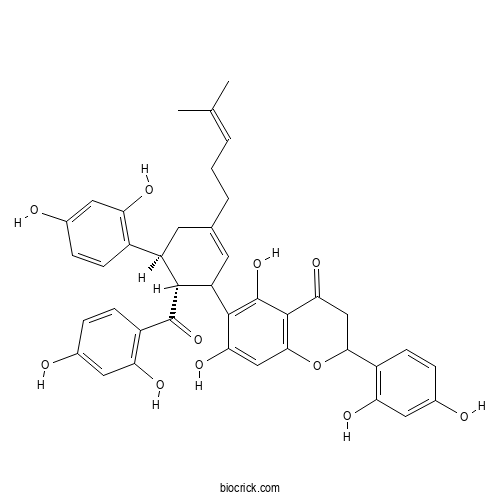
| Chemical Name | 6-[(5S,6R)-6-(2,4-dihydroxybenzoyl)-5-(2,4-dihydroxyphenyl)-3-(4-methylpent-3-enyl)cyclohex-2-en-1-yl]-2-(2,4-dihydroxyphenyl)-5,7-dihydroxy-2,3-dihydrochromen-4-one | ||
| SMILES | CC(=CCCC1=CC(C(C(C1)C2=C(C=C(C=C2)O)O)C(=O)C3=C(C=C(C=C3)O)O)C4=C(C5=C(C=C4O)OC(CC5=O)C6=C(C=C(C=C6)O)O)O)C | ||
| Standard InChIKey | VYCKCQBOVSSJSK-CFQOWUBYSA-N | ||
| Standard InChI | InChI=1S/C40H38O11/c1-19(2)4-3-5-20-12-27(24-9-6-21(41)14-29(24)44)36(39(49)26-11-8-23(43)16-31(26)46)28(13-20)37-32(47)18-35-38(40(37)50)33(48)17-34(51-35)25-10-7-22(42)15-30(25)45/h4,6-11,13-16,18,27-28,34,36,41-47,50H,3,5,12,17H2,1-2H3/t27-,28?,34?,36-/m1/s1 | ||
| General tips | For obtaining a higher solubility , please warm the tube at 37 ℃ and shake it in the ultrasonic bath for a while.Stock solution can be stored below -20℃ for several months. We recommend that you prepare and use the solution on the same day. However, if the test schedule requires, the stock solutions can be prepared in advance, and the stock solution must be sealed and stored below -20℃. In general, the stock solution can be kept for several months. Before use, we recommend that you leave the vial at room temperature for at least an hour before opening it. |
||
| About Packaging | 1. The packaging of the product may be reversed during transportation, cause the high purity compounds to adhere to the neck or cap of the vial.Take the vail out of its packaging and shake gently until the compounds fall to the bottom of the vial. 2. For liquid products, please centrifuge at 500xg to gather the liquid to the bottom of the vial. 3. Try to avoid loss or contamination during the experiment. |
||
| Shipping Condition | Packaging according to customer requirements(5mg, 10mg, 20mg and more). Ship via FedEx, DHL, UPS, EMS or other couriers with RT, or blue ice upon request. | ||
Quality Control & MSDS
3D structure
Package In Stock

Number of papers citing our products


Sanggenon G Dilution Calculator
Sanggenon G Molarity Calculator

| 1 mg | 5 mg | 10 mg | 20 mg | 25 mg | |
| 1 mM | 1.4395 mL | 7.1974 mL | 14.3947 mL | 28.7894 mL | 35.9868 mL |
| 5 mM | 0.2879 mL | 1.4395 mL | 2.8789 mL | 5.7579 mL | 7.1974 mL |
| 10 mM | 0.1439 mL | 0.7197 mL | 1.4395 mL | 2.8789 mL | 3.5987 mL |
| 50 mM | 0.0288 mL | 0.1439 mL | 0.2879 mL | 0.5758 mL | 0.7197 mL |
| 100 mM | 0.0144 mL | 0.072 mL | 0.1439 mL | 0.2879 mL | 0.3599 mL |
| * Note: If you are in the process of experiment, it's necessary to make the dilution ratios of the samples. The dilution data above is only for reference. Normally, it's can get a better solubility within lower of Concentrations. | |||||
- Scutebarbolide A
Catalog No.:BCX2434
CAS No.:2691860-41-8
- Spiramine B
Catalog No.:BCX2433
CAS No.:114485-96-0
- Mukonine
Catalog No.:BCX2432
CAS No.:23523-94-6
- Monardic acid A
Catalog No.:BCX2431
CAS No.:1607436-76-9
- Heptaphylline
Catalog No.:BCX2430
CAS No.:17750-35-5
- 3-Methylcarbazole
Catalog No.:BCX2429
CAS No.:4630-20-0
- 7-Methoxymukonal
Catalog No.:BCX2428
CAS No.:119736-83-3
- Aesculioside E
Catalog No.:BCX2427
CAS No.:254896-68-9
- Artemorin
Catalog No.:BCX2426
CAS No.:64845-92-7
- Aesculioside F
Catalog No.:BCX2425
CAS No.:254896-69-0
- Kuwanon D
Catalog No.:BCX2424
CAS No.:67172-84-3
- Spiradine G
Catalog No.:BCX2423
CAS No.:21040-66-4
- 7-Hydroxyheptaphylline
Catalog No.:BCX2436
CAS No.:170663-15-7
- Clauszoline K
Catalog No.:BCX2437
CAS No.:187110-71-0
- Clausine K
Catalog No.:BCX2438
CAS No.:182261-96-7
- 2-Phenyl-2-norkhellin
Catalog No.:BCX2439
CAS No.:2549-25-9
- Mukonal
Catalog No.:BCX2440
CAS No.:20323-67-5
- Maltol 3-O-β-D-apiofuranosyl-(1→2)-β-D-glucopyranoside
Catalog No.:BCX2441
CAS No.:1449315-07-4
- Embigenin
Catalog No.:BCX2442
CAS No.:21089-34-9
- Velutone A
Catalog No.:BCX2443
CAS No.:2716080-96-3
- 12-Hydroxy-2,6,10-trimethyldodeca-2,6,10-trienoic acid
Catalog No.:BCX2444
CAS No.:156415-81-5
- 3,6-Dimethoxy-8,8-dimethyl-2-phenyl-4H,8H-pyrano[2,3-f]chromen-4-one
Catalog No.:BCX2445
CAS No.:61755-75-7
- 3'-Deoxyhispolon
Catalog No.:BCX2446
CAS No.:117930-30-0
- (10E,12Z)-9-Oxooctadeca-10,12-dienoic acid
Catalog No.:BCX2447
CAS No.:54232-59-6
Ribosomal protein L5 mediated inhibition of c-Myc is critically involved in sanggenon G induced apoptosis in non-small lung cancer cells.[Pubmed:32935429]
Phytother Res. 2021 Feb;35(2):1080-1088.
Though Sanggenon G (SanG) from root bark of Morus alba was known to exhibit anti-oxidant and anti-depressant effects, its underlying mechanisms still remain unclear. Herein SanG reduced the viability of A549 and H1299 non-small lung cancer cells (NSCLCs). Also, SanG increased sub-G1 population via inhibition of cyclin D1, cyclin E, CDK2, CDK4 and Bcl-2, cleavages of poly (ADP-ribose) polymerase (PARP) and caspase-3 in A549 and H1299 cells. Of note, SanG effectively inhibited c-Myc expression by activating ribosomal protein L5 (RPL5) and reducing c-Myc stability even in the presence of cycloheximide and 20% serum in A549 cells. Furthermore, SanG enhanced the apoptotic effect with doxorubicin in A549 cells. Taken together, our results for the first time provide novel evidence that SanG suppresses proliferation and induces apoptosis via caspase-3 activation and RPL5 mediated inhibition of c-Myc with combinational potential with doxorubicin.
Discovery of prenylated flavonoids with dual activity against influenza virus and Streptococcus pneumoniae.[Pubmed:27257160]
Sci Rep. 2016 Jun 3;6:27156.
Influenza virus neuraminidase (NA) is the primary target for influenza therapeutics. Severe complications are often related to secondary pneumonia caused by Streptococcus pneumoniae (pneumococci), which also express NAs. Recently, a NA-mediated lethal synergism between influenza A viruses and pneumococci was described. Therefore, dual inhibitors of both viral and bacterial NAs are expected to be advantageous for the treatment of influenza. We investigated the traditional Chinese herbal drug sang bai pi (mulberry root bark) as source for anti-infectives. Two prenylated flavonoid derivatives, Sanggenon G (4) and sanggenol A (5) inhibited influenza A viral and pneumococcal NAs and, in contrast to the approved NA inhibitor oseltamivir, also planktonic growth and biofilm formation of pneumococci. Evaluation of 27 congeners of 5 revealed a correlation between the degree of prenylation and bioactivity. Abyssinone-V 4'-methyl ether (27) inhibited pneumococcal NA with IC50 = 2.18 muM, pneumococcal growth with MIC = 5.63 muM, and biofilm formation with MBIC = 4.21 muM, without harming lung epithelial cells. Compounds 5 and 27 also disrupt the synergism between influenza A virus and pneumococcal NA in vitro, hence functioning as dual-acting anti-infectives. The results warrant further studies on whether the observed disruption of this synergism is transferable to in vivo systems.
Enhanced anti-immobility effects of Sanggenon G isolated from the root bark of Morus alba combined with the alpha2-antagonist yohimbine in the rat forced swim test.[Pubmed:26899239]
J Nat Med. 2016 Jul;70(3):679-82.
In this study, we aimed to determine whether Sanggenon G, an active compound isolated from the root bark of Morus alba, exhibited enhanced anti-immobility activity with the addition of the alpha2-antagonist yohimbine in rats subjected to forced swim test (FST)-induced depression. Fluoxetine (a selective serotonin reuptake inhibitor) treatment in rats reduced the immobility time, and pretreatment with yohimbine significantly enhanced the antidepressant-like behavior of fluoxetine at 5, 10 and 20 mg/kg. Similarly, Sanggenon G significantly decreased the immobility time, reducing immobility by a maximum of 43.9 % when treated at a dose of 20 mg/kg. Furthermore, pretreatment with yohimbine significantly enhanced the antidepressant-like behavior of Sanggenon G at 5 and 10 mg/kg. Our findings suggest that the antidepressant-like effect of Sanggenon G could be facilitated by concomitant use of the alpha2-antagonist. Further studies are needed to evaluate the potential of Sanggenon G as an alternative therapeutic approach for the treatment of depression.
Antidepressant-Like Effects of Sanggenon G, Isolated from the Root Bark of Morus alba, in Rats: Involvement of the Serotonergic System.[Pubmed:26289125]
Biol Pharm Bull. 2015;38(11):1772-8.
The root bark of Morus alba is commonly used as an alternative medicine due to its numerous health benefits in humans. However, the antidepressant effects of various active components from M. alba have not been fully elucidated. In this study, we aimed to determine whether Sanggenon G, an active compound isolated from the root bark of M. alba, exhibited antidepressant-like activity in rats subjected to forced swim test (FST)-induced depression. Acute treatment of rats with Sanggenon G (30 mg/kg, intraperitoneally (i.p.)) significantly reduced immobility time and increased swimming time without any significant change in climbing. Rats treated with Sanggenon G also exhibited a decrease in the limbic hypothalamic-pituitary-adrenal (HPA) axis response to the FST, as indicated by attenuation of the corticosterone response and decreased c-Fos immunoreactivity in the hypothalamic paraventricular nucleus (PVN). In addition, the antidepressant-like effects of Sanggenon G were significantly inhibited by WAY100635 (1 mg/kg, i.p.; a selective 5-hydroxytryptamine1A (5-HT1A) receptor antagonist), but not SCH23390 (0.05 mg/kg, i.p.; a dopamine D1 receptor antagonist). Our findings suggested that the antidepressant-like effects of Sanggenon G were mediated by an interaction with the serotonergic system. Further studies are needed to evaluate the potential of Sanggenon G as an alternative therapeutic approach for the treatment of depression.
Isoprenylated flavonoids from the root bark of Morus alba and their hepatoprotective and neuroprotective activities.[Pubmed:25981820]
Arch Pharm Res. 2015 Nov;38(11):2066-75.
A new isoprenylated flavonoid, 2S-5,7,2',4'-tetrahydroxy-3',5'-di-(gamma,gamma-dimethylallyl)flavanone, sanggenol Q (1), along with seven known isoprenylated flavonoids, sanggenol A (2), sanggenol L (3), kuwanon T (4), cyclomorusin (5), sanggenon F (6), sanggenol O (7), and sanggenon N (8), three known Diels-Alder type adducts, Sanggenon G (9), mulberrofuran G (10), and mulberrofuran C (11), and a known benzofuran, moracin E (12), were isolated from the root bark of Morus alba using silica gel, ODS, and Sephadex LH-20 column chromatography. Chemical structures were determined based on spectroscopic data analyses including NMR, MS, CD, and IR. For the first time, compounds 1 and 7 were isolated from the root bark of M. alba. All compounds were evaluated for hepatoprotective activity on t-BHP-induced oxidative stress in HepG2 cells and neuroprotective activity on glutamate-induced cell death in HT22 cells. Compounds 1, 4, 8, 10, and 11 showed protective effects on t-BHP-induced oxidative stress with EC50 values of 6.94 +/- 0.38, 30.32 +/- 6.82, 23.45 +/- 4.72, 15.31 +/- 2.21, and 0.41 +/- 0.48 muM, respectively, and compounds 1, 2, 10, 11, and 12 showed protective effects on glutamate-induced cell death with EC50 values of 5.54 +/- 0.86, 34.03 +/- 7.71, 19.71 +/- 0.71, 16.50 +/- 7.82, and 1.02 +/- 0.13 muM, respectively.
Discovery of Sanggenon G as a natural cell-permeable small-molecular weight inhibitor of X-linked inhibitor of apoptosis protein (XIAP).[Pubmed:25161875]
FEBS Open Bio. 2014 Jul 5;4:659-71.
Defects in the regulation of apoptosis are one main cause of cancer development and may result from overexpression of anti-apoptotic proteins such as the X-linked inhibitor of apoptosis protein (XIAP). XIAP is frequently overexpressed in human leukemia and prostate and breast tumors. Inhibition of apoptosis by XIAP is mainly coordinated through direct binding to the initiator caspase-9 via its baculovirus-IAP-repeat-3 (BIR3) domain. XIAP inhibits caspases directly making it to an attractive target for anti-cancer therapy. In the search for novel, non-peptidic XIAP inhibitors in this study we focused on the chemical constituents of sang bai pi (mulberry root bark). Most promising candidates of this plant were tested biochemically in vitro by a fluorescence polarization (FP) assay and in vivo via protein fragment complementation analysis (PCA). We identified the Diels Alder adduct Sanggenon G (SG1) as a novel, small-molecular weight inhibitor of XIAP. As shown by FP and PCA analyses, SG1 binds specifically to the BIR3 domain of XIAP with a binding affinity of 34.26 muM. Treatment of the transgenic leukemia cell line Molt3/XIAP with SG1 enhances caspase-8, -3 and -9 cleavage, displaces caspase-9 from XIAP as determined by immunoprecipitation experiments and sensitizes these cells to etoposide-induced apoptosis. SG1 not only sensitizes the XIAP-overexpressing leukemia cell line Molt3/XIAP to etoposide treatment but also different neuroblastoma cell lines endogenously expressing high XIAP levels. Taken together, Sanggenon G (SG1) is a novel, natural, non-peptidic, small-molecular inhibitor of XIAP that can serve as a starting point to develop a new class of improved XIAP inhibitors.
HPLC-based activity profiling--discovery of sanggenons as GABAA receptor modulators in the traditional Chinese drug Sang bai pi (Morus alba root bark).[Pubmed:22294264]
Planta Med. 2012 Mar;78(5):440-7.
EtOAc extracts from two batches of Morus alba root bark (Sang bai pi) potentiated gamma-aminobutyric acid (GABA)-induced chloride influx in Xenopus oocytes, which transiently expressed GABA (A) receptors of the subunit composition alpha(1)beta(2)gamma(2S). With the aid of HPLC-based activity profiling of the extract from the first batch, activity was traced to a peak subsequently identified as Sanggenon G (3). The second batch had a different phytochemical profile, and HPLC-based activity profiling led to the identification of sanggenon C (4) and a stereoisomer of sanggenon D (2) as positive GABA (A) receptor modulators. The structurally related compound kuwanon L (1) was inactive. The sanggenons represent a new scaffold of positive GABA (A) receptor modulators.
Protein tyrosine phosphatase 1B inhibitors from Morus root bark.[Pubmed:16356713]
Bioorg Med Chem Lett. 2006 Mar 1;16(5):1426-9.
An organic layer prepared from the Chinese crude drug 'Sang-Bai-Pi' (Morus root bark) was studied in order to identify the inhibitory compounds for protein tyrosine phosphatase 1B (PTP1B). Bioassay-guided fractionation resulted in the isolation of sanggenon C (1), Sanggenon G (2), mulberrofuran C (3) and kuwanon L (4) as PTP1B inhibitors, along with moracin O (5) and moracin P (6). Compounds 1-4 inhibited PTP1B with IC(50) values ranging from 1.6+/-0.3 microM to 16.9+/-1.1 microM.

Calcutta University

University of Minnesota

University of Maryland School of Medicine

University of Illinois at Chicago

The Ohio State University

University of Zurich

Harvard University

Colorado State University

Auburn University

Yale University

Worcester Polytechnic Institute

Washington State University

Stanford University

University of Leipzig

Universidade da Beira Interior

The Institute of Cancer Research

Heidelberg University

University of Amsterdam

University of Auckland

TsingHua University

The University of Michigan

Miami University

DRURY University

Jilin University

Fudan University

Wuhan University

Sun Yat-sen University

Universite de Paris

Deemed University

Auckland University

The University of Tokyo

Korea University



