
ArtemorinCAS# 64845-92-7 |
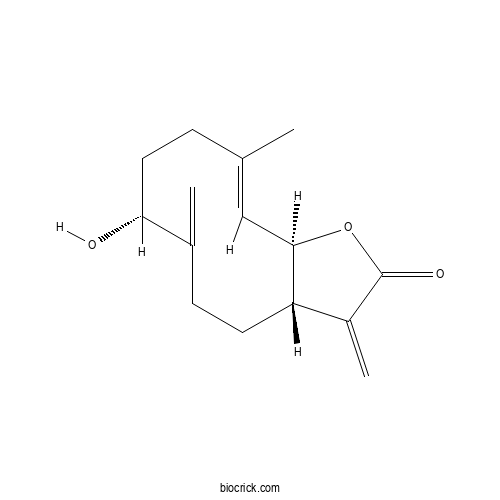
| Cas No. | 64845-92-7 | SDF | File under preparation. |
| PubChem ID | 5281428.0 | Appearance | Powder |
| Formula | C15H20O3 | M.Wt | 248.3 |
| Type of Compound | N/A | Storage | Desiccate at -20°C |
| Solubility | Soluble in Chloroform,Dichloromethane,Ethyl Acetate,DMSO,Acetone,etc. | ||
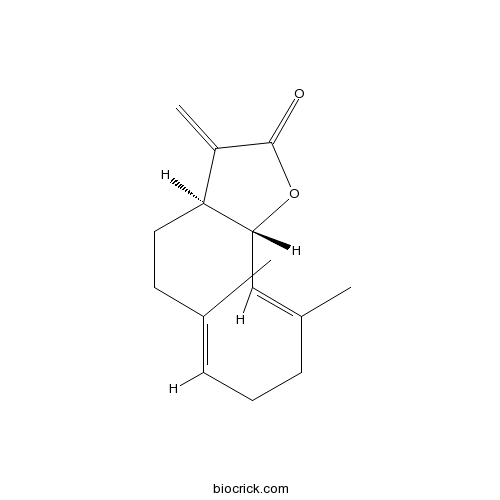
| Chemical Name | (3aS,7R,10E,11aR)-7-hydroxy-10-methyl-3,6-dimethylidene-4,5,7,8,9,11a-hexahydro-3aH-cyclodeca[b]furan-2-one | ||
| SMILES | CC1=CC2C(CCC(=C)C(CC1)O)C(=C)C(=O)O2 | ||
| Standard InChIKey | JNHKVMWTQCZYHK-CVZWCJCVSA-N | ||
| Standard InChI | InChI=1S/C15H20O3/c1-9-4-7-13(16)10(2)5-6-12-11(3)15(17)18-14(12)8-9/h8,12-14,16H,2-7H2,1H3/b9-8+/t12-,13+,14+/m0/s1 | ||
| General tips | For obtaining a higher solubility , please warm the tube at 37 ℃ and shake it in the ultrasonic bath for a while.Stock solution can be stored below -20℃ for several months. We recommend that you prepare and use the solution on the same day. However, if the test schedule requires, the stock solutions can be prepared in advance, and the stock solution must be sealed and stored below -20℃. In general, the stock solution can be kept for several months. Before use, we recommend that you leave the vial at room temperature for at least an hour before opening it. |
||
| About Packaging | 1. The packaging of the product may be reversed during transportation, cause the high purity compounds to adhere to the neck or cap of the vial.Take the vail out of its packaging and shake gently until the compounds fall to the bottom of the vial. 2. For liquid products, please centrifuge at 500xg to gather the liquid to the bottom of the vial. 3. Try to avoid loss or contamination during the experiment. |
||
| Shipping Condition | Packaging according to customer requirements(5mg, 10mg, 20mg and more). Ship via FedEx, DHL, UPS, EMS or other couriers with RT, or blue ice upon request. | ||
Quality Control & MSDS
3D structure
Package In Stock

Number of papers citing our products


Artemorin Dilution Calculator
Artemorin Molarity Calculator
| 1 mg | 5 mg | 10 mg | 20 mg | 25 mg | |
| 1 mM | 4.0274 mL | 20.1369 mL | 40.2739 mL | 80.5477 mL | 100.6847 mL |
| 5 mM | 0.8055 mL | 4.0274 mL | 8.0548 mL | 16.1095 mL | 20.1369 mL |
| 10 mM | 0.4027 mL | 2.0137 mL | 4.0274 mL | 8.0548 mL | 10.0685 mL |
| 50 mM | 0.0805 mL | 0.4027 mL | 0.8055 mL | 1.611 mL | 2.0137 mL |
| 100 mM | 0.0403 mL | 0.2014 mL | 0.4027 mL | 0.8055 mL | 1.0068 mL |
| * Note: If you are in the process of experiment, it's necessary to make the dilution ratios of the samples. The dilution data above is only for reference. Normally, it's can get a better solubility within lower of Concentrations. | |||||
- Aesculioside F
Catalog No.:BCX2425
CAS No.:254896-69-0
- Kuwanon D
Catalog No.:BCX2424
CAS No.:67172-84-3
- Spiradine G
Catalog No.:BCX2423
CAS No.:21040-66-4
- Morusalnol B
Catalog No.:BCX2422
CAS No.:1941207-44-8
- Sanggenon I
Catalog No.:BCX2421
CAS No.:86450-79-5
- Kuwanon F
Catalog No.:BCX2420
CAS No.:71344-07-5
- Aesculioside G
Catalog No.:BCX2419
CAS No.:254896-70-3
- Escin Ia methyl ester
Catalog No.:BCX2418
CAS No.:26339-91-3
- Esculetin 6-O-β-D-apiofuranosyl-(1→6)-β-D-glucopyranoside
Catalog No.:BCX2417
CAS No.:163017-13-8
- Didendronbiline A
Catalog No.:BCX2416
CAS No.:2267991-55-7
- 2',4'-Dihydroxychalcone
Catalog No.:BCX2415
CAS No.:25515-43-9
- 5,7-Dimethoxy-4'-hydroxyflavan
Catalog No.:BCX2414
CAS No.:103963-45-7
- Aesculioside E
Catalog No.:BCX2427
CAS No.:254896-68-9
- 7-Methoxymukonal
Catalog No.:BCX2428
CAS No.:119736-83-3
- 3-Methylcarbazole
Catalog No.:BCX2429
CAS No.:4630-20-0
- Heptaphylline
Catalog No.:BCX2430
CAS No.:17750-35-5
- Monardic acid A
Catalog No.:BCX2431
CAS No.:1607436-76-9
- Mukonine
Catalog No.:BCX2432
CAS No.:23523-94-6
- Spiramine B
Catalog No.:BCX2433
CAS No.:114485-96-0
- Scutebarbolide A
Catalog No.:BCX2434
CAS No.:2691860-41-8
- Sanggenon G
Catalog No.:BCX2435
CAS No.:85698-31-3
- 7-Hydroxyheptaphylline
Catalog No.:BCX2436
CAS No.:170663-15-7
- Clauszoline K
Catalog No.:BCX2437
CAS No.:187110-71-0
- Clausine K
Catalog No.:BCX2438
CAS No.:182261-96-7
Secondary Metabolites and Their Biological Evaluation from the Aerial Parts of Staehelina uniflosculosa Sibth. & Sm. (Asteraceae).[Pubmed:39408914]
Int J Mol Sci. 2024 Oct 1;25(19):10586.
Phytochemical investigation of Staehelina uniflosculosa Sibth. & Sm. resulted in the isolation of twenty-two natural products: eleven sesquiterpene lactones, Artemorin (1), tamirin (2), tanachin (3), reynosin (4), baynol C (5), desacetyl-beta-cyclopyrethrosin (6), 1beta-hydroxy-4alpha-methoxy-5alpha,7alpha,6beta-eudesm-11(13)-en-6,12-olide (7), 1beta,4alpha,6alpha-trihydroxyeudesm-11-en-8alpha,12-olide (8), 1beta-hydroxy-arbusculin A (9), methyl-1beta,4alpha,6alpha-trihydroxy-5alpha,7alphaH-eudesm-11(13)-en-12-oate (10) and methyl-1beta,6alpha,8alpha-trihydroxy-5alpha,7alphaH-eudesma-4(15),11(13)-dien-12-oate (11); one lignan, pinoresinol (12); one norisoprenoid, loliolide (13); six flavonoids (four genins and two glycosides), hispidulin (14), nepetin (15), jaceosidin (16), eriodictyol (17), eriodictyol-3'-O-beta-D-glucoside (18) and eriodictyol-7-O-beta-D-glucuronide (19); and three phenolic derivatives (one phenolic acid and two phenolic glucosides), protocatechuic acid (20), arbutin (21) and nebrodenside A (22). From the isolated compounds, only nepetin (15) has been reported previously from the Staehelina genus and, to the best of our knowledge, it is the first time that compound (18) has been identified in Asteraceae. A number of these substances were tested for (a) inhibition of lipoxygenase and acetylocholinesterase, (b) their antioxidant activity using the DPPH (1,1-Diphenyl-2-picrylhydrazyl) method or/and (c) inhibition of lipid peroxidation. The tested components exhibited low antioxidant activity with the exception of 5 and 22, while the effectiveness of these compounds in the inhibition of acetylocholinesterase is limited. Furthermore, Molinspiration, an online computer tool, was used to determine the bioactivity ratings of the isolated secondary metabolites. The compounds' bioactivity ratings for potential therapeutic targets were very promising.
Studies on the sesquiterpene lactones from Laurus novocanariensis lead to the clarification of the structures of 1-epi-tatridin B and its epimer tatridin B.[Pubmed:29864627]
Phytochemistry. 2018 Sep;153:48-52.
The germacranolide 1-epi-tatridin B has been isolated from the aerial parts of Laurus novocanariensis. We have observed that the identification of this lactone and its epimer tetradin B in the scientific literature is confusing and contradictory. We have therefore studied this issue clarifying errors and contributing to the structural elucidation of other related products. Moreover, we have isolated from this plant a lactone with an 1,5-ether bridge, previously obtained from Austrolabium candidum. We have now named it austroliolide, reassigned its (13)C NMR spectrum and compared its structure with that of badgerin. In addition, we have also isolated from L. novocanariensis the known germacranolides Artemorin, costunolide, tatridin A, tulirinol and verlotorin, the eudesmanolides beta-cyclopyrethrosin, 1beta-hydroxy-arbusculin A, magnoliaolide and reynosin, and the guaianolide dehydrocostus lactone.
Extraction, fractionation and re-fractionation of Artemisia nilagirica for anticancer activity and HPLC-ESI-QTOF-MS/MS determination.[Pubmed:29109061]
J Ethnopharmacol. 2018 Mar 1;213:72-80.
ETHNOPHARMACOLOGICAL RELEVANCE: Medicinal plants used in traditional medicines are affordable, easily accessible, safer, less toxic and considered as a rich or efficient source of bioactive molecules for modern therapeutics. Artemisia nilagirica (AR) has a long history of use in Indian traditional medicine to combat a wide variety of diseases including cancer. AIM OF THE STUDY: Considering the vast potential of traditional healing plants to deliver safer, less toxic and efficient chemotherapeutics, we have examined anticancer activity of ethanolic extract, bioactive fractions and sub-fractions of AR against different human cancer cell lines along with their phytochemical analysis to understand the insights of novel anticancer activities for further preclinical studies. MATERIALS AND METHODS: Fresh plant material of AR was procured from the wild, dried and ground. The grinded materials was extracted in ethanol (AR-01) and fractionated into butanol (AR-02), ethyl acetate (AR-03), hexane (AR-04) and water (AR-05). The cytotoxicity was evaluated against three different human cancer cell lines, i.e. colon (DLD-1), lung (A-549), and breast (MCF-7) using Sulforhodamine B (SRB) assay along with non-cancerous VERO cells as control and doxorubicin (DOX) as positive control. As we observed strong cytotoxicity of AR-03 and AR-04 fractions against tested cells and marked cytotoxic effects particularly in colon cancer cell lines, we further re-fractionated, AR-03 into (AR-03A, AR-03B, AR-03C, AR-03D, AR-03E) and AR-04 into (AR-04A, AR-04B, AR-04C) sub-fractions by column chromatography and investigated against the same panel of cell lines in addition to one more colon cancer cell line (HT-29). Phytochemical analysis was performed through HPLC-ESI-QTOF-MS/MS fragmentation. RESULTS: Ethyl acetate (AR-03) and hexane (AR-04) fractions were found to be the most cytotoxic against all the tested cell lines. Further, AR-03E and AR-04A sub-fractions were found more specific cytotoxic selectively against DLD-1 cancer cell lines at 100microg/ml concentration. HPLC-ESI-QTOF-MS/MS determination revealed the presence of 17 compounds in AR-01. Among them, 4 compounds were reported for the first time in this species. However, 3 identified compounds (Artemorin, beta-santonin and caryophyllene oxide) in AR-03E sub-fraction were commonly present in each bioactive fraction and may be considered as potential and safest cytotoxic agents for anticancer activity. CONCLUSIONS: Experimental evidences reported in this paper for anticancer activity validate the traditional wisdom of Artemisia nilagirica as an anticancer herbal drug. To our knowledge, this is our first novel observation of cytotoxicity and selectivity of ethyl acetate and hexane sub-fraction of AR-01 i.e. AR-03E and AR-04A respectively against DLD-1 human cancer cell lines. HPLC-ESI-QTOF-MS/MS determination attributes the identification of cytotoxic compounds which may be used for further preclinical studies.
New sesquiterpene acid and inositol derivatives from Inula montana L.[Pubmed:28579553]
Fitoterapia. 2017 Jul;120:79-84.
A phytochemical investigation of the ethanol extract of leaves and flowers of Inula montana L. led to the isolation of one new sesquiterpene acid called Eldarin (1) and four new inositol derivatives, Myoinositol,1,5-diangelate-4,6-diacetate (2), Myoinositol,1,6-diangelate-4,5-diacetate (3), Myoinositol-1-angelate-4,5-diacetate-6-(2-methylbutirate) (4), Myoinositol-1-angelate-4,5-diacetate-6-isovalerate (5) isolated for the first time, along with eleven known compounds described for the first time in Inula montana, 1beta-Hydroxyarbusculin A (6), Artemorin (7), Santamarin (8), Chrysosplenol C (9), 6-Hydroxykaempferol 3,7-dimethyl ether (10), Reynosin (11), Calenduladiol-3-palmitate (12), Costunolide (13), 4-Hydroxy-3,5-dimethoxybenzenemethanol (14), 9beta-Hydroxycostunolide (15) and Hispidulin (16). Structural elucidation has been carried out by spectral methods, such as 1D and 2D NMR, IR, UV and HR-ESI-MS. These compounds have been tested in vitro for anti-inflammatory and cytotoxic activity on macrophages RAW 264.7. As a result, compounds 2, 3, 7, 13, 14, 15 and 16 showed a release of NO with IC(50) value <30muM on macrophages.

Calcutta University

University of Minnesota

University of Maryland School of Medicine

University of Illinois at Chicago

The Ohio State University

University of Zurich

Harvard University

Colorado State University

Auburn University

Yale University

Worcester Polytechnic Institute

Washington State University

Stanford University

University of Leipzig

Universidade da Beira Interior

The Institute of Cancer Research

Heidelberg University

University of Amsterdam

University of Auckland

TsingHua University

The University of Michigan

Miami University

DRURY University

Jilin University

Fudan University

Wuhan University

Sun Yat-sen University

Universite de Paris

Deemed University

Auckland University

The University of Tokyo

Korea University



