
Clauszoline KCAS# 187110-71-0 |
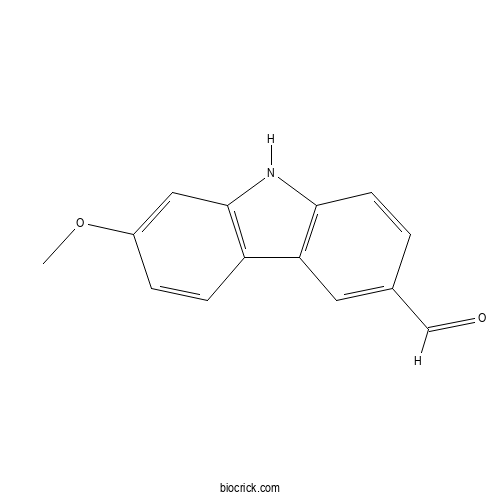
| Cas No. | 187110-71-0 | SDF | File under preparation. |
| PubChem ID | 10537169.0 | Appearance | Powder |
| Formula | C14H11NO2 | M.Wt | 225.2 |
| Type of Compound | N/A | Storage | Desiccate at -20°C |
| Solubility | Soluble in Chloroform,Dichloromethane,Ethyl Acetate,DMSO,Acetone,etc. | ||
| Chemical Name | 7-methoxy-9H-carbazole-3-carbaldehyde | ||
| SMILES | COC1=CC2=C(C=C1)C3=C(N2)C=CC(=C3)C=O | ||
| Standard InChIKey | IBDBRUPJUXYODT-UHFFFAOYSA-N | ||
| Standard InChI | InChI=1S/C14H11NO2/c1-17-10-3-4-11-12-6-9(8-16)2-5-13(12)15-14(11)7-10/h2-8,15H,1H3 | ||
| General tips | For obtaining a higher solubility , please warm the tube at 37 ℃ and shake it in the ultrasonic bath for a while.Stock solution can be stored below -20℃ for several months. We recommend that you prepare and use the solution on the same day. However, if the test schedule requires, the stock solutions can be prepared in advance, and the stock solution must be sealed and stored below -20℃. In general, the stock solution can be kept for several months. Before use, we recommend that you leave the vial at room temperature for at least an hour before opening it. |
||
| About Packaging | 1. The packaging of the product may be reversed during transportation, cause the high purity compounds to adhere to the neck or cap of the vial.Take the vail out of its packaging and shake gently until the compounds fall to the bottom of the vial. 2. For liquid products, please centrifuge at 500xg to gather the liquid to the bottom of the vial. 3. Try to avoid loss or contamination during the experiment. |
||
| Shipping Condition | Packaging according to customer requirements(5mg, 10mg, 20mg and more). Ship via FedEx, DHL, UPS, EMS or other couriers with RT, or blue ice upon request. | ||
Quality Control & MSDS
3D structure
Package In Stock

Number of papers citing our products


Clauszoline K Dilution Calculator
Clauszoline K Molarity Calculator
| 1 mg | 5 mg | 10 mg | 20 mg | 25 mg | |
| 1 mM | 4.4405 mL | 22.2025 mL | 44.405 mL | 88.8099 mL | 111.0124 mL |
| 5 mM | 0.8881 mL | 4.4405 mL | 8.881 mL | 17.762 mL | 22.2025 mL |
| 10 mM | 0.444 mL | 2.2202 mL | 4.4405 mL | 8.881 mL | 11.1012 mL |
| 50 mM | 0.0888 mL | 0.444 mL | 0.8881 mL | 1.7762 mL | 2.2202 mL |
| 100 mM | 0.0444 mL | 0.222 mL | 0.444 mL | 0.8881 mL | 1.1101 mL |
| * Note: If you are in the process of experiment, it's necessary to make the dilution ratios of the samples. The dilution data above is only for reference. Normally, it's can get a better solubility within lower of Concentrations. | |||||
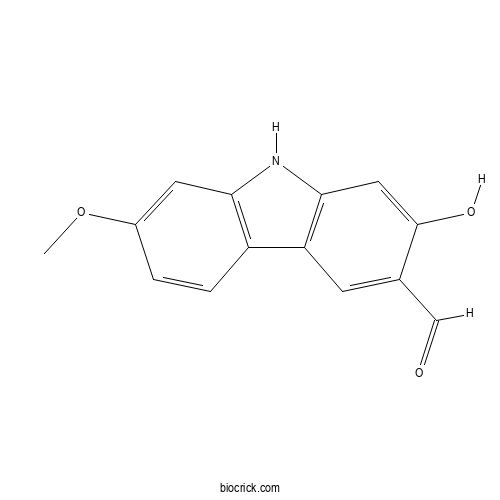
- 7-Hydroxyheptaphylline
Catalog No.:BCX2436
CAS No.:170663-15-7
- Sanggenon G
Catalog No.:BCX2435
CAS No.:85698-31-3
- Scutebarbolide A
Catalog No.:BCX2434
CAS No.:2691860-41-8
- Spiramine B
Catalog No.:BCX2433
CAS No.:114485-96-0
- Mukonine
Catalog No.:BCX2432
CAS No.:23523-94-6
- Monardic acid A
Catalog No.:BCX2431
CAS No.:1607436-76-9
- Heptaphylline
Catalog No.:BCX2430
CAS No.:17750-35-5
- 3-Methylcarbazole
Catalog No.:BCX2429
CAS No.:4630-20-0
- 7-Methoxymukonal
Catalog No.:BCX2428
CAS No.:119736-83-3
- Aesculioside E
Catalog No.:BCX2427
CAS No.:254896-68-9
- Artemorin
Catalog No.:BCX2426
CAS No.:64845-92-7
- Aesculioside F
Catalog No.:BCX2425
CAS No.:254896-69-0
- Clausine K
Catalog No.:BCX2438
CAS No.:182261-96-7
- 2-Phenyl-2-norkhellin
Catalog No.:BCX2439
CAS No.:2549-25-9
- Mukonal
Catalog No.:BCX2440
CAS No.:20323-67-5
- Maltol 3-O-β-D-apiofuranosyl-(1→2)-β-D-glucopyranoside
Catalog No.:BCX2441
CAS No.:1449315-07-4
- Embigenin
Catalog No.:BCX2442
CAS No.:21089-34-9
- Velutone A
Catalog No.:BCX2443
CAS No.:2716080-96-3
- 12-Hydroxy-2,6,10-trimethyldodeca-2,6,10-trienoic acid
Catalog No.:BCX2444
CAS No.:156415-81-5
- 3,6-Dimethoxy-8,8-dimethyl-2-phenyl-4H,8H-pyrano[2,3-f]chromen-4-one
Catalog No.:BCX2445
CAS No.:61755-75-7
- 3'-Deoxyhispolon
Catalog No.:BCX2446
CAS No.:117930-30-0
- (10E,12Z)-9-Oxooctadeca-10,12-dienoic acid
Catalog No.:BCX2447
CAS No.:54232-59-6
- Spiredine
Catalog No.:BCX2448
CAS No.:60062-45-5
- Spiradine D
Catalog No.:BCX2449
CAS No.:20071-93-6
Palladium-Catalyzed Ortho C-H Arylation of Aniline Carbamates with Diazonium Salts under Mild Conditions: Expedient Synthesis of Carbazole Alkaloids.[Pubmed:31458136]
ACS Omega. 2018 Oct 31;3(10):14503-14516.
Despite the significant progress, C-H arylation with aryldiazonium salts is a major challenge because of the faster rate of oxidative addition compared to the C-H insertion, leading to a deleterious homocoupling product. Recently, this limitation has been overcome by merging a photoredox catalyst with transition-metal catalysts which proceeds through a distinct single electron-transfer mechanism. However, we have observed that the photoredox catalyst is not necessary for the C-H arylation of aniline rather chemical reactivity can be controlled by tuning the electronic nature of the substrate. We report, herein, a palladium-catalyzed C-H arylation of aniline carbamates with aryldiazonium salts under external oxidant, acid, base free conditions at room temperature. Mechanistic studies suggest that the present reaction proceeds through a directed electrophilic metalation pathway which is the slowest step. However, the oxidative addition may take place through either ionic (2e(-)) or radical (1e(-)) pathway to generate hypervalent Pd(IV) or Pd(III) intermediate, respectively. A facile reductive elimination from the hypervalent palladium complex furnishes the C-H arylation product under mild conditions. The carbamate directing group is easily removed from the product to obtain the corresponding ortho-arylated aniline, which is a precursor for plethora of carbazole alkaloids and other biologically active molecules. The reaction is scaled-up to gram scale to furnish the desired product in comparable yields. Finally, we have applied this C-H arylation methodology for the synthesis of series of carbazole alkaloids such as clausine V, Clauszoline K, O-methoxymahanine, and O-methylmurrayamine-D.
A Palladium-Catalyzed Ullmann Cross-Coupling/Reductive Cyclization Route to the Carbazole Natural Products 3-Methyl-9H-carbazole, Glycoborine, Glycozoline, Clauszoline K, Mukonine, and Karapinchamine A.[Pubmed:28225623]
J Org Chem. 2017 Apr 21;82(8):4148-4159.
The title natural products 2-7 have been prepared by reductive cyclization of the relevant 2-arylcyclohex-2-en-1-one (e.g. 20) to the corresponding tetrahydrocarbazole and dehydrogenation (aromatization) of this to give the target carbazole (e.g. 4). Compounds such as 20 were prepared using a palladium-catalyzed Ullmann cross-coupling reaction between the appropriate 2-iodocyclohex-2-en-1-one and o-halonitrobenzene.

Calcutta University

University of Minnesota

University of Maryland School of Medicine

University of Illinois at Chicago

The Ohio State University

University of Zurich

Harvard University

Colorado State University

Auburn University

Yale University

Worcester Polytechnic Institute

Washington State University

Stanford University

University of Leipzig

Universidade da Beira Interior

The Institute of Cancer Research

Heidelberg University

University of Amsterdam

University of Auckland

TsingHua University

The University of Michigan

Miami University

DRURY University

Jilin University

Fudan University

Wuhan University

Sun Yat-sen University

Universite de Paris

Deemed University

Auckland University

The University of Tokyo

Korea University



