
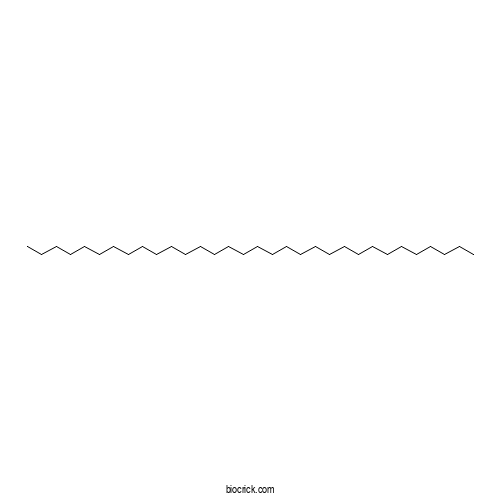
DotriacontaneCAS# 544-85-4 |
| Cas No. | 544-85-4 | SDF | File under preparation. |
| PubChem ID | 11008.0 | Appearance | Powder |
| Formula | C32H66 | M.Wt | 450.9 |
| Type of Compound | N/A | Storage | Desiccate at -20°C |
| Solubility | Soluble in Chloroform,Dichloromethane,Ethyl Acetate,DMSO,Acetone,etc. | ||
| Chemical Name | dotriacontane | ||
| SMILES | CCCCCCCCCCCCCCCCCCCCCCCCCCCCCCCC | ||
| Standard InChIKey | QHMGJGNTMQDRQA-UHFFFAOYSA-N | ||
| Standard InChI | InChI=1S/C32H66/c1-3-5-7-9-11-13-15-17-19-21-23-25-27-29-31-32-30-28-26-24-22-20-18-16-14-12-10-8-6-4-2/h3-32H2,1-2H3 | ||
| General tips | For obtaining a higher solubility , please warm the tube at 37 ℃ and shake it in the ultrasonic bath for a while.Stock solution can be stored below -20℃ for several months. We recommend that you prepare and use the solution on the same day. However, if the test schedule requires, the stock solutions can be prepared in advance, and the stock solution must be sealed and stored below -20℃. In general, the stock solution can be kept for several months. Before use, we recommend that you leave the vial at room temperature for at least an hour before opening it. |
||
| About Packaging | 1. The packaging of the product may be reversed during transportation, cause the high purity compounds to adhere to the neck or cap of the vial.Take the vail out of its packaging and shake gently until the compounds fall to the bottom of the vial. 2. For liquid products, please centrifuge at 500xg to gather the liquid to the bottom of the vial. 3. Try to avoid loss or contamination during the experiment. |
||
| Shipping Condition | Packaging according to customer requirements(5mg, 10mg, 20mg and more). Ship via FedEx, DHL, UPS, EMS or other couriers with RT, or blue ice upon request. | ||
Quality Control & MSDS
3D structure
Package In Stock

Number of papers citing our products


Dotriacontane Dilution Calculator
Dotriacontane Molarity Calculator
-
 DecaneCatalog No.: BCN8138CAS No.: 124-18-5
-
 NonacosaneCatalog No.: BCC9102CAS No.: 630-03-5
-
 n-TridecaneCatalog No.: BCN9855CAS No.: 629-50-5
-
 1-HeptylamineCatalog No.: BCN1801CAS No.: 111-68-2
-
 1-OctacosanolCatalog No.: BCN2973CAS No.: 557-61-9
-
 Docosanol (Abreua)Catalog No.: BCC3769CAS No.: 661-19-8
-
 1-HexadecanolCatalog No.: BCC4616CAS No.: 36653-82-4
-
 N-dotriacontanolCatalog No.: BCC8218CAS No.: 6624-79-9
-
 TriacontanolCatalog No.: BCC8260CAS No.: 593-50-0
-
 1-HeptacosanolCatalog No.: BCN0107CAS No.: 2004-39-9
-
 1-PentacosanolCatalog No.: BCX2515CAS No.: 26040-98-2
| 1 mg | 5 mg | 10 mg | 20 mg | 25 mg | |
| 1 mM | 2.2178 mL | 11.0889 mL | 22.1779 mL | 44.3557 mL | 55.4447 mL |
| 5 mM | 0.4436 mL | 2.2178 mL | 4.4356 mL | 8.8711 mL | 11.0889 mL |
| 10 mM | 0.2218 mL | 1.1089 mL | 2.2178 mL | 4.4356 mL | 5.5445 mL |
| 50 mM | 0.0444 mL | 0.2218 mL | 0.4436 mL | 0.8871 mL | 1.1089 mL |
| 100 mM | 0.0222 mL | 0.1109 mL | 0.2218 mL | 0.4436 mL | 0.5544 mL |
| * Note: If you are in the process of experiment, it's necessary to make the dilution ratios of the samples. The dilution data above is only for reference. Normally, it's can get a better solubility within lower of Concentrations. | |||||
- 5-Pentadecylresorcinol
Catalog No.:BCX2352
CAS No.:3158-56-3
- 2-tert-Butyl-4-methoxyphenol
Catalog No.:BCX2351
CAS No.:121-00-6
- Pipemidic acid
Catalog No.:BCX2350
CAS No.:51940-44-4
- Methylaervine
Catalog No.:BCX2349
CAS No.:86293-40-5
- Pyridoxal phosphate
Catalog No.:BCX2348
CAS No.:54-47-7
- (+)-Licarin B
Catalog No.:BCX2347
CAS No.:42016-15-9
- Caffealdehyde
Catalog No.:BCX2346
CAS No.:141632-15-7
- Acridone
Catalog No.:BCX2345
CAS No.:578-95-0
- Lactose
Catalog No.:BCX2344
CAS No.:63-42-3
- Bryodulcosigenin
Catalog No.:BCX2343
CAS No.:88930-16-9
- D-Glucuronic acid
Catalog No.:BCX2342
CAS No.:6556-12-3
- 6-Hydroxyflavanone
Catalog No.:BCX2341
CAS No.:190831-08-4
- Phenylephrine
Catalog No.:BCX2354
CAS No.:59-42-7
- Uridine 5'-diphosphogaluronic acid trisodium
Catalog No.:BCX2355
CAS No.:148407-07-2
- Cisplatin
Catalog No.:BCX2356
CAS No.:15663-27-1
- Adenosine triphosphate
Catalog No.:BCX2357
CAS No.:56-65-5
- Uridine 5'-diphosphoxylose disodium
Catalog No.:BCX2358
CAS No.:108320-89-4
- Uridine 5'-diphosphogalactose disodium
Catalog No.:BCX2359
CAS No.:137868-52-1
- 2,2-Dimethyl-2,3-dihydroquinazolin-4(1H )-one
Catalog No.:BCX2360
CAS No.:77726-78-4
- Desmosterol
Catalog No.:BCX2361
CAS No.:313-04-2
- 7-Dehydrocholestero
Catalog No.:BCX2362
CAS No.:434-16-2
- Acetyl CoA
Catalog No.:BCX2363
CAS No.:102029-73-2
- CoA
Catalog No.:BCX2364
CAS No.:85-61-0
- Caffeoyl CoA
Catalog No.:BCX2365
CAS No.:53034-79-0
Phytochemical Characterization and Anticancer Potential of Avocado Seed Oil.[Pubmed:41237077]
Chem Biodivers. 2026 Jan;23(1):e01833.
The current research aims to investigate the phytochemicals in Persea americana (Avocado) seed oil and assess its potential anticancer properties. The cytotoxic activity was evaluated against five cell lines, including HT29 (colorectal cancer), A-549 (lung cancer), B16-F10 (mouse Melanoma), Huh-7 (liver cancer), and T-47D (breast ductal carcinoma). In addition, the oil was analyzed using gas chromatography/mass spectrometry analysis. The results revealed 45 compounds in unsaponifiable matter, representing 94.56% of the total composition. 1-methyl dodecylbenzene and Dotriacontane are the major compounds, constituting 6.71% and 6.62%, respectively. Furthermore, 15 compounds were identified from the saponifiable matter, representing 92.56 % of the total composition. 9-Octadecenoic methyl ester (methyl oleate) and 9,12-octadecadienoic acid methyl ester (methyl linoleate) are the major compounds, constituting 10.67 % and 8.04 %, respectively. Furthermore, avocado seed oil showed potential cytotoxicity against all cell lines under investigation. The oil exhibited promising cytotoxic/antiproliferative activity (average IC(50) of 16.6 microg/mL). Additionally, Huh-7 (liver cancer cells) and HT-29 (colorectal cancer) cells showed the highest susceptibility to the oil, while B16-F10 (melanoma cells) and A549 (lung cancer) cells were the most resistant to the oil. Based on the current results, avocado seed oil may be presented as a possible natural cancer treatment.
High-Temperature Size Exclusion Chromatography for Advanced Recycling: Systematic Errors in Analysis of PolyethyleneAlkane Mixtures.[Pubmed:40874047]
ACS Appl Polym Mater. 2025 Aug 1;7(16):10826-10835.
Polyolefins, which dominate the plastics marketplace, require high-temperature size exclusion chromatography (HT-SEC) to characterize their molar masses. Chemical recycling methods designed to deconstruct plastic waste into smaller molecules (i.e., depolymerization methods) rely on HT-SEC to characterize their products, but depolymerization methods often yield a complex mixture, including components below the typical separation range of commercial HT-SEC columns. Herein, we report the accuracy and limitations of triple detection HT-SEC to analyze model chemical recycling products. We examined the chromatographic separation and quantification of individual components and mixtures of short polyethylenes (apparent M (n) = 465 and 2722 g/mol), hexatriacontane (C(36)H(74), M = 507 g/mol), Dotriacontane (C(32)H(66), M = 451 g/mol), and octadecane (C(18)H(38), M = 254 g/mol). Despite short alkanes exhibiting molar masses below the lower molar mass limit of the columns (500 g/mol), the separation of their mixtures was resolved via refractive index (RI) detection. However, the determined molar masses of these alkane mixtures did not agree with the known molar masses of the short alkanes or their prepared mixtures. Similarly, the SEC analysis of mixtures containing discrete alkanes with low molar mass PE revealed that their individual components are easily resolved in the HT-SEC chromatogram. No obvious shift in the elution volume of the blend components versus the elution volume of the pure components was observed. However, inaccurate molar masses and molar mass distributions for these alkane-PE mixtures are calculated from the HT-SEC data. These inaccuracies are attributable to two factors: (1) molar mass-dependent partial differentialn/ partial differentialc for low molar mass components and (2) the small size of the molecules in solution that limits light scattering. These results highlight the importance of considering measurement limitations for quantitative interpretation of triple detection HT-SEC data obtained from chemical recycling and depolymerization experiments that commonly contain complex mixtures of polymeric, oligomeric, and small molecule alkanes.
Long-Chain Hydrocarbons in the Mucous Layer of the Galleria mellonella Insect Eggs as Potential Antibacterial Agents against Multidrug-Resistant Bacteria.[Pubmed:40385173]
ACS Omega. 2025 Apr 28;10(18):18899-18909.
Natural products represent a vital source of chemical entities for the development of anti-infective agents. Insects face constant threats from pathogens and have evolved diverse mechanisms of the infection response. Among various insect species, the chemical protection provided by Galleria mellonella eggs against microorganisms remains poorly understood. This study aimed to investigate whether G. mellonella produces chemical compounds that could serve as anti-infective agents against clinically important bacteria. Additionally, the study examined the effects of larval exposure to bacterial antigens from multidrug-resistant Staphylococcus aureus, Klebsiella pneumoniae, and Pseudomonas aeruginosaon the chemical composition, morphology, and anti-infective properties of the eggs. Larvae were challenged with antigens derived from multidrug-resistant Gram-positive and Gram-negative bacteria. Eggs from intragroup mating were collected and analyzed by using histological and physicochemical techniques, including field-emission gun scanning electron microscopy, energy-dispersive X-ray spectroscopy, and Fourier-transform infrared spectroscopy. Antibacterial and antibiofilm activities of the egg extracts were assessed using broth microdilution and crystal violet assays, respectively. The volatile compound profile of the extracts was characterized by gas chromatography-mass spectrometry. This pioneering study demonstrates the broad-spectrum antibacterial activity of G. mellonella eggs against clinically relevant bacteria. Notably, the antibacterial efficacy of the mucous layer extract was significantly enhanced when larvae were exposed to Gram-positive bacterial antigens. Dotriacontane and tetracontane were identified as the predominant volatile compounds. These findings highlight G. mellonella eggs as a promising source of bioactive compounds and underscore the potential of long-chain hydrocarbons in the development of novel antibacterial agents.
Dosing and fecal sample collection effects on the estimates of intake using n-alkanes as markers.[Pubmed:40183667]
J Anim Sci. 2025 Jan 4;103:skaf106.
The use of indigestible markers continues to be among the best tools available for estimating dry matter intake (DMI) in situations where individual animal feeding cannot be feasibly measured. The constant animal handling required for dosing markers and subsequent fecal sample collection required are often limiting, especially when grazing or when animal handling facilities are not accessible. Identifying strategies for more efficient use of labor while not sacrificing the accuracy of DMI estimates are important for further application of these techniques. The objectives of this study were to: 1) Test potential diet and dosing effects of C32 n-alkane for intake estimates; 2) Compare intake estimates from 2 contrasting (i.e., intensive vs. less intensive) fecal sampling regimes; and 3) Determine whether intake estimates differ when 2 different n-alkane pairs (C31:C32 or C32:C33) are used. The study was laid out using a 2 x 2 x 2 factorial arrangement in a randomized complete block design. Treatments were 2 diets, 2 n-alkane marker dosing regimens, and 2 fecal sampling regimens. Diets were grass haylage (HLG) and a total mixed ration (TMR). Daily intakes were recorded using Calan gates. Alkane dosing was once (1x) or twice (2x) daily dosing of a bolus containing Dotriacontane (C32) n-alkane. The 1x treatments received 2 capsules every morning, while the 2x treatments received 1 capsule in the morning and 1 in the afternoon, both receiving 933 mg of C32/d. Fecal samples were either taken 3 times daily over 4 d with times shifted each day (4 x 3), or twice daily at the same times each day (AMPM). The results indicate the use of C32:C33 n-alkane pairs were not accurate for predicting DMI (Lin's Concordance Correlation Coefficient [CCC] all < 0.5). The C31:C32 n-alkane pairs provided accurate estimates of DMI, having adequate agreement (CCC >0.6) between predicted and observed DMI estimates. Strategies for dosing either 1x or 2x daily were both accurate, within the confines of the experiment. In terms of fecal sampling, there was no discernable advantage for the intensive (4 x 3) sampling regimen compared to the twice daily (AMPM) sampling. In addition, intake estimates were similar with either the 1x or 2x dosing regimens. For studies conducted under similar conditions, it may be suitable to adopt 1x dosing regimen with twice-daily fecal sampling schedules.
Assessing the efficiency of danacid as corrosion inhibitor for aluminium in HCl medium: Experimental, theoretical and optimization studies.[Pubmed:39759301]
Heliyon. 2024 Dec 6;10(24):e40994.
The present study examined the corrosion protection of aluminium in 1M HCl by deploying expired danacid, with techniques such as gravimetric, electrochemical, and density functional theory (DFT). Inhibitor characterization was executed with Fourier transform infrared (FTIR) spectroscopy and gas chromatography mass spectrometry (GC-MS), which was supplemented by optimization of parameters with response surface methodology. The results of gravimetric study indicates that the inhibition efficiency (IE) rose with rise in danacid concentration and reduced with rise in temperature. FTIR results shows the presence of heteroatoms in the inhibitor while further analysis by GC-MS showed the presence of heteroatom-carrying compounds such as menthyl acetate, eicosyl vinyl ester, carbonic acid, Dotriacontane, n-hexadecanoic acid, among others. The activation energy value obtained from this work suggest that the inhibitor molecule's adsorption on the surface of aluminium follows physical adsorption mechanism. Potentiodynamic polarization (PDP) results portrays the inhibitor as a mixed-type while the results of electrochemical impedance spectroscopy (EIS) tests gave an inhibition efficiency of 95.05 %. RSM results show optimum inhibition efficiency of 93.57 % while artificial neural network (ANN) gave improved predicted values. The DFT results further show that the danacid molecules could effectively inhibit alumina corrosion in aggressive media. Hence, danacid proved to be a viable inhibitor for aluminium corrosion.
Anabasis setifera leaf extract from arid habitat: A treasure trove of bioactive phytochemicals with potent antimicrobial, anticancer, and antioxidant properties.[Pubmed:39453934]
PLoS One. 2024 Oct 25;19(10):e0310298.
The main objective of this study was to evaluate the biological activities of Anabasis setifera extract, including its antimicrobial, anticancer, and antioxidant properties. In the current study, Anabasis setifera leaves extract was evaluated for antimicrobial, anticancer, antioxidant activities and phytochemical analyses. Ethyl acetate extract of Anabasis setifera (EA-AS) exhibited promising antimicrobial activity toward Escherichia coli, Staphylococcus aureus, Salmonella typhimurium, Bacillus subtilis, Candida albicans, Aspergillus brasiliensis, Aspergillus fumigatus with MICs 62.5, 125, 62.5, 31.25, 62.5, 125 and 125 mug/mL respectively. Moreover, EA-AS showed anticancer activity at safe concentrations, where IC50 were 36.4 and 44 mug/mL toward Hep-G2 and MCF-7 cancerous cell lines. EA-AS was found to contain 55 significant compounds identified through gas chromatography mass spectrophotometry (GCMS). The most abundant compounds were 1,4-dimethoxy-6,7,8,9-tetrahydro-5-benzocycloheptenone (26.04%), hexa-2,4-diyn-1-ylbenzene (8.40%), dihydrobenzo[b]fluoranthene (6.10%), ethanone, 1-[2,3-dihydro-2-(1-methylethenyl)-5-benzofuranyl (6.10%), and valerenol (4.08%). GC mass analysis confirmed the antioxidant properties of AS by detecting several compounds with antioxidant activity, including hexa-2,4-diyn-1-ylbenzene, nerolidol, spathulenol, -naphthalenem ethanol, decahydro-4-trimethyl-8-methylene, hexadecenoic acid, tremetone, desmethoxyencecalin, heptadecyn-1-ol, thunbergol, hexadecanol, Dotriacontane, taylorione, ligulatin, retinoic acid, and falcarinol. The analysis of EA-AS reveals that it is a rich source of valuable phytochemicals: total Phenolic Content: a promising 4,264 mug/mL /, suggesting substantial biological and pharmacological potential. Total tannin content: 391.17 mug/mL, indicating potential applications in industries like nutraceuticals, pharmaceuticals, and cosmetics. Total flavonoid content exceptionally high at 5,163 mug/mL, while the total alkaloid content measured 1,036.26 mug/mL. Additionally, EA-AS demonstrated antioxidant activity with an EC50 of 30.6 mug/mL. In conclusion, the comprehensive analysis of the EA-AS reveals its immense potential as a rich source of valuable phytochemicals with diverse bioactivities, warranting further in-depth studies to unlock its full pharmaceutical and commercial prospects. Our results suggest substantial biological and pharmacological prospects for EA-AS as a promising antimicrobial, anticancer, and potent antioxidant.
Unveiling the Launaea nudicaulis (L.) Hook medicinal bioactivities: phytochemical analysis, antibacterial, antibiofilm, and anticancer activities.[Pubmed:39421554]
Front Microbiol. 2024 Oct 3;15:1454623.
Commonly used antimicrobial agents are no longer effective due to their overuse or misuse. In addition, many medicinal plant extracts can combat infectious diseases due to their main active constituents or secondary metabolites. The current study aimed to assess the bioactivities of Launaea nudicaulis (LN) leaf extract (LE) against different multi-drug resistant (MDR) Pseudomonas aeruginosa (P. aeruginosa) isolates. The ethyl acetate extract of a Launaea nudicaulis (LN) leaf was analyzed using GC-MS, which identified 27 key bioactive compounds. The major constituents found were as follows: 7-acetyl-6-ethyl-1,1,4,4-tetramethyltetralin, isopropyl myristate, thiocarbamic acid, N,N-dimethyl, S-1,3-diphenyl-2-butenyl ester, hahnfett, cyclopentane acetic acid, 3-oxo-2-pentyl-, methyl ester, hexadecanoic acid, and Dotriacontane. Our study demonstrated that the LN leaf was a rich source of other important phytochemicals, including phenolic acids, tannins, saponins, and steroids. The relative biosafety of the L. nudicaulis LE was determined from the elevated inhibitory concentration 50 (IC50) of 262 mug/mL, as calculated from the cytotoxicity assay against the Wi-38 normal cell line. Conversely, 12.7 and 24.5 mug/mL were the recorded low IC50 values for the tested extract against the MCF-7 and Hep-G2 cancerous cell lines, respectively, reflecting its potent activity against the tested cancerous cell lines. Microbiologically, the susceptible P. aeruginosa isolates to the tested extract showed a growth inhibition zone diameter, in the well diffusion assay, ranging from 11.34 +/- 0.47 to 26.67 +/- 0.47 mm, and a percent inhibition (PI) value of 50-106.2%, reflecting its acceptable activity. In addition, the broth microdilution assay recorded minimum inhibitory concentration (MIC) and minimum bactericidal concentration (MBC) in the ranges of 15.625-1,000 mug/mL and 125-1,000 mug/mL, respectively. In conclusion, the L. nudicaulis LE revealed showed promising activity and high selectivity against P. aeruginosa. Moreover, the extract exhibited natural anticancer activities with safe low concentrations, indicating its potential as a superior candidate for future studies of its active constituents.
Silk Fibroin-Based Multiple-Shape-Memory Organohydrogels.[Pubmed:39370600]
ACS Appl Mater Interfaces. 2024 Oct 16;16(41):56146-56158.
Organohydrogels (OHGs) are intriguing materials due to their unique composition of both hydrophilic and hydrophobic domains. This antagonistic nature endows the OHGs with several remarkable properties, making them highly versatile for various applications. We present here a simple and inexpensive approach to fabricate silk fibroin (SF)-based OHGs with multistage switching mechanics and viscoelasticity. The continuous hydrophilic phase of the OHG precursor consists of an aqueous SF solution, while the hydrophobic droplet phase consists of a crystallizable n-octadecyl acrylate (C18A) monomer and several long-chain saturated hydrocarbons (HCs) with various chain lengths between 14 and 32 carbon atoms, namely, n-tetradecane, n-octadecane, n-docosane, n-Dotriacontane, and 1-docosanol. After the addition of a C18A/HC mixture containing Irgacure photoinitiator into the continuous aqueous SF phase under stirring, a stable oil-in-water emulsion was obtained, which was then photopolymerized at 23 +/- 2 degrees C to obtain nonswelling OHGs with multiple-shape-memory behavior. By changing the chain length and mass proportion of HCs, a series of OHGs with tunable transition temperatures could be obtained, meeting various applications. OHGs containing dimer, trimer, and quadruple combinations of in situ-formed poly(C18A) and HC microinclusions exhibit effective triple- or quintuple-shape memory whose shape-recovery temperatures could be adjusted over a wide range, e.g., between 7 and 70 degrees C.
White Stork Pellets: Non-Invasive Solution to Monitor Anthropogenic Particle Pollution.[Pubmed:38668458]
Toxics. 2024 Mar 23;12(4):236.
The present study applied a non-invasive method to analyse anthropogenic particles and prey items in white stork (Ciconia ciconia) pellets. Pellets (n = 20) were obtained from white stork nests during the 2020 breeding season from two sites in Croatia. In total, 7869 anthropogenic particles were isolated. The majority of particles were fragments, while previous studies on other birds often reported fibres. An ATR-FTIR polymer analysis detected glass and construction and building materials, as well as several compounds associated with plastic masses. Polymer investigation revealed the presence of Dotriacontane and octacosane, which are by-products of polyethylene (PE) degradation and transformation. Additionally, the detection of vinylidene chloride (VDC) highlights the historical contribution of polyvinylidene chloride (PVDC) to plastic pollution. Significant variation in particle quantity and size between the sampling sites was detected, with larger particles found at sites associated with the metal mechanical engineering industry and agriculture. Prey assessment revealed chitin remains of large insects such as Orthoptera and Coleoptera. This research confirms the potential of pellet analysis as a valuable tool for assessing the presence of anthropogenic particles in the environment. However, further research is needed to fully understand the extent of particle ingestion, particle sources and potential impact.
Wax Composition of Serbian Dianthus spp. (Caryophyllaceae): Identification of New Metabolites and Chemotaxonomic Implications.[Pubmed:37299073]
Plants (Basel). 2023 May 24;12(11):2094.
Although ethnopharmacologically renowned, wax constituents of Dianthus species were sporadically studied. A combination of GC-MS analysis, synthesis, and chemical transformations enabled the identification of 275 constituents of diethyl-ether washings of aerial parts and/or flowers of six Dianthus taxa (Dianthus carthusianorum, D. deltoides, D. giganteus subsp. banaticus, D. integer subsp. minutiflorus, D. petraeus, and D. superbus) and one Petrorhagia taxon (P. prolifera) from Serbia. Seventeen of these constituents (nonacosyl benzoate, additional 12 benzoates with anteiso-branched 1-alkanols, eicosyl tiglate, triacontane-14,16-dione, Dotriacontane-14,16-dione, and tetratriacontane-16,18-dione) and two additional synthesized eicosyl esters (angelate and senecioate) represent completely new compounds. The structures of the tentatively identified beta-ketones were confirmed by analysis of the mass fragmentation of the corresponding pyrazoles and silyl enol ethers obtained by transformations of crude extracts and extract fractions. Silylation allowed the identification of 114 additional constituents, including a completely new natural product (30-methylhentriacontan-1-ol). The results obtained by multivariate statistical analyses showed that the chemical profile of Dianthus taxa's surface waxes is subject to both genetic and ecological factors, whereas the latter seemingly takes a more important role for the studied Dianthus samples.
Breath Volatile Organic Compounds in Surveillance of Gastric Cancer Patients following Radical Surgical Management.[Pubmed:37238155]
Diagnostics (Basel). 2023 May 9;13(10):1670.
As of today, there is a lack of a perfect non-invasive test for the surveillance of patients for potential relapse following curative treatment. Breath volatile organic compounds (VOCs) have been demonstrated to be an accurate diagnostic tool for gastric cancer (GC) detection; here, we aimed to prove the yield of the markers in surveillance, i.e., following curative surgical management. Patients were sampled in regular intervals before and within 3 years following curative surgery for GC; gas chromatography-mass spectrometry (GC-MS) and nanosensor technologies were used for the VOC assessment. GC-MS measurements revealed a single VOC (14b-Pregnane) that significantly decreased at 12 months, and three VOCs (Isochiapin B, Dotriacontane, Threitol, 2-O-octyl-) that decreased at 18 months following surgery. The nanomaterial-based sensors S9 and S14 revealed changes in the breath VOC content 9 months after surgery. Our study results confirm the cancer origin of the particular VOCs, as well as suggest the value of breath VOC testing for cancer patient surveillance, either during the treatment phase or thereafter, for potential relapse.
Potential application of postbiotics metabolites from bioprotective culture to fabricate bacterial nanocellulose based antimicrobial packaging material.[Pubmed:35988726]
Int J Biol Macromol. 2022 Nov 1;220:528-536.
Postbiotics (P) of FreshQ, a food protective culture, was prepared and used to develop an antimicrobial membrane by bacterial nanocellulose (BNC). Postbiotics were prepared in de Man, Rogosa and Sharpe medium and freeze-dried. The chemical composition was investigated by GC-MS and the antibacterial activity of postbiotics on different bacterial and fungal strains was investigated. Finally, postbiotics were included in wet and lyophilized BNC by ex-situ method, and their antibacterial activity and FTIR specifications were studied. The GC-MS analysis of postbiotics revealed the presence of fatty acids, alkanes, aldehydes, hydrocarbones fatty acid esters, propionic acid, and certain antibacterial and antifungal compounds such as 2,4-Di-tert-butyl phenol and Dotriacontane. Postbiotics revealed antibacterial activity on all investigated strains in a concentration-dependent manner and as the concentation decreased, there was a significant reduction in antimicrobial effects. The zone of inhibition for all bacterial pathogens exceeded 20 mm, then they were classified as "extremely sensitive microorganisms" to the postbiotics at 50 % concentration, while fungal strains revealed a lower zone of inhibition (<17 mm). The order of antimicrobial susceptibility was as follows: Listeria monocytogenes > Staphylococcus aureus > Escherichia coli > Salmonella Typhimurium > Aspergillus flavus > Penicillium citrinum. We also recognized that P-BNC in wet form has significant antimicrobial activity than lyophilized form due to the high adsorption capacity and open 3D structure of BNC in wet form. The fabricated material can serve as an antimicrobial membrane for food applications.
Metabolomic analysis of sheath blight disease of rice (Oryza sativa L.) induced by Rhizoctonia solani phytotoxin.[Pubmed:35957552]
J Appl Microbiol. 2022 Nov;133(5):3215-3227.
AIM: To understand the mechanism of necrosis incited by a host-selective phytotoxin designated as Rhizoctonia solani toxin (RST) identified to be a potential pathogenic factor of R. solani AG1 IA, causing sheath blight (ShB) of rice. METHODS AND RESULTS: The metabolomic changes induced by the phytotoxic metabolite in a ShB susceptible rice cultivar were elucidated by gas chromatography-mass spectrometry analysis and compared with that of the pathogen to identify rice metabolites targeted by the phytotoxin. The profiles of about 29 metabolites with various physiological roles in rice plants have been identified worldwide. Unsupervised and supervised multivariate chemometrics (principal component analysis and partial least squares-discriminant analysis) and cluster (Heat maps) analyses were used to compare the metabolites obtained from chemical profiles of the treatments with sterile distilled water (SDW) control. The results indicated that the rice plant expressed more metabolites in response to the pathogen than the phytotoxin and was lowest in SDW control. The key metabolites expressed in rice in response to the treatments were investigated by the variable importance in projection (VIP) analysis using p < 0.05 VIP >15. The analysis identified 7 and 11 upregulating metabolites in the phytotoxin and the pathogen treatments, respectively, compared to the untreated control. Among the phytotoxin-treated and the pathogen inoculated samples, the phytotoxin-treated sample recorded upregulation of six metabolites, whereas nine metabolites were upregulated in the pathogen-inoculated samples. These upregulating metabolites are speculated for the necrotic symptoms characteristic to both the phytotoxin and pathogen. In this analysis, hexadecanoic acid and Dotriacontane were highly expressed metabolites specific to the phytotoxin and pathogen-treated samples, respectively. Besides upregulation, the metabolites also have a VIP score of >1.5 and hence fulfilled the criteria of classifying them as reliable potential biomarkers. In the pathway analysis, hexadecanoic acid and Dotriacontane were identified to be involved in several important biosynthetic pathways of rice, such as the biosynthesis of saturated fatty acid and unsaturated fatty acids cutin, suberin and wax. CONCLUSIONS: The study concludes that though certain metabolites induced by the phytotoxin in the susceptible variety during necrosis shares with that of the pathogen, the identification of metabolites specific to the phytotoxin in comparison to the pathogenic and SDW controls indicated that the phytotoxin modulates the host metabolism differently and hence can be a potential pathogenicity factor of the ShB fungus. SIGNIFICANCE AND IMPACT OF THE STUDY: Due to lack of knowledge on the pathway genes of RST and in the absence of an ShB-resistant variety, understanding differentially expressed metabolic changes induced in the susceptible variety by the phytotoxin in comparison to that of the pathogenic and uninoculated controls enables us to identify the key metabolite changes during the ShB infection. Such metabolomic changes can further be used to infer gene functions for exploitation in ShB control.
Molecular Interaction Studies and Phytochemical Characterization of Mentha pulegium L. Constituents with Multiple Biological Utilities as Antioxidant, Antimicrobial, Anticancer and Anti-Hemolytic Agents.[Pubmed:35956775]
Molecules. 2022 Jul 28;27(15):4824.
Multiple biological functions of Mentha pulegium extract were evaluated in the current work. Phytochemical components of the M. pulegium extract were detected by Gas Chromatography-Mass Spectrometry (GC-MS) and High-performance liquid chromatography (HPLC). Moreover, M. pulegium extract was estimated for antioxidant potential by 2,2-Diphenyl-1-picryl-hydrazyl-hydrate (DPPH) free radical scavenging, antimicrobial activity by well diffusion, and anticoagulant activity via prothrombin time (PT) and activated partial thromboplastin time (APTT). GC-MS analysis detected compounds including cholesterol margarate, stigmast-5-en-3-ol, 19-nor-4-androstenediol, androstan-17-one, pulegone-1,2-epoxide, isochiapin B, Dotriacontane, hexadecanoic acid and neophytadiene. Chrysoeriol (15.36 microg/mL) was followed by kaempferol (11.14 microg/mL) and 7-OH flavone (10.14 microg/mL), catechin (4.11 microg/mL), hisperdin (3.05 microg/mL), and luteolin (2.36 microg/mL) were detected by HPLC as flavonoids, in addition to ferulic (13.19 microg/mL), cinnamic (12.69 microg/mL), caffeic (11.45 microg/mL), pyrogallol (9.36 microg/mL), p-coumaric (5.06 microg/mL) and salicylic (4.17 microg/mL) as phenolics. Antioxidant activity was detected with IC(50) 18 microg/mL, hemolysis inhibition was recorded as 79.8% at 1000 mug/mL, and PT and APTT were at 21.5 s and 49.5 s, respectively, at 50 mug/mL of M. pulegium extract. The acute toxicity of M. pulegium extract was recorded against PC3 (IC(50) 97.99 microg/mL) and MCF7 (IC(50) 80.21 microg/mL). Antimicrobial activity of M. pulegium extract was documented against Bacillus subtilis, Escherichia coli, Pseudomonasaureus, Candida albicans, Pseudomonas aeruginosa, but not against black fungus Mucor circinelloides. Molecular docking was applied using MOE (Molecular Operating Environment) to explain the biological activity of neophytadiene, luteolin, chrysoeriol and kaempferol. These compounds could be suitable for the development of novel pharmacological agents for treatment of cancer and bacterial infections.
Anticancer, antioxidant, antiviral and antimicrobial activities of Kei Apple (Dovyalis caffra) fruit.[Pubmed:35396383]
Sci Rep. 2022 Apr 8;12(1):5914.
Secondary plant metabolites remain one of the key sources of therapeutic agents despite the development of new approaches for the discovery of medicinal drugs. In the current study, chemical analysis, and biological activities of Kei apple (Dovyalis caffra) methanolic extract were evaluated. Chemical analysis was performed using HPLC and GC-MS. Antiviral and anticancer effect were assessed using the crystal violet technique and activity against human liver cells (HepG2), respectively. Antibacterial activity was tested with the disc diffusion method. The obtained results showed that chlorogenic acid (2107.96 +/- 0.07 microg/g), catechin (168 +/- 0.58 microg/g), and gallic acid (15.66 +/- 0.02 microg/g) were the main bioactive compounds identified by HPLC techniques. While, compounds containing furan moieties, as well as levoglucosenone, isochiapin B, Dotriacontane, 7-nonynoic acid and tert-hexadecanethiol, with different biological activities were identified by GC-MS. Additionally, inhibition of 2,2-diphenyl-1-picryl-hydrazyl-hydrate (DPPH) scavenging was 79.25% at 2000 microg/mL, indicating its antioxidant activity with IC(50) of 728.20 +/- 1.04 microg/mL. The tested extract exhibited potential anticancer activity (58.90% toxicity) against HepG2 cells at 1000 microg/mL. Potential bacterial inhibition was observed mainly against Escherichia coli and Proteus vulgaris, followed by Staphylococcus aureus and Bacillus subtilis with a diameter of growth inhibition ranging from 13 to 24 mm. While weak activities were recorded for fungi Candida albicans (10 mm). The extract showed mild antiviral activity against human coronavirus 229E with a selective index (SI) of 10.4, but not against human H3N2 (SI of 0.67). The molecular docking study's energy ratings were in good promise with the experiment documents of antibacterial and antiviral activities. The findings suggest that D. caffra juice extract is a potential candidate for further experiments to assess its use as potential alternative therapeutic agent.

Calcutta University

University of Minnesota

University of Maryland School of Medicine

University of Illinois at Chicago

The Ohio State University

University of Zurich

Harvard University

Colorado State University

Auburn University

Yale University

Worcester Polytechnic Institute

Washington State University

Stanford University

University of Leipzig

Universidade da Beira Interior

The Institute of Cancer Research

Heidelberg University

University of Amsterdam

University of Auckland

TsingHua University

The University of Michigan

Miami University

DRURY University

Jilin University

Fudan University

Wuhan University

Sun Yat-sen University

Universite de Paris

Deemed University

Auckland University

The University of Tokyo

Korea University



