
Pyridoxal phosphateCAS# 54-47-7 |
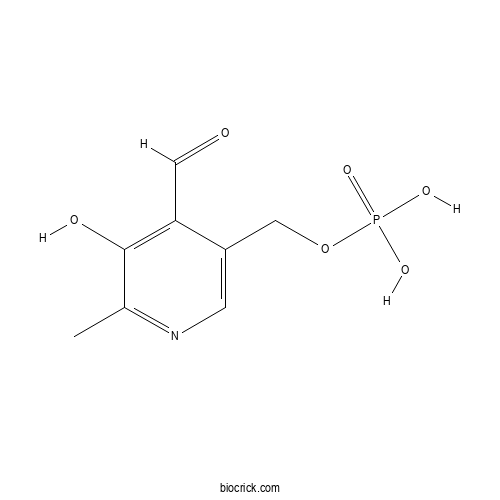
| Cas No. | 54-47-7 | SDF | File under preparation. |
| PubChem ID | 1051.0 | Appearance | Powder |
| Formula | C8H10NO6P | M.Wt | 247.1 |
| Type of Compound | N/A | Storage | Desiccate at -20°C |
| Solubility | Soluble in Chloroform,Dichloromethane,Ethyl Acetate,DMSO,Acetone,etc. | ||
| Chemical Name | (4-formyl-5-hydroxy-6-methyl-3-pyridinyl)methyl dihydrogen phosphate | ||
| SMILES | CC1=NC=C(C(=C1O)C=O)COP(=O)(O)O | ||
| Standard InChIKey | NGVDGCNFYWLIFO-UHFFFAOYSA-N | ||
| Standard InChI | InChI=1S/C8H10NO6P/c1-5-8(11)7(3-10)6(2-9-5)4-15-16(12,13)14/h2-3,11H,4H2,1H3,(H2,12,13,14) | ||
| General tips | For obtaining a higher solubility , please warm the tube at 37 ℃ and shake it in the ultrasonic bath for a while.Stock solution can be stored below -20℃ for several months. We recommend that you prepare and use the solution on the same day. However, if the test schedule requires, the stock solutions can be prepared in advance, and the stock solution must be sealed and stored below -20℃. In general, the stock solution can be kept for several months. Before use, we recommend that you leave the vial at room temperature for at least an hour before opening it. |
||
| About Packaging | 1. The packaging of the product may be reversed during transportation, cause the high purity compounds to adhere to the neck or cap of the vial.Take the vail out of its packaging and shake gently until the compounds fall to the bottom of the vial. 2. For liquid products, please centrifuge at 500xg to gather the liquid to the bottom of the vial. 3. Try to avoid loss or contamination during the experiment. |
||
| Shipping Condition | Packaging according to customer requirements(5mg, 10mg, 20mg and more). Ship via FedEx, DHL, UPS, EMS or other couriers with RT, or blue ice upon request. | ||
Quality Control & MSDS
3D structure
Package In Stock

Number of papers citing our products


Pyridoxal phosphate Dilution Calculator
Pyridoxal phosphate Molarity Calculator
| 1 mg | 5 mg | 10 mg | 20 mg | 25 mg | |
| 1 mM | 4.0469 mL | 20.2347 mL | 40.4694 mL | 80.9389 mL | 101.1736 mL |
| 5 mM | 0.8094 mL | 4.0469 mL | 8.0939 mL | 16.1878 mL | 20.2347 mL |
| 10 mM | 0.4047 mL | 2.0235 mL | 4.0469 mL | 8.0939 mL | 10.1174 mL |
| 50 mM | 0.0809 mL | 0.4047 mL | 0.8094 mL | 1.6188 mL | 2.0235 mL |
| 100 mM | 0.0405 mL | 0.2023 mL | 0.4047 mL | 0.8094 mL | 1.0117 mL |
| * Note: If you are in the process of experiment, it's necessary to make the dilution ratios of the samples. The dilution data above is only for reference. Normally, it's can get a better solubility within lower of Concentrations. | |||||
- (+)-Licarin B
Catalog No.:BCX2347
CAS No.:42016-15-9
- Caffealdehyde
Catalog No.:BCX2346
CAS No.:141632-15-7
- Acridone
Catalog No.:BCX2345
CAS No.:578-95-0
- Lactose
Catalog No.:BCX2344
CAS No.:63-42-3
- Bryodulcosigenin
Catalog No.:BCX2343
CAS No.:88930-16-9
- D-Glucuronic acid
Catalog No.:BCX2342
CAS No.:6556-12-3
- 6-Hydroxyflavanone
Catalog No.:BCX2341
CAS No.:190831-08-4
- Guanidinoacetic acid
Catalog No.:BCX2340
CAS No.:352-97-6
- 3-Amino-3-(3,4-dimethoxyphenyl)propionic acid
Catalog No.:BCX2339
CAS No.:54160-63-3
- 3-Methyl-4-isopropylphenol
Catalog No.:BCX2338
CAS No.:3228-02-2
- Turanose
Catalog No.:BCX2337
CAS No.:547-25-1
- Doxofylline
Catalog No.:BCX2336
CAS No.:69975-86-6
- Methylaervine
Catalog No.:BCX2349
CAS No.:86293-40-5
- Pipemidic acid
Catalog No.:BCX2350
CAS No.:51940-44-4
- 2-tert-Butyl-4-methoxyphenol
Catalog No.:BCX2351
CAS No.:121-00-6
- 5-Pentadecylresorcinol
Catalog No.:BCX2352
CAS No.:3158-56-3
- Dotriacontane
Catalog No.:BCX2353
CAS No.:544-85-4
- Phenylephrine
Catalog No.:BCX2354
CAS No.:59-42-7
- Uridine 5'-diphosphogaluronic acid trisodium
Catalog No.:BCX2355
CAS No.:148407-07-2
- Cisplatin
Catalog No.:BCX2356
CAS No.:15663-27-1
- Adenosine triphosphate
Catalog No.:BCX2357
CAS No.:56-65-5
- Uridine 5'-diphosphoxylose disodium
Catalog No.:BCX2358
CAS No.:108320-89-4
- Uridine 5'-diphosphogalactose disodium
Catalog No.:BCX2359
CAS No.:137868-52-1
- 2,2-Dimethyl-2,3-dihydroquinazolin-4(1H )-one
Catalog No.:BCX2360
CAS No.:77726-78-4
Comparison of the catalysis of ThDP-dependent enzymes AHAS, ALS, and DXPS.[Pubmed:42805693]
Methods Enzymol. 2026;736:127-156.
Thiamine diphosphate (ThDP)-dependent enzymes are primarily classified into lyases, transferases, and oxidoreductases, catalyzing various biologically important reactions such as keto transfer, dehydrogenation, decarboxylation, and stereoselective C-C bond formation/cleavage in chiral natural products biosynthesis. They constitute one of the largest superfamilies of biocatalysts, operate basically in all forms of living systems. In this chapter, the research progress on three ThDP enzymes are reviewed, including acetohydroxyacid synthase (AHAS) which is a key enzyme in the anabolic pathway for the biosynthesis of branched chain amino acids, acetolactate synthase (ALS) that belongs to the catabolic pathway for the biosynthesis of platform compounds acetoin and 2,3-butanediol, and 1-deoxy-D-xylulose-5-phosphate synthase (DXPS) which is a rate-limiting enzyme in the MEP terpenoid biosynthetic pathway and is also involved in the biosynthesis of ThDP and Pyridoxal phosphate in certain bacteria, with the emphasis on comparing the catalysis of the three enzymes. Furthermore, two precolumn derivatization-HPLC protocols using 4-nitro-o-phenylenediamine and 2,4-dinitrophenylhydrazine as respective derivatizing reagents are also described in detail. The methods can not only be utilized to measure the activities of the above enzymes, supplementing the deficiencies of the classic spectrophotometry, but also be used to comprehensively elucidate the consumption of the substrate(s) and the formation of the products in the reactions catalyzed by AHAS, ALS, or DXPS.
Cycloserine inhibits glutamate decarboxylase from Mycobacterium tuberculosis.[Pubmed:42765272]
J Enzyme Inhib Med Chem. 2026 Dec;41(1):2707854.
Glutamate decarboxylase (GadB) is a Pyridoxal phosphate (PLP)-dependent enzyme that contributes to intracellular pH homeostasis and supports the survival of Mycobacterium tuberculosis (Mtb) in lung tissue, granulomas, and within host macrophages. Here, we demonstrate that glutamate decarboxylase from Mycobacterium tuberculosis (MtbGadB) is a multimeric enzyme exhibiting maximal activity under acidic conditions. MtbGadB is inhibited by the clinical antibiotic d-cycloserine as well as l-cycloserine in vitro. Both cycloserine enantiomers break the internal aldimine bond between PLP and the conserved Lys277 residue, forming a previously unrecognised PLP-oxime product and subsequently inhibiting catalysis. Given that PLP-dependent enzymes are promising drug targets, understanding the chemical behaviour of PLP is essential for developing selective inhibitors.

Calcutta University

University of Minnesota

University of Maryland School of Medicine

University of Illinois at Chicago

The Ohio State University

University of Zurich

Harvard University

Colorado State University

Auburn University

Yale University

Worcester Polytechnic Institute

Washington State University

Stanford University

University of Leipzig

Universidade da Beira Interior

The Institute of Cancer Research

Heidelberg University

University of Amsterdam

University of Auckland

TsingHua University

The University of Michigan

Miami University

DRURY University

Jilin University

Fudan University

Wuhan University

Sun Yat-sen University

Universite de Paris

Deemed University

Auckland University

The University of Tokyo

Korea University



