
AcridoneCAS# 578-95-0 |
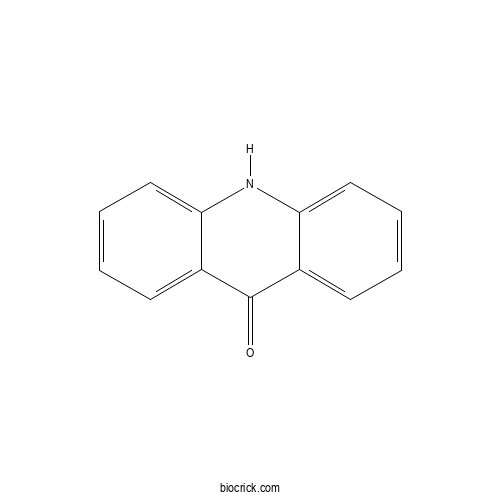
| Cas No. | 578-95-0 | SDF | File under preparation. |
| PubChem ID | 2015.0 | Appearance | Yellow powder |
| Formula | C13H9NO | M.Wt | 195.2 |
| Type of Compound | N/A | Storage | Desiccate at -20°C |
| Solubility | Soluble in Chloroform,Dichloromethane,Ethyl Acetate,DMSO,Acetone,etc. | ||
| Chemical Name | 10H-acridin-9-one | ||
| SMILES | C1=CC=C2C(=C1)C(=O)C3=CC=CC=C3N2 | ||
| Standard InChIKey | FZEYVTFCMJSGMP-UHFFFAOYSA-N | ||
| Standard InChI | InChI=1S/C13H9NO/c15-13-9-5-1-3-7-11(9)14-12-8-4-2-6-10(12)13/h1-8H,(H,14,15) | ||
| General tips | For obtaining a higher solubility , please warm the tube at 37 ℃ and shake it in the ultrasonic bath for a while.Stock solution can be stored below -20℃ for several months. We recommend that you prepare and use the solution on the same day. However, if the test schedule requires, the stock solutions can be prepared in advance, and the stock solution must be sealed and stored below -20℃. In general, the stock solution can be kept for several months. Before use, we recommend that you leave the vial at room temperature for at least an hour before opening it. |
||
| About Packaging | 1. The packaging of the product may be reversed during transportation, cause the high purity compounds to adhere to the neck or cap of the vial.Take the vail out of its packaging and shake gently until the compounds fall to the bottom of the vial. 2. For liquid products, please centrifuge at 500xg to gather the liquid to the bottom of the vial. 3. Try to avoid loss or contamination during the experiment. |
||
| Shipping Condition | Packaging according to customer requirements(5mg, 10mg, 20mg and more). Ship via FedEx, DHL, UPS, EMS or other couriers with RT, or blue ice upon request. | ||
Quality Control & MSDS
3D structure
Package In Stock

Number of papers citing our products


Acridone Dilution Calculator
Acridone Molarity Calculator

| 1 mg | 5 mg | 10 mg | 20 mg | 25 mg | |
| 1 mM | 5.123 mL | 25.6148 mL | 51.2295 mL | 102.459 mL | 128.0738 mL |
| 5 mM | 1.0246 mL | 5.123 mL | 10.2459 mL | 20.4918 mL | 25.6148 mL |
| 10 mM | 0.5123 mL | 2.5615 mL | 5.123 mL | 10.2459 mL | 12.8074 mL |
| 50 mM | 0.1025 mL | 0.5123 mL | 1.0246 mL | 2.0492 mL | 2.5615 mL |
| 100 mM | 0.0512 mL | 0.2561 mL | 0.5123 mL | 1.0246 mL | 1.2807 mL |
| * Note: If you are in the process of experiment, it's necessary to make the dilution ratios of the samples. The dilution data above is only for reference. Normally, it's can get a better solubility within lower of Concentrations. | |||||
- Lactose
Catalog No.:BCX2344
CAS No.:63-42-3
- Bryodulcosigenin
Catalog No.:BCX2343
CAS No.:88930-16-9
- D-Glucuronic acid
Catalog No.:BCX2342
CAS No.:6556-12-3
- 6-Hydroxyflavanone
Catalog No.:BCX2341
CAS No.:190831-08-4
- Guanidinoacetic acid
Catalog No.:BCX2340
CAS No.:352-97-6
- 3-Amino-3-(3,4-dimethoxyphenyl)propionic acid
Catalog No.:BCX2339
CAS No.:54160-63-3
- 3-Methyl-4-isopropylphenol
Catalog No.:BCX2338
CAS No.:3228-02-2
- Turanose
Catalog No.:BCX2337
CAS No.:547-25-1
- Doxofylline
Catalog No.:BCX2336
CAS No.:69975-86-6
- 5-Methoxytryptamine
Catalog No.:BCX2335
CAS No.:608-07-1
- L-Mannose
Catalog No.:BCX2334
CAS No.:10030-80-5
- L-Galactose
Catalog No.:BCX2333
CAS No.:15572-79-9
- Caffealdehyde
Catalog No.:BCX2346
CAS No.:141632-15-7
- (+)-Licarin B
Catalog No.:BCX2347
CAS No.:42016-15-9
- Pyridoxal phosphate
Catalog No.:BCX2348
CAS No.:54-47-7
- Methylaervine
Catalog No.:BCX2349
CAS No.:86293-40-5
- Pipemidic acid
Catalog No.:BCX2350
CAS No.:51940-44-4
- 2-tert-Butyl-4-methoxyphenol
Catalog No.:BCX2351
CAS No.:121-00-6
- 5-Pentadecylresorcinol
Catalog No.:BCX2352
CAS No.:3158-56-3
- Dotriacontane
Catalog No.:BCX2353
CAS No.:544-85-4
- Phenylephrine
Catalog No.:BCX2354
CAS No.:59-42-7
- Uridine 5'-diphosphogaluronic acid trisodium
Catalog No.:BCX2355
CAS No.:148407-07-2
- Cisplatin
Catalog No.:BCX2356
CAS No.:15663-27-1
- Adenosine triphosphate
Catalog No.:BCX2357
CAS No.:56-65-5
Substituted methyl acridone-carboxylate derivatives as CD1/CD2 dual-targeting HDAC6 inhibitors to ameliorate the pathological phenotype of Alzheimer's disease.[Pubmed:42763962]
Eur J Med Chem. 2026 Sep 19;320:119350.
Histone deacetylase 6 (HDAC6) has emerged as a promising target for Alzheimer' disease (AD). Although most reported HDAC6 inhibitors were designed to target CD2 catalytic domain, recent studies highlighted the functional importance of CD1 domain for the regulation of AD-related substrates. In this study, a series of substituted methyl Acridone-carboxylate derivatives bearing a methyl ester moiety were discovered as CD1/CD2 dual-targeting HDAC6 inhibitors. The leading compound 6c could direct bind to HDAC6, and selectively inhibits HDAC6 with a high affinity in vitro. Molecular docking analysis revealed that 6c forms non-chelating coordination interactions with the zinc ions in both CD1 and CD2 domains of HDAC6. 6c inhibited Abeta oligomer-induced microtubule depolymerization and microglial phagocytic impairments in vitro. Furthermore, 6c effectively prevented HDAC6-driven alpha-tubulin and Hsp90 deacylation, as well as cognitive impairments in Abeta(1-42) oligomer-treated mice. Combined with the acceptable physicochemical properties and promising biosafety of 6c, this study suggested that substituted methyl Acridone-carboxylate derivatives, as CD1/CD2 dual-targeting HDAC6 inhibitors, might be developed as a novel lead drug for the treatment of AD.
Design, Synthesis and Anticancer Evaluation of Novel SO(2)F-Containing Medicinally Privileged Structures via Ketone-Directed C-H Functionalization.[Pubmed:42738753]
Molecules. 2026 Sep 3;31(17):3094.
The weakly coordinating ketone group-directed C-H functionalizations of chromones, flavones, 1,4-naphthoquinones, (thio)xanthones, and Acridones with ethenesulfonyl fluoride under rhodium(III) or ruthenium(II) catalysis are described. These protocols efficiently provide a range of chromone-based scaffolds and xanthone analogues bearing an SO(2)F group with excellent site-selectivity and functional group compatibility. The practicality of this approach was demonstrated by simple SuFEx conjugations with representative biologically relevant molecules, DNA conjugation, and Michael addition with a secondary amine. All the synthesized derivatives were initially screened for their in vitro cytotoxic activity against human lung adenocarcinoma A549 cells. In particular, compound 5aa with a xanthone scaffold was found to be highly cytotoxic.
Host-controlled switching between TADF and RTP in acridone-carboline donor-acceptor dyads.[Pubmed:42664951]
Spectrochim Acta A Mol Biomol Spectrosc. 2027 Jan 5;364(Pt 2):128670.
Purely organic, metal-free emitters that combine thermally activated delayed fluorescence (TADF) and room-temperature phosphorescence (RTP) provide an attractive route to triplet harvesting without heavy-metal complexes. Here, we report two Acridone-carboline donor-acceptor emitters, Acr-Me-Cb and Acr-Anisyl-Cb, that exhibit bluish-green emission centered at 422 nm and high photoluminescence quantum yields of up to 85% in toluene. A moderate singlet-triplet energy gap (DeltaE(ST) approximately 0.3 eV) enables competing reverse intersystem crossing and triplet stabilization pathways, allowing delayed fluorescence and phosphorescence to be accessed within the same molecular framework. Host-dependent photophysical studies in CBP and PVA matrices reveal distinct relaxation channels: 10 wt% CBP-doped films show TADF at 300 K with delayed lifetimes of 67 and 136 mus for Acr-Me-Cb and Acr-Anisyl-Cb, respectively, whereas rigid PVA films promote RTP with an afterglow of approximately 1 s under ambient conditions. These results establish Acridone-carboline dyads as a host-responsive platform for switching between TADF and RTP in metal-free organic emitters.
Synthesis and In Vitro Anticancer Activity of New Acridone Derivatives: Computational DFT and Molecular Docking Studies.[Pubmed:42626998]
Chem Biodivers. 2026 Aug;23(8):e71593.
Cancer continuing to present a serious global health threat, creating an urgent demand for new and effective anticancer candidates. In this study, several novel Acridone derivatives were synthesized and characterized by (1)H NMR, (13)C NMR, HRMS and FT-IR, and their in vitro anticancer activity was evaluated combined with systematic theoretical calculations. Of these derivatives, 6a demonstrated antiproliferative activity against the HGC-27 gastric cancer cell line (IC(50) = 4.86 microM) in comparison with the HeLa cervical cancer cell line and the HCT116 colon carcinoma cell line. Furthermore, morphological assessment under an inverted microscope revealed that it induced apoptosis like morphological changes. Density functional theory calculations were employed to gain insight into the electronic structure and intramolecular interactions of these compounds. Molecular docking studies revealed that compound 6a binds to the gastric cancer target protein (4OUM) through hydrogen bonds with Arg1106 and Asn1057, which contribute to its enhanced binding affinity (-5.59 kcal/mol). This binding energy is consistent with its potent antiproliferative activity, establishing a correlation between the computational prediction and the experimental observation. Taken together, these results indicate that compound 6a represents a promising lead for the development of novel anticancer agents.
Discovery of acridone analogs as novel entry inhibitors targeting e protein of dengue virus.[Pubmed:42567122]
Bioorg Chem. 2026 Oct 5;181:110314.
The envelope (E) protein of the Dengue virus (DENV) is critical for virion attachment and membrane fusion with the host cell, as well as the release of the viral RNA genome into the cytoplasm. In this study, we describe the design, synthesis, and biological evaluation of novel viral entry inhibitors containing an Acridone core. Notably, compound 13e demonstrated potent cellular antiviral activity (IC(50) = 8.6 muM and selectivity index = 21.4). Compound 13e was evaluated using several methods, including time-of-addition and virus entry/binding assays, which revealed that it selectively blocked DENV2 infection by inhibiting virion attachment. Furthermore, compound 13e exhibited potent antiviral efficacy, as evidenced by viremia quantification and histopathological analysis results, without causing significant body weight loss or other toxicities. Furthermore, target engagement assay supported the role of compound 13e as an E protein binder, consistent with its function as an entry inhibitor.
Rational design, synthesis, and evaluation of acridone-peptide based antimicrobial and Antifolate agents against methicilin-resistant Staphylococcus aureus, Bacillus subtilis and dihydrofolate reductase.[Pubmed:42561777]
Bioorg Med Chem. 2026 Nov;142:118761.
To conquer the antimicrobial resistance, here, we developed Acridone-peptide based DHFR inhibitors. Small peptides or amino acids are coupled with acid Acridone either through amide linkage or via an azole-based linker. These hybrids exerted their antibacterial activity through a dual mechanism involving membrane disruption and intracellular DHFR inhibition, compound 7 emerged as the most potent DHFR inhibitor (IC(50) 0.11 muM) and good antibacterial agent against methicillin-resistant Staphylococcus aureus and Bacillus subtilis. Moreover, it attained >10-fold selectivity over hemolytic activity which justify the moderate MIC values. Drug-like features were evaluated by physiological experiments including solubility, plasma and liver microsomal stability, hemolysis study, and ADME analysis. Fluorescence imaging depicts compound 7 able to stain bacterial cells, time-kill kinetic study reveals its bactericidal mode of inhibition and it also attains antibiofilm activity. Compound 7 binds with the enzyme in a competitive mode of inhibition and with excellent binding affinity. Molecular dynamics simulations were executed to provide critical insights into enzyme-ligand interactions and their conformational changes.
Design and Synthesis of N-Heteroacridone Derivatives and Their Ferroptosis-Inducing Activity Against Human Melanoma.[Pubmed:42289379]
ChemMedChem. 2026 Jun 15;21(11):e202501070.
In order to obtain structurally unique and biologically significant antitumor compounds, a series of N-heteroAcridone derivatives were designed and synthesized under the guidance of "scaffold hopping" strategy. The antiproliferative effects of the synthetic N-heteroAcridones were evaluated against five tumor cell lines (Cal-27 human tongue cancer, A673 human Ewing's sarcoma, 143B human osteosarcoma, T24 human bladder cancer, and A375 human melanoma) and one normal line (HaCaT human keratinocytes), with doxorubicin (Dox) used as a positive control. The best compound 8E showed selective inhibitory effect against human melanoma A375 cells with IC(50) value of 1.49 +/- 0.56 muM. Interestingly, instead of acting as an apoptosis-inducing agent, 8E triggers ferroptosis in A375 cells, suggesting its potential for skin cancer therapy.
Annulative pi-Extension by Ru(II)-Catalyzed peri-C-H Activation: Access to Pyranoacridine Photocatalyst.[Pubmed:42212450]
J Org Chem. 2026 Jun 12;91(23):7678-7684.
The precise construction of heteroatom-doped nanographenes remains a long-standing challenge in organic optoelectronics. Herein, we demonstrate a strategy for the synthesis of N,O-doped PAHs through Ru(II)-catalyzed peri-C-H activation/annulation of readily available Acridones with internal alkynes. This protocol delivers diversely substituted pyranoacridines with high efficiency and excellent regioselectivity, as corroborated by DFT studies. Furthermore, this tetracyclic acridine core proved to be an efficient organo-photocatalyst for the dehalogenative reductive borylation and Truce-Smiles rearrangement of ortho-bromo benzanilides under visible-light irradiation.
Efficacy, Structure-Activity Relationship, and Mode of Action Studies of a New Generation of Acridine/Acridone-Based Antimalarials.[Pubmed:42186303]
ACS Infect Dis. 2026 Jun 12;12(6):1866-1883.
Malaria continues to devastate humanity with significant global morbidity and mortality. The emerging resistance to antimalarials suggests artemisinin and its derivatives will encounter the same challenges as other antimalarial drugs. Strategies to accelerate developing new antimalarials include utilizing known scaffolds and making structural modifications to enhance properties and elucidate their mode of action. We have focused on acridine derivatives and describe 18 acridine/Acridone analogs based on pyronaridine or quinacrine cores. Several molecules demonstrated potent in vitro activity against both chloroquine-sensitive strains ofPlasmodium falciparum, with either no observed or low cytotoxicity. Additionally, we investigated the mode of action of these derivatives, their combination with other antimalarials, and their inhibitory activity against multidrug-resistant strains ofP. falciparum. Compound 5a, an Acridone-based derivative, demonstrated lower potency against the atovaquone-resistant strain (IC(50)(PfTM90C6B) > 12.5 muM) and exhibited a slow-acting mechanism, along with inhibition of the mitochondrial bc1 complex (IC(50)(bc1) = 2 muM). In contrast, compound 2d (IC(50)(Pf3D7) = 0.02 muM), an acridine-based derivative, showed fast-acting inhibition, localized near the parasite's digestive vacuole, and inhibited hemozoin formation (IC(50) = 5 muM). Acridine-based derivatives 2d showed potent nanomolar inhibitory activity against P. falciparum and P. vivax field isolates and improved survival in mice infected with P. berghei, achieving a 100% survival rate at 30 days. These findings suggest that Acridone- and acridine-based derivatives likely act through distinct modes of action, providing valuable insights for developing new antimalarials active against resistant strains of P. falciparum and demonstrating efficacy in both ex vivo and in vivo models.
N-Aryl Acridone Derivatives as Effective Catalysts for Energy Transfer Reactions.[Pubmed:42161328]
Chemistry. 2026 Sep 1;32(33):e71143.
Organic photocatalysts capable of promoting high-energy triplet energy transfer (EnT) remain limited, particularly for demanding [2+2] photocycloaddition reactions. In this study, we report the use of readily accessible N-aryl Acridones as efficient visible-light-driven organic photocatalysts for challenging EnT processes. Although largely unexplored in photocatalysis, Acridone derivatives exhibit photophysical properties suitable for sensitizing substrates with high triplet energies. Using N-Boc-indole-2-methyl ester and coumarin as representative high-triplet-energy substrates, we demonstrate that N-aryl Acridones effectively mediate [2+2] cycloadditions under mild conditions via an energy-transfer mechanism. The modular Acridone scaffold enables straightforward structural modification through N-functionalization, allowing systematic tuning of electronic and steric parameters to optimize catalytic performance.
Anti-Adipogenic Effects of N-Methylatalaphylline in 3T3-L1 Cells Through Modulation of Metabolic and Mitogenic Signaling Pathways.[Pubmed:42123500]
Int J Mol Sci. 2026 Apr 28;27(9):3914.
Adipogenesis is a critical factor in causing obesity, which is a global health problem associated with metabolic disorders, such as insulin resistance and cardiovascular diseases. Natural compounds with anti-adipogenic activity may represent potential approaches for modulating adipocyte function. However, despite increasing interest in natural products, the anti-adipogenic potential of Acridone alkaloids, particularly prenylated derivatives, remains largely unexplored. This study examined the effects of N-methylatalaphylline (NMA), a prenylated Acridone alkaloid, on adipocyte differentiation, lipid accumulation, and glucose uptake. NMA exhibited anti-adipogenesis, particularly toward preadipocytes, and significantly reduced lipid accumulation in murine 3T3-L1 and human PCS-210-010 adipocytes at nontoxic doses (1.5-6 microM). At 3-6 microM, NMA downregulated adipogenic regulators, including PPARgamma, C/EBPalpha, and SREBP1, along with adipogenic effectors, such as FABP4, adiponectin, LPL, PLIN1, and FAS. Mechanistic studies indicated that NMA treatment was associated with reduced phosphorylation of AKT, ERK, and p38, accompanied by cell cycle arrest and inhibition of mitotic clonal expansion. Meanwhile, activation of AMPK-ACC signaling, which may contribute to suppression of adipogenesis and reduced glucose uptake, was observed in differentiated 3T3-L1 cells after treatment with 6 microM NMA for 48 h. Additionally, molecular docking and molecular dynamics simulations suggested potential interaction between NMA and ERK1, supported by hydrogen bonding and hydrophobic contacts. Overall, these findings suggest that NMA exerts anti-adipogenic effects in vitro by modulating adipocyte proliferation, differentiation, and lipid metabolism. These findings highlight NMA as a promising Acridone alkaloid scaffold for anti-adiposity applications, warranting further in vivo validation.
Evaluating acridones as novel therapeutics for human babesiosis.[Pubmed:42037395]
Antimicrob Agents Chemother. 2026 Jun 3;70(6):e0001626.
Human babesiosis is an emerging tick-borne disease caused by Babesia parasites, most notably Babesia microti and Babesia duncani in North America and Babesia divergens in Europe. Infections can be severe or persistent or relapse despite treatment, and current therapeutic options remain limited, underscoring the urgent need for new and effective treatment options. Acridone derivatives originally developed as potent antimalarial agents against multiple life cycle stages of the malaria parasites were evaluated for their antibabesial activity using continuous in vitro culture systems of B. duncani and B. divergens. Lead candidates were assessed for selectivity against human cell lines to establish preliminary safety profiles, and select compounds were further advanced into preliminary in vivo efficacy studies using murine models of B. duncani and B. microti babesiosis to assess their therapeutic potential. A set of prioritized Acridone derivatives demonstrated potent in vitro activity against both B. duncani and B. divergens and displayed favorable selectivity indices relative to human cell lines. However, in vivo evaluation of representative compounds did not achieve parasite clearance in murine models. Structure-activity relationship (SAR) analyses highlight key structural features that are critical for maintaining antibabesial potency and offer guidance for further lead optimization. Acridone derivatives show strong in vitro antibabesial activity and represent promising lead chemotypes for therapeutic development. To advance these candidates, future studies focused on optimizing their pharmacokinetic properties and evaluating synergistic combination regimens will be essential for progressing toward effective treatments for human babesiosis.
Potent acridone antimalarial against all three life stages of Plasmodium.[Pubmed:41980931]
Nat Commun. 2026 Apr 14;17(1):4230.
Antimalarial therapeutics ideally should target all three major Plasmodium life cycle stages. Here we present an Acridone antimalarial chemotype that is potent against blood, liver, and mosquito stages of malaria parasites. Attributes of lead candidate T111 include potent in vitro activity against cultured parasites, ex vivo activity against clinical isolates, oral single-dose cure in an asexual blood-stage rodent model, inhibition of sexual blood-stage parasites, activity against relapsing parasites in non-human primate liver cells, prevention of parasite development in mosquitoes, and synergy in combination with tafenoquine against blood- and liver-stage parasites. Analysis of parasites selected for resistance to T111 suggests inhibition of the mitochondrial electron transport chain, with a mechanism distinct from that of other antimalarials in use or under development. The safety profile of T111, including toxicology evaluations in rats, absence of hemolytic toxicity, and low genotoxicity and cardiotoxicity potential, demonstrates a favorable therapeutic index. Overall, T111 emerges as a promising candidate for treatment and prevention of malaria, with potential for single-dose cure of bloodstream infections, radical cure of liver infections, and interruption of transmission to mosquitoes.

Calcutta University

University of Minnesota

University of Maryland School of Medicine

University of Illinois at Chicago

The Ohio State University

University of Zurich

Harvard University

Colorado State University

Auburn University

Yale University

Worcester Polytechnic Institute

Washington State University

Stanford University

University of Leipzig

Universidade da Beira Interior

The Institute of Cancer Research

Heidelberg University

University of Amsterdam

University of Auckland

TsingHua University

The University of Michigan

Miami University

DRURY University

Jilin University

Fudan University

Wuhan University

Sun Yat-sen University

Universite de Paris

Deemed University

Auckland University

The University of Tokyo

Korea University



