
2-tert-Butyl-4-methoxyphenolCAS# 121-00-6 |
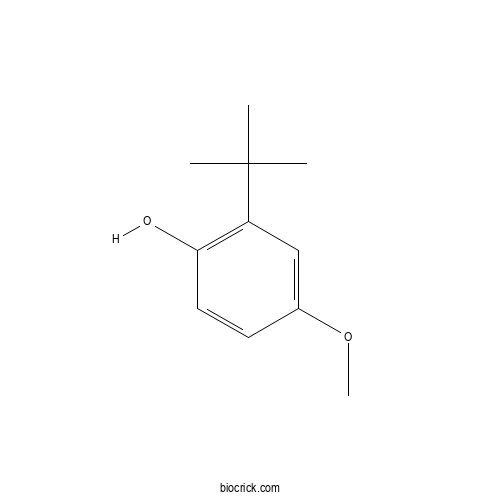
| Cas No. | 121-00-6 | SDF | File under preparation. |
| PubChem ID | 8456.0 | Appearance | Powder |
| Formula | C11H16O2 | M.Wt | 180.2 |
| Type of Compound | N/A | Storage | Desiccate at -20°C |
| Solubility | Soluble in Chloroform,Dichloromethane,Ethyl Acetate,DMSO,Acetone,etc. | ||
| Chemical Name | 2-tert-butyl-4-methoxyphenol | ||
| SMILES | CC(C)(C)C1=C(C=CC(=C1)OC)O | ||
| Standard InChIKey | MRBKEAMVRSLQPH-UHFFFAOYSA-N | ||
| Standard InChI | InChI=1S/C11H16O2/c1-11(2,3)9-7-8(13-4)5-6-10(9)12/h5-7,12H,1-4H3 | ||
| General tips | For obtaining a higher solubility , please warm the tube at 37 ℃ and shake it in the ultrasonic bath for a while.Stock solution can be stored below -20℃ for several months. We recommend that you prepare and use the solution on the same day. However, if the test schedule requires, the stock solutions can be prepared in advance, and the stock solution must be sealed and stored below -20℃. In general, the stock solution can be kept for several months. Before use, we recommend that you leave the vial at room temperature for at least an hour before opening it. |
||
| About Packaging | 1. The packaging of the product may be reversed during transportation, cause the high purity compounds to adhere to the neck or cap of the vial.Take the vail out of its packaging and shake gently until the compounds fall to the bottom of the vial. 2. For liquid products, please centrifuge at 500xg to gather the liquid to the bottom of the vial. 3. Try to avoid loss or contamination during the experiment. |
||
| Shipping Condition | Packaging according to customer requirements(5mg, 10mg, 20mg and more). Ship via FedEx, DHL, UPS, EMS or other couriers with RT, or blue ice upon request. | ||
Quality Control & MSDS
3D structure
Package In Stock

Number of papers citing our products


2-tert-Butyl-4-methoxyphenol Dilution Calculator
2-tert-Butyl-4-methoxyphenol Molarity Calculator
| 1 mg | 5 mg | 10 mg | 20 mg | 25 mg | |
| 1 mM | 5.5494 mL | 27.7469 mL | 55.4939 mL | 110.9878 mL | 138.7347 mL |
| 5 mM | 1.1099 mL | 5.5494 mL | 11.0988 mL | 22.1976 mL | 27.7469 mL |
| 10 mM | 0.5549 mL | 2.7747 mL | 5.5494 mL | 11.0988 mL | 13.8735 mL |
| 50 mM | 0.111 mL | 0.5549 mL | 1.1099 mL | 2.2198 mL | 2.7747 mL |
| 100 mM | 0.0555 mL | 0.2775 mL | 0.5549 mL | 1.1099 mL | 1.3873 mL |
| * Note: If you are in the process of experiment, it's necessary to make the dilution ratios of the samples. The dilution data above is only for reference. Normally, it's can get a better solubility within lower of Concentrations. | |||||
- Pipemidic acid
Catalog No.:BCX2350
CAS No.:51940-44-4
- Methylaervine
Catalog No.:BCX2349
CAS No.:86293-40-5
- Pyridoxal phosphate
Catalog No.:BCX2348
CAS No.:54-47-7
- (+)-Licarin B
Catalog No.:BCX2347
CAS No.:42016-15-9
- Caffealdehyde
Catalog No.:BCX2346
CAS No.:141632-15-7
- Acridone
Catalog No.:BCX2345
CAS No.:578-95-0
- Lactose
Catalog No.:BCX2344
CAS No.:63-42-3
- Bryodulcosigenin
Catalog No.:BCX2343
CAS No.:88930-16-9
- D-Glucuronic acid
Catalog No.:BCX2342
CAS No.:6556-12-3
- 6-Hydroxyflavanone
Catalog No.:BCX2341
CAS No.:190831-08-4
- Guanidinoacetic acid
Catalog No.:BCX2340
CAS No.:352-97-6
- 3-Amino-3-(3,4-dimethoxyphenyl)propionic acid
Catalog No.:BCX2339
CAS No.:54160-63-3
- 5-Pentadecylresorcinol
Catalog No.:BCX2352
CAS No.:3158-56-3
- Dotriacontane
Catalog No.:BCX2353
CAS No.:544-85-4
- Phenylephrine
Catalog No.:BCX2354
CAS No.:59-42-7
- Uridine 5'-diphosphogaluronic acid trisodium
Catalog No.:BCX2355
CAS No.:148407-07-2
- Cisplatin
Catalog No.:BCX2356
CAS No.:15663-27-1
- Adenosine triphosphate
Catalog No.:BCX2357
CAS No.:56-65-5
- Uridine 5'-diphosphoxylose disodium
Catalog No.:BCX2358
CAS No.:108320-89-4
- Uridine 5'-diphosphogalactose disodium
Catalog No.:BCX2359
CAS No.:137868-52-1
- 2,2-Dimethyl-2,3-dihydroquinazolin-4(1H )-one
Catalog No.:BCX2360
CAS No.:77726-78-4
- Desmosterol
Catalog No.:BCX2361
CAS No.:313-04-2
- 7-Dehydrocholestero
Catalog No.:BCX2362
CAS No.:434-16-2
- Acetyl CoA
Catalog No.:BCX2363
CAS No.:102029-73-2
Determination of water content in dimethyl sulfoxide/N,N-dimethyl formamide and methanol content in ethanol by solvatochromism of azo dye, 2-(tert-butyl)-4-methoxy-6-(naphthalen-1-yldiazenyl) phenol.[Pubmed:36628738]
Anal Chim Acta. 2023 Jan 25;1239:340747.
A novel 2-(tert-butyl)-4-methoxy-6-(naphthalen-1-yldiazenyl)phenol (NAP) was synthesized by coupling reaction of 2-tert-Butyl-4-methoxyphenol with diazotized naphthylamine as diazo component. The azo dye was characterized by NMR, FT-IR and UV-vis spectroscopic techniques. The visible spectrum of NAP was recorded in different solvents and at different pHs. NAP exhibited a large wavelength shift with increasing solvent polarity, showing significant color change over a wide range in different solvents. The determination of water content in organic solvents miscible with water such as dimethyl sulfoxide (DMSO)/N,N-dimethyl formamide (DMF) and methanol content in ethanol, which is also a common mixture were investigated with NAP which is azo dye. The present reported solvatochromic compound for the determination of water content in DMSO/DMF and methanol content in ethanol showed a fairly wide linear range compared to some previously reported solvatochromic compounds in the literature. In addition, the solvatochromism of NAP allows the determination of methanol content in ethanol, which has caused many deaths, with a fast, cheap and easy method.
Synthesis, Characterization, and Antimicrobial Activity of a Novel Trisazo Dye from 3-Amino-4H-thieno[3,4-c][1]benzopyran-4-one.[Pubmed:29484208]
Int J Med Chem. 2018 Feb 1;2018:9197821.
A new trisazo dye has been synthesized by coupling the diazonium ion of 3-amino-4H thieno[3,4-c][1]benzopyran-4-one with 2-tert-Butyl-4-methoxyphenol. The newly prepared trisazo dye was characterized by its physical, elemental, and spectroscopic data. 2D-NMR (COSY, HSQC, and HMBC) techniques were used to secure the structural assignments. The new trisazo dye (compound 7) along with precursors 3, 4, and 6 was screened by microdilution susceptibility assay for antibacterial and antifungal activities towards eight bacterial strains and three yeasts selected on the basis of their relevance as human pathogens. The results showed that compound 7 (MIC = 2-128 mug/mL) was the most active as compared with its precursors. The most resistant microorganisms were V. cholerae NB2 and V. cholerae SG24, whereas the most sensitive microorganism was C. neoformans. The overall results of this study indicated that compound 7 had the greatest potential value against both yeasts and multidrug-resistant bacteria, so further investigation is warranted.
Synthetic phenolic antioxidants, including butylated hydroxytoluene (BHT), in resin-based dental sealants.[Pubmed:27522571]
Environ Res. 2016 Nov;151:339-343.
Resin-based dental sealants (also referred to as pit-and-fissure sealants) have been studied for their contribution to bisphenol A (BPA) exposure in children. Nevertheless, little attention has been paid to the occurrence of other potentially toxic chemicals in dental sealants. In this study, the occurrence of six synthetic phenolic antioxidants (SPAs), including 2,6-di-tert-butyl-4-hydroxytoluene (BHT), 2,6-di-tert-butyl-4-(hydroxyethyl)phenol (BHT-OH), 3,5-di-tert-butyl-4-hydroxy-benzaldehyde (BHT-CHO), 2,6-di-tert-butylcyclohexa-2,5-diene-1,4-dione (BHT-Q), 3,5-di-tert-butyl-4-hydroxybenzoic acid (BHT-COOH) and 2-tert-Butyl-4-methoxyphenol (BHA), was examined in 63 dental sealant products purchased from the U.S. market. BHT was found in all dental sealants at median and maximum concentrations of 56.8 and 1020microg/g, respectively. The metabolites of BHT and BHA were detected in 39-67% of samples, at concentration ranges of BACKGROUND/AIM: The artificial complex phenols, 2-tert-Butyl-4-methoxyphenol (BHA), 2,6-di-tert-butyl-4-methylphenol (BHT) and 2,4,6-tri-tert-butylphenol (TBP) exert efficient antioxidant activity; however, they are considerable toxic and potentially tumor-promoting. These phenols, particularly in combinations, have enhanced antioxidant activity due to synergistic interactions and produce bioactive intermediates such as quinone methide. We investigated the anti-inflammatory activity of BHA, BHT and TBP, and combinations of BHT/BHA (in molar ratios of 1:1, 1:2, 1:3 and 2:1), BHT/TBP (1:1), and BHA/TBP (1:1), using gene-expression systems for cyclooxygenase-2 (Cox2) and tumor necrosis facto-alpha (Tnfa) in RAW264.7 cells. MATERIALS AND METHODS: The inhibitory effects of BHA, BHT and TBP on expression of Cox2 and Tnfa genes upon stimulation with Escherichia coli lipopolysaccharide (LPS) or Porphyomonas gingivalis (Pg) fimbriae were determined using real-time polymerase chain reaction. RESULTS: The inhibitory effect on expression of Cox2 and Tnfa genes upon stimulation with LPS and fimbriae was greatly enhanced by the combination of two antioxidants (molar ratio 1:1), BHT/BHA. In addition, that of the Cox2 gene, but not of Tnfa gene was slightly enhanced by a combination of equimolar BHT/TBP and BHA/TBP. None of the antioxidants alone exerted any anti-inflammatory activity upon stimulation with LPS, but a slight anti-inflammatory activity was observed upon stimulation with Pg fimbriae. The inhibitory effect of the BHT/BHA combination on expression of Cox2 mRNA upon stimulation with LPS was investigated at afferent molar ratios, and a molar ratio of 1:1 was found to have considerably less effect than a molar ratio of 1:2 or 2:1. The 1:3 combination had no effect. CONCLUSION: The combination of BHT and BHA at a molar ratio of 0.5-2 exerts potent anti-inflammatory activity. This anti-inflammatory activity on the generation of inflammatory mediators in LPS-activated RAW264.7 cells may be attributable to complex synergistic antioxidant activity of the combination of BHT and BHA. Our results suggest the potential usefulness of the BHT/BHA combination at an appropriate molar ratio as an antioxidant in foods and pharmaceuticals, whereas either antioxidant alone is unlikely to be effective. Butylated hydroxyanisole (BHA; a mixture of 2- and 3-BHA) is widely used as a potent antioxidant, but is reported to have adverse effects, such as carcinogenesis and pro-inflammatory activity, possibly due to the pro-oxidant property of this compound. 2-Methoxyphenol dimers derived from ferulic acid were recently demonstrated to inhibit the expression of lipopolysaccharide-stimulated cyclooxygenase-2 (COX-2) via redox-sensitive transcription factors such as nuclear factor kappa B or activator protein-1 (AP-1), due to a weakening of its pro-oxidant property by dimerization. To develop anti-inflammatory and/or anticancer drugs for the prevention of oral diseases, such as leukoplakia and destructive chronic periodontitis, whether 2-BHA (2-tert-Butyl-4-methoxyphenol) and its synthetic ortho dimer, bis-BHA (3,3'-di-tert-butyl-5,5'-dimethoxy-1,1'-biphenyl-2,2'-diol) can inhibit AP-1 transcriptional activity stimulated by Porphyromonas gingivalis fimbriae was examined. The fimbria-stimulated AP-1 activation of RAW 264.7 murine macrophages was markedly inhibited by bis-BHA. However, BHA showed slight inhibition. Furthermore, bis-BHA significantly inhibited fimbria-induced COX-2 gene expression, which is closely involved with inflammation and carcinogenesis. These findings suggest that bis-BHA may possess a potent anti-inflammatory effect against oral diseases. Butylated hydroxyanisole, BHA, is widely used as a potent antioxidant, but its adverse effects such as carcinogenesis and proinflammatory activity have been reported, which are possibly due to the prooxidant property of this compound. We recently demonstrated that the dimer of 2-methoxyphenols exhibits cyclooxygenase-2 inhibition, because of lessening of its prooxidant property caused by the dimerization. In the present study, toward our goal of developing a chemopreventive agent for chronic periodontal diseases, we examined whether 2-BHA (2-tert-Butyl-4-methoxyphenol) and its synthetic ortho dimer, bis-BHA (3,3'-di-tert-butyl-5,5'-dimethoxy-1,1'-biphenyl-2,2'-diol) could inhibit the Porphyromonas gingivalis fimbria-stimulated inflammatory reaction. The fimbria-induced expression of interleukin-1beta and neutrophil chemoattractant KC genes in RAW264.7 murine macrophages was strongly inhibited by bis-BHA. In contrast, 2-BHA showed only slight inhibition. bis-BHA also significantly inhibited the fimbria-stimulated phosphorylation-dependent degradation of the alpha inhibitor of nuclear factor-kappaB and the transcriptional activity of this factor in the cells. These findings suggest that bis-BHA possesses anti-inflammatory activity against chronic periodontal diseases. This paper aims to investigate the possibility of oxidation of the flavor active constituents of champagne wines during the critical steps of the extraction for analytical purposes and to estimate its consequences on the extract's aroma characteristics. The investigation uses conventional sensory and GC/O analyses. Triangle and similarity sensory tests carried out on champagne samples and on their extracts show that the absence of antioxidants implies a deterioration of the aroma quality. Conversely, the use of 2-tert-Butyl-4-methoxyphenol (BHA) as antioxidant gives an extract with an odor judged to be more similar to the original odor of the champagne. The alteration in the odor of the unprotected extracts is explained, from GC/O and GC/MS analyses, as three types of uncontrolled reactions. These are, first, the chemical oxidation of the fusel alcohols and the amino acids; second, the oxidation of sensitive flavor compounds such as enolic lactones and monoterpenic alcohols; and, third, the hydrolysis of fatty acid esters and saturated gamma-lactones. A systematic use of BHA during flavor extraction is therefore advisable, in particular when oxidation phenomena such as wine aging are under study. The effects of dietary addition of some xenobiotics on tissue levels of copper and alpha-tocopherol in rats were studied with special reference to serum cholesterol. The chemicals added here were 0.05% polychlorinated biphenyls (PCB), 0.3% caffeine, 0.05% 1,1,1-trichloro-2,2-bis(p-chlorophenyl)ethane (DDT), 0.3% flavone, 0.3% chloretone, 0.3% 2-tert-Butyl-4-methoxyphenol (BHA), 0.15% sodium phenobarbital, 0.15% phenytoin, 0.2% sodium pentobarbital, and 0.15% phenylbutazone. Of these chemicals, dietary PCB, caffeine, DDT, flavone, chloretone, BHA and phenytoin raised the level of copper in liver, kidney, or serum. Serum alpha-tocopherol and cholesterol also increased with the additive or synergistic effects on these metabolisms. Moreover, these combined addition of dietary 0.02% PCB with 0.2% BHA seemed to cause additive or synergistic effects on these metabolism. Moreover, these chemicals raised serum ceruloplasmin activity. In general, serum copper, ceruloplasmin activity and alpha-tocopherol were correlated with serum cholesterol in these dietary manipulations.Anti-inflammatory activity of the artificial antioxidants 2-tert-butyl-4-methoxyphenol (BHA), 2,6-di-tert-butyl-4-methylphenol (BHT) and 2,4,6-tri-tert-butylphenol (TBP), and their various combinations.[Pubmed:25792646]
In Vivo. 2015 Mar-Apr;29(2):197-206.
Preventive effect of ortho dimer of butylated hydroxyanisole on activator protein-1 activation and cyclooxygenase-2 expression in macrophages stimulated by fimbriae of Porphyromonas gingivalis, an oral anaerobe.[Pubmed:16886613]
Anticancer Res. 2006 Jul-Aug;26(4B):2915-20.
An ortho dimer of butylated hydroxyanisole inhibits nuclear factor kappa B activation and gene expression of inflammatory cytokines in macrophages stimulated by Porphyromonas gingivalis fimbriae.[Pubmed:16546114]
Arch Biochem Biophys. 2006 May 15;449(1-2):171-7.
Effect of antioxidants on the flavor characteristics and the gas chromatography/olfactometry profiles of champagne extracts.[Pubmed:10552650]
J Agric Food Chem. 1999 Aug;47(8):3303-8.
Effects of dietary xenobiotics on the metabolism of copper, alpha-tocopherol and cholesterol in rats.[Pubmed:3125311]
J Nutr Sci Vitaminol (Tokyo). 1987 Aug;33(4):281-8.

Calcutta University

University of Minnesota

University of Maryland School of Medicine

University of Illinois at Chicago

The Ohio State University

University of Zurich

Harvard University

Colorado State University

Auburn University

Yale University

Worcester Polytechnic Institute

Washington State University

Stanford University

University of Leipzig

Universidade da Beira Interior

The Institute of Cancer Research

Heidelberg University

University of Amsterdam

University of Auckland

TsingHua University

The University of Michigan

Miami University

DRURY University

Jilin University

Fudan University

Wuhan University

Sun Yat-sen University

Universite de Paris

Deemed University

Auckland University

The University of Tokyo

Korea University



