
BryodulcosigeninCAS# 88930-16-9 |
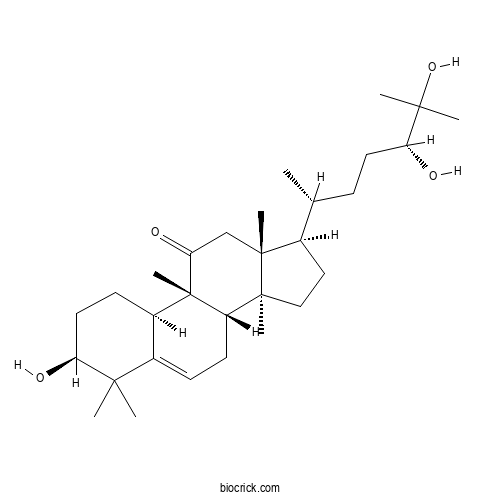
| Cas No. | 88930-16-9 | SDF | File under preparation. |
| PubChem ID | 399493.0 | Appearance | Powder |
| Formula | C30H50O4 | M.Wt | 474.7 |
| Type of Compound | N/A | Storage | Desiccate at -20°C |
| Solubility | Soluble in Chloroform,Dichloromethane,Ethyl Acetate,DMSO,Acetone,etc. | ||
| Chemical Name | (3S,8S,9R,10R,13R,14S,17R)-17-[(2R,5R)-5,6-dihydroxy-6-methylheptan-2-yl]-3-hydroxy-4,4,9,13,14-pentamethyl-1,2,3,7,8,10,12,15,16,17-decahydrocyclopenta[a]phenanthren-11-one | ||
| SMILES | CC(CCC(C(C)(C)O)O)C1CCC2(C1(CC(=O)C3(C2CC=C4C3CCC(C4(C)C)O)C)C)C | ||
| Standard InChIKey | FPMQKXQOBKDVHF-DJHQPCGUSA-N | ||
| Standard InChI | InChI=1S/C30H50O4/c1-18(9-13-24(32)27(4,5)34)19-15-16-28(6)22-12-10-20-21(11-14-23(31)26(20,2)3)30(22,8)25(33)17-29(19,28)7/h10,18-19,21-24,31-32,34H,9,11-17H2,1-8H3/t18-,19-,21-,22+,23+,24-,28+,29-,30+/m1/s1 | ||
| General tips | For obtaining a higher solubility , please warm the tube at 37 ℃ and shake it in the ultrasonic bath for a while.Stock solution can be stored below -20℃ for several months. We recommend that you prepare and use the solution on the same day. However, if the test schedule requires, the stock solutions can be prepared in advance, and the stock solution must be sealed and stored below -20℃. In general, the stock solution can be kept for several months. Before use, we recommend that you leave the vial at room temperature for at least an hour before opening it. |
||
| About Packaging | 1. The packaging of the product may be reversed during transportation, cause the high purity compounds to adhere to the neck or cap of the vial.Take the vail out of its packaging and shake gently until the compounds fall to the bottom of the vial. 2. For liquid products, please centrifuge at 500xg to gather the liquid to the bottom of the vial. 3. Try to avoid loss or contamination during the experiment. |
||
| Shipping Condition | Packaging according to customer requirements(5mg, 10mg, 20mg and more). Ship via FedEx, DHL, UPS, EMS or other couriers with RT, or blue ice upon request. | ||
Quality Control & MSDS
3D structure
Package In Stock

Number of papers citing our products


Bryodulcosigenin Dilution Calculator
Bryodulcosigenin Molarity Calculator


| 1 mg | 5 mg | 10 mg | 20 mg | 25 mg | |
| 1 mM | 2.1066 mL | 10.533 mL | 21.0659 mL | 42.1319 mL | 52.6648 mL |
| 5 mM | 0.4213 mL | 2.1066 mL | 4.2132 mL | 8.4264 mL | 10.533 mL |
| 10 mM | 0.2107 mL | 1.0533 mL | 2.1066 mL | 4.2132 mL | 5.2665 mL |
| 50 mM | 0.0421 mL | 0.2107 mL | 0.4213 mL | 0.8426 mL | 1.0533 mL |
| 100 mM | 0.0211 mL | 0.1053 mL | 0.2107 mL | 0.4213 mL | 0.5266 mL |
| * Note: If you are in the process of experiment, it's necessary to make the dilution ratios of the samples. The dilution data above is only for reference. Normally, it's can get a better solubility within lower of Concentrations. | |||||
- D-Glucuronic acid
Catalog No.:BCX2342
CAS No.:6556-12-3
- 6-Hydroxyflavanone
Catalog No.:BCX2341
CAS No.:190831-08-4
- Guanidinoacetic acid
Catalog No.:BCX2340
CAS No.:352-97-6
- 3-Amino-3-(3,4-dimethoxyphenyl)propionic acid
Catalog No.:BCX2339
CAS No.:54160-63-3
- 3-Methyl-4-isopropylphenol
Catalog No.:BCX2338
CAS No.:3228-02-2
- Turanose
Catalog No.:BCX2337
CAS No.:547-25-1
- Doxofylline
Catalog No.:BCX2336
CAS No.:69975-86-6
- 5-Methoxytryptamine
Catalog No.:BCX2335
CAS No.:608-07-1
- L-Mannose
Catalog No.:BCX2334
CAS No.:10030-80-5
- L-Galactose
Catalog No.:BCX2333
CAS No.:15572-79-9
- L-Arabinose
Catalog No.:BCX2332
CAS No.:5328-37-0
- Norcantharidin
Catalog No.:BCX2331
CAS No.:29745-04-8
- Lactose
Catalog No.:BCX2344
CAS No.:63-42-3
- Acridone
Catalog No.:BCX2345
CAS No.:578-95-0
- Caffealdehyde
Catalog No.:BCX2346
CAS No.:141632-15-7
- (+)-Licarin B
Catalog No.:BCX2347
CAS No.:42016-15-9
- Pyridoxal phosphate
Catalog No.:BCX2348
CAS No.:54-47-7
- Methylaervine
Catalog No.:BCX2349
CAS No.:86293-40-5
- Pipemidic acid
Catalog No.:BCX2350
CAS No.:51940-44-4
- 2-tert-Butyl-4-methoxyphenol
Catalog No.:BCX2351
CAS No.:121-00-6
- 5-Pentadecylresorcinol
Catalog No.:BCX2352
CAS No.:3158-56-3
- Dotriacontane
Catalog No.:BCX2353
CAS No.:544-85-4
- Phenylephrine
Catalog No.:BCX2354
CAS No.:59-42-7
- Uridine 5'-diphosphogaluronic acid trisodium
Catalog No.:BCX2355
CAS No.:148407-07-2
Active Components and Potential Molecular Mechanisms of Panax Notoginseng in Alleviating Intestinal Ischemia/Reperfusion-induced Acute Lung Injury: A Study Integrating UHPLC-MS/MS, Network Pharmacology, and Molecular Docking.[Pubmed:42311014]
Curr Med Chem. 2026 Jun 15.
INTRODUCTION: Intestinal ischemia/reperfusion (I/R)-induced acute lung injury (ALI) is a key contributing factor to mortality and disability following surgery for acute abdominal emergencies. Panax notoginseng (PN) exerts a significant alleviating effect on intestinal I/R-induced ALI. The objective of this study is to use Ultra-high performance liquid chromatography-Mass spectrometry (UHPLC-MS/MS), network pharmacology, and molecular docking methods to investigate the main active components of PN in alleviating intestinal I/R-induced ALI and their molecular mechanisms. METHODS: The chemical compositions of PN were identified using UHPLC-MS/MS, and potential targets for these compounds were predicted using the Swiss Target Prediction database. Subsequently, Cytoscape 3.7.2 was utilized to design a network that demonstrates the interactions of drugs, components, and targets. Targets associated with intestinal I/R-induced ALI were detected using the GeneCards and OMIM databases. Cross-- targets between the drug and the disease were analyzed, and a PPI network was established via the STRING database. The targets that overlap were subjected to GO and KEGG enrichment analyses. The interactions between core bioactive substances and key proteins were validated through molecular docking. RESULTS: UHPLC-MS/MS analysis identified 71 major chemical constituents in PN. Protein- protein interactions (PPI) network analysis revealed that TNF, IL-6, AKT1, and IL-1beta were the most highly interconnected hub targets. The GO analysis revealed a notable enrichment in biological processes such as response to xenobiotic stimulus, positive regulation of gene expression, and inflammatory response. According to the KEGG pathway analysis, significant signaling pathways include PI3K-Akt, TNF, and HIF-1. The stable binding conformations of L-Tryptophan, Quercetin, Adenosine, Linolenic acid ethyl ester, and Bryodulcosigenin with core targets TNF, IL-6, AKT1, IL-1beta, and GAPDH were confirmed through molecular docking. DISCUSSION: This computational study provides a systematic framework for deciphering the complex mechanisms of traditional medicines. Our analysis proposes that PN alleviates intestinal I/R-induced ALI through a "multi-component, multi-target, multi-pathway" mechanism. The findings serve as a robust hypothesis-generating resource, offering precise candidates and pathways for future experimental validation. CONCLUSION: This research predicts the effective components of PN and their potential molecular mechanisms in treating intestinal I/R-induced ALI, laying a theoretical groundwork for future experimental confirmation and clinical application.
Anti-inflammatory and neuroprotective effect of bryodulcosigenin against cerebral ischemia/reperfusion injury via modulation of inflammatory signaling pathways.[Pubmed:41269478]
Inflammopharmacology. 2026 Jan;34(1):525-544.
BACKGROUND: During acute ischemic stroke, a cascade of pathophysiological reactions leads to brain cell injury, primarily via disruptions in energy metabolism and increased oxidative stress. In this study, we scrutinized the neuroprotective effects of Bryodulcosigenin (BRY) against acute cerebral ischemia/reperfusion (CIR) injury in rats. MATERIAL AND METHODS: To induce middle cerebral artery occlusion (MCAO) in rats, a nylon monofilament suture with a silicon-coated tip was inserted into the internal carotid artery. The cerebral infarct volume, brain water content, neurological deficits, brain edema, Evan Blue extravasation and blood brain barrier (BBB) leakage were estimated. The antioxidant, cytokines, inflammatory and matrix metalloproteinases (MMP) parameters were evaluated. mRNA expression and histopathological study were performed. RESULTS: Bryodulcosigenin significantly suppressed the neurological deficits, cerebral infarct volume, brain edema, brain water content, BBB leakage and Evan Blue extravasation. It also suppressed brain injury markers like K(+)-Cl(-) cotransporter 1 (KCC1), S100 calcium-binding protein B (S-100beta), neuron specific enolase (NSE), occludin and clusterin. Moreover, Bryodulcosigenin altered antioxidant levels via enhancing the level of glutathione peroxidase (GPx), glutathione (GSH), superoxide dismutase (SOD), catalase (CAT), while reducing malonaldehyde (MDA) and 8-hydroxy-2'-deoxyguanosine (8-OhdG). It altered the pro-inflammatory cytokines like tumor necrosis factor-alpha (TNF-alpha), interleukin (IL)-1, IL-1beta, IL-4, IL-6, IL-10, as well as inflammatory mediators such as inducible nitric oxide (iNOS), cyclooxygenase-2 (COX-2), vascular endothelium growth factor (VEGF), prostaglandin (PGE(2)), nuclear factor kappa B (NF-kappaB) and MMP (MMP-2, MMP-3 and MMP-9) level in the serum and brain tissue. Additionally, Bryodulcosigenin modulated the mRNA expression of Toll-Like Receptor 4 (TLR4), syndecan-1, cerebrospinal fluid (CSF), aquaporin-1 (AQP1), organic cation transporter 3 (OCT3), reduced expression 1 (REX1) and improved the histopathological condition. CONCLUSION: Bryodulcosigenin exerted anti-inflammatory and neuroprotective effects against CIR injury via alteration of TLR4/NF-kappaB signaling pathways.
Antiosteoporosis effect of bryodulcosigenin on ovariectomy-induced osteoporosis in experimental rats.[Pubmed:38656061]
Acta Cir Bras. 2024 Apr 22;39:e391024.
PURPOSE: Osteoporosis is a bone disease which commonly occurred in postmenopausal women. Almost 10 percent of world population and approximately 30% of women (postmenopausal) suffer from this disease. Alternative medicine has great success in the treatment of osteoporosis disease. Bryodulcosigenin, a potent phytoconstituent, already displayed the anti-inflammatory and antioxidant effect. In this study, we made effort to analyze the antiosteoporosis effect of Bryodulcosigenin against ovariectomy (OVX) induced osteoporosis in rats. METHODS: Swiss albino Wistar rats were grouped into fIve groups and given an oral dose of Bryodulcosigenin (10, 20 and 30 mg/kg) for eight weeks. Body weight, uterus, bone mineral density, cytokines, hormones parameters, transforming growth factor (TGF)-beta, insulin-like growth factor (IGF), osteoprotegerin (OPG), receptor activator of nuclear factor kappa-Beta ligand (RANKL), and its ratio were estimated. RESULTS: Bryodulcosigenin significantly (p < 0.001) suppressed the body weight and enhanced the uterine weight and significantly (p < 0.001) increased the bone mineral density in whole femur, caput femoris, distal femur and proximal femur. Bryodulcosigenin significantly (P < 0.001) altered the level of biochemical parameters at dose dependent manner, significantly (P < 0.001) improved the level of estrogen and suppressed the level of follicle stimulating hormone and luteinizing hormone. Bryodulcosigenin significantly (P < 0.001) improved the level of OPG and suppressed the level of RANKL. CONCLUSIONS: Bryodulcosigenin reduced the cytokines level and suppressed the TGF-beta and IGF. We concluded that Bryodulcosigenin is an antiosteoporosis medication based on the findings.
Bryodulcosigenin attenuates bleomycin-induced pulmonary fibrosis via inhibiting AMPK-mediated mesenchymal epithelial transition and oxidative stress.[Pubmed:35794782]
Phytother Res. 2022 Oct;36(10):3911-3923.
Fibrosis is a pathological result of a dysfunctional repair response to tissue injury and occurs in several organs, including the lungs. Bryodulcosigenin (BDG) is a cucurbitane-type triterpene isolated from Siratia grosvenori and has clear-cut anti-inflammatory effects, yet its benefit of pulmonary fibrosis (PF) remains unclear. In this study, we investigated the protective effects of BDG (10 mg/kg/day, for 14 days) against TGF-beta1-stimulated mouse alveolar epithelial MLE-12 cells and bleomycin (BLM)-induced PF mice. In vitro experiments showed that BDG could inhibit epithelial-mesenchymal transition (EMT) and oxidative stress. In vivo experiments indicated that BDG could ameliorate BLM-induced PF in mice as evidenced by characteristic structural changes in histopathology, increased collagen deposition and reduced survival and weight of mice. The abnormal increased expressions of TGF-beta1, p-Smad2/3, alpha-SMA, COL-I, and NOX4 and decreased expressions for Sirt1 and p-AMPK were improved in BDG treatment. But these beneficial effects could be eliminated by co-treatment with Compound C (CC, a selective AMPK inhibitor). Molecular docking technology also revealed the potential of BDG to activate AMPK. In summary, AMPK activation modulated by BDG not only ameliorated TGF-beta1/Smad2/3 signaling pathways but also partially mediated the suppression effects on EMT and oxidative stress, thus mediating the anti-fibrotic effects.
Bryodulcosigenin a natural cucurbitane-type triterpenoid attenuates dextran sulfate sodium (DSS)-induced colitis in mice.[Pubmed:34798522]
Phytomedicine. 2022 Jan;94:153814.
BACKGROUND: Bryodulcosigenin (BDG) a cucurbitane-type triterpenoid has been isolated from the roots of Bryonia dioca and possesses marked anti-inflammatory effects, although its beneficial effect against intestinal disorders remains unclear. PURPOSE: To explore the underlying mechanism of BDG on the dysbiosis of chronic ulcerative colitis (UC) and its associated side-effects on lung tissues. METHODS: A chronic UC model was established using 2.5% dextran sulfate sodium (DSS) in mice treated for 64 days and diagnostic assessments, western blot analysis and quantitative real time-PCR were employed to determine the protective mechanism of BDG. RESULTS: Oral administration of BDG (10 mg/kg/day) significantly improved colon length, disease activity index, and alleviated colonic histopathological damage in the DSS-induced colitis mice. BDG not only reversed the TNF-alpha-induced degradation of tight junction proteins (occludin and ZO-1) but also suppressed the elevated apoptosis seen in intestinal epithelial cells (NCM460). In addition, BDG significantly attenuated damage in alveolar epithelial cells (MLE-12) co-cultured with NCM460 cells under inflammatory conditions. Furthermore, BDG in vivo significantly prevented the symptoms of respiratory disorders and repressed alveolar inflammation by regulating DSS-induced chronic colitis in mice. CONCLUSION: BDG effectively inhibited the apoptosis of intestinal epithelial cells and suppressed the activation of the NLRP3 inflammasome which resulted in the restoration of the intestinal barrier. Therefore, the enhanced integrity of intestinal epithelial cells produced by BDG intervention contributed to its anti-colitis effects, indicating its great potential as an inhibitor of UC and lung injury. Therefore, restoring intestinal integrity may represent a promising strategy in the prevention of pulmonary disease.
Anti-inflammatory and anti-tumor-promoting effects of cucurbitane glycosides from the roots of Bryonia dioica.[Pubmed:11858752]
J Nat Prod. 2002 Feb;65(2):179-83.
Seven new triterpene glycosides, bryoniosides A-G (1-7), have been isolated along with two known triterpene glycosides, cabenoside D (8) and bryoamaride (9), from a methanol extract of the roots of Bryoniadioica. The structures of 1-7 were determined on the basis of spectroscopic and chemical methods. Six compounds, 2, 3, 5, and 7-9, and 11 compounds, 1-9, Bryodulcosigenin (10), and bryosigenin (11), respectively, were evaluated for their inhibitory effects on 12-O-tetradecanoylphorbol-13-acetate (TPA)-induced inflammation (1 microg/ear) in mice and on Epstein-Barr virus early antigen (EBV-EA) activation induced by TPA. All compounds tested showed marked anti-inflammatory effects, with 50% inhibitory doses (ID(50)) of 0.2-0.6 mg per ear. In addition, all of the compounds tested except for compound 5 showed potent inhibitory effects on EBV-EA induction (100% inhibition at 1 x 10(3) mol ratio/TPA).
Biosynthesis of cucurbitacins in Bryonia dioica seedlings.[Pubmed:17401854]
Planta Med. 1981 Apr;41(4):328-36.
The biosynthesis of cucurbitacins during the seed germination of Bryonia dioica was studied by analysis of the cucurbitacin-triterpenoid fraction and by tracer experiments with acetate-[2- (14)C]. Isolation of 10alpha-cucurbita-5,24-dien-3beta-ol (9a), the simplest tetracyclic triterpene with a cucurbitane skeleton, supports the view that (9a) is the general precursor of cucurbitacins. Moreover, following the tracer experiments, cucurbitacin E (1a) was the first cucurbitacin formed, whereas the less oxygenated Bryodulcosigenin (4a) was not detectable during germination of the plant. In the course of the present investigation, a new pentacyclic triterpene, isomultiflorenol (11a) (possible precursor of bryonolic acid (5a)), was also isolated.

Calcutta University

University of Minnesota

University of Maryland School of Medicine

University of Illinois at Chicago

The Ohio State University

University of Zurich

Harvard University

Colorado State University

Auburn University

Yale University

Worcester Polytechnic Institute

Washington State University

Stanford University

University of Leipzig

Universidade da Beira Interior

The Institute of Cancer Research

Heidelberg University

University of Amsterdam

University of Auckland

TsingHua University

The University of Michigan

Miami University

DRURY University

Jilin University

Fudan University

Wuhan University

Sun Yat-sen University

Universite de Paris

Deemed University

Auckland University

The University of Tokyo

Korea University



