
CaffealdehydeCAS# 141632-15-7 |
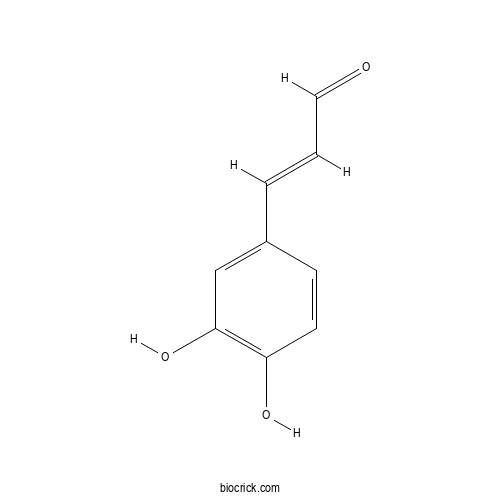
| Cas No. | 141632-15-7 | SDF | File under preparation. |
| PubChem ID | 5281871.0 | Appearance | Yellow powder |
| Formula | C9H8O3 | M.Wt | 164.2 |
| Type of Compound | N/A | Storage | Desiccate at -20°C |
| Solubility | Soluble in Chloroform,Dichloromethane,Ethyl Acetate,DMSO,Acetone,etc. | ||
| Chemical Name | (E)-3-(3,4-dihydroxyphenyl)prop-2-enal | ||
| SMILES | C1=CC(=C(C=C1C=CC=O)O)O | ||
| Standard InChIKey | AXMVYSVVTMKQSL-OWOJBTEDSA-N | ||
| Standard InChI | InChI=1S/C9H8O3/c10-5-1-2-7-3-4-8(11)9(12)6-7/h1-6,11-12H/b2-1+ | ||
| General tips | For obtaining a higher solubility , please warm the tube at 37 ℃ and shake it in the ultrasonic bath for a while.Stock solution can be stored below -20℃ for several months. We recommend that you prepare and use the solution on the same day. However, if the test schedule requires, the stock solutions can be prepared in advance, and the stock solution must be sealed and stored below -20℃. In general, the stock solution can be kept for several months. Before use, we recommend that you leave the vial at room temperature for at least an hour before opening it. |
||
| About Packaging | 1. The packaging of the product may be reversed during transportation, cause the high purity compounds to adhere to the neck or cap of the vial.Take the vail out of its packaging and shake gently until the compounds fall to the bottom of the vial. 2. For liquid products, please centrifuge at 500xg to gather the liquid to the bottom of the vial. 3. Try to avoid loss or contamination during the experiment. |
||
| Shipping Condition | Packaging according to customer requirements(5mg, 10mg, 20mg and more). Ship via FedEx, DHL, UPS, EMS or other couriers with RT, or blue ice upon request. | ||
Quality Control & MSDS
3D structure
Package In Stock

Number of papers citing our products


Caffealdehyde Dilution Calculator
Caffealdehyde Molarity Calculator

| 1 mg | 5 mg | 10 mg | 20 mg | 25 mg | |
| 1 mM | 6.0901 mL | 30.4507 mL | 60.9013 mL | 121.8027 mL | 152.2533 mL |
| 5 mM | 1.218 mL | 6.0901 mL | 12.1803 mL | 24.3605 mL | 30.4507 mL |
| 10 mM | 0.609 mL | 3.0451 mL | 6.0901 mL | 12.1803 mL | 15.2253 mL |
| 50 mM | 0.1218 mL | 0.609 mL | 1.218 mL | 2.4361 mL | 3.0451 mL |
| 100 mM | 0.0609 mL | 0.3045 mL | 0.609 mL | 1.218 mL | 1.5225 mL |
| * Note: If you are in the process of experiment, it's necessary to make the dilution ratios of the samples. The dilution data above is only for reference. Normally, it's can get a better solubility within lower of Concentrations. | |||||
- Acridone
Catalog No.:BCX2345
CAS No.:578-95-0
- Lactose
Catalog No.:BCX2344
CAS No.:63-42-3
- Bryodulcosigenin
Catalog No.:BCX2343
CAS No.:88930-16-9
- D-Glucuronic acid
Catalog No.:BCX2342
CAS No.:6556-12-3
- 6-Hydroxyflavanone
Catalog No.:BCX2341
CAS No.:190831-08-4
- Guanidinoacetic acid
Catalog No.:BCX2340
CAS No.:352-97-6
- 3-Amino-3-(3,4-dimethoxyphenyl)propionic acid
Catalog No.:BCX2339
CAS No.:54160-63-3
- 3-Methyl-4-isopropylphenol
Catalog No.:BCX2338
CAS No.:3228-02-2
- Turanose
Catalog No.:BCX2337
CAS No.:547-25-1
- Doxofylline
Catalog No.:BCX2336
CAS No.:69975-86-6
- 5-Methoxytryptamine
Catalog No.:BCX2335
CAS No.:608-07-1
- L-Mannose
Catalog No.:BCX2334
CAS No.:10030-80-5
- (+)-Licarin B
Catalog No.:BCX2347
CAS No.:42016-15-9
- Pyridoxal phosphate
Catalog No.:BCX2348
CAS No.:54-47-7
- Methylaervine
Catalog No.:BCX2349
CAS No.:86293-40-5
- Pipemidic acid
Catalog No.:BCX2350
CAS No.:51940-44-4
- 2-tert-Butyl-4-methoxyphenol
Catalog No.:BCX2351
CAS No.:121-00-6
- 5-Pentadecylresorcinol
Catalog No.:BCX2352
CAS No.:3158-56-3
- Dotriacontane
Catalog No.:BCX2353
CAS No.:544-85-4
- Phenylephrine
Catalog No.:BCX2354
CAS No.:59-42-7
- Uridine 5'-diphosphogaluronic acid trisodium
Catalog No.:BCX2355
CAS No.:148407-07-2
- Cisplatin
Catalog No.:BCX2356
CAS No.:15663-27-1
- Adenosine triphosphate
Catalog No.:BCX2357
CAS No.:56-65-5
- Uridine 5'-diphosphoxylose disodium
Catalog No.:BCX2358
CAS No.:108320-89-4
Genome-wide identification of LAC and CAD gene family and the function of lignin biosynthesis by co-expressed PsiLAC8-PsiCAD5 module in Populus simonii.[Pubmed:41223596]
Plant Physiol Biochem. 2026 Jan;230:110742.
This study presents the first genome-wide identification and comprehensive analysis of laccase (LAC) and cinnamyl alcohol dehydrogenase (CAD) gene families in Populus simonii, revealing 39 PsiLAC and 18 PsiCAD members. Phylogenetic and structural analyses classified these genes into distinct subfamilies, highlighting conserved motifs and evolutionary divergence. Tissue-specific expression patterns demonstrated high activity in roots, leaves, and apex, while abiotic stress responses implicated their roles in drought and salt tolerance. Since the knockout of COMT leads to the accumulation of the C-lignin precursor (caffeyl alcohol), we chose the COMT-KO line as the background. Additionally, research results on Cleome hassleriana showed that CAD5 has a higher affinity for Caffealdehyde and can specifically catalyze the reduction of caffeoyl-CoA (caffeoyl coenzyme A) to caffeyl alcohol. This allows LAC8 to promote the polymerization of caffeyl alcohol to form C-lignin. A groundbreaking achievement was the construction of a PsiLAC8-PsiCAD5 tandem gene module, which was transformed into COMT-KO poplar lines. Transgenic plants exhibited elevated lignin content and altered phenotypes, providing functional evidence for their involvement in lignin polymerization. This work not only advances understanding of lignin biosynthesis in woody plants but also establishes a foundation for engineering C-lignin production in Populus, offering novel strategies for improving biomass utilization and stress resilience. The integration of bioinformatics, expression profiling, and transgenic validation underscores the dual functional significance of PsiLAC8-PsiCAD5 in lignin synthesis and stress adaptation.
Integrated metabolome and transcriptome analysis of maize roots response to different degrees of drought stress.[Pubmed:40259225]
BMC Plant Biol. 2025 Apr 21;25(1):505.
BACKGROUND: Plants in arid environments can regulate the generation of specialized metabolites to enhance their adaptability. Roots serve as the first defense line, responding directly to drought situations; however, the knowledge regarding the molecular mechanisms of metabolite changes to drought in maize roots remain largely limited. Here, we employed RNA-seq and UPLC-MS/MS methods to examine changes in the root metabolome and transcriptome of maize seedlings subjected to moderate drought (MD) and severe drought (SD) conditions by controlling water supply. RESULTS: Compared to the untreated control group, 460 differentially accumulated metabolites were detected in roots under MD and SD conditions. Among these metabolites, lignin compounds emerged as the primary response to drought. Most lignin metabolites, including Caffealdehyde, sinapyl alcohol, coniferaldehyde, p-coumaryl alcohol, and p-coumaric acid, showed a significant increase under MD but decreased under SD. Transcriptional profiling identified 903 and 5306 differential genes in roots treated with MD and SD, respectively. The majority of these genes were associated with lignin biosynthesis, hormone synthesis and signal transduction, and defense response processes. These metabolites and genes play crucial roles in lignin biosynthesis, antioxidant capacity, hormone balance, and root growth, particularly under MD conditions, which aligns with the results from morpho-physiological studies. Further, a conjoint omics analysis highlighted the significant regulatory roles of hormone-associated genes in lignin formation. CONCLUSION: Our results suggest that the co-regulation of the lignin biosynthesis pathway and hormone signals significantly enhances root performance, helping maize maintain growth under MD conditions. This study leads to a better understanding of the regulatory mechanisms involved in maize root adaptation to drought environments.
Enzymatic basis for C-lignin monomer biosynthesis in the seed coat of Cleome hassleriana.[Pubmed:31002459]
Plant J. 2019 Aug;99(3):506-520.
C-lignin is a linear polymer of caffeyl alcohol, found in the seed coats of several exotic plant species, with promising properties for generation of carbon fibers and high value chemicals. In the ornamental plant Cleome hassleriana, guaiacyl (G) lignin is deposited in the seed coat for the first 6-12 days after pollination, after which G-lignin deposition ceases and C-lignin accumulates, providing an excellent model system to study C-lignin biosynthesis. We performed RNA sequencing of seed coats harvested at 2-day intervals throughout development. Bioinformatic analysis identified a complete set of lignin biosynthesis genes for Cleome. Transcript analysis coupled with kinetic analysis of recombinant enzymes in Escherichia coli revealed that the switch to C-lignin formation was accompanied by down-regulation of transcripts encoding functional caffeoyl CoA- and caffeic acid 3-O-methyltransferases (CCoAOMT and COMT) and a form of cinnamyl alcohol dehydrogenase (ChCAD4) with preference for coniferaldehyde as substrate, and up-regulation of a form of CAD (ChCAD5) with preference for Caffealdehyde. Based on these analyses, blockage of lignin monomer methylation by down-regulation of both O-methyltransferases (OMTs) and methionine synthase (for provision of C1 units) appears to be the major factor in diversion of flux to C-lignin in the Cleome seed coat, although the change in CAD specificity also contributes based on the reduction of C-lignin levels in transgenic Cleome with down-regulation of ChCAD5. Structure modeling and mutational analysis identified amino acid residues important for the preference of ChCAD5 for Caffealdehyde.
Overexpression of artificially fused bifunctional enzyme 4CL1-CCR: a method for production of secreted 4-hydroxycinnamaldehydes in Escherichia coli.[Pubmed:26264710]
Microb Cell Fact. 2015 Aug 12;14:118.
BACKGROUND: 4-Hydroxycinnamaldehydes are important intermediates in several secondary metabolism pathways, including those involved in the biosynthesis of phenolic acids, flavonoids, terpenoids and monolignols. They are also involved in the biosynthesis and degradation of lignins, which are important limiting factors during the processes of papermaking and biofuel production. Access to these aromatic polymers is necessary to explore the secondary biometabolic pathways they are involved in. Coniferaldehyde, sinapaldehyde, p-coumaraldehyde and Caffealdehyde are members of the 4-hydroxycinnamaldehyde family. Although coniferaldehyde and sinapaldehyde can be purchased from commercial sources, p-coumaraldehyde and Caffealdehyde are not commercially available. Therefore, there is increasing interest in producing 4-hydroxycinnamaldehydes. Here, we attempted to produce 4-hydroxycinnamaldehydes using engineered Escherichia coli. RESULTS: 4-Coumaric acid: coenzyme A ligase (4CL1) and cinnamoyl coenzyme A reductase (CCR) were fused by means of genetic engineering to generate an artificial bifunctional enzyme, 4CL1-CCR, which was overexpressed in cultured E. coli supplemented with phenylpropanoic acids. Three 4-hydroxycinnamaldehydes, p-coumaraldehyde, Caffealdehyde and coniferaldehyde, were thereby biosynthesized and secreted into the culture medium. The products were extracted and purified from the culture medium, and identically characterized by the HPLC-PDA-ESI-MSn. The productivity of this new metabolic system were 49 mg/L for p-coumaraldehyde, 19 mg/L for Caffealdehyde and 35 mg/L for coniferaldehyde. Extracellular hydroxycinnamoyl-coenzyme A thioesters were not detected, indicating that these thioesters could not pass freely through the cellular membrane. The fusion enzyme 4CL1-CCR can catalyze sequential multistep reactions, thereby avoiding the permeability problem of intermediates, which reveals its superiority over a mixture of individual native enzymes. Moreover, we have described a highly sensitive and selective method for separation and identification of phenylpropanoic acids and their corresponding cinnamaldehydes in the present paper. The feasibility of this method has been proven in the application of the method to the analysis of the metabolites of whole-cell catalysts. CONCLUSIONS: We have established a bioconversion pathway for the microbial production of valuable 4-hydroxycinnamaldehydes from phenylpropanoic acids. This biotransformation method is both convenient and environmentally friendly, and provides new insights into the biosynthesis of natural plant secondary products.

Calcutta University

University of Minnesota

University of Maryland School of Medicine

University of Illinois at Chicago

The Ohio State University

University of Zurich

Harvard University

Colorado State University

Auburn University

Yale University

Worcester Polytechnic Institute

Washington State University

Stanford University

University of Leipzig

Universidade da Beira Interior

The Institute of Cancer Research

Heidelberg University

University of Amsterdam

University of Auckland

TsingHua University

The University of Michigan

Miami University

DRURY University

Jilin University

Fudan University

Wuhan University

Sun Yat-sen University

Universite de Paris

Deemed University

Auckland University

The University of Tokyo

Korea University



