
TuranoseCAS# 547-25-1 |
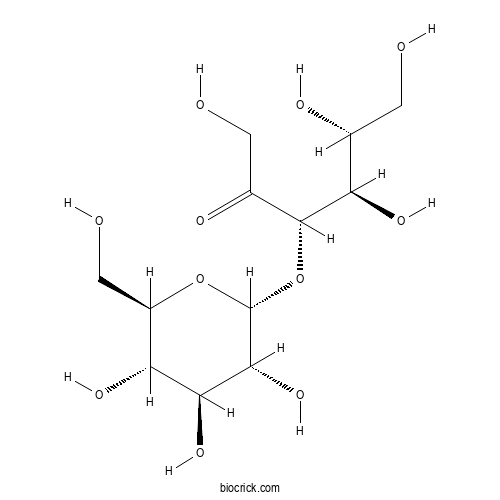
| Cas No. | 547-25-1 | SDF | File under preparation. |
| PubChem ID | 5460935.0 | Appearance | Powder |
| Formula | C12H22O11 | M.Wt | 342.3 |
| Type of Compound | N/A | Storage | Desiccate at -20°C |
| Solubility | Soluble in Chloroform,Dichloromethane,Ethyl Acetate,DMSO,Acetone,etc. | ||
| Chemical Name | (3S,4R,5R)-1,4,5,6-tetrahydroxy-3-[(2R,3R,4S,5S,6R)-3,4,5-trihydroxy-6-(hydroxymethyl)oxan-2-yl]oxyhexan-2-one | ||
| SMILES | C(C1C(C(C(C(O1)OC(C(C(CO)O)O)C(=O)CO)O)O)O)O | ||
| Standard InChIKey | RULSWEULPANCDV-PIXUTMIVSA-N | ||
| Standard InChI | InChI=1S/C12H22O11/c13-1-4(16)7(18)11(5(17)2-14)23-12-10(21)9(20)8(19)6(3-15)22-12/h4,6-16,18-21H,1-3H2/t4-,6-,7-,8-,9+,10-,11-,12-/m1/s1 | ||
| General tips | For obtaining a higher solubility , please warm the tube at 37 ℃ and shake it in the ultrasonic bath for a while.Stock solution can be stored below -20℃ for several months. We recommend that you prepare and use the solution on the same day. However, if the test schedule requires, the stock solutions can be prepared in advance, and the stock solution must be sealed and stored below -20℃. In general, the stock solution can be kept for several months. Before use, we recommend that you leave the vial at room temperature for at least an hour before opening it. |
||
| About Packaging | 1. The packaging of the product may be reversed during transportation, cause the high purity compounds to adhere to the neck or cap of the vial.Take the vail out of its packaging and shake gently until the compounds fall to the bottom of the vial. 2. For liquid products, please centrifuge at 500xg to gather the liquid to the bottom of the vial. 3. Try to avoid loss or contamination during the experiment. |
||
| Shipping Condition | Packaging according to customer requirements(5mg, 10mg, 20mg and more). Ship via FedEx, DHL, UPS, EMS or other couriers with RT, or blue ice upon request. | ||
Quality Control & MSDS
3D structure
Package In Stock

Number of papers citing our products


Turanose Dilution Calculator
Turanose Molarity Calculator
| 1 mg | 5 mg | 10 mg | 20 mg | 25 mg | |
| 1 mM | 2.9214 mL | 14.6071 mL | 29.2141 mL | 58.4283 mL | 73.0353 mL |
| 5 mM | 0.5843 mL | 2.9214 mL | 5.8428 mL | 11.6857 mL | 14.6071 mL |
| 10 mM | 0.2921 mL | 1.4607 mL | 2.9214 mL | 5.8428 mL | 7.3035 mL |
| 50 mM | 0.0584 mL | 0.2921 mL | 0.5843 mL | 1.1686 mL | 1.4607 mL |
| 100 mM | 0.0292 mL | 0.1461 mL | 0.2921 mL | 0.5843 mL | 0.7304 mL |
| * Note: If you are in the process of experiment, it's necessary to make the dilution ratios of the samples. The dilution data above is only for reference. Normally, it's can get a better solubility within lower of Concentrations. | |||||
- Doxofylline
Catalog No.:BCX2336
CAS No.:69975-86-6
- 5-Methoxytryptamine
Catalog No.:BCX2335
CAS No.:608-07-1
- L-Mannose
Catalog No.:BCX2334
CAS No.:10030-80-5
- L-Galactose
Catalog No.:BCX2333
CAS No.:15572-79-9
- L-Arabinose
Catalog No.:BCX2332
CAS No.:5328-37-0
- Norcantharidin
Catalog No.:BCX2331
CAS No.:29745-04-8
- Dopamine
Catalog No.:BCX2330
CAS No.:51-61-6
- L-Ornithine
Catalog No.:BCX2329
CAS No.:70-26-8
- Putrescine
Catalog No.:BCX2328
CAS No.:110-60-1
- 3-Methyl-1-(3-methylfuran-2-yl)but-3-en-1-one
Catalog No.:BCX2327
CAS No.:78173-38-3
- Sorocein H
Catalog No.:BCX2326
CAS No.:157382-82-6
- Cathayanin B
Catalog No.:BCX2325
CAS No.:330195-60-3
- 3-Methyl-4-isopropylphenol
Catalog No.:BCX2338
CAS No.:3228-02-2
- 3-Amino-3-(3,4-dimethoxyphenyl)propionic acid
Catalog No.:BCX2339
CAS No.:54160-63-3
- Guanidinoacetic acid
Catalog No.:BCX2340
CAS No.:352-97-6
- 6-Hydroxyflavanone
Catalog No.:BCX2341
CAS No.:190831-08-4
- D-Glucuronic acid
Catalog No.:BCX2342
CAS No.:6556-12-3
- Bryodulcosigenin
Catalog No.:BCX2343
CAS No.:88930-16-9
- Lactose
Catalog No.:BCX2344
CAS No.:63-42-3
- Acridone
Catalog No.:BCX2345
CAS No.:578-95-0
- Caffealdehyde
Catalog No.:BCX2346
CAS No.:141632-15-7
- (+)-Licarin B
Catalog No.:BCX2347
CAS No.:42016-15-9
- Pyridoxal phosphate
Catalog No.:BCX2348
CAS No.:54-47-7
- Methylaervine
Catalog No.:BCX2349
CAS No.:86293-40-5
Amylosucrase as a Versatile Biocatalyst for Next-Generation Functional Ingredients: Starch Modification and Glycoside Synthesis.[Pubmed:42746754]
Compr Rev Food Sci Food Saf. 2026 Sep;25(5):e70656.
Amylosucrase (ASase, E.C. 2.4.1.4) is a transglucosidase that catalyzes alpha-glucan synthesis and transglycosylation reactions using sucrose as the sole substrate. Unlike Leloir glycosyltransferases requiring expensive nucleotide sugars, ASases utilize readily available sucrose as a cost-effective glucose donor, offering economic advantages for industrial applications. This review comprehensively examines the current state of ASase research, covering structural characteristics, catalytic mechanisms, substrate specificities, and industrial applications. Major applications include the synthesis of functional carbohydrates, such as short-chain glucan microparticles for encapsulation and rare sugars (Turanose and trehalulose), as well as starch modification for enhanced nutritional profiles. Furthermore, the enzyme plays a crucial role in generating alpha-glycosides of bioactive compounds, significantly improving their physicochemical stability and bioavailability. Recent advances in protein engineering have improved enzyme thermostability and expanded substrate scope, though challenges remain in industrial-scale implementation. Current limitations in enzyme stability and product yields are critically analyzed, alongside future research directions for improving catalytic performance and process economics. The diverse applications of ASases in food, nutraceutical, and cosmetic industries demonstrate their potential as versatile biocatalysts for producing functional ingredients with improved properties.
Jieduquyuziyin prescription alleviates lupus by upregulating GDF15 to inhibit M1 macrophage polarization.[Pubmed:42636683]
Phytomedicine. 2026 Nov;161:158733.
BACKGROUND: Jieduquyuziyin prescription (JP) was clinically effective for the treatment of systemic lupus erythematosus (SLE), with increasing evidence supporting its immunomodulatory effects. Although growth differentiation factor 15 (GDF15) has been implicated in the development of SLE, whether GDF15 mediates the therapeutic action of JP remains to be determined. PURPOSE: This research aims to identify GDF15 as a specific molecular target mediating the JP's pharmacological activity against SLE. METHODS: Serum and renal GDF15 levels were measured by ELISA and western blot, respectively, in MRL/lpr and MRL/Mpj mice at 12, 16, and 20 weeks of age. To determine whether GDF15 mediates the therapeutic effects of JP in lupus, we utilized GDF15 knockdown in RAW264.7 cells and bone marrow derived macrophages (BMDMs), and GDF15-knockout lupus mice. UPLC-MS/MS was employed to identify the main constituents of JP decoction and serum, and the major active components were subsequently validated for their effects on GDF15 expression in RAW264.7 cells and BMDMs. RESULTS: During disease progression in MRL/lpr mice, serum GDF15 levels decreased and renal GDF15 expression fluctuated, while exogenous GDF15 protein alleviated lupus manifestations, suggesting that GDF15 was closely linked to lupus pathogenesis. In addition, JP upregulated GDF15 more strongly than prednisone, leading to increased serum levels and renal expression of GDF15. Genetic ablation of GDF15 partially abolished the beneficial effects of JP on lupus. Mechanistically, JP serum strongly inhibited M1 macrophage polarization of RAW246.7 cells and BMDMs, an effect that was eliminated by GDF15 silencing or GDF15 knock-out. Furthermore, active ingredients of JP, including paeoniflorin, glycyrrhizic acid, and Turanose, also inhibited M1 polarization by upregulating GDF15. CONCLUSION: These findings identify GDF15 as a key mediator and potential therapeutic target of SLE, and provided experimental evidence supporting JP as a treatment for SLE.
Functional Characterization of a Thermostable Amylosucrase from Bifidobacterium boum for Efficient Turanose Production.[Pubmed:42584117]
J Agric Food Chem. 2026 Aug 12;74(31):24593-24601.
Amylosucrase efficiently synthesizes sucrose isomers, including Turanose, a low-glycemic functional sweetener. In this study, an amylosucrase from Bifidobacterium boum (BbAS) was identified through sequence-based analysis, which predicted favorable thermostability. Molecular dynamics simulations revealed that the B'-domain residues at the active-site entrance exhibited reduced flexibility in the Turanose-bound state compared to the apo form, suggesting that Turanose-induced stabilization of the active-site entrance contributes to the enhanced isomerization efficiency of BbAS. Experimental characterization confirmed these computational predictions by demonstrating optimal activity at 50 degrees C, while maintaining high residual activity during prolonged incubation at 45 degrees C. Kinetic analysis of BbAS with sucrose further revealed a biphasic non-Michaelian pattern, with a 3-fold increase in kcat,app above 49.1 mM. Notably, fructose supplementation shifted catalysis toward isomerization, achieving a Turanose conversion rate of 61.3% while suppressing alpha-glucan formation to below 3.6%. These findings establish BbAS as a thermostable and industrially promising biocatalyst for efficient Turanose production.
Modulation of Fructose Transfer Process for Promoting Apparent Isomerization Activity of Amylosucrase from Bifidobacterium thermophilum.[Pubmed:41937541]
J Agric Food Chem. 2026 Apr 15;74(14):11714-11724.
Amylosucrase catalyzes the synthesis of valuable carbohydrate products, including alpha-1,4 glucans and sucrose isomers, but controlling product distribution remains challenging. We engineered the +2 subsite of Bifidobacterium thermophilum amylosucrase through saturation mutagenesis at Gly374 to enhance product selectivity. Among 19 variants, G374H and G374T demonstrated remarkable improvements in Turanose and trehalulose production, respectively. G374H exhibited a 9.1-fold increase in catalytic efficiency for Turanose formation, achieving 88.64% selectivity. G374T showed a 7.8-fold enhancement in trehalulose production efficiency. Molecular dynamics simulations revealed that these substitutions induced coordinated structural changes, specifically by modulating the flexibility of active-site loops (loops 3 and 7) and optimizing the local hydrogen-bond network, which collectively determine product specificity. G374H showed enhanced conformational flexibility for optimal substrate positioning, while G374T displayed efficient product release mechanisms. This work demonstrates that strategic modification of substrate-binding residues enables selective control of product distribution for functional food ingredient production.
Unraveling Variations in Primary Metabolites of Longjing Green Tea During Processing and from Different Geographical Origins.[Pubmed:41829138]
Foods. 2026 Mar 4;15(5):865.
(1) Background: Primary metabolism is essential for tea quality formation, however systematic analysis of tea primary metabolites remains limited; (2) Methods: An orthogonal design was used to optimize the pre-column derivatization reaction conditions for the tea matrix. Using the optimized method, gas chromatography-mass spectrometry (GC-MS) was employed to analyze Longjing green tea (LJGT) samples from different processing stages and regions; (3) Results: Optimal derivatization was achieved with 75 muL of methoxamine hydrochloride pyridine solution at 30 degrees C for 1.5 h. A total of 52 primary metabolites were identified in LJGT. Processing analysis showed that 8 metabolites associated with carbohydrate metabolism significantly decreased during spreading. Five reducing sugars significantly decreased, while sucrose, Turanose, and quinic acid significantly increased due to the thermal action during pan-fixation. Additionally, 15 key differential compounds were identified among three regions (Xihu, Qiantang, and Yuezhou) of LJGT. Quantitative analysis revealed that shikimic and quinic acid contents were significantly higher in the Xihu region compared to other regions; (4) Conclusions: This study established a pre-column derivatization GC-MS method for primary metabolite profiling, elucidated metabolic regulation during LJGT processing, and identified differences in primary metabolite content among LJGT from different geographical origins.
Metabolite-rich Saccharomyces cerevisiae cell wall extract counter diabetic tissue damage via AMPK activation and microbiome modulation in rats.[Pubmed:41762911]
Tissue Cell. 2026 Aug;101:103414.
Saccharomyces cerevisiae cell wall extract (SCCWE) contains a variety of bioactive compounds, yet its antidiabetic action mechanisms remain unclear. The current work aimed to characterize the chemical components using GC-MS of SCCWE along with its antidiabetic, hepatoprotective, antioxidant, and microbiome-modulating properties in streptozotocin (STZ)-induced diabetic rats. The rats were treated with glibenclamide, SCCWE (25, 50, or 100 mg/kg), or non-diabetic normal rats as a control. Key regulators (P-AMPK, HMGR, SREBP-1c, and LXRalpha) as well as metabolic parameters, oxidative and inflammatory indicators, and histopathology and FTIR analysis were evaluated. Trehalose (16.03%), Turanose (15.05%), glycerol (12.24%), and mannobiose (7.38%) were found to be the primary constituents by GC-MS profiling. STZ elevated fasting glucose 1.5-fold and reduced lactic acid bacteria 6.6-fold. SCCWE lowered glucose by 27.4-30.4% and restored lactic acid bacteria by 266.7-711.6%. Serum ALT, increased 2.1-fold in diabetic rats, decreased by 35.3-55.6% with SCCWE. Dyslipidemia improved markedly, with total lipids, cholesterol, and triglycerides reduced by up to 45.6%, 63.9%, and 46%. SCCWE decreased hepatic MDA by 56.5% and increased GSH up to 607.2%. It elevated P-AMPK while suppressing HMGR (18.9-154.6%), SREBP-1c (29.7-92.6%), and LXRalpha mRNA (21.3-87.6%). Histopathology and FTIR confirmed tissue and membrane restoration. SCCWE demonstrates potent antidiabetic and hepatoprotective activities, supporting its potential as a natural therapeutic for diabetes.
Sugar profile in monofloral honeys from China: Implications for quality control.[Pubmed:41724152]
Food Chem. 2026 Apr 15;508(Pt B):148513.
Honey is primarily composed of sugars, with their profiles governing its quality. Twelve types of sugars in 784 honey samples, including 20 types of Chinese monofloral honeys, were accurately quantified by ultra-high performance liquid chromatography coupled with evaporative light scattering detection. Turanose (1.48 +/- 0.63 g/100 g) was the most abundant oligosaccharide, followed by maltose (1.33 +/- 0.43 g/100 g), and erlose (0.96 +/- 0.80 g/100 g) was the predominant trisaccharide. Using unsupervised clustering, these honey samples were segmented into three clusters: high-oligosaccharide (e.g., jujube and fennel honey), high-glucose and low-oligosaccharide (e.g., rape, lychee and rubber honeys) and moderate-oligosaccharide clusters. The correlation analysis revealed strong correlations among Turanose, maltulose, kojibiose and isomaltose, suggesting co-transformation among these sugars during honey ripening process and guiding future research directions. This study elucidated the sugar profile characteristics of Chinese honey, laying the foundation for enhancing its quality.
Genomic and taxonomic characterization of strain CCM 2573: Uncovering unique genetic features and description of Macrococcus caseolyticus subsp. lactis subsp. nov.[Pubmed:41632443]
Folia Microbiol (Praha). 2026 Feb 3.
Strain CCM 2573 is a Gram-positive bacterium that has been intensively studied in the past due to its distinct chemotaxonomic properties, but its reliable taxonomic classification has not been satisfactorily clarified. Whole-genome sequencing and comparative genomic analyses performed in this study revealed that the strain belongs to the Macrococcus caseolyticus phylogenetic clade. Genome-to-genome comparisons confirmed the closest relationship to the type strains of M. caseolyticus subsp. hominis CCM 7927(T) and M. caseolyticus subsp. caseolyticus DSM 20597(T). However, the strain harbored unique genomic elements distinguishing it from its nearest phylogenetic neighbors. Its accessory genome contains dozens of insertion sequences, a 92-kbp composite transposon with unique palindromic repeat loci associated with a CRISPR-Cas adaptive immune system, a pseudo-staphylococcal chromosome cassette, and several additional genomic islets. Unlike other macrococci, strain CCM 2573 exhibits a specific peptidoglycan composition (L-Lys-Gly(2)-Ser(2)-Gly) and shows a higher phylogenetic divergence of aminoacyltransferases (FemABX) involved in interpeptide bridge synthesis. In addition, it reveals distinct biochemical characteristics from both subspecies of M. caseolyticus, particularly in its ability to produce acid from galactose, cellobiose, melezitose, and Turanose, as well as in its susceptibility to novobiocin. The MALDI-TOF mass spectra enable differentiation of the strain from other type strains of the genus Macrococcus. The results of polyphasic taxonomy obtained in this study showed that strain CCM 2573 belongs to the species M. caseolyticus, but it is distinct from both validly named M. caseolyticus subspecies. We propose to assign the analyzed strain as a new subspecies, Macrococcus caseolyticus subsp. lactis subsp. nov. The type strain is CCM 2573(T) (= DSM 20227(T)).
Precise Discrimination Between Rape Honey and Acacia Honey Based on Sugar and Amino Acid Profiles Combined with Machine Learning.[Pubmed:41517136]
Foods. 2025 Dec 25;15(1):70.
Honey variety authentication is critical for ensuring market integrity and protecting consumer rights, especially for high-value unifloral honeys, such as acacia honey, which are frequently adulterated with low-value alternatives such as rape honey due to their similar visual appearance. The aim of this study was to develop a method for precise discrimination between rape honey and acacia honey using their chemical profiles combined with machine learning. A total of 542 honey samples were collected from major beekeeping regions in China. Targeted quantification of 12 sugars and 20 amino acids was performed using UPLC-MS/MS. Multivariate analysis revealed significant differences in sugar and amino acid compositions between the two honey types, though partial samples overlapped due to chemical similarity. Six machine learning algorithms, including the Multilayer Perceptron, were employed for classification. Optimization was performed via 10-fold cross-validation and ADASYN oversampling, yielding optimal performance of 98% and 100% prediction accuracies for rape honey and acacia honey, respectively, on the independent test set. SHAP (Shapley Additive Explanations) analysis identified key differential markers, including fructose, Turanose, glucose, and GABA, which contributed most to the classification. Furthermore, a user-friendly web application was developed to facilitate rapid on-site authentication. This study provides an innovative technical framework for honey variety discrimination, with potential applications in quality control and anti-fraud practices.
Integrative metabolomic and transcriptomic analysis provides insight into the mechanism of pigmentation in potato tuber eyes.[Pubmed:40885937]
BMC Plant Biol. 2025 Aug 30;25(1):1164.
BACKGROUND: The pigmentation of tuber eyes serves as a critical morphological marker for distinguishing potato varieties, yet the molecular mechanisms underlying localized pigmentation in tuber eyes remain largely unexplored. In this study, localized pigmentation around the tuber eyes of a potato variety named M4, which produces tubers with yellow and red eyes, was studied via targeted and untargeted metabolomics and transcriptome profiling. RESULTS: A comparison of the yellow and red tuber eyes revealed that the main differentially accumulated metabolites (DAMs) were pelargonidin, cyanidin, and peonidin, leading to the red pigmentation surrounding the tuber eyes. Other metabolites, such as flavonoids (e.g., kaempferol-3-O-rutinoside), lonicerin, Turanose, isomaltulose, alpha, alpha-trehalose, galactinol, and 2'-hydroxyacetophenone, also contribute to the accumulation of anthocyanins in red tuber eyes. Transcriptomic analysis revealed 22 differentially expressed genes (DEGs) in M4, with 18 upregulated genes and 4 downregulated genes, including a novel gene, MSTRG.13,281, which is predicted to encode a long noncoding RNA (lncRNA). Among these genes, ten were associated with the anthocyanin biosynthetic pathway, whereas seven were putative defence-related genes. Integrative analyses of metabolic and transcriptomic data revealed strong network-level associations between 21 DEGs and both 10 targeted and 7 untargeted DAMs. CONCLUSIONS: These findings enhance our understanding of pigmentation patterning in potatoes and provide valuable genetic and metabolic insights for breeding programs aiming to manipulate tuber colour for improved varietal identification and nutritional quality.
Liquid chromatography-mass spectrometry approach for characterizing sucrose isomers in complex mono-floral honey.[Pubmed:40632181]
Anal Bioanal Chem. 2025 Aug;417(20):4709-4722.
Sucrose, which forms < 2% of the chemical content in honey samples, is known to have five structural isomers each with its own medicinal benefits. Unfortunately, studies characterizing the specific sucrose isomer(s) present in honey samples are limited. Herein, we introduce a contained electrospray ionization (cESI) method that can be coupled between liquid chromatography (LC) and tandem mass spectrometry (MS/MS). This LC-cESI-MS/MS platform leverages chloride adduction to enable sensitive differentiation and characterization of disaccharide isomers in complex honey samples. By integrating retention time and collision-induced dissociation (CID) MS/MS data, we achieved orthogonal analysis of six sucrose isomers. The MS/MS on the chloride adducts showed distinct fragment ions for each isomer. Additional optimization afforded nanomolar (nM) detection limits for all disaccharides analyzed via chloride adduction in negative-ion mode, a feature that showed superior sensitivity compared with conventional sodium adduction methods typically achieved in positive-ion mode. We identified four sucrose isomers (Turanose, palatinose, maltulose, and trehalulose) in three mono-floral honey samples, of which Turanose was the most abundant isomer. Sucrose itself could not be confirmed in any of the honey samples tested and leucrose was confirmed to be absent. Although the specific amounts of these isomers were not determined, principal component analysis showed that the abundances of the four identified structural isomers significantly differed in the three mono-floral honey samples. The current study forms the first report suggesting Turanose to be the main sucrose isomer in the tested mono-floral honey. Such identification was made possible because of our ability to independently optimize LC and cESI spray solvents, and to enable online microdroplet chemistry via chloride adduction, which allowed the conventional CID-MS/MS to yield highly informative fragmentation.
Exploration of the substances and key processing steps related to the sweetness of Niangniang tea.[Pubmed:40491707]
Food Chem X. 2025 May 15;28:102556.
Niangniang tea (NNT) is processed using a unique twice bunch-drying method, which tastes very sweet. In order to explore the key substances related to the sweetness of NNT, we processed green tea (GT), yellow tea (YT) and NNT and conducted a sensory evaluation and metabolomic analysis. NNT was the sweetest, with the lowest contents of total polyphenol and caffeine and highest content of soluble sugar. A total of 365 differential substances were identified in all the samples, most of which were flavonoids, alkaloids, and terpenoids. Thirty differential substances, especially caffeine, Turanose, kojibiose, L-phenylalanine, L-leucine, and flavone, were explored as important factors contributing to sweetness. The second bunch-drying step was found to be critical to enhance the sweetness and reduce the bitterness of NNT. This study clarified the chemical basis for the sweetness of NNT and provides insights for the potential reduction of bitterness and astringency in summer and autumn tea.
Turanose and erlose as characteristic oligosaccharides in honey: Their formation mechanism and potential application for detecting honey adulteration.[Pubmed:40398220]
Food Chem. 2025 Sep 30;487:144784.
Honey contains abundant oligosaccharides which play an important role in controlling honey quality. However, there have been few reports on their formation mechanism in honey. In this study, the formation mechanism of Turanose and erlose was proposed by analyzing sugar composition of obtained honey samples combined with (13)C labeled sucrose experiments. Sucrose as a glucosyl donor undergoes the glycosyl transferase reaction to form Turanose and erlose via alpha-glucosidase. Glucose binding with fructose occurs isomerization to form turansoe, while glucose binds with sucrose to form erlose. High content of erlose in obtained honey samples by feeding sucrose to honeybees implied erlose can serve as a potential index to identify the adulterated honey (artificially feeding sucrose to bee colonies). Based on the absence of Turanose in common syrups and naturally existing in honey, syrup-disguised or adulterated honey can be preliminarily identified. This work provides a new theoretical basis for honey quality control.
The active components and potential mechanisms of Li-Chong-Xiao-Zhen granules in the treatment of ovarian cancer: An integrated metabolomics, proteomics, network pharmacology and experimental validation.[Pubmed:39938763]
J Ethnopharmacol. 2025 Mar 13;343:119474.
ETHNOPHARMACOLOGICAL RELEVANCE: Li-Chong-Xiao-Zhen granules (LCXZG) has the effect of " activate blood and resolve stasis," " soften hardness and dissipate binds " properties, and was widely used in the clinic for decades to treat uterine fibroids and ovarian cancer (OC), which is called "zheng jia" in traditional Chinese medicine. AIM OF THE STUDY: The aim of this study is to identify the active components of LCXZG and elucidate the mechanism of LCXZG in ovarian cancer by combining network pharmacology, metabolomics and proteomics. MATERIAL AND METHODS: The absorbed compounds in serum of LCXZG was identified by liquid chromatography-mass spectrometry. Network pharmacology was used to predict the active components and target genes of LCXZG. The therapy mechanism of LCXZG on OC were determined by establishing a nude mouse xenograft tumor model and using combined metabolomics and proteomics analysis. RESULTS: A total of 218 absorbed compounds in serum of LCXZG were identified by UPLC-MS. Network pharmacology results showed that lipid and atherosclerosis, chemical carcinoma-receptor activation and PI3K-AKT signaling were potential target pathways of LCXZG in the treatment of OC. Further metabolomics and proteomics studies demonstrated that LCXZG altered glycerophospholipid metabolism in ovarian cancer. CONCLUSIONS: This study demonstrated that most of the active Compound of LCXZG are Paeoniflorin, Turanose, Amygdalin and Benzoylpaeoniflorin, which may exert their anti-tumor effects by regulating glycerophospholipid metabolism in ovarian cancer.
Changes in Metabolites Produced in Wheat Plants Against Water-Deficit Stress.[Pubmed:39795270]
Plants (Basel). 2024 Dec 24;14(1):10.
Drought stress can adversely affect the seed germination and seedling growth of wheat plants. This study analyzed the effect of drought on seed germination and the morphological parameters of seedlings from ten winter wheat genotypes. The primary focus was to elucidate the effects of two drought intensities on metabolic status in wheat seedlings. The findings suggest that most wheat genotypes exhibited a significant reduction in germination and growth traits under severe drought, while the genotype Srpanjka exhibited less reduction under both drought conditions. Out of 668 metabolic features, 54 were altered under 10% PEG stress and 140 under 20% PEG stress, with 48 commonly shared between these two stress intensities. This study demonstrated that the metabolic response of shoots to 10% PEG stress contrasts with that of 20% PEG stress. Some growth metabolites, such as oxalic acid, sophorose, and Turanose, showed the highest positive increase under both stresses, while butanoic acid, tropic acid, glycine, propionic acid, and phosphonoacetic acid decreased. It is suggested that the accumulation of amino acids, such as proline, contributed to the drought tolerance of the plants. Among all organic acids, succinic and aspartic acids particularly increased the plant response to mild and severe drought stress, respectively. Our results suggest that different metabolites in wheat seedlings enhance the potential ability of wheat to cope with drought stress in the early growth stages by activating a rapid and comprehensive tolerance mechanism. This discovery presents a new approach for enhancing wheat tolerance to abiotic stress, including water deficit.

Calcutta University

University of Minnesota

University of Maryland School of Medicine

University of Illinois at Chicago

The Ohio State University

University of Zurich

Harvard University

Colorado State University

Auburn University

Yale University

Worcester Polytechnic Institute

Washington State University

Stanford University

University of Leipzig

Universidade da Beira Interior

The Institute of Cancer Research

Heidelberg University

University of Amsterdam

University of Auckland

TsingHua University

The University of Michigan

Miami University

DRURY University

Jilin University

Fudan University

Wuhan University

Sun Yat-sen University

Universite de Paris

Deemed University

Auckland University

The University of Tokyo

Korea University



