
PutrescineCAS# 110-60-1 |
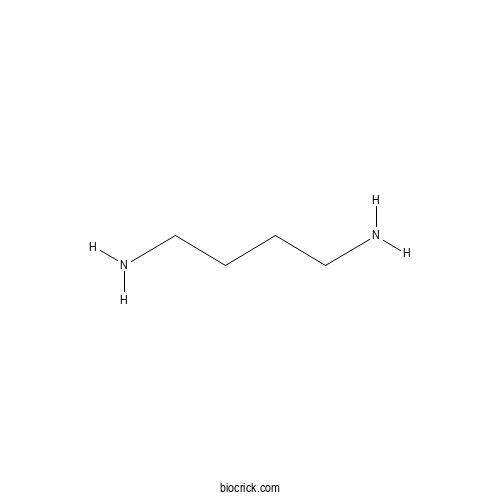
| Cas No. | 110-60-1 | SDF | File under preparation. |
| PubChem ID | 1045.0 | Appearance | Liquid |
| Formula | C4H12N2 | M.Wt | 88.2 |
| Type of Compound | N/A | Storage | Desiccate at -20°C |
| Solubility | Soluble in Chloroform,Dichloromethane,Ethyl Acetate,DMSO,Acetone,etc. | ||
| Chemical Name | butane-1,4-diamine | ||
| SMILES | C(CCN)CN | ||
| Standard InChIKey | KIDHWZJUCRJVML-UHFFFAOYSA-N | ||
| Standard InChI | InChI=1S/C4H12N2/c5-3-1-2-4-6/h1-6H2 | ||
| General tips | For obtaining a higher solubility , please warm the tube at 37 ℃ and shake it in the ultrasonic bath for a while.Stock solution can be stored below -20℃ for several months. We recommend that you prepare and use the solution on the same day. However, if the test schedule requires, the stock solutions can be prepared in advance, and the stock solution must be sealed and stored below -20℃. In general, the stock solution can be kept for several months. Before use, we recommend that you leave the vial at room temperature for at least an hour before opening it. |
||
| About Packaging | 1. The packaging of the product may be reversed during transportation, cause the high purity compounds to adhere to the neck or cap of the vial.Take the vail out of its packaging and shake gently until the compounds fall to the bottom of the vial. 2. For liquid products, please centrifuge at 500xg to gather the liquid to the bottom of the vial. 3. Try to avoid loss or contamination during the experiment. |
||
| Shipping Condition | Packaging according to customer requirements(5mg, 10mg, 20mg and more). Ship via FedEx, DHL, UPS, EMS or other couriers with RT, or blue ice upon request. | ||
Quality Control & MSDS
3D structure
Package In Stock

Number of papers citing our products


Putrescine Dilution Calculator
Putrescine Molarity Calculator
| 1 mg | 5 mg | 10 mg | 20 mg | 25 mg | |
| 1 mM | 11.3379 mL | 56.6893 mL | 113.3787 mL | 226.7574 mL | 283.4467 mL |
| 5 mM | 2.2676 mL | 11.3379 mL | 22.6757 mL | 45.3515 mL | 56.6893 mL |
| 10 mM | 1.1338 mL | 5.6689 mL | 11.3379 mL | 22.6757 mL | 28.3447 mL |
| 50 mM | 0.2268 mL | 1.1338 mL | 2.2676 mL | 4.5351 mL | 5.6689 mL |
| 100 mM | 0.1134 mL | 0.5669 mL | 1.1338 mL | 2.2676 mL | 2.8345 mL |
| * Note: If you are in the process of experiment, it's necessary to make the dilution ratios of the samples. The dilution data above is only for reference. Normally, it's can get a better solubility within lower of Concentrations. | |||||
- 3-Methyl-1-(3-methylfuran-2-yl)but-3-en-1-one
Catalog No.:BCX2327
CAS No.:78173-38-3
- Sorocein H
Catalog No.:BCX2326
CAS No.:157382-82-6
- Cathayanin B
Catalog No.:BCX2325
CAS No.:330195-60-3
- Taurodeoxycholic acid
Catalog No.:BCX2324
CAS No.:516-50-7
- Cathayanin C
Catalog No.:BCX2323
CAS No.:330195-61-4
- Spilanthol
Catalog No.:BCX2322
CAS No.:25394-57-4
- Naringenin chalcone
Catalog No.:BCX2321
CAS No.:73692-50-9
- Glutathione disulfide
Catalog No.:BCX2320
CAS No.:27025-41-8
- N6-Isopentenyladenine
Catalog No.:BCX2319
CAS No.:2365-40-4
- Laurolitsine
Catalog No.:BCX2318
CAS No.:904927-11-3
- 9-Nitrocamptothecin
Catalog No.:BCX2317
CAS No.:86639-62-5
- Mandelic acid
Catalog No.:BCX2316
CAS No.:90-64-2
- L-Ornithine
Catalog No.:BCX2329
CAS No.:70-26-8
- Dopamine
Catalog No.:BCX2330
CAS No.:51-61-6
- Norcantharidin
Catalog No.:BCX2331
CAS No.:29745-04-8
- L-Arabinose
Catalog No.:BCX2332
CAS No.:5328-37-0
- L-Galactose
Catalog No.:BCX2333
CAS No.:15572-79-9
- L-Mannose
Catalog No.:BCX2334
CAS No.:10030-80-5
- 5-Methoxytryptamine
Catalog No.:BCX2335
CAS No.:608-07-1
- Doxofylline
Catalog No.:BCX2336
CAS No.:69975-86-6
- Turanose
Catalog No.:BCX2337
CAS No.:547-25-1
- 3-Methyl-4-isopropylphenol
Catalog No.:BCX2338
CAS No.:3228-02-2
- 3-Amino-3-(3,4-dimethoxyphenyl)propionic acid
Catalog No.:BCX2339
CAS No.:54160-63-3
- Guanidinoacetic acid
Catalog No.:BCX2340
CAS No.:352-97-6
Content of free amino acids and biogenic amines during the maturation of Casin cheese: Feasibility of using VIS-NIRS spectroscopy for their quantification.[Pubmed:42828968]
Talanta. 2026 Oct 2;313(Pt A):130731.
Casin cheese is a traditional Spanish raw-milk cow's milk cheese with PDO status that is characterized by intense proteolysis during ripening. In this study, the evolution of free amino acids, biogenic amines and ammonium ion during the ripening of Casin cheese was evaluated, and the feasibility of using a portable Vis-NIR instrument (350-2500 nm) combined with chemometrics for their quantification was assessed. Ninety cheese samples of different batches from three manufacturers were analyzed at five stages of ripening (from 3 to 60 days). Quantification of amino acids and derivatives was performed using ultra-high-performance liquid chromatography after derivatization with diethyl ethoxymethylenemalonate. Calibration models were developed using modified partial least squares regression. Total free amino acids, the ammonium ion and biogenic amines peaked on day 30, with tyramine and histamine being the most abundant amines. The chemometric models achieved excellent predictive performance during external validation (N = 18) for phenylalanine (RSQ = 0.92, RPD = 3.37), valine (RSQ = 0.86, RPD = 2.40), serine (RSQ = 0.92, RPD = 2.14), tryptophan (RSQ = 0.80, RPD = 2.12), Putrescine (RSQ = 0.83, RPD = 2.42), histamine (RSQ = 0.82, RPD = 2.20), and ammonium ion (RSQ = 0.88, RPD = 2.77). Under the conditions of the study, portable Vis-NIR spectroscopy proved to be a reliable, rapid, and non-destructive tool for analyzing biogenic amines in cheese and monitoring the degree of ripening in traditional artisanal Casin cheese.
Immunometabolic effects of oral testosterone for castration-resistant prostate cancer in the ACROBAT trial.[Pubmed:42814510]
Mol Cancer Res. 2026 Sep 30.
High-dose testosterone is an emerging treatment option for selected patients with castration-resistant prostate cancer (CRPC), but its efficacy is limited by frequent primary and acquired resistance. Preclinical studies suggest that high-dose testosterone induces tumor metabolic reprogramming that promotes resistance, however clinical validation is lacking. In the prospective ACROBAT trial, we performed longitudinal plasma metabolomic profiling and high-dimensional immune cell phenotyping of 10 patients with CRPC treated with high-dose oral testosterone undecanoate. Testosterone exposure increased circulating metabolites within the arginine-ornithine-polyamine axis, including guanidoacetic acid, creatine, homoarginine, and N1-acetylspermidine. Notably, non-responders exhibited elevated levels of circulating polyamines, including Putrescine. Although we observed no significant changes in circulating immune cell subset frequencies, integrative analyses revealed positive associations between polyamine-related metabolites and immunosuppressive myeloid populations, including monocytic myeloid-derived suppressor cells. Collectively, these data provide clinical evidence that high-dose testosterone therapy increases polyamine synthesis from arginine, which is associated with therapy resistance and abundance of immunosuppressive myeloid cells. Implications: High-dose testosterone treatment of patients with castration-resistant prostate cancer enrolled on the ACROBAT trial increased circulating polyamines, which were associated with non-response to treatment and greater abundance of circulating immunosuppressive myeloid cells.
Putrescine-bound structure and multi-temperature crystallography provide new insights into ligand binding and conformational heterogeneity in spermidine synthase.[Pubmed:42808128]
Struct Dyn. 2026 Sep 28;13(5):054701.
Spermidine synthase (SPDS) is an important enzyme in the pathway for the biosynthesis of polyamines, and it synthesizes the polyamine spermidine from Putrescine (PUT) and decarboxylated S-adenosylmethionine. This pathway is a promising target for antiproliferative therapies because of the functions of polyamines in cellular proliferation and differentiation. Higher polyamine levels are linked to cancer and cell proliferation. Previous structures of the enzyme were solved at cryogenic temperatures. Here, we report a new SPDS structure in complex with PUT (SPDS-PUT) and multitemperature crystallography of SPDS complexed with PUT and 5-deoxy-5-methylthioadenosine (MTA) at 100, 273, and 293 K to study its structure and dynamics. The results revealed that the occupancy of the active site is important for the extent of stabilization in the gatekeeping loop. The SPDS-PUT structure revealed Putrescine binding in the absence of MTA, providing insight into its interactions within the active site and the conformational state of the gatekeeping loop. The binding of PUT alone was not enough to stabilize the gatekeeping loop, and greater stabilization of the loop occurred in the presence of MTA alone compared to PUT alone. The observed structural asymmetry between the gatekeeping loops of SPDS reflects differences in ligand binding between chains. These findings expand our understanding of the conformational landscape of SPDS.
Polyamine-mediated crosstalk in plant-microbe systems: implications for stress tolerance and crop protection.[Pubmed:42807932]
Front Plant Sci. 2026 Sep 14;17:1913716.
The interaction between plants and microbes is a complex network of signaling pathways that plays a pivotal role in plant health and resilience to environmental stressors. Recently, polyamines (PAs), including Putrescine, spermidine, and spermine, have emerged as crucial mediators in the crosstalk between plants and microbes. These small molecules are not only involved in cellular growth and differentiation but also significantly influence the plant's response to biotic and abiotic stresses. Research indicates that PAs can enhance the expression of defense-related genes, thereby increasing resistance to pathogens such as Pseudomonas syringae and Hyaloperonospora arabidopsidis. Furthermore, PAs interact with reactive oxygen species (ROS) to form positive feedback loops that amplify defensive responses during pathogen attacks. Additionally, the modulation of polyamine metabolism has been shown to improve crop resilience under stress conditions, suggesting their potential as biostimulants in agricultural practices. This review explores the multifaceted roles of PAs in plant-microbe interactions, highlighting their implications for stress tolerance and crop protection. Understanding the molecular mechanisms underpinning polyamine-mediated crosstalk could lead to the development of innovative strategies for enhancing crop productivity and sustainability in the face of increasing environmental challenges.
Polyamines across neurodegenerative proteinopathies.[Pubmed:42800647]
Neurobiol Dis. 2026 Sep 26;230:107629.
Polyamines (PAs) are evolutionarily conserved metabolites that connect protein quality control with lysosomal, mitochondrial, and redox homeostasis. Their metabolism is situated at a critical intersection of cell-sustaining and neurodegenerative pathways. Here, we synthesize evidence across Alzheimer's disease, Parkinson's disease, polyglutamine repeat disorders, amyotrophic lateral sclerosis, and multiple system atrophy, each of which differs in vulnerability to changes in PA metabolism. Although previous reviews have investigated PAs in individual neurodegenerative disorders, few have compared their roles across the broader spectrum of neurodegenerative proteinopathies. We address this gap by synthesizing evidence across multiple diseases to examine how PAs influence disease-associated protein aggregation and clearance, and how these effects depend on PA species, concentration, cellular context, disease stage, subcellular localization, redox state, and lysosomal and mitochondrial capacity. Human tissue and biofluid studies report disease-associated changes in PA metabolites, pathway enzymes, and transporter remodeling, as a function of neurodegenerative disorders. Mechanistic studies reveal that spermidine and spermine can alter the assembly, condensation, compartmentalization, and clearance of various neurotoxic proteins, whereas the effects of Putrescine are more system- and concentration-dependent. These effects engage both shared pathways and distinct mechanisms, depending on protein identity, cell type, and subcellular location. Curiously, PA manipulation may be protective in one context yet harmful in another. The framework that we propose can distinguish adaptive remodeling from pathogenic dysregulation and can guide disease-relevant therapeutic strategies.
Understanding the Mechanistic Connection between Dysbiosis and Polyamine Regulation in Oral and Intestinal Inflammation- Role of Tregs and Th17 Cells.[Pubmed:42799257]
J Cell Immunol. 2026;8(2):65-73.
Periodontitis and inflammatory bowel disease (IBD) are chronic inflammatory conditions driven by dysbiotic microbial communities that subvert host mucosal immunity. Central to the immunopathology of both diseases is the disruption of the balance between regulatory T cells (Tregs) and T helper 17 (Th17) cells, an equilibrium that governs tissue homeostasis versus inflammatory destruction. Polyamines, principally Putrescine (PUT), spermidine (SPD), and spermine (SPN), are emerging as critical immunometabolic regulators that modulate the plasticity and functional identity of both cell populations. Dysbiosis, particularly the enrichment of microbial communities that drive aberrant polyamine biosynthesis through ornithine decarboxylase (ODC)-dependent pathways, generates a polyamine-rich microenvironment that further dysregulates T cell function and promotes sustained inflammation. Experimental evidence demonstrates that mucosal polyamine levels correlate with dysbiosis, dysfunctional Treg (TregDys) expansion, and CD4(+)CD4(+)T cell hyperactivation, collectively contributing to and perpetuating chronic inflammation. The striking parallels between periodontitis and IBD reinforce the existence of conserved mechanisms linking mucosal dysbiosis to polyamine-driven immune dysregulation, with shared therapeutic implications for targeting the dysbiosis-T cell-polyamine axis to restore immune homeostasis. This review presents a unified mechanistic framework connecting oral and intestinal dysbiosis, polyamine dysregulation, and disruption of the Treg/Th17 balance, linking both diseases along the oral-gut axis.
Impact of Combined Botanical Functional Ingredients on the Canine Gut Microbiome.[Pubmed:42797912]
Vet Sci. 2026 Aug 27;13(9):877.
The canine gut microbiome plays a key role in digestive, immune, and metabolic health and is increasingly recognized as an important indicator of overall animal well-being. Medicinal and Aromatic Plants are emerging as a promising approach to support intestinal balance through modulation of the gut microbiome. This pilot study evaluated the effects of Aloe vera, Artemisia annua, and Curcuma longa on the gut microbiome of healthy dogs. The study included eighteen healthy dogs, divided into an Experimental group (n = 9) and a Control group (n = 9). Dogs in the Experimental group received a daily combination of the three plants for 30 days, while Control dogs received microcrystalline cellulose as a placebo. Fecal samples were collected on Day 30 and analyzed using shotgun metagenomic sequencing. Differential abundance analysis revealed an enrichment of taxa associated with short-chain fatty acid production in the Experimental group, including Megasphaera elsdenii, Blautia, Butyricimonas, Bacteroides, and Phascolarctobacterium, together with a reduction in opportunistic and dysbiosis-associated taxa, such as Enterocloster bolteae, Anaerobiospirillum spp., and Stenotrophomonas maltophilia. Functional profiling showed a reduction in pathways related to virulence-associated mechanisms and iron siderophore systems, alongside an increase in pathways associated with GABA and Putrescine metabolism and serine endopeptidase activity. Overall, these findings suggest that supplementation with these functional botanical ingredients may promote a more balanced and functionally beneficial gut microbiome in healthy dogs.
Alternating Wetting and Drying Irrigation During Grain Filling Period Improves the Eating Quality and 2AP Content of Aromatic Rice.[Pubmed:42796921]
Plants (Basel). 2026 Sep 21;15(18):2890.
Water management during grain filling plays a critical role in determining rice quality, but its coordinated regulation of eating and aroma quality in aromatic rice remains unclear. In this study, two indica cultivars, Nongxiang 32 and Yuzhenxiang, were subjected to three irrigation regimes: continuous flooding (CF), alternate wetting and drying (AWD), and saturated soil irrigation (SSI). Our results showed that 2-acetyl-1-pyrroline (2AP) content exhibited the highest level under AWD and the lowest under SSI. Starch pasting properties were improved under AWD and SSI, as reflected by higher peak viscosity and breakdown and lower setback values. Further analysis of Nongxiang 32 showed that AWD enhanced amylopectin and total starch contents, elevated proline and Putrescine levels, and differentially regulated enzyme activities, maintaining higher proline dehydrogenase activity at early filling stage and favorable Delta(1)-pyrroline-5-carboxylate synthetase, ornithine delta-aminotransferase, and diamine oxidase activities at late filling. Meanwhile, AWD was associated with reduced gamma-aminobutyric acid accumulation, consistent with greater precursor availability for 2AP biosynthesis. Antioxidant enzyme activities followed the order AWD > SSI > CF, whereas malondialdehyde and free fatty acids showed SSI > AWD > CF. Hormonal responses differed: gibberellic acid (SSI > AWD > CF), abscisic acid (AWD > SSI > CF), and indole-3-acetic acid (AWD > CF > SSI). Collectively, in Nongxiang 32, AWD optimally coordinates precursor metabolism, enzyme activities, antioxidant defense, and hormone regulation, thus improving both the aroma and starch quality of aromatic rice. This work provides a mechanistic understanding of water-driven quality formation in aromatic rice and offers a feasible irrigation strategy for high-quality aromatic rice cultivation.
Controlling Epileptic Activity by Modulating Putrescine Metabolism.[Pubmed:42793161]
Biomolecules. 2026 Sep 12;16(9):1329.
Glial mechanisms regulate neuronal excitability through multiple mechanisms, including the control of extracellular inhibitory signaling. One such mechanism is the Glu/GABA exchange process, in which glutamate uptake is coupled to GABA release, with GABA being synthesized from the polyamine Putrescine, placing Putrescine at a central position in metabolic pathways that may influence epileptiform activity. Here, we examined how pharmacological manipulation of key enzymes of Putrescine metabolism affects seizure-like activity in the low-[Mg(2+)] in vitro model of frontotemporal epilepsy, complemented by in vivo recordings in the non-convulsive absence epilepsy model Wistar Albino Glaxo/Rijswijk (WAG/Rij) rats. Increasing Putrescine availability by inhibiting spermidine synthase with trans-4-methylcyclohexylamine significantly reduced both the duration and appearance of seizure-like events. Strikingly, simultaneous inhibition of monoamine oxidase B (MAO-B) and diamine oxidase (DAO) with deprenyl and aminoguanidine almost completely abolished seizure-like events in vitro and markedly suppressed spike-wave discharges in WAG/Rij rats. This effect was largely reversed by blockade of GAT-2/3 transporters with SNAP-5114, suggesting the presence and significant anti-epileptic potential of a MAO-B- and DAO-independent Putrescine-GABA synthesis pathway. Together, these findings indicate that the anticonvulsant effects of Putrescine metabolism arise from the coordinated engagement of multiple parallel pathways rather than from a single dominant enzymatic route. Putrescine thus appears to function as a metabolic hub whose increased availability can be channeled into several anticonvulsant processes, suggesting that therapeutic strategies enhancing Putrescine-dependent inhibitory pathways at the network level may offer promising avenues for the modulation of epileptiform activity.
Exogenous Polyamines and Plant Salinity Tolerance: A Systematic Review, Evidence Map, and Family-Aware Quantitative Synthesis.[Pubmed:42792204]
Antioxidants (Basel). 2026 Sep 14;15(9):1165.
Salinity disrupts plant redox balance, ion homeostasis, and water relations, and exogenous polyamines have been widely investigated as potential mitigators of these effects. However, it remains unclear which polyamine-mediated responses are reproducible across independent studies and whether redox protection consistently translates into downstream physiological recovery. We therefore conducted an integrated systematic review, evidence map, and publication-family-aware quantitative synthesis to evaluate the effects of exogenous Putrescine, spermidine, and spermine in salt-stressed plants. We systematically searched Scopus and Web of Science through 9 August 2026, and eligible studies compared exogenous-polyamine-treated plants with corresponding salt-stressed controls. The review was not prospectively registered. Of 1093 records, 647 unique records were screened, and 179 reports were assessed in full text, yielding 34 retained reports and 444 complete quantitative contrasts. Multilevel random-effects models estimated reductions of 19.2% in malondialdehyde (95% confidence interval [CI], 12.9-25.1%) and 25.6% in hydrogen peroxide (H(2)O(2); 95% CI, 15.5-34.6%). Superoxide showed a protective mean response but remained uncertain because its 95% CI included the null. In contrast, antioxidant-enzyme responses varied widely across studies, with no consistent cross-family increase in superoxide dismutase (SOD), catalase (CAT), ascorbate peroxidase (APX), or peroxidase (POD/POX) activity. Conservative independent-family syntheses supported favorable ion balance, modestly higher relative water content, and greater dry biomass, whereas total chlorophyll remained uncertain and net photosynthesis was highly heterogeneous. No clear superiority of Putrescine, spermidine, or spermine was detected. Overall, exogenous polyamines most consistently reduced oxidative damage and stabilized ion-water homeostasis, whereas antioxidant-enzyme activity and photosynthetic recovery were more context-dependent. Interpretation is limited by small independent-family counts, incomplete reporting in some studies, and the absence of a formal study-level risk-of-bias assessment. By integrating systematic review, evidence mapping, and family-aware quantitative synthesis, this review provides an evidence-based hierarchy that distinguishes reproducible polyamine-mediated responses from context-dependent outcomes and helps define priorities for future salinity-tolerance research.
Tear Metabolomics in Thyroid Eye Disease: Molecular Signatures, Disease Activity, and Therapeutic Implications.[Pubmed:42782279]
Int Ophthalmol Clin. 2026 Oct 1;66(4):104-111.
Thyroid eye disease (TED) is a complex autoimmune orbital disease where clinical assessment tools, such as the Clinical Activity Score, often fail to capture the underlying molecular transitions between active inflammation and permanent fibrosis. As the field moves toward precision medicine, tear film metabolomics has emerged as a powerful, noninvasive source of biomarkers that can decode the orbital microenvironment. This review synthesizes current evidence on the metabolic signatures of TED, highlighting the shift from traditional protein biomarkers to small-molecule metabolites, including lipids, amino acids, and oxidative stress products. The current literature provides evidence that alterations in amino acid metabolism, polyamine synthesis, acylcarnitine profiles, and other markers of oxidative stress indicate disease activity in TED. We explore how liquid chromatography-mass spectrometry (LC-MS) and gas chromatography-mass spectrometry (GC-MS) have identified key dysregulated pathways-most notably in the ornithine-polyamine axis, with an increased Putrescine-to-ornithine ratio correlating best with inflammatory activity. By bridging the gap between systemic thyroid dysfunction and localized ocular manifestations, tear metabolomics offers a promising noninvasive approach for biomarker development, disease stratification, and therapeutic decision-making in thyroid eye disease.
Polyamines control inorganic polyphosphate levels during bacterial nitrogen starvation.[Pubmed:42779857]
bioRxiv [Preprint]. 2026 Sep 18:2026.09.16.752086.
Inorganic polyphosphate (polyP) is a ubiquitous, multifunctional biomolecule that supports stress survival in bacteria. During nitrogen (N) starvation, Escherichia coli rapidly accumulates polyP, which drives the formation of RNA-protein granules that sustain long-term survival. What triggers this upregulation has remained unknown. Here we show that polyamines, a group of highly conserved, amino acid-derived polycations, regulate polyP accumulation during N starvation. We found that deleting all nine polyamine biosynthesis genes elevates polyP during exponential growth and by more than 5-fold under N starvation, with shorter chains preferentially accumulating. To dissect which polyamine matters, we further deleted the three catabolic enzymes that consume polyamines as a nitrogen source, which enabled complementation assays. Supplying any one of the three physiological polyamines, Putrescine, spermidine, or cadaverine, restored wild-type polyP levels during N starvation. We found that the absence of polyamines did not affect the steady-state levels of either the polyP-synthesizing kinase PPK or the exopolyphosphatase PPX, pointing instead to post-translational control of enzyme activity or to as-yet-unidentified polyamine-dependent regulators. These findings establish a direct metabolic link between two universal, functionally intertwined biomolecules and suggest that the polyamine decline upon N starvation contributes to the observed polyP accumulation.
Metabolic cooperation supports mutual growth between the protozoan parasite Trichomonas vaginalis and dysbiotic vaginal bacteria.[Pubmed:42777004]
PLoS Pathog. 2026 Sep 23;22(9):e1014620.
The protozoan parasite Trichomonas vaginalis, the causative agent of trichomoniasis, is frequently associated with dysbiotic vaginal microbial communities characteristic of bacterial vaginosis (BV). While previous studies have shown that vaginal bacteria can modulate parasite pathogenicity, the metabolic basis underlying this ecological association remains unclear. Here, we investigated whether T. vaginalis and BV-associated bacteria (BVAB) engage in metabolic cooperation that could support their coexistence. Using in vitro co-culture systems, we examined microbial growth under defined nutrient conditions and integrated metabolomic profiling with targeted transcriptional analysis to characterize metabolic interactions between partners. In serum-free defined medium that does not support proliferation of either microorganism alone, T. vaginalis and BVAB exhibited mutualistic growth, indicating that they engage in cooperative metabolic interactions to overcome shared nutritional limitations. Gas chromatography-mass spectrometry revealed a coordinated metabolic shift toward amino acid catabolism during co-culture, with prominent accumulation of ornithine and Putrescine linking the arginine dihydrolase (ADH) pathway to polyamine synthesis. Gene expression analyses showed strong upregulation of the parasite carbamate kinase gene during co-culture, implicating enhanced ADH pathway activity in this interaction. Inhibition of polyamine biosynthesis partially impaired the cooperative growth of both microorganisms, further supporting the importance of this metabolic axis. Together, these findings provide experimental evidence that cross-kingdom metabolic cooperation can reciprocally support infection and dysbiosis, highlighting how parasite-microbiome interactions can reshape metabolic networks to overcome environmental constraints and promote their persistence within host-associated microbial ecosystems.
Microbial-associated acylated putrescines as immunomodulatory molecules in inflammatory bowel diseases.[Pubmed:42774064]
bioRxiv [Preprint]. 2026 Aug 25:2026.08.24.746719.
The gut microbiota profoundly shapes intestinal immunity through the production of small-molecule metabolites; yet in inflammatory bowel diseases (IBD), where the microbial metabolome is substantially altered, the identities and immunological functions of most disease-associated metabolites remain unknown. Here, we integrate untargeted fecal metabolomics from two independent IBD patient cohorts with gnotobiotic mouse metabolomic data to identify N-acyl Putrescines as a class of microbiome-associated metabolites consistently enriched in both Crohn's disease (CD) and ulcerative colitis (UC). Among these, N-oleoylPutrescine (NOP) induces potent and selective transcriptional responses in bone marrow-derived dendritic cells (BMDCs) and colonic organoids, establishing it as the primary immunomodulatory candidate in this metabolite class. Enterocloster species harboring nonribosomal peptide synthetase (NRPS) biosynthetic gene clusters produce NOP via conjugation of oleic acid with Putrescine, confirmed by isotope-tracing in vitro and germ-free mouse mono-colonization in vivo. NOP suppresses five core IBD-associated inflammatory pathways in mouse dendritic cells and human monocytes, reduces gene signatures of histologic inflammation and IBD therapy non-response, and ameliorates colitis in four murine models. NOP dampens NF-kappaB activation and iNOS expression in myeloid cells and suppresses type 1 immune responses through a T cell-intrinsic mechanism. The enrichment of NOP in IBD despite its anti-inflammatory activity supports a holobiont defense hypothesis: that the gut microbiota mounts a compensatory metabolic response to intestinal inflammation that may contribute to the restoration of organismal homeostasis. IN BRIEF: Bae et al. identify N-acyl Putrescines as gut microbiota-associated metabolites enriched in IBD and demonstrate that N-oleoylPutrescine (NOP), produced by Enterocloster species via NRPS biosynthetic machinery, broadly suppresses innate and adaptive inflammatory programs and ameliorates colitis in mice, supporting a holobiont defense hypothesis for microbiota-mediated immunomodulation. HIGHLIGHTS: N-acyl Putrescines are microbiome-associated metabolites enriched in IBD feces across two independent human cohorts Enterocloster species harboring NRPS biosynthetic gene clusters produce NOP via oleic acid- Putrescine conjugation NOP suppresses NF-kappaB, iNOS, and IBD therapy non-response gene signatures in mouse and human myeloid cellsNOP ameliorates colitis in four distinct murine models and suppresses type 1 immunity via a T cell-intrinsic mechanism.
Dysregulated polyamine metabolism in neurological disorders: molecular mechanisms and therapeutic opportunities.[Pubmed:42771220]
Mol Biol Rep. 2026 Sep 22;53(1):1602.
Polyamines (PAs), principally Putrescine (Put), spermidine (Spd), and spermine (Spm), are ubiquitous aliphatic polycations that regulate nucleic-acid interactions, ion-channel activity, autophagy, redox balance, proteostasis, and immune signaling. Growing genetic, multi-omics, and experimental evidence indicates that disruption of PA biosynthesis, catabolism, acetylation, and transport contributes to neurological disease. In Alzheimer's disease (AD), altered PA flux intersects with Tau and amyloid-beta (Abeta) pathology, methylation imbalance, oxidative stress, and impaired autophagic clearance. In Parkinson's disease (PD), PA transport and interconversion are linked to lysosomal dysfunction, mitochondrial stress, and alpha-synuclein toxicity; ATP13A2-associated Kufor-Rakeb syndrome further illustrates the neurological consequences of defective lysosomal PA transport. PA dysregulation is also implicated in amyotrophic lateral sclerosis (ALS), diabetic retinopathy, Snyder-Robinson syndrome, epilepsy, Bachmann-Bupp syndrome, and cerebral ischemia. This review integrates disease-specific evidence with four interconnected mechanisms-autophagy, oxidative stress, proteostasis, and neuroinflammation-and discusses therapeutic approaches including direct Spd administration, modulation of PA-metabolic enzymes and transporters, and combination strategies. Because PAs can exert both protective and toxic effects depending on concentration, cellular compartment, and disease context, translation will require CNS-relevant biomarkers, dose and route optimization, and explicit consideration of blood-brain barrier constraints.

Calcutta University

University of Minnesota

University of Maryland School of Medicine

University of Illinois at Chicago

The Ohio State University

University of Zurich

Harvard University

Colorado State University

Auburn University

Yale University

Worcester Polytechnic Institute

Washington State University

Stanford University

University of Leipzig

Universidade da Beira Interior

The Institute of Cancer Research

Heidelberg University

University of Amsterdam

University of Auckland

TsingHua University

The University of Michigan

Miami University

DRURY University

Jilin University

Fudan University

Wuhan University

Sun Yat-sen University

Universite de Paris

Deemed University

Auckland University

The University of Tokyo

Korea University



