
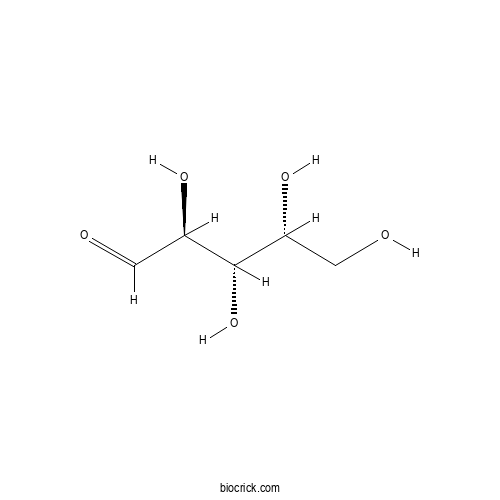
L-GalactoseCAS# 15572-79-9 |
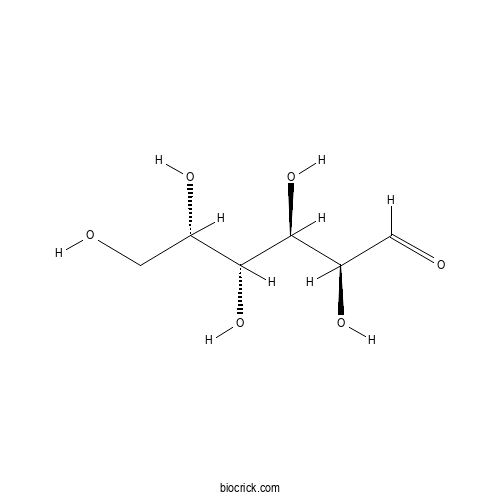
| Cas No. | 15572-79-9 | SDF | File under preparation. |
| PubChem ID | 84996.0 | Appearance | Powder |
| Formula | C6H12O6 | M.Wt | 180.2 |
| Type of Compound | N/A | Storage | Desiccate at -20°C |
| Solubility | Soluble in Chloroform,Dichloromethane,Ethyl Acetate,DMSO,Acetone,etc. | ||
| Chemical Name | (2S,3R,4R,5S)-2,3,4,5,6-pentahydroxyhexanal | ||
| SMILES | C(C(C(C(C(C=O)O)O)O)O)O | ||
| Standard InChIKey | GZCGUPFRVQAUEE-DPYQTVNSSA-N | ||
| Standard InChI | InChI=1S/C6H12O6/c7-1-3(9)5(11)6(12)4(10)2-8/h1,3-6,8-12H,2H2/t3-,4+,5+,6-/m1/s1 | ||
| General tips | For obtaining a higher solubility , please warm the tube at 37 ℃ and shake it in the ultrasonic bath for a while.Stock solution can be stored below -20℃ for several months. We recommend that you prepare and use the solution on the same day. However, if the test schedule requires, the stock solutions can be prepared in advance, and the stock solution must be sealed and stored below -20℃. In general, the stock solution can be kept for several months. Before use, we recommend that you leave the vial at room temperature for at least an hour before opening it. |
||
| About Packaging | 1. The packaging of the product may be reversed during transportation, cause the high purity compounds to adhere to the neck or cap of the vial.Take the vail out of its packaging and shake gently until the compounds fall to the bottom of the vial. 2. For liquid products, please centrifuge at 500xg to gather the liquid to the bottom of the vial. 3. Try to avoid loss or contamination during the experiment. |
||
| Shipping Condition | Packaging according to customer requirements(5mg, 10mg, 20mg and more). Ship via FedEx, DHL, UPS, EMS or other couriers with RT, or blue ice upon request. | ||
Quality Control & MSDS
3D structure
Package In Stock

Number of papers citing our products


L-Galactose Dilution Calculator
L-Galactose Molarity Calculator
-
 D-(+)-GlucoseCatalog No.: BCN1259CAS No.: 50-99-7
-
 β-D-AlloseCatalog No.: BCN0445CAS No.: 2595-97-3
-
 L-MannoseCatalog No.: BCX2334CAS No.: 10030-80-5
-
 D-ArabinoseCatalog No.: BCN3791CAS No.: 10323-20-3
-
 D-(+)-XyloseCatalog No.: BCN1010CAS No.: 58-86-6
-
 DL-ArabinoseCatalog No.: BCN8541CAS No.: 147-81-9
-
 D-RiboseCatalog No.: BCN9063CAS No.: 50-69-1
-
 L-xyloseCatalog No.: BCX0644CAS No.: 609-06-3
-
 D-LyxoseCatalog No.: BCX0719CAS No.: 1114-34-7
-
 LyxoseCatalog No.: BCX2252CAS No.: 65-42-9
| 1 mg | 5 mg | 10 mg | 20 mg | 25 mg | |
| 1 mM | 5.5494 mL | 27.7469 mL | 55.4939 mL | 110.9878 mL | 138.7347 mL |
| 5 mM | 1.1099 mL | 5.5494 mL | 11.0988 mL | 22.1976 mL | 27.7469 mL |
| 10 mM | 0.5549 mL | 2.7747 mL | 5.5494 mL | 11.0988 mL | 13.8735 mL |
| 50 mM | 0.111 mL | 0.5549 mL | 1.1099 mL | 2.2198 mL | 2.7747 mL |
| 100 mM | 0.0555 mL | 0.2775 mL | 0.5549 mL | 1.1099 mL | 1.3873 mL |
| * Note: If you are in the process of experiment, it's necessary to make the dilution ratios of the samples. The dilution data above is only for reference. Normally, it's can get a better solubility within lower of Concentrations. | |||||
- L-Arabinose
Catalog No.:BCX2332
CAS No.:5328-37-0
- Norcantharidin
Catalog No.:BCX2331
CAS No.:29745-04-8
- Dopamine
Catalog No.:BCX2330
CAS No.:51-61-6
- L-Ornithine
Catalog No.:BCX2329
CAS No.:70-26-8
- Putrescine
Catalog No.:BCX2328
CAS No.:110-60-1
- 3-Methyl-1-(3-methylfuran-2-yl)but-3-en-1-one
Catalog No.:BCX2327
CAS No.:78173-38-3
- Sorocein H
Catalog No.:BCX2326
CAS No.:157382-82-6
- Cathayanin B
Catalog No.:BCX2325
CAS No.:330195-60-3
- Taurodeoxycholic acid
Catalog No.:BCX2324
CAS No.:516-50-7
- Cathayanin C
Catalog No.:BCX2323
CAS No.:330195-61-4
- Spilanthol
Catalog No.:BCX2322
CAS No.:25394-57-4
- Naringenin chalcone
Catalog No.:BCX2321
CAS No.:73692-50-9
- L-Mannose
Catalog No.:BCX2334
CAS No.:10030-80-5
- 5-Methoxytryptamine
Catalog No.:BCX2335
CAS No.:608-07-1
- Doxofylline
Catalog No.:BCX2336
CAS No.:69975-86-6
- Turanose
Catalog No.:BCX2337
CAS No.:547-25-1
- 3-Methyl-4-isopropylphenol
Catalog No.:BCX2338
CAS No.:3228-02-2
- 3-Amino-3-(3,4-dimethoxyphenyl)propionic acid
Catalog No.:BCX2339
CAS No.:54160-63-3
- Guanidinoacetic acid
Catalog No.:BCX2340
CAS No.:352-97-6
- 6-Hydroxyflavanone
Catalog No.:BCX2341
CAS No.:190831-08-4
- D-Glucuronic acid
Catalog No.:BCX2342
CAS No.:6556-12-3
- Bryodulcosigenin
Catalog No.:BCX2343
CAS No.:88930-16-9
- Lactose
Catalog No.:BCX2344
CAS No.:63-42-3
- Acridone
Catalog No.:BCX2345
CAS No.:578-95-0
Balancing tuber vitamin C improvement with trade-off side effect by fine-tuning regulation of StGGPs.[Pubmed:42802851]
Hortic Res. 2026 May 13;13(10):uhag191.
Potato (Solanum tuberosum L.) is a globally important staple crop. Improving its nutritional quality without compromising yield-a classic manifestation of the growth-defense trade-off-remains a major challenge in modern agriculture. Traditional breeding in potato is hindered by its highly heterozygous genome and tetrasomic inheritance, making it difficult and time-consuming to introduce and fix new traits. To address this, we applied a gene-editing approach to enhance vitamin C (Vc) content in tubers by mutating the upstream open reading frames of two potato GDP-L-Galactose phosphorylase genes. New variants, with significantly elevated Vc levels, well-balanced nutrient profiles, and maintained yield, were created. The nutritionally enriched tubers retained high Vc content after culinary processing and exhibited substantially increased antioxidant activity. Importantly, we also found that excessive Vc enrichment can disrupt auxin activity, leading to developmental arrest and yield penalties. Thus, our study not only provides an effective strategy for multitrait improvement in potato, but also offers broader insights into the physiological mechanisms governing the balance between yield and nutritional quality in horticultural crops.
High-Yield and High-Titer Production of Levulinic Acid from Red Macroalgae via Sulfuric Acid-Catalyzed Hydrolysis: Optimization by Response Surface Methodology and Application to Actual Biomass.[Pubmed:42802148]
J Microbiol Biotechnol. 2026 Sep 18;36:e2606033.
Levulinic acid (LA) is a versatile bio-based platform chemical with wide-ranging applications in biofuels, solvents, and biodegradable materials. To establish an efficient LA production strategy, red macroalgae were selected as the biomass feedstock due to their high carbohydrate content-particularly galactan, which is rich in 3,6-anhydro-L-Galactose (AHG), a sugar that readily converts to LA under acidic conditions. In this study, a response surface methodology (RSM) based on a Box-Behnken design was used to optimize LA production from agar, the primary polysaccharide in red algae. The RSM model predicted an optimum of 172.5 degrees C, 67.4 min, 8% H(2)SO(4), with a predicted LA yield of 32.45%, and independent experimental validation under these conditions resulted in an LA yield of 33.23%. The validated reaction conditions were subsequently applied to two species of red macroalgae, Gracilaria verrucosa and Gelidium amansii. At 1% (w/v) biomass loading, carbohydrate-based LA yields of 52.9% and 48.4% were obtained, with corresponding titers of 3.1 and 3.0 g/L, respectively. Increasing the biomass loading to 25% (w/v) increased the LA titers to 49.8 and 48.6 g/L, while the corresponding carbohydrate-based yields decreased to 34.6% and 31.3%, respectively. These findings highlight the potential of high-solids processing as a practical approach for LA production from marine biomass and provide a basis for further process development toward sustainable biorefinery applications.
The RrWRKY75-mediated activation of ascorbate synthesis in Rosa roxburghii Tratt contributes to salt stress tolerance.[Pubmed:42660356]
Plant Sci. 2026 Nov;372:113395.
L-Ascorbic acid (AsA) is a key antioxidant that alleviates oxidative stress in plants. Previous yeast one-hybrid (Y1H) screening identified RrWRKY75 as a transcription factor capable of binding to the promoter of RrGGP2 (GDP-L-Galactose pyrophosphatase 2), a key structural gene responsible for massive AsA accumulation in Rosa roxburghii fruit. The function of RrWRKY75 in plant stress responses remains unclear. Here, RrWRKY75 is verified to specifically bind to the RrGGP2 promoter and activate its transcription. This positive regulatory effect on RrGGP2 transcript levels and AsA accumulation is further confirmed through overexpression or silencing of RrWRKY75 in R. roxburghii fruit or callus. Among various abiotic stress conditions, RrWRKY75 expression is significantly induced by salt stress. Upon its overexpression in callus or Arabidopsis thaliana, elevated AsA levels and antioxidant capacity are observed, thereby enhancing salt tolerance. Interestingly, RrWRKY75 also binds to the promoter of RrUNE12, a salt-responsive factor in R. roxburghii, and activates its expression. Moreover, yeast two-hybrid and bimolecular fluorescence complementation (BiFC) assays confirm the physical interaction between RrWRKY75 and RrUNE12, which jointly upregulates RrGGP2 expression and AsA production. Collectively, RrWRKY75 boosts AsA biosynthesis and salt tolerance both by directly trans-activating RrGGP2 and by synergizing with RrUNE12 through transcriptional activation and protein complex formation. These findings provide insights into the regulatory role of RrWRKY75 in abiotic stress tolerance and offer valuable genetic resources for R. roxburghii germplasm improvement.
Natural and CRISPR/Cas9 Editing Variations of Dual-uORFs Synergistically Increase the Nutritional Value of Silage Maize Feed.[Pubmed:42563555]
Plant Biotechnol J. 2026 Aug 7:10.1111/pbi.70731.
The precise enhancement of nutritional quality in silage maize is a core strategy for increasing livestock production efficiency. Through evolutionary analysis of multiple plant species, we identified two functionally synergistic upstream open reading frames (uORF1 and uORF2) within the 5' untranslated region of the gene encoding GDP-L-Galactose phosphorylase (GGP). By leveraging a natural translation-enhancing haplotype of uORF1 (Hap2) and performing CRISPR/Cas9-mediated targeted mutagenesis of the highly conserved uORF2, we successfully engineered an elite dual-uORFs variant. This variant significantly increased vitamin C (Vc) content and concurrently improved key silage quality traits, including crude protein and phosphorus levels, without inducing growth penalties. Transcriptomic profiling further elucidated the molecular mechanisms by which the dual-uORFs variation coordinately regulates Vc biosynthesis and the improvement of silage quality. Our findings deepen the understanding of the conventional paradigm of single-uORF regulation and provide a novel strategy and superior germplasm resources for the precision breeding of high-Vc, high-quality silage maize.
Crystal structure of rice L-galactose dehydrogenase.[Pubmed:42554157]
Acta Crystallogr F Struct Biol Commun. 2026 Sep 1;82(Pt 9):289-294.
L-Galactose dehydrogenase plays a key role in the biosynthesis of L-ascorbic acid (vitamin C) in plants. Here, we report crystal structures of rice (Oryza sativa) L-Galactose dehydrogenase in both apo and NAD(+)-bound forms at 1.2 and 1.8 A resolution, respectively. Rice L-Galactose dehydrogenase adopts a conserved (beta/alpha)(8)-barrel fold with a well preserved NAD(+)-binding cleft, as in other plant L-Galactose dehydrogenases. Structural comparisons revealed conformational flexibility in the first and second loop regions, which form the lid and side wall of the NAD(+)-binding site. These loops undergo significant rearrangement upon NAD(+) binding, likely facilitating cofactor and substrate uptake. These findings suggest a flexible loop-mediated regulation of cofactor and substrate access.
Exploration of mucin-protein interactions using liquid glycan array.[Pubmed:42399057]
Methods Enzymol. 2026;732:391-453.
M13 phage makes it possible to produce DNA-encoded display of any molecules stable in water by prospective DNA-barcoding. For example, chemical conjugation of a glycan to an M13 virion that contains a prospectively introduced DNA barcode in the M13 genome creates a DNA-barcoded glycophage. In this glycophage, there is a 1:1 correspondence between the DNA sequence inside the phage and the structure of the glycan displayed on the surface of the phage. The same construct simultaneously illustrates the concept of DNA-encoded multivalency because there is a one-to-one correspondence between the DNA barcode and the displayed density. In this chapter, we show that a collection of these DNA-barcoded multivalent glycophages, known as Liquid Glycan Array (LiGA), can measure the glycan-recognition profile of mucin-binding proteins. Using DNA-encoded multivalency, we make an intriguing observation that a simple ultra-dense display of D-galactose on M13 "looks like mucin" because it binds to the proteolytically inactive E447D mutant of mucinase StcE (StcE(E447D)). The binding is specific because StcE(E447D) does not bind to the ultra-high-density display of the enantiomer control, L-Galactose, nor to the diastereomer controls (D-glucose and D-mannose).
The APT1-NACsa3-GGP1 Module Enhances Salt Tolerance and Regulates Ascorbic Acid Biosynthesis in Medicago.[Pubmed:42393922]
Plant Cell Environ. 2026 Jul 2.
The unclear salt tolerance mechanism of alfalfa (Medicago sativa) is a major constraint to its molecular design breeding. Here, we identified a novel ATAF subfamily transcription factor, MtNACsa3, in the closely related diploid Medicago truncatula, and elucidated its function in salt tolerance. Phenotypic analysis of the MtNACsa3 mutants and overexpression lines showed its positive role in salt tolerance. Under salt or oxidative stress, MtNACsa3 relocates from the plasma membrane to the nucleus mediated by the de-S-acylation of Acyl-Protein Thioesterase 1 (MtAPT1). MtNACsa3 up-regulates the expression of GDP-L-Galactose phosphorylase 1 (MtGGP1), enhancing ascorbic acid (AsA) synthesis to scavenge H(2)O(2). Furthermore, we created MtNACsa3 exogenous transgenic alfalfa, which has higher AsA content and higher biomass than the recipient Zhongmu No.1 under salt stress. The APT1-NACsa3-GGP1 module not only enriches our understanding of the mechanism of salt tolerance, but also provides valuable genetic resources for salt-tolerant and AsA-rich alfalfa breeding.
The bioactive potential of red seaweed oligosaccharides obtained using autohydrolysis: Correlation between extract composition and prebiotic activity.[Pubmed:42250713]
Int J Biol Macromol. 2026 Jul;370:152905.
This study evaluated, for the first time, the prebiotic-like potential of glucooligosaccharides and galactooligosaccharides derived from five red seaweeds, produced using autohydrolysis. The non-purified oligosaccharide-rich extracts were characterized in terms of composition, glycosidic linkages, and molecular weight profiles. They were then evaluated for cytotoxicity (using a co-culture of Caco-2 and HT29-MTX cells), as well as for their ability to serve as the carbon source for the growth of pure probiotics and modulate gut microbiota in vitro (fecal fermentation using five healthy donors). Despite their structural differences, all oligosaccharide-rich extracts promoted the growth of pure probiotic strains, with the extract obtained from agar-extraction residue enhancing Lactobacillus acidophilus growth more effectively than inulin (used as a prebiotic reference for benchmarking purposes). When subjected to fecal fermentation, beta diversity metrics confirmed that a Gracilaria extract with a low (<1%) sulfation degree and constituted of 44.56 +/- 0.84 mol% glucose, 34.66 +/- 2.45 mol% galactose, 10.99 +/- 1.24 mol% 6-anhydro-L-Galactose, 5.73 +/- 0.86 mol% 6-methyL-Galactose, and residues of mannose and xylose, linked by (1 --> 4)-Glcp ( approximately 31%), (1 --> 4)-Galp ( approximately 26%), (1 --> 3)-Galp ( approximately 15%), terminal Galp ( approximately 9%), terminal Glcp ( approximately 5%), and (1 --> 4)-AnGalp ( approximately 1%), significantly modulated the human gut microbiota, showing effects comparable to those of inulin, and supporting increased production of short-chain fatty acids. These findings highlight the potential of red seaweed-derived oligosaccharide fractions as safe functional ingredients with potential relevance for human gut health.
Characteristics of galacturonate reductase (GalUR) genes in garlic (Allium sativum L.) and changes in their expression in response to abiotic stressors.[Pubmed:42245179]
Vavilovskii Zhurnal Genet Selektsii. 2026 May;30(3):412-423.
In plants, the synthesis of L-ascorbic acid (Aa), in addition to the main L-Galactose pathway, is carried out by three known alternative pathways. One of them, the D-galacturonic acid pathway, is thought to be specific for tissues with excess D-galacturonate, the substrate of D-galacturonate reductase (GalUR), which belongs to the Aldo-Keto Reductase (AKR) superfamily. In this study, the AKR gene family of garlic Allium sativum L. was identified and seven genes, AsGalUR1-7, presumably encoding GalUR enzymes, were determined. The structure and phylogeny of the AsGalUR1-7 genes and the proteins they encode, as well as the AsGalUR1-7 expression pattern in different organs of the garlic plant (in silico and qRT-PCR), were characterized. Based on the obtained data, the genes were conditionally divided into root (AsGalUR1-4) and leaf (AsGalUR5-7) groups depending on the highest expression level in the underground and aboveground parts of the plant, respectively. The AsGalUR expression in leaves and roots was analyzed in response to drought, salt and cold stresses, as well as exogenous phytohormones (abscisic acid, methyl jasmonate), accompanied by the AsA content measurement. It was shown that hormone treatment suppresses the expression of all analyzed genes in both organ types. Cold conditions stimulate the expression of root group genes and suppress that of leaf group genes in roots, and have the opposite effect in leaves. Osmotic stressors (NaCl, PEG) suppress the transcription of all genes in leaves, but do not change (NaCl) or stimulate (PEG) it in roots, which is accompanied by an increase in AsA accumulation in organs of both types. A positive correlation between the expression of the AsGalUR1 and 4 genes and the AsA content is found in leaves under stress conditions. The data obtained can form the basis for further study of the mechanisms regulating AsA synthesis in garlic and other Allium species.
Agaro-Oligosaccharide Supplementation Alters the Gut Microbiota, Revealing Potential Agaro-Oligosaccharide-Utilizing Taxa in Healthy Japanese Adults.[Pubmed:42193435]
Biomedicines. 2026 May 14;14(5):1112.
Background: Agaro-oligosaccharides (AOS) have been shown to modulate the gut microbiota in in vitro and animal studies; however, human evidence remains scarce. Methods: Herein, we conducted a four-week open-label, single-arm, non-randomized pilot trial in 18 healthy Japanese adults to examine the association of AOS intake at 200 mg/day with gut microbiota composition and bowel condition. Fecal samples collected before and after the intervention were analyzed using QIIME2-based 16S rRNA sequencing, and bowel condition was assessed with the Bristol Stool Form Scale. This study was registered in the UMIN Clinical Trials Registry (UMIN000056992). Results: AOS intake was not associated with significant changes in bowel condition. Gut microbiota analysis showed no significant alterations in overall community structure but revealed taxon-specific trends in the relative abundance of several bacterial taxa. Notably, nominal changes were observed in the abundance of the Ruminococcus gnavus group and Bacteroides uniformis after the intervention. In addition, quantitative PCR analysis showed an increase in 3,6-anhydro-L-Galactose cycloisomerase (ACI) gene abundance after the intervention. Conclusions: These findings suggest that, in this exploratory pilot study, AOS intake was associated with a taxon-specific pattern in the gut microbiota. Further randomized controlled studies are needed to clarify the microbiota-related effects of AOS in humans.
Novel Donepezil-Chalcone Hybrids as Potential Multifunctional Anti-Alzheimer's Disease Agents: Design, Synthesis, Computational Simulation, and In Vitro/In Vivo Biological Evaluation.[Pubmed:42175774]
Chem Biol Drug Des. 2026 May;107(5):e70316.
A novel series of donepezil-chalcone including pyridine, piperazine, phenylamide skeleton hybrids were designed, synthesized, and evaluated for their inhibitory activities against AChE and BChE. Subsequently, a subset of these derivatives was investigation to inhibit Abeta(1-42) aggregation and promote Abeta(1-42) disaggregation effects. Among them, compounds 8b, 8c, 8j, and 8ab possessing good activity were further assayed for their inhibitory effects on BACE-1 and GSK3beta, as well as their PI displacement activity. 8b (AChE, IC(50): 0.11 muM; BChE, IC(50): 0.18 muM; Abeta(1-42) aggregation, IC(50): 3.40 muM; their ability to promote Abeta(1-42) disaggregation, IC(50): 4.53 muM; BACE-1, IC(50): 1.82 muM; GSK3beta, IC(50): 0.98 muM) exhibited prominent bioactivities across the above assays. Meanwhile, the molecular docking and the molecular dynamics simulations were performed to analyze the interactions between 8b and the key amino acid residues of the target proteins, which verified the stability of the corresponding protein ligand complexes. Furthermore, 8b significantly attenuated the cytotoxicity induced by Fe(3+) and Cu(2+) in BV-2 microglial cells, L-Glu in HT-22 hippocampal neuronal cells, and Abeta(1-42) in both BV-2 and SH-SY5Y neuroblastoma cells. Additionally, 8b reduced the levels of intracellular ROS and NO in LPS-stimulated BV-2 cells, demonstrating potent anti-inflammatory and neuroprotective properties. Acute toxicity tests in mice confirmed the safety profile of 8b. In in vivo studies, compound 8b effectively protected against neuroinflammation 8b ameliorated cognitive deficits in mice induced by AlCl(3) combined with L-Galactose, which was associated with the upregulation of p-GSK3beta and the downregulation of p-Tau expression. In conclusion, 8b holds great potential as a promising multitarget-directed new lead compound for the treatment of AD.
Generation and characterization of a double-knockout Arabidopsis thaliana line lacking expression of AOX1a and VTC2.[Pubmed:42111797]
Vavilovskii Zhurnal Genet Selektsii. 2026 Apr;30(2):241-249.
In higher plants, the L-Galactose pathway is the main pathway for the biosynthesis of vitamin C (ascorbate, Asc), the final step of which is connected with the functioning of the mitochondrial electron transport chain (ETC). In addition to the main cytochrome pathway, plant ETC includes an alternative pathway (AP) via alternative terminal oxidase (AOX). The engagement of AOX promotes Asc synthesis, and it is hypothesized that AOX suppression under conditions of Asc deficiency may reduce plant viability. The aim of this work was to examine the consequences of simultaneously knocking out two genes in Arabidopsis thaliana: AOX1a, the most stress-inducible AOX gene, and VTC2, encoding a key enzyme of the L-Galactose pathway of Asc synthesis. Two lines of A. thaliana with T-DNA insertions in the target genes were crossed to generate hybrid lines. Seed characteristics of the first (F1) and second (F2) generations were analyzed. F1 seeds were larger than those of parent lines, possibly due to heterosis. In the F2 generation, self-pollination of F1 plants resulted in seeds with significant size variation, including a group of small seeds with degenerative morphological abnormalities. Most of small seeds failed to germinate or died at the seedling stage. PCR genotyping of these seeds revealed the absence of native AOX1a and VTC2 indicating a lethal mutation caused by simultaneous knockout of both genes. One likely genetic cause is the interaction of mutations in non-allelic genes. At the physiological level, irreversible respiratory damage may occur, possibly including the impact of a cryptic mutation in the vtc2 line. Further studies are necessary to confirm these hypotheses. In general, the results obtained indicate the vital co-functioning of the AP and the L-Galactose pathway of Asc biosynthesis and may be useful for the development of genetically engineered techniques for the control of vitamin C synthesis in plants.
Molecular Characterization and Mechanistic Insights of a Thermostable Neoagarobiose Hydrolase Aga2457 from Alteromonas sp.[Pubmed:42042198]
Mar Drugs. 2026 Mar 25;24(4):123.
The enzymatic valorization of agarose, a major polysaccharide in red algae, is critical for its application in the food, pharmaceutical, and biotechnology industries. In this study, a gene encoding a thermostable alpha-neoagarobiose hydrolase, aga2457, was cloned from an epiphytic bacterium associated with Indonesian macroalgae. Unlike typical mesophilic GH117 enzymes, recombinant Aga2457 displayed a higher optimal temperature at 50 degrees C and retained 55% activity after 12 days of incubation at 50 degrees C. The enzyme specifically hydrolyzes neoagarobiose into D-galactose and 3,6-anhydro-L-Galactose, thereby facilitating the complete depolymerization of agarose. Combined molecular dynamics (MD) simulations and site-directed mutagenesis revealed that residues P253, N256, and Q285 are pivotal for substrate recognition and active site stability. These findings highlight Aga2457 as a robust biocatalyst for industrial agar processing and provide structural insights for the rational design of thermostable agarolytic enzymes.

Calcutta University

University of Minnesota

University of Maryland School of Medicine

University of Illinois at Chicago

The Ohio State University

University of Zurich

Harvard University

Colorado State University

Auburn University

Yale University

Worcester Polytechnic Institute

Washington State University

Stanford University

University of Leipzig

Universidade da Beira Interior

The Institute of Cancer Research

Heidelberg University

University of Amsterdam

University of Auckland

TsingHua University

The University of Michigan

Miami University

DRURY University

Jilin University

Fudan University

Wuhan University

Sun Yat-sen University

Universite de Paris

Deemed University

Auckland University

The University of Tokyo

Korea University



