
Guanidinoacetic acidCAS# 352-97-6 |
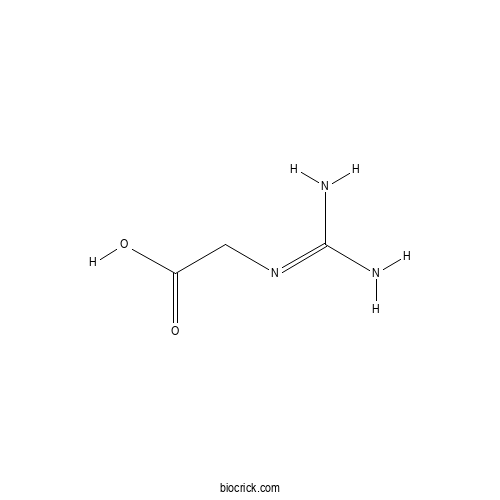
| Cas No. | 352-97-6 | SDF | File under preparation. |
| PubChem ID | 763.0 | Appearance | Powder |
| Formula | C3H7N3O2 | M.Wt | 117.1 |
| Type of Compound | N/A | Storage | Desiccate at -20°C |
| Solubility | Soluble in Chloroform,Dichloromethane,Ethyl Acetate,DMSO,Acetone,etc. | ||
| Chemical Name | 2-(diaminomethylideneamino)acetic acid | ||
| SMILES | C(C(=O)O)N=C(N)N | ||
| Standard InChIKey | BPMFZUMJYQTVII-UHFFFAOYSA-N | ||
| Standard InChI | InChI=1S/C3H7N3O2/c4-3(5)6-1-2(7)8/h1H2,(H,7,8)(H4,4,5,6) | ||
| General tips | For obtaining a higher solubility , please warm the tube at 37 ℃ and shake it in the ultrasonic bath for a while.Stock solution can be stored below -20℃ for several months. We recommend that you prepare and use the solution on the same day. However, if the test schedule requires, the stock solutions can be prepared in advance, and the stock solution must be sealed and stored below -20℃. In general, the stock solution can be kept for several months. Before use, we recommend that you leave the vial at room temperature for at least an hour before opening it. |
||
| About Packaging | 1. The packaging of the product may be reversed during transportation, cause the high purity compounds to adhere to the neck or cap of the vial.Take the vail out of its packaging and shake gently until the compounds fall to the bottom of the vial. 2. For liquid products, please centrifuge at 500xg to gather the liquid to the bottom of the vial. 3. Try to avoid loss or contamination during the experiment. |
||
| Shipping Condition | Packaging according to customer requirements(5mg, 10mg, 20mg and more). Ship via FedEx, DHL, UPS, EMS or other couriers with RT, or blue ice upon request. | ||
Quality Control & MSDS
3D structure
Package In Stock

Number of papers citing our products


Guanidinoacetic acid Dilution Calculator
Guanidinoacetic acid Molarity Calculator
| 1 mg | 5 mg | 10 mg | 20 mg | 25 mg | |
| 1 mM | 8.5397 mL | 42.6985 mL | 85.3971 mL | 170.7942 mL | 213.4927 mL |
| 5 mM | 1.7079 mL | 8.5397 mL | 17.0794 mL | 34.1588 mL | 42.6985 mL |
| 10 mM | 0.854 mL | 4.2699 mL | 8.5397 mL | 17.0794 mL | 21.3493 mL |
| 50 mM | 0.1708 mL | 0.854 mL | 1.7079 mL | 3.4159 mL | 4.2699 mL |
| 100 mM | 0.0854 mL | 0.427 mL | 0.854 mL | 1.7079 mL | 2.1349 mL |
| * Note: If you are in the process of experiment, it's necessary to make the dilution ratios of the samples. The dilution data above is only for reference. Normally, it's can get a better solubility within lower of Concentrations. | |||||
- 3-Amino-3-(3,4-dimethoxyphenyl)propionic acid
Catalog No.:BCX2339
CAS No.:54160-63-3
- 3-Methyl-4-isopropylphenol
Catalog No.:BCX2338
CAS No.:3228-02-2
- Turanose
Catalog No.:BCX2337
CAS No.:547-25-1
- Doxofylline
Catalog No.:BCX2336
CAS No.:69975-86-6
- 5-Methoxytryptamine
Catalog No.:BCX2335
CAS No.:608-07-1
- L-Mannose
Catalog No.:BCX2334
CAS No.:10030-80-5
- L-Galactose
Catalog No.:BCX2333
CAS No.:15572-79-9
- L-Arabinose
Catalog No.:BCX2332
CAS No.:5328-37-0
- Norcantharidin
Catalog No.:BCX2331
CAS No.:29745-04-8
- Dopamine
Catalog No.:BCX2330
CAS No.:51-61-6
- L-Ornithine
Catalog No.:BCX2329
CAS No.:70-26-8
- Putrescine
Catalog No.:BCX2328
CAS No.:110-60-1
- 6-Hydroxyflavanone
Catalog No.:BCX2341
CAS No.:190831-08-4
- D-Glucuronic acid
Catalog No.:BCX2342
CAS No.:6556-12-3
- Bryodulcosigenin
Catalog No.:BCX2343
CAS No.:88930-16-9
- Lactose
Catalog No.:BCX2344
CAS No.:63-42-3
- Acridone
Catalog No.:BCX2345
CAS No.:578-95-0
- Caffealdehyde
Catalog No.:BCX2346
CAS No.:141632-15-7
- (+)-Licarin B
Catalog No.:BCX2347
CAS No.:42016-15-9
- Pyridoxal phosphate
Catalog No.:BCX2348
CAS No.:54-47-7
- Methylaervine
Catalog No.:BCX2349
CAS No.:86293-40-5
- Pipemidic acid
Catalog No.:BCX2350
CAS No.:51940-44-4
- 2-tert-Butyl-4-methoxyphenol
Catalog No.:BCX2351
CAS No.:121-00-6
- 5-Pentadecylresorcinol
Catalog No.:BCX2352
CAS No.:3158-56-3
Guanidinoacetic Acid and Cysteamine Hydrochloride Improve Beef Cattle Growth and Antioxidant Capacity via Fecal Microbiome and Serum Metabolome.[Pubmed:42792217]
Antioxidants (Basel). 2026 Sep 16;15(9):1178.
Balancing muscle growth and antioxidant/anti-inflammatory homeostasis is a core requirement for modern beef production. This study investigated whether cysteamine hydrochloride (CSH) co-supplementation with Guanidinoacetic acid (GAA) enhances growth and antioxidant status through fecal microbiome and serum metabolome modulation in Simmental beef cattle. A 60-day trial randomly assigned 45 10-month-old cattle to control (CON), GAA-supplemented, and GAA + CSH-supplemented groups (n = 15 per group). Growth performance was recorded throughout the trial. Fecal samples were collected for 16S rRNA sequencing, and serum samples for non-targeted metabolomics. Both GAA and GAA + CSH (GCSH) improved growth performance versus CON (p < 0.05), with no differences between supplemented groups. However, GCSH uniquely elevated antioxidant enzymes and reduced malondialdehyde (p < 0.05). GCSH treatment was associated with higher abundance of Adlercreutzia, Anaerofustis, and Monoglobus, alongside elevated indole-3-propionic acid and salicylsulfuric acid. In contrast, GAA reduced phenylacetyl-L-glutamine and indole-3-acetic acid. iCAMP analysis revealed that GCSH relieved homogenizing selection while enhancing heterogeneous selection, promoting beneficial taxa colonization. GAA primarily enhances nitrogen utilization, while CSH enriches beneficial microbiota and antioxidant metabolites. These findings suggest that GAA and CSH co-supplementation improves growth and antioxidant homeostasis through complementary mechanisms.
LDHC Hyperacetylation Disrupts the Guanidinoacetic Acid-Creatine Axis Underlying Cryoinjury in Boar Sperm: Rescue by GAA Supplementation.[Pubmed:42792171]
Antioxidants (Basel). 2026 Sep 7;15(9):1132.
Boar sperm are highly sensitive to cryopreservation, limiting the use of frozen semen in pig breeding. We previously reported that cryopreservation alters lysine acetylation of metabolism-related proteins, including the sperm-specific isoform LDHC. Here we show that cryopreservation reduces LDH activity, and that the LDH inhibitor galloflavin recapitulates this loss, confirming that LDHC is required for boar sperm motility, acrosome integrity, and mitochondrial membrane potential. Treatment with the SIRT inhibitor nicotinamide increased LDHC acetylation and simultaneously suppressed LDH activity, indicating that hyperacetylation negatively regulates LDHC function. Untargeted metabolomics of LDH-inhibited sperm revealed a notable decrease in Guanidinoacetic acid (GAA), the sole precursor of creatine. Supplementing the freezing extender with 600 muM GAA significantly improved post-thaw motility, preserved mitochondrial membrane potential and ATP levels, reduced oxidative stress, and protected acrosome integrity. These improvements were accompanied by elevated intracellular creatine content, enhanced antioxidant capacity (increased T-AOC, CAT, and SOD activities, decreased MDA), and reduced apoptosis. Our findings demonstrate that cryopreservation-induced LDHC hyperacetylation impairs enzyme activity and sperm quality, and that GAA replenishment effectively counteracts this injury through creatine-dependent and antioxidant mechanisms.
Synthesis of sericin-based antibacterial material and its application for durable antibacterial silk fabric.[Pubmed:42753851]
Int J Biol Macromol. 2026 Sep 17;383(Pt 1):154538.
The extensive use of antibiotics has led to the emergence of multidrug-resistant bacteria, thereby creating an urgent demand for novel antimicrobial agents. Bio-based cationic antibacterial materials have emerged as a promising alternative to conventional antibiotics due to their rapid bactericidal action and broad-spectrum efficacy against pathogenic microorganisms. In this study, a dual-functionalized sericin-based antibacterial material (ChCl-GA-SS) was synthesized through the sequential grafting of choline chloride and Guanidinoacetic acid onto the sericin backbone, followed by immobilization onto silk fabric. The successful modification of sericin was confirmed using FTIR, XPS, Raman spectroscopy, and (13)C NMR spectroscopic analyses. Importantly, the modified silk fabric demonstrated a bacterial reduction rate exceeding 99.99% against E. coli and S. aureus, while maintaining high efficacy after 20 washing cycles and 50 rubbing cycles. Moreover, the treatment preserved the intrinsic properties of silk and demonstrated good cytocompatibility. This approach demonstrates a durable strategy for producing sericin-based cationic antibacterial materials for textile applications and highlights the potential for value-added utilization of sericin.
Effects of six weeks of guanidinoacetic acid supplementation with and without creatine monohydrate on cognitive function and markers of health in healthy adults.[Pubmed:42730704]
J Int Soc Sports Nutr. 2026 Dec 31;23(sup1):2711032.
BACKGROUND: Guanidinoacetic acid (GAA) supplementation has been reported to increase brain creatine content more effectively than creatine monohydrate (CrM). However, the effects on cognitive function are unclear. PURPOSE: The purpose of this proof-of-concept exploratory clinical trial was to determine whether GAA supplementation with and without CrM affects cognitive function and/or markers of health. METHODS: In a double-blind, randomized, and counterbalanced manner, 58 healthy and active adults (33 females, 35.5 +/- 14 years, 76.2 +/- 14 kg) ingested a PLA (PLA, 2 x 6 g/d maltodextrin), GAA (2 x 1 g/d) + PLA (2 x 5 g/d), or GAA (2 x 1 g/d) + CrM (2 x 5 g/d) for six weeks. The participants donated fasting blood samples and completed a battery of tests and questionnaires assessing various aspects of function, mood, stress, sleep quality, and markers of health at baseline and after six weeks of supplementation. Data were analyzed using General Linear Model (GLM) multivariate and univariate with repeated measures, and mean changes from baseline with 95% confidence intervals, and Chi-squared analysis, and considered significant when the probability of error was 0.05 or less, and approaching significance (p > 0.05-p < 0.10). RESULTS: GAA supplementation tended to improve overall reaction time (-241.8 ms [-533, 50], p = 0.10) while significant interaction effects were observed in overall reaction time (p = 0.031-330 ms [-629, -31]) and YES reaction time (-290 ms [-484, -96], p = 0.004) while recalled correct reaction time (-178 ms [-374, 21], p = 0.078) and recalled correct YES (7.4 % [-1, 15.8], p = 0.084) approached significance compared to PLA. Limited to no effects were observed on the Delayed Picture Recognition Task Test, Digit Vigilance Task Test, Corsi Block Task Test, or Stroop Color-Word Task Test. The amount of time engaged in moderate physical activity was significantly greater (p < 0.05) in the GAA group compared to PLA. Participants in the GAA group reported a lower frequency of controlling irritations (p = 0.036), and feeling like difficulties are mounting (p = 0.053) on the Perceived Stress Scale. Some positive and potentially undesirable effects were observed in sleep quality assessments. The quality of life assessment revealed that participants in the GAA group reported less frequent feelings of being worn out (p = 0.068) and that their health was excellent (p = 0.092) while those in the GAA + CrM group reported more frequent limitations when bending, kneeling, or stooping (p = 0.053), more often feeling full of life (p = 0.081), and less frequency in feeling downhearted and depressed (p = 0.066). No clinically meaningful changes were observed in blood markers or self-reported side effects among the groups. CONCLUSION: Dietary supplementation with GAA (2 g/d) and the combination of CrM (10 g/d + GAA 2 g/d) for six weeks improved delayed verbal episodic recognition memory and retrieval speed and some measures of perceived stress, sleep quality, and quality of life. However, most cognitive tests were not affected, particularly when comparing the GAA to the PLA group; there were some inconsistencies in the findings, and several differences only approached significance. Additional research is needed before conclusions can be drawn. Clinical trial registration: ISRCTN68542582.
Effects of rumen-protected guanidinoacetic acid on fat deposition, antioxidant capacity, fatty acid profiles in subcutaneous adipose of Tibetan sheep: integrated RNA-seq and LC-MS/MS analysis.[Pubmed:42713445]
Front Vet Sci. 2026 Aug 25;13:1866223.
INTRODUCTION: The subcutaneous fat exerts energy storage and protective effects. However, excessive fat deposition results in waste of biological resources and compromises meat quality. According to the biological function, we hypothesized that GAA's could reduce subcutaneous fat deposition in Tibetan sheep. METHODS: A total of 120 healthy weaned male lambs (2 months old) with similar body weight (17.33 +/- 0.21 kg) were randomly divided into four groups, each receiving a basal diet or diet containing 0.08%, 0.10%, or 0.12% GAA. The experimental period lasted 90 days. RESULTS: Our results showed that 0.10% GAA significantly reduced subcutaneous fat thickness (P < 0.05). Antioxidant capacity was improved, as evidenced by a reduced MDA (P, P-linear, P-quadratic < 0.05), while increased SOD and T-AOC (P, P-linear, P-quadratic < 0.05). The contents of C18:3(n-3) (P, P-quadratic < 0.05) and C18:2(n-6) (P, P-linear < 0.05) was significantly increased when supplementing 0.10% GAA, while those of C16:0 (P < 0.05) and C22:2(n-6) (P, P-linear < 0.05) was significantly decreased. Pearson correlation analysis revealed that the differential genes including ANGPT2, PLA2G4A, PIK3CB, IDNK, MAPKAPK5 and the differential metabolites including DG (16:0/20:4), TG (16:0/16:0/18:1), DG (16:1/18:1), DG (16:0/18:2), Cer (d18:1/18:1) were closely associated with the antioxidant capacity and fat deposition. CONCLUSION: In summary, 0.10% GAA reduced subcutaneous fat thickness, improved the fatty acid profile, and maintained redox homeostasis in Tibetan sheep.
Nanopowder-Reinforced Thixotropic Interface Enabled High-Filling Functional Epoxy Composites with Enhanced Impact Resistance and Mechanoluminescence Properties.[Pubmed:42709092]
Langmuir. 2026 Sep 8;42(35):25876-25888.
High-filling epoxy composites possess indispensable and pivotal performance in structural materials and functional devices; However, owing to their intrinsic brittleness and inevitable interface defects, potential stress concentration and structural damage may result in unacceptable losses. Here, a nanopowder-reinforced thixotropic interfacial design strategy was proposed, in which different morphologies of nanosized calcium carbonate were used to reinforce Guanidinoacetic acid-modified polyborosiloxane (GPBS), which was then introduced into the organic-inorganic interface of epoxy composites. Owing to the frequency-dependent O-->B dynamic bonds and guanidyl-carboxylate structure, the obtained GPBS exhibits an enhanced shear-thickening behavior, with its storage modulus (G') increasing sharply from 34.89 Pa at 0.1 Hz to 69.87 MPa at 100 Hz (an increase of 20,026.51 times). As a result, the corresponding epoxy composites exhibited improved mechanical properties (a 385.6% increase in tensile stress) and impact resistance performance (a force attenuation rate of up to 80%). Meanwhile, SrAl2O4:Eu2+, Dy3+ was incorporated into the composites for stress visualization, and a machine learning-assisted analysis system was developed for signal analysis. This study provides an insight into high-filling functional epoxy composites, holding great application potential in intelligent protection engineering.
Enhancement of growth performance, muscle nutrient composition, and nutritional value in rainbow trout (Oncorhynchus mykiss) by guanidinoacetic acid-enriched diets.[Pubmed:42699757]
Anim Nutr. 2026 Jul 31;27:35-47.
The role of Guanidinoacetic acid (GAA) in modulating nutritional value and muscle quality warrants attention, particularly given the scarcity of mechanistic studies in aquatic animals. A total of 450 healthy juvenile rainbow trout (Oncorhynchus mykiss, aged approximately 76 d post-hatch, initial body weight 7.77 +/- 0.14 g) were randomly distributed into 5 groups (3 replicates per group, 30 fish per replicate) to investigate the effects of dietary GAA supplementation at concentrations of 0, 300, 600, 1200, and 2400 mg/kg on muscle nutritional value and quality, designated as groups G0, G3, G6, G12, and G24, respectively. After an 8-week feeding trial, dietary supplementation with 600 mg/kg GAA significantly increased final body weight and protein efficiency ratio, and decreased feed conversion ratio compared to the G0 group (P < 0.05). Whole-body crude protein and crude lipid contents were significantly affected by dietary GAA supplementation, with the G6 group exhibiting significantly higher levels of total amino acids, non-essential amino acids, and essential amino acids than the G0 group (P < 0.05). In parallel, GAA supplementation significantly enhanced muscle polyunsaturated fatty acid deposition (P < 0.05), with linear increases observed for polyunsaturated fatty acid and linoleic acid (P < 0.05), and a quadratic response for docosahexaenoic acid (P = 0.003). Notably, the G6 group exhibited the highest combined docosahexaenoic acid (DHA) + eicosapentaenoic acid (EPA) content (P = 0.011). Nutritional evaluation based on FAO/WHO standards confirmed that dietary GAA supplementation significantly improved essential amino acid index (EAAI; P < 0.001), with the highest value observed in the G6 group (72.806). Met + Cys was the first limiting amino acid across all GAA treatments. Moreover, GAA supplementation significantly upregulated the expression of genes involved in lipid metabolism, including gpat, srebp 1, fas, and lpl, as well as mechanistic target of rapamycin (mTOR) signaling-related genes, including tgf-beta, tor, igf-1, and 4e-bp1, with the G6 group showing significantly higher expression levels than the G0 group (P < 0.05). Antioxidant analysis further revealed significantly lower malondialdehyde levels in the G6 group (P < 0.001). Collectively, these findings demonstrate that dietary supplementation with 600 mg/kg GAA effectively enhances growth performance, whole-body chemical composition, and muscle nutritional value in rainbow trout, likely through the coordinated regulation of amino acid utilization, lipid metabolism, and antioxidant defense systems.
Metabolomics Reveals Metabolic Characteristics of Functional Cure in Chronic Hepatitis B Treated With Entecavir Combined With Pegylated Interferon Alpha.[Pubmed:42693772]
Biomed Res Int. 2026;2026(1):e1031453.
BACKGROUND: Entecavir (ETV) combined with pegylated interferon alpha (PEG-IFNalpha) improves chronic hepatitis B (CHB) functional cure rates, but therapeutic heterogeneity and underlying metabolic mechanisms remain unclear. This study used untargeted metabolomics to identify metabolic signatures, mechanisms, and predictive biomarkers of functional cure with ETV-PEG-IFNalpha. METHODS: Thirty-eight CHB patients were grouped into ETV monotherapy (Group E, n = 12) and ETV-PEG-IFNalpha combination therapy (Group Z, n = 26); Group Z was subdivided into cured (Group A, n = 13) and noncured (Group B, n = 13). Serum metabolomic profiling, multivariate statistics, and Kyoto Encyclopedia of Genes and Genomes (KEGG) pathway analysis identified differential metabolites. A random forest model was built using key metabolites. RESULTS: Three hundred eighty-eight metabolites were identified. Four differential metabolites distinguished Group A and B (upregulated Guanidinoacetic acid, uracil 5-carboxylate; downregulated L-methionine S-oxide, oleamide), enriching amino acid metabolism pathways. Nine differential metabolites between Group E and Z implicated amino acid, immune, and fatty acid pathways. The random forest model based on the four Group A/B metabolites showed 88.5% cross-validation accuracy (AUC = 0.920), with L-methionine S-oxide and oleamide as key predictors. CONCLUSIONS: This study reveals metabolic rewiring in CHB functional cure via ETV-PEG-IFNalpha therapy, involving energy metabolism, oxidative stress, and immunomodulation, based on which we propose a tentative metabolism-immunity synergy model to guide future research. Key metabolites, especially L-methionine S-oxide and oleamide, show exploratory predictive potential for functional cure that warrants further validation in independent cohorts.
Distinct performance and ruminal adaptations to ethyl-cellulose rumen-protected methionine and guanidinoacetic acid during a heat stress challenge in lactating Holstein cows.[Pubmed:42692333]
J Dairy Sci. 2026 Sep 3:S0022-0302(26)03230-3.
Thermal stress alters ruminal function and physiology, compromising health and productivity. Methionine enhances endogenous antioxidant synthesis, whereas Guanidinoacetic acid (GAA) supports cellular ATP production. Because methionine serves as a methyl donor for the conversion of GAA to creatine, both nutrients are linked to cellular metabolism and antioxidant defense. The objective was to determine effects of rumen-protected methionine (RPM; Mepron(R), Evonik) and GAA (GuanAMINO(R), >/= 97% GAA, approximately 1% starch, approximately 1% moisture; Evonik), fed alone or in combination during heat stress (HS) on production, thermoregulation, ruminal biopolymer-degrading enzymes and microbiota, ruminal papillae gene expression and cystathionine beta-synthase (CBS) activity, and plasma biomarkers. Milk, blood, ruminal fluid and papillae were collected to evaluate lactational, metabolic, microbial, and molecular responses. Ten multiparous Holstein cows (5 intact and 5 with a ruminal cannula; 122 +/- 28 DIM, 41.8 +/- 3.7 kg milk/d) were used in a replicated 5 x 5 Latin square with 23-d periods (16 d thermoneutral, 7 d HS) and 5 treatments: thermoneutral control (CON-TN), HS control (CON-HS), RPM-HS (RPM at 0.10% of DM), GAA-HS (25 g GAA/d), MIX-HS (RPM at 0.10% of DM plus 25 g GAA/d). Electric heat blankets (EHB) operating at the highest setting ( approximately 40 degrees C) were used to induce HS. Data were analyzed using PROC MIXED (SAS v9.4) with preplanned contrasts: CON-HS vs. CON-TN, RPM-HS vs. CON-HS, RPM-HS vs. GAA-HS, and MIX-HS vs. CON-HS. Compared with CON-TN, CON-HS cows had greater rectal (+0.32 degrees C) and vaginal (+0.34 degrees C) temperatures and respiration rate (+11 beats/min). These variables did not differ among HS treatments. Compared with CON-TN, CON-HS cows had lower milk yield (-3.9 kg/d), milk protein concentration (-0.22 percentage units), and milk protein yield (-0.11 kg/d), whereas MUN was greater (+2.4 mg/dL). Compared with CON-HS, RPM-HS increased milk protein (+0.28 percentage units), casein (+0.11 percentage units), and protein yield (+0.12 kg/d). Milk protein concentration also was greater in RPM-HS than GAA-HS. Total plasma AA concentrations did not differ among treatments (2,056 +/- 89 microM), but citrulline concentration was greater in CON-HS than CON-TN (69 vs. 55 microM). Feeding RPM-HS increased plasma cystine concentration compared with CON-HS (24.4 vs. 18.8 microM). At the ruminal level, compared with CON-TN, CON-HS increased the molar proportions of iso-butyrate and isovalerate, and the abundance of Rumicoccus flavefaciens and Succinimonas amylolytica. These variables were not affected by feeding RPM, GAA, or MIX; however, relative to CON-HS, RPM-HS increased cellulase activity and tended to increase xylanase activity. The abundance of Megaspheara elsdenii was greater and Succinimonas amylolytica lower in RPM-HS than CON-HS, whereas GAA-HS increased abundance of Streptococcus bovis approximately 3-fold relative to CON-HS. Ruminal papillae CBS activity more than doubled in CON-HS compared with CON-TN. The HS did not affect mRNA abundance of the 28 target genes evaluated. In contrast, RPM-HS and, to a greater extent, MIX-HS induced coordinated molecular remodeling characterized by upregulation of genes involved in polyamine synthesis, antioxidant responses, and tight-junction signaling. Overall, RPM improved milk protein synthesis and metabolic resilience during HS, whereas MIX primarily enhanced epithelial adaptative responses without additional lactational benefits.
Comparative Effects of Guanidinoacetic Acid and Creatine on Body Composition, Muscle Strength, and Protein Metabolism Biomarkers in Older Adults: A Randomized Exploratory Pilot Trial.[Pubmed:42669527]
J Nutr Sci Vitaminol (Tokyo). 2026;72(4):284-290.
Creatine supplementation can improve muscle outcomes in older adults, particularly when combined with resistance exercise; however, its efficacy without exercise is less consistent. Guanidinoacetic acid (GAA), the immediate precursor of creatine, may bypass age-related limitations in creatine synthesis and transport and exert distinct effects on muscle energetics and protein metabolism. The main aim of the study was compare the effects of 8 wk of GAA versus creatine supplementation on muscle strength, body composition, and selected protein metabolism biomarkers in older adults. In this randomized, double-blind, exploratory pilot trial, 25 apparently healthy adults aged >/=65 y were assigned to receive GAA (2.0 g/d) or an equimolar dose of creatine monohydrate for 8 wk. Twenty-one participants completed the study (GAA, n=11; creatine, n=10). Handgrip strength, body composition and fluid compartments (via multifrequency bioelectrical impedance analysis), and circulating myostatin, insulin-like growth factor-1, mammalian target of rapamycin, total homocysteine, albumin, and total protein were assessed at baseline and follow-up. Intervention effects were evaluated using repeated-measures ANOVA, and between-group effect sizes for change scores were estimated using Hedges' g with 95% confidence intervals. Handgrip strength increased significantly with GAA (p=0.01) but not with creatine, with a significant time-by-treatment interaction (p=0.04) and a large between-group effect favoring GAA (g=0.91, 95% CI: 0.00 to 1.81). GAA supplementation was associated with significant within-group increases in fat-free mass, body cell mass, muscle mass, and total body water, whereas creatine supplementation did not produce comparable changes. Effect size analyses generally favored GAA for strength, muscle-related indices, and hydration-related compartments, although confidence intervals were wide. Both supplements reduced circulating myostatin, with greater suppression observed with GAA. Creatine supplementation produced a modest reduction in serum albumin that remained within physiological reference ranges. Serum IGF-1 concentrations were below the assay detection limit in most participants, precluding evaluation of the GH-IGF-1 axis. No adverse events were reported, and compliance exceeded 97% in both groups. In this exploratory pilot trial conducted without structured exercise, GAA supplementation was associated with numerically greater improvements in muscle strength and several muscle-related indices compared with creatine; however, these findings are preliminary and hypothesis-generating and require confirmation in adequately powered trials targeting sarcopenia.
Interactive Effects of Dietary Guanidinoacetic Acid and Energy Density on Growth Performance, Carcass Characteristics, Meat Quality, and Heat Stress Tolerance in Broilers.[Pubmed:42652912]
Life (Basel). 2026 Jul 24;16(8):1225.
Guanidinoacetic acid (GAA), a natural precursor of creatine, plays a pivotal role in cellular energy metabolism. This study investigated the effects of dietary GAA supplementation at varying levels (0, 0.6, and 1.2 g/kg) combined with standard or reduced (-100 kcal/kg) dietary energy on growth performance, carcass characteristics, meat quality, and heat stress tolerance (during the finisher phase) in broiler chickens. A total of 360 one-day-old male Ross-308 broiler chicks were randomly allocated to 36 floor pens in a 3 x 2 factorial arrangement under a completely randomized design. Six treatments with six replicates, each having 10 birds, were evaluated over 35 days. Growth performance parameters were recorded weekly. On day 35, samples were collected for carcass characteristics (dressing percentage, breast and thigh yield, and organ weights), meat quality analysis (drip loss, cooking loss, and color parameters), and heat stress response. The heat stress response (panting frequency) was recorded during the finisher phase of the trial. GAA supplementation at 1.2 g/kg significantly (p < 0.001) improved final body weight, total weight gain, feed conversion ratio, dressing percentage, breast yield, and thigh yield. Meat quality parameters showed significant improvement (p < 0.001) with GAA in a dose-dependent manner for drip loss, cooking loss, and all color parameters (L*; a*; b*). Significant GAA x energy interactions (p < 0.001) were observed for final body weight, total weight gain, feed intake, FCR, cooking loss, live body weight at slaughter, breast yield, liver weight, gizzard weight, intestine weight, and panting frequency. The effect of GAA on heat stress tolerance was context-dependent, with a significant GAA x energy interaction (p < 0.001) for panting frequency. Under reduced-energy conditions, 1.2 g/kg GAA decreased panting frequency, suggesting improved thermoregulatory capacity, while under standard-energy conditions, GAA increased panting frequency. The main effect of GAA on panting frequency was not significant (p = 0.38), while the main effect of energy was highly significant (p < 0.001). In conclusion, GAA supplementation at 1.2 g/kg significantly improves growth performance, feed efficiency, meat quality (reduced drip and cooking losses and improved color parameters), and carcass yield in broiler chickens. Importantly, GAA supplementation largely compensated for a 100 kcal/kg reduction in dietary energy while maintaining performance. These findings support GAA as a promising nutritional strategy for sustainable broiler production, particularly in hot-climate regions.
Guanidinoacetic Acid as a Dietary Additive for Lambs: A Meta-Analysis on Performance, Antioxidant Status, Nutrient Digestibility, Ruminal Fermentation and Meat Quality.[Pubmed:42589155]
Biology (Basel). 2026 Aug 4;15(15):1288.
This study aimed to evaluate the effects of dietary supplementation with Guanidinoacetic acid (GAA) on growth performance, antioxidant status, nutrient digestibility, ruminal fermentation, and meat quality in lambs through a meta-analysis. The electronic databases Scopus, Web of Science, ScienceDirect, and Google Scholar were used to identify the articles required for the meta-analysis using the Preferred Reporting Elements for Systematic Reviews and Meta-Analyses (PRISMA) methodology. The data used in this meta-analysis were obtained from 12 peer-reviewed English-language articles published in the last decade (January 2016 to April 2026). All data were analyzed using random-effects models. Dietary supplementation with GAA decreased the feed conversion ratio (p < 0.05) and increased (p < 0.05) dry matter intake, average daily gain, carcass weight and yield, and Longissimus dorsi muscle area. Dietary supplementation with GAA decreased (p < 0.001) serum malondialdehyde concentration and increased (p Guanidinoacetic acid can be used as a dietary additive to improve growth performance, antioxidant status, nutrient digestibility, ruminal fermentation, and meat quality in lambs.
Dietary guanidinoacetic acid supplementation favourably modulates energy dynamics and nitrogen balance in broilers.[Pubmed:42571458]
Anim Nutr. 2026 Jul 7;26:526-533.
The arginine-sparing potential of Guanidinoacetic acid (GAA) has been well documented; however, information regarding its effects on energy dynamics and nitrogen balance in broilers is limited. This study evaluated the effects of dietary GAA supplementation on heat increment, net energy, efficiency of energy utilization, and nitrogen and energy balance in broilers using closed-circuit calorimetry chambers. One-d-old Ross 308 male broilers (39 +/- 1 g, n = 80) were fed common starter and grower diets until 18 d of age. From d 19, birds continued to receive the grower diet supplemented with 0, 0.03%, 0.06%, or 0.09% GAA. Following an acclimation period in chambers (d 22-25), indirect calorimetry measurements were conducted from d 25 to 28. Each dietary treatment consisted of eight replicate chambers with 2 birds per chamber divided across two consecutive experimental runs. In each run, there were four replicate chambers per treatment. The efficacy of GAA on growth performance was evidenced by a linear improvement in feed conversion ratio (FCR; P = 0.022), along with a tendency for quadratic responses in weight gain (WG; P = 0.057) and feed intake (P = 0.080) as GAA levels increased. Dietary GAA did not affect (P > 0.05) apparent metabolizable energy (AME) or nitrogen-corrected AME (AMEn) of the feed. However, dietary net energy (NE) tended to increase linearly (P = 0.063) with increasing GAA inclusion. The efficiency of AME utilization for NE, expressed as NE/AME and NE/AMEn, was affected by GAA supplementation, with a linear increase in NE/AMEn (P = 0.017) and a tendency for a linear increase in NE/AME (P = 0.062). Dietary GAA linearly decreased (P = 0.031) AME intake per unit of WG while it had no impact (P > 0.05) on NE intake. Increasing dietary GAA levels increased nitrogen (N) retention in a quadratic manner (P = 0.017) and linearly improved N utilization efficiency (P = 0.002). Heat production decreased linearly (P = 0.015) with increasing GAA concentration. The retained energy as protein increased quadratically (P = 0.022) and retained energy as fat tended to decrease linearly (P = 0.090) with increasing GAA levels. In conclusion, dietary GAA reduced heat production and the efficiency of AME utilization for NE, and favourably modulated body energy partitioning by enhancing energy retention as protein, thereby improving feed efficiency in broilers.
Guanidinoacetic acid enhances Tibetan sheep-meat quality through the gut-muscle axis: insights from metabolome-microbiome integration.[Pubmed:42571430]
Food Chem (Oxf). 2026 Jul 27;13:100440.
This study evaluated whether dietary Guanidinoacetic acid (GAA) was associated with meat quality, jejunal microbiota and muscle metabolomic profiles in Tibetan sheep. A total of 120 healthy, 2-month-old, weaned male Tibetan sheep (17.33 +/- 0.21 kg) were allocated to four groups: CON, basal diet (control group); LG, basal diet supplemented with 0.08% GAA; MG, basal diet supplemented with 0.10% GAA; HG, basal diet supplemented with 0.12% GAA. The feeding trial lasted 90 days after a 10-day adaptation. Compared with CON, 0.12% GAA was associated with higher relative abundances of selected jejunal taxa (Eubacterium_nodatum_group, Family_XIII_AD3011_group and Bacillus) and increased acetate and propionate concentrations. Untargeted metabolomics identified significantly altered muscle metabolites associated with glycerophospholipid metabolism, including PC 37:5, PC 38:4 and LPA 14:0. The HG group also showed higher glutathione peroxidase activity and total antioxidant capacity, a higher a* value and lower shear force. Correlation analyses indicated associations among jejunal microbiota, muscle metabolites and meat-quality traits. These findings provide further evidence supporting the potential use of dietary GAA as a feed additive for improving selected meat-quality traits in Tibetan sheep.

Calcutta University

University of Minnesota

University of Maryland School of Medicine

University of Illinois at Chicago

The Ohio State University

University of Zurich

Harvard University

Colorado State University

Auburn University

Yale University

Worcester Polytechnic Institute

Washington State University

Stanford University

University of Leipzig

Universidade da Beira Interior

The Institute of Cancer Research

Heidelberg University

University of Amsterdam

University of Auckland

TsingHua University

The University of Michigan

Miami University

DRURY University

Jilin University

Fudan University

Wuhan University

Sun Yat-sen University

Universite de Paris

Deemed University

Auckland University

The University of Tokyo

Korea University



