
DopamineCAS# 51-61-6 |
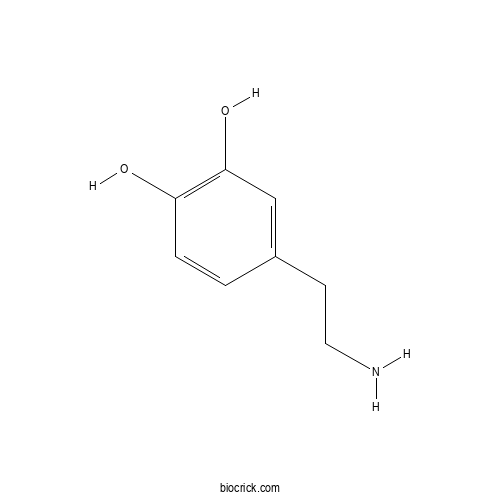
| Cas No. | 51-61-6 | SDF | File under preparation. |
| PubChem ID | 681.0 | Appearance | Powder |
| Formula | C8H11NO2 | M.Wt | 153.2 |
| Type of Compound | N/A | Storage | Desiccate at -20°C |
| Solubility | Soluble in Chloroform,Dichloromethane,Ethyl Acetate,DMSO,Acetone,etc. | ||
| Chemical Name | 4-(2-aminoethyl)benzene-1,2-diol | ||
| SMILES | C1=CC(=C(C=C1CCN)O)O | ||
| Standard InChIKey | VYFYYTLLBUKUHU-UHFFFAOYSA-N | ||
| Standard InChI | InChI=1S/C8H11NO2/c9-4-3-6-1-2-7(10)8(11)5-6/h1-2,5,10-11H,3-4,9H2 | ||
| General tips | For obtaining a higher solubility , please warm the tube at 37 ℃ and shake it in the ultrasonic bath for a while.Stock solution can be stored below -20℃ for several months. We recommend that you prepare and use the solution on the same day. However, if the test schedule requires, the stock solutions can be prepared in advance, and the stock solution must be sealed and stored below -20℃. In general, the stock solution can be kept for several months. Before use, we recommend that you leave the vial at room temperature for at least an hour before opening it. |
||
| About Packaging | 1. The packaging of the product may be reversed during transportation, cause the high purity compounds to adhere to the neck or cap of the vial.Take the vail out of its packaging and shake gently until the compounds fall to the bottom of the vial. 2. For liquid products, please centrifuge at 500xg to gather the liquid to the bottom of the vial. 3. Try to avoid loss or contamination during the experiment. |
||
| Shipping Condition | Packaging according to customer requirements(5mg, 10mg, 20mg and more). Ship via FedEx, DHL, UPS, EMS or other couriers with RT, or blue ice upon request. | ||
Quality Control & MSDS
3D structure
Package In Stock

Number of papers citing our products


Dopamine Dilution Calculator
Dopamine Molarity Calculator

| 1 mg | 5 mg | 10 mg | 20 mg | 25 mg | |
| 1 mM | 6.5274 mL | 32.6371 mL | 65.2742 mL | 130.5483 mL | 163.1854 mL |
| 5 mM | 1.3055 mL | 6.5274 mL | 13.0548 mL | 26.1097 mL | 32.6371 mL |
| 10 mM | 0.6527 mL | 3.2637 mL | 6.5274 mL | 13.0548 mL | 16.3185 mL |
| 50 mM | 0.1305 mL | 0.6527 mL | 1.3055 mL | 2.611 mL | 3.2637 mL |
| 100 mM | 0.0653 mL | 0.3264 mL | 0.6527 mL | 1.3055 mL | 1.6319 mL |
| * Note: If you are in the process of experiment, it's necessary to make the dilution ratios of the samples. The dilution data above is only for reference. Normally, it's can get a better solubility within lower of Concentrations. | |||||
- L-Ornithine
Catalog No.:BCX2329
CAS No.:70-26-8
- Putrescine
Catalog No.:BCX2328
CAS No.:110-60-1
- 3-Methyl-1-(3-methylfuran-2-yl)but-3-en-1-one
Catalog No.:BCX2327
CAS No.:78173-38-3
- Sorocein H
Catalog No.:BCX2326
CAS No.:157382-82-6
- Cathayanin B
Catalog No.:BCX2325
CAS No.:330195-60-3
- Taurodeoxycholic acid
Catalog No.:BCX2324
CAS No.:516-50-7
- Cathayanin C
Catalog No.:BCX2323
CAS No.:330195-61-4
- Spilanthol
Catalog No.:BCX2322
CAS No.:25394-57-4
- Naringenin chalcone
Catalog No.:BCX2321
CAS No.:73692-50-9
- Glutathione disulfide
Catalog No.:BCX2320
CAS No.:27025-41-8
- N6-Isopentenyladenine
Catalog No.:BCX2319
CAS No.:2365-40-4
- Laurolitsine
Catalog No.:BCX2318
CAS No.:904927-11-3
- Norcantharidin
Catalog No.:BCX2331
CAS No.:29745-04-8
- L-Arabinose
Catalog No.:BCX2332
CAS No.:5328-37-0
- L-Galactose
Catalog No.:BCX2333
CAS No.:15572-79-9
- L-Mannose
Catalog No.:BCX2334
CAS No.:10030-80-5
- 5-Methoxytryptamine
Catalog No.:BCX2335
CAS No.:608-07-1
- Doxofylline
Catalog No.:BCX2336
CAS No.:69975-86-6
- Turanose
Catalog No.:BCX2337
CAS No.:547-25-1
- 3-Methyl-4-isopropylphenol
Catalog No.:BCX2338
CAS No.:3228-02-2
- 3-Amino-3-(3,4-dimethoxyphenyl)propionic acid
Catalog No.:BCX2339
CAS No.:54160-63-3
- Guanidinoacetic acid
Catalog No.:BCX2340
CAS No.:352-97-6
- 6-Hydroxyflavanone
Catalog No.:BCX2341
CAS No.:190831-08-4
- D-Glucuronic acid
Catalog No.:BCX2342
CAS No.:6556-12-3
The role of PRKRA mutation in antipsychotic-induced extrapyramidal symptoms: a case report and implications for precision psychiatry.[Pubmed:42831374]
Psychiatr Genet. 2026 Oct 5.
Antipsychotic-induced extrapyramidal symptoms (EPS) significantly impact patient adherence and treatment outcomes in schizophrenia. While genetic susceptibility to EPS has been recognized, rare mutations influencing Dopamine regulation remain underexplored. We report a case of a 43-year-old woman with atypical psychosis who developed severe EPS following olanzapine treatment, despite its lower propensity. Genetic testing revealed a heterozygous duplication in the PRKRA gene, a key regulator of stress response pathways and movement control. This finding underscores the role of individualized pharmacogenomics in optimizing care. Additionally, allopurinol augmentation in this case suggests a novel therapeutic approach for neuroleptic sensitivity, leveraging its antioxidative and neuroprotective properties.
Astaxanthin Nanoemulsion Attenuates Paraquat-Induced Parkinsonism via Modulation of Oxidative Stress, Neuroinflammation, and Dopaminergic Dysfunction in Rats.[Pubmed:42830532]
Xenobiotica. 2026 Oct 4:1-22.
1. BACKGROUND: Parkinson's disease (PD) involves Dopaminergic dysfunction, oxidative stress, and neuroinflammation. This study evaluated an optimized astaxanthin-loaded nanoemulsion (AXTNE) in paraquat-induced experimental Parkinsonism. 2. METHODS: Male Wistar rats were randomly assigned to nine groups (n = 6). Parkinsonian alterations were induced by paraquat (10 mg/kg, i.p.) twice weekly for 4 weeks. Aqueous astaxanthin (AXT; 30 mg/kg), AXTNE (15 and 30 mg/kg), levodopa + carbidopa (15 + 3.75 mg/kg), and AXTNE-levodopa combinations were administered orally for 28 days. Motor function was assessed using catalepsy, locomotor activity, grip strength, postural instability, and beam-walk tests. Pooled bilateral striatal tissue was analyzed for oxidative stress, inflammatory cytokines, monoaminergic neurotransmitters, and Dopaminergic protein markers. 3. RESULTS: Paraquat induced motor deficits, oxidative imbalance, increased inflammatory cytokines, reduced Dopamine and noradrenaline, and altered tyrosine hydroxylase (TH), aromatic L-amino acid decarboxylase (AADC), and alpha-synuclein levels. AXTNE attenuated these alterations and reduced MDA levels measured by TBARS. AXTNE-levodopa combinations produced additional improvements across several endpoints. 4. CONCLUSION: AXTNE attenuated multiple paraquat-associated Parkinsonian alterations, with generally greater numerical improvements than aqueous AXT. Combination with levodopa showed potential complementary effects. Further histopathological, pharmacokinetic, biodistribution, and mechanistic studies are warranted.
Reproducible human reward imaging phenotypes exhibit differential sensitivity to dopamine D2 receptor antagonism.[Pubmed:42830297]
Nat Commun. 2026 Sep 3;17(1):10477.
Human reward processing varies along cue-centric and outcome-centric axes, but the mechanistic basis of individual variation in incentive salience attribution remains incompletely characterized. Here we show, using fMRI across five cohorts (N-total = 1251; N1 = 890; N2 = 245; N3 = 34; N4 = 48; N5 = 34), two reproducible imaging phenotypes mirroring sign- and goal-tracking (ST-like, GT-like). ST-like individuals showed dominant ventral striatal responses to reward-anticipation cues and sustained incentive salience attribution; GT-like individuals showed heightened responses to reward outcomes. This distinction was replicable across sites and independent samples. Single-dose and repeated-dose D(2)/D(3) antagonism (risperidone, haloperidol, amisulpride) selectively reduced anticipatory ventral striatal activity in ST, with single-dose antagonism additionally producing a parallel drop in self-reported energy. Instead, D(2)/D(3) partial agonism (aripiprazole) increased anticipatory and reduced outcome-phase responses in GT. In a psychosis cohort, antipsychotic D(2) affinity was associated with blunted anticipatory signals and higher negative symptom burden, offering a neuroimaging-driven basis for stratifying patients and predicting response to Dopaminergic agents.
Estradiol regulates L-type calcium channel-dependent social behavior deficits during cocaine abstinence in female rats.[Pubmed:42830198]
J Neuroendocrinol. 2026 Oct;38(10):e70280.
Social withdrawal during cocaine abstinence is a significant predictor of relapse, yet the neuroendocrine mechanisms underlying this vulnerability remain poorly understood, particularly in females. Estradiol, a potent neuromodulator of mesocorticolimbic circuitry, regulates Dopamine-dependent processes that encode social motivation. L-type calcium channels (LTCCs) similarly regulate neuronal excitability and plasticity in corticolimbic regions implicated in addiction and affective regulation, and estradiol interacts with LTCC signaling through both membrane-initiated and transcriptional mechanisms. However, whether estradiol and LTCCs functionally converge to regulate social behavior during cocaine abstinence is unknown. Here, we used a preclinical behavioral pharmacology approach to examine this interaction in female Sprague-Dawley rats. Ovariectomized (OVX) rats with or without 17beta-estradiol replacement underwent jugular catheterization and self-administered cocaine (0.5 mg/kg/inf, FR1) or saline for 10 days, followed by 17 days of forced abstinence. Social preference was assessed using a three-chamber social interaction test, with systemic isradipine (1.2 mg/kg, i.p.) administered 15 min prior to testing. Cocaine abstinence significantly reduced social preference in intact females. LTCC blockade with isradipine restored social preference, but this effect was dependent on ovarian hormone status: isradipine normalized social behavior in sham-operated and OVX + E2 rats but not in OVX rats lacking estradiol. Multiple linear regression confirmed that ovarian hormone status and isradipine treatment, but not total cocaine intake, significantly predicted social preference, with a robust hormone x isradipine interaction explaining 44.6% of behavioral variance. These findings demonstrate that estradiol does not simply protect against abstinence-related social deficits but rather biases neural signaling such that social behavior becomes sensitive to LTCC-dependent mechanisms. This work identifies a functional estradiol-LTCC interaction regulating social motivation during cocaine abstinence and highlights the importance of hormonal state in shaping sex-specific addiction vulnerability.
Behavioural and neurochemical mechanisms of learning and memory in Planaria.[Pubmed:42830182]
Neurobiol Learn Mem. 2026 Oct 4:108221.
Planaria, a freshwater flatworm with unique regenerative abilities, has emerged as a valuable model organism for studying learning and memory. A growing body of evidence shows that planarians can recover their learning behaviour even after decapitation and regeneration. Behavioural paradigms, including classical, operant, and threat-related conditioning responses, show the capacity of planaria in learning and expressing both appetitive and aversive memories. Evidence at the molecular level, further confirms the presence of principal neurotransmitters, including glutamate, gamma-aminobutyric acid (GABA) and Dopamine, which may contribute to planarian learning, memory and behavioural expression. Importantly, the dynamic balance among glutamatergic, GABAergic and Dopaminergic pathways is consistently implicated in learning, memory, neuronal expression and behavioural activity. This review summarises behavioural evidence for learning and memory and highlights the key neurotransmitter systems that regulate these processes. It outlines future research directions for planaria as a valuable model for translational studies on memory and learning.
Iron Oxide-GO Nanocomposite to develop a High-Performance Electrochemical Sensor for Simultaneous Detection of Drugs.[Pubmed:42830137]
Anal Biochem. 2026 Oct 4:116265.
In this study, iron oxide nanoparticles were synthesized through a simple, cost-effective, and environmentally friendly green synthesis route using aqueous rose extract as a natural reducing and stabilizing agent. The synthesized nanoparticles were combined with graphene oxide (GO) and employed to modify a carbon paste electrode (CPE) for the simultaneous electrochemical detection of Dopamine (DOP) and tryptophan (TRP). The fabricated Fe(2)O(3)/Fe(3)O(4)-GO/CPE sensor was characterized using cyclic voltammetry (CV), differential pulse voltammetry (DPV), and chronoamperometry. The modified electrode exhibited significantly enhanced electrocatalytic activity, sensitivity, and electron transfer capability compared with the bare electrode. Under optimized conditions, the sensor demonstrated wide linear dynamic ranges of 0.5-300 muM for Dopamine and 1-300 muM for tryptophan, with low detection limits of 0.32 muM and 0.47 muM, respectively. The proposed sensor also showed excellent repeatability, good stability, high selectivity against common interfering species, and enhanced electroactive surface area due to the synergistic effect of iron oxide nanoparticles and graphene oxide. These results indicate that the developed nanocomposite-modified electrode is a promising, sensitive, and low-cost electrochemical platform for the simultaneous determination of biologically important analytes in pharmaceutical and biomedical applications. Future studies may focus on applying the proposed sensor to real biological and pharmaceutical samples and further improving its performance for portable and point-of-care electrochemical sensing applications.
An Oral Nanozyme Microsupplement Converts Pathological ROS Into a Colon-Adhesive Shield for Long-Term Neutrophil-Directed Remission of Ulcerative Colitis.[Pubmed:42829799]
Adv Mater. 2026 Oct 4:e75234.
Neutrophil extracellular traps (NETs) perpetuate chronic inflammation in ulcerative colitis (UC), yet current neutrophil-targeting therapies focus on acute intervention rather than sustained daily control. Here, we propose an oral microsupplement for long-term UC management that concurrently scavenges reactive oxygen species (ROS) and suppresses NET formation. The microsupplement integrates a catalase-mimetic CoAl-layered double hydroxide (LDH) nanozyme intercalated with the autophagy inhibitor chloroquine (CQ), together with Dopamine (DOPA). The LDH nanozyme catalytically converts pathological ROS into oxygen, driving in situ polymerization of DOPA into polyDopamine (PDA), a mucoadhesive polymer that prolongs colonic retention of CQ@LDH and promotes mucosal healing. RNA sequencing reveals that internalized CQ@LDH inhibits autophagic flux in neutrophils, thereby upregulating catalase expression and peroxisomal function to prevent NET formation. Consequently, NET-driven M1 macrophage polarization is reduced from 29.5% to 17.9%, and Th17 differentiation is markedly suppressed, accompanied by a decrease in colonic Th17/Treg ratio from 8.68 to 1.31. In a murine UC model, this microsupplement restores colonic mucosal integrity, rebalances the gut microbiota, and outperforms the clinical drug 5-aminosalicylic acid in both immune regulation and epithelial restitution. This neutrophil-regulating, colon-adhesive platform offers a promising strategy for routine daily UC management.
Comparative Analysis of Antidepressant Mechanisms and Side Effects: Network Pharmacology and Molecular Docking Study of Amitriptyline, Mirtazapine, and Escitalopram for Treating Major Depressive Disorder.[Pubmed:42829528]
Depress Anxiety. 2026 Oct 2;2026:6981320.
BACKGROUND: Amitriptyline, mirtazapine, and escitalopram are effective antidepressants for treating major depressive disorder (MDD). Our study aimed to use computational biology to understand the mechanisms for the similarities and differences in efficacies and side effects of these drugs. METHODS: Potential targets for MDD and the three drugs were obtained using public databases. Venn diagrams and protein-protein interaction (PPI) networks were constructed. Drug-target-pathway (D-T-P) networks were built using Cytoscape, and core targets were filtered using CytoNCA and CytoHubba plugins. Gene Ontology (GO) and Kyoto Encyclopedia of Genes and Genomes (KEGG) pathway analyses were conducted using the Database for Annotation, Visualization, and Integrated Discovery. Ligand compounds and receptor proteins were processed with PyMOL and AutoDock. The binding of amitriptyline, mirtazapine, and escitalopram with core targets was predicted by molecular docking using AutoDock Vina. The results were visualized using PyMOL and protein-ligand interaction profiler (PLIP). RESULTS: Forty-eight overlapping targets and 66, 50, and 30 individual targets for MDD treatment were identified for amitriptyline, mirtazapine, and escitalopram, respectively. Critical pathways included "Neuroactive ligand-receptor interaction," "Calcium signaling pathway," and "Serotonergic synapse." Key targets, indicating a wide range of effects on cellular activities and signaling mechanisms, included D(2) Dopamine receptor (DRD2), CYP2D6, monoamine oxidase type B (MAOB), solute carrier family 6 member 3 (SLC6A3), solute carrier family 6 member 4 (SLC6A4), 5-hydroxytryptamine receptor 2C (HTR2C), and CHRNA4. MAOB had the highest binding affinity with amitriptyline, followed by SLC6A4 and DRD2. Binding stability was enhanced by salt bridges and pi-stacking interactions. Mirtazapine formed strong binding affinities with HTR2C, SLC6A4, and CHRNA4 through hydrogen bonds and pi-stacking interactions. Escitalopram exhibited the highest affinity for SLC6A3, followed by HTR2C. CONCLUSION: All three drugs regulated serotonin, norepinephrine (NE), and Dopamine, but target specificity, pathways, and binding patterns differed. Amitriptyline exhibited stronger antidepressant effects and broader mechanisms but a higher risk of side effects. Mirtazapine's dual mechanism regulates broad targets with reliable efficacy and fewer side effects. Escitalopram selectively acts on serotonin-related targets, with narrow actions and potentially fewer side effects. These findings align with the clinical profiles of the antidepressant efficacy and side effects.
Human iPSC-Derived Tissue-Engineered Nigrostriatal Pathway for Chronic Restoration of Dopaminergic Axon Tracts in a Rat Parkinson's Model.[Pubmed:42829468]
Adv Healthc Mater. 2026 Oct 3:e71775.
Parkinson's disease (PD) is a progressive neurodegenerative disorder characterized by loss of Dopamine-producing neurons in the substantia nigra, causing motor symptoms. Current surgical interventions fail to restore the native nigrostriatal pathway essential for Dopamine regulation. We have developed tissue-engineered nigrostriatal pathways (TE-NSPs) using hyaluronic acid hydrogel microcolumns with a collagen/laminin core encasing aggregated Dopaminergic neurons and long-projecting axon tracts. TE-NSPs fabricated using human iPSC-derived Dopaminergic neurons extended bundled axon tracts at a rate of 1 mm/day-twice that of neuronal aggregates on planar surfaces. Fully grown engineered microtissue exhibited nigrostriatal-like cytoarchitecture, appropriate Dopaminergic phenotypes, evoked Dopamine release, and innervation of striatal neurons in vitro. TE-NSPs were then evaluated in a rat 6-OHDA PD model via histology and voltammetry at 3- and 6 months post-implantation. TE-NSPs showed Dopaminergic neuronal survival in the substantia nigra, preserved axon tracts within the microcolumn, and outgrowth into host striatum. Voltammetry on ex vivo brain slices containing the implanted microtissue revealed evoked Dopamine release at both 3- and 6-months post-implant. This study shows engineered microtissue fabricated using human cells with an anatomically-inspired architecture and subsequently used for chronic replacement of a long-distance brain pathway in a preclinical model, potentially offering a promising future treatment for pathway reconstruction in PD.
Centrally administered SGLT2 inhibitor improves gut barrier function through the brain orexin, AMPK, dopamine D2 signaling and the vagal pathway in rats.[Pubmed:42829074]
Neurosci Res. 2026 Oct 3:105135.
Leaky gut, defined as increased intestinal permeability, has been associated with many diseases. Recent studies suggest the brain is involved in maintaining gut barrier function. Since tofogliflozin, a sodium/glucose cotransporter 2 (SGLT2) inhibitor acts centrally to increase food intake, and feeding and gut functions are deeply associated, this study aimed to clarify the hypothesis that gut barrier function is influenced by centrally administered SGLT2 inhibitors in rats using Evans blue method. Intracisternal SGLT2 inhibitor blocked colonic hyperpermeability in response to lipopolysaccharide dose-dependently (15 mug-). The blockade was cancelled by atropine, vagotomy, intracisternal orexin receptor antagonist, intracisternal compound C, an adenosine monophosphate-activated protein kinase (AMPK) inhibitor, or subcutaneously injected sulpiride, a Dopamine D2 receptor antagonist. Subcutaneous SGLT2 inhibitor at much higher doses of 5mg or more could improve colonic hyperpermeability, and the improvement was also blocked by atropine or intracisternal orexin receptor antagonist or compound C. These results indicate SGLT2 inhibitor administered centrally or peripherally reduces colonic hyperpermeability through the vagal pathway although we could not exclude the possibility that peripherally administered SGLT2 inhibitor might act first in periphery. Brain orexin, AMPK and Dopamine D2 signaling are involved in this process. SGLT2 inhibitors may be useful to treat leaky gut-related diseases.
Synucleins deficiency alter dopamine- and glutamate-induced calcium signal in neurons and astrocytes.[Pubmed:42828908]
Neurochem Int. 2026 Oct 3;200:106269.
Proteins alpha-, beta-, and gamma-synuclein in brain distributed predominantly in presynaptic terminals suggesting their role in regulating neurotransmitter release and signal transduction. Misfolded alpha-synuclein is involved in the pathology of Parkinson's disease which is characterized by the loss of Dopaminergic neurons and the resulting Dopamine deficiency. The role of synucleins in the physiology of Dopamine-controlled signal transmission is still not fully understood. Using acute brain slices from transgenic mice with alpha-, beta-, gamma-synuclein knockout (KO) we studied the effect of synuclein deficiency on Dopamine and glutamate-induced calcium signals in neurons and astrocytes. We have found that lack of alpha- or gamma -synuclein decreases the Dopamine-induced calcium signal in neurons while gamma- or alphabetagamma-KO were characterized by a lower calcium signal in response to glutamate. The ability of Dopamine to reduce glutamate-induced calcium signal were altered by gamma- and alphabetagamma-synuclein deficiency. Monoamine oxidase-dependent Dopamine-induced calcium signal in astrocytes was increased in alpha-synuclein KO brain slices. alphabetagamma-synuclein deficiency had no effect on mitochondrial Ca(2+)-transport and only gamma-synuclein KO led to decrease in the rate of mitochondrial calcium uptake and mitochondrial calcium capacity. Thus, synuclein deficiency alters Dopamine- and glutamate -induced calcium signalling in neurons and astrocytes.
Multimodal neuroimaging in dementia and neurodegenerative disorders: complementary roles of clinically available nuclear medicine and MRI in the era of disease-modifying therapies.[Pubmed:42828695]
Jpn J Radiol. 2026 Oct 3.
The introduction of anti-amyloid-beta antibody therapies has fundamentally changed the clinical landscape of dementia, shifting the role of neuroimaging from diagnosis toward therapeutic decision-making. Amyloid positron emission tomography (PET) has become essential for confirming amyloid pathology and determining treatment eligibility. However, amyloid deposition is frequently observed in cognitively normal elderly individuals and in non-Alzheimer neurodegenerative disorders, indicating that amyloid status alone is insufficient to explain clinical symptoms. In this context, imaging modalities reflecting neurodegeneration, including structural magnetic resonance imaging (MRI) and functional imaging such as (18)F-FDG-PET and brain perfusion single-photon emission computed tomography (SPECT), remain important for assessing disease severity and functional impairment. Furthermore, discrepancies between imaging biomarkers-such as the presence of neurodegeneration without amyloid pathology in cases clinically suspected of Alzheimer's disease, and atypical imaging patterns-are commonly encountered in clinical practice and may reflect underlying pathological heterogeneity. A multimodal imaging approach that integrates multiple biomarkers provides complementary information and may improve diagnostic accuracy and clinical interpretation. In addition, other imaging modalities, including Dopamine transporter (DAT) imaging and cardiac sympathetic imaging, can contribute to the evaluation of non-Alzheimer pathologies. This review summarizes the current roles of clinically available multimodal imaging in dementia, with a focus on nuclear medicine and MRI, highlighting their complementary value and clinical implications in the era of disease-modifying therapies.
Wolfberry glycopeptides alleviate levodopa-induced dyskinesia.[Pubmed:42828445]
Neural Regen Res. 2026 Sep 30.
Levodopa-induced dyskinesia is a prevalent and almost inevitable complication of long-term levodopa therapy in Parkinson's disease, significantly impairing patients' quality of life. Despite its clinical significance, levodopa-induced dyskinesia remains insufficiently understood, and effective therapeutic strategies are still limited. Wolfberry glycopeptides, bioactive components extracted from Lycium barbarum L. have recently been widely reported to possess neuroimmune activities. In this study, levodopa-induced dyskinesia was induced through chronic levodopa administration in multiple Parkinson's disease animal models, including synuclein alpha-overexpressing mice and glutathione peroxidase 4 conditional knockdown mice, and then treated with wolfberry glycopeptides. Behavioral assessment using abnormal involuntary movements scoring showed that wolfberry glycopeptides significantly alleviated levodopa-induced dyskinesia-like symptoms across these models. Mechanistically, wolfberry glycopeptides preserved nigral Dopaminergic neurons by restoring membrane lipid oxidative homeostasis, thereby delaying neuronal loss, and modestly improving Dopamine metabolic homeostasis in the brain. Collectively, these findings demonstrate that wolfberry glycopeptides effectively mitigate levodopa-induced dyskinesia through Dopaminergic neuroprotection and support their use as an integrative strategy in combination with levodopa to reduce levodopa-induced dyskinesia development and improve Parkinson's disease symptom management.
Approach to the pregnant patient with prolactinoma.[Pubmed:42828437]
J Clin Endocrinol Metab. 2026 Oct 3:dgag408.
Prolactinomas account for approximately half of the pituitary adenomas and predominantly affect women of reproductive age. Hyperprolactinemia commonly causes infertility by suppressing hypothalamic gonadotropin-releasing hormone (GnRH) secretion and impairing gonadal function. Because Dopamine agonist therapy can rapidly restore fertility, clinicians caring for women with prolactinomas should be qualified to manage problems that may arise during pregnancy. Pregnancy is characterized by physiological enlargement of the anterior pituitary gland and progressive hyperprolactinemia, primarily driven by increased placental estrogen secretion. Therefore, the management of prolactinoma during preconception, pregnancy, and the postpartum period requires an individualized, multidisciplinary approach by an experienced team. The principal challenges are symptomatic tumor enlargement and, rarely, pituitary apoplexy. If clinically significant tumor growth occurs during pregnancy, Dopamine agonist therapy can be safely restarted. Both bromocriptine and cabergoline may be used safely during gestation, but cabergoline is increasingly preferred because of its greater efficacy and better tolerability. In patients with pituitary apoplexy, management may include close observation, Dopamine agonist therapy, glucocorticoid replacement when indicated, or transsphenoidal surgery, depending on the severity of clinical and neuro-ophthalmological findings. Breastfeeding can generally be permitted in women with prolactinomas; therefore, Dopamine agonist therapy should be withheld during lactation unless treatment is clinically necessary. This review discusses the practical aspects of recognizing, and managing prolactinoma-related problems before, during, and after pregnancy.
A subject-specific mechanistic model of affect links electroencephalography, cardiorespiratory feedback, and monoaminergic dynamics.[Pubmed:42827930]
Front Comput Neurosci. 2026 Sep 18;20:1875657.
INTRODUCTION: Affective experience emerges from interactions among cortical activity, bodily physiology, and contextual interpretation, yet the mechanisms linking these processes remain incompletely understood. Although EEG-based studies have advanced affect decoding, many data-driven approaches provide limited mechanistic insight into inter-individual variability. We developed a subject-specific, hypothesis-generating computational framework linking EEG-derived cortical activity and cardiorespiratory dynamics to subjective affect through putative neuromodulatory processes. METHODS: The framework integrates a respiratory-circulatory subsystem with spiking-neuron models representing the locus coeruleus, ventral tegmental area, raphe nucleus, and basolateral amygdala. EEG band-power features were used as hypothesis-driven, indirect inputs to these modeled processes rather than as direct measures of deep-brain activity, while cardiorespiratory variables provided physiological feedback to the neural circuit. Model-derived activity was converted into putative norepinephrine-, Dopamine-, and serotonin-related signals. Together with two fitted serotonin-related modulation coefficients, these signals constituted five latent parameters used to represent valence-arousal states. The modulation coefficients were estimated for each participant-stimulus observation by nonlinear optimization so that model-derived arousal and valence matched the corresponding subjective ratings. Model calibration and predictive validation were evaluated separately. Predictive validity was assessed using leave-one-stimulus-out cross-validation, in which each stimulus was held out in turn and predicted from regression equations fitted only to the remaining 15 stimuli. RESULTS: The framework was evaluated using the AMIGOS dataset (nine participants, 16 video stimuli; 144 participant-stimulus observations). Under the calibration procedure, the five latent parameters reproduced participant-specific valence-arousal ratings. In cross-validation across all participants, the mean root mean square error was 0.380 +/- 0.288 for arousal and 1.283 +/- 1.512 for valence, indicating more consistent prediction of unseen stimuli for arousal and substantial inter-individual variability in valence prediction. Cross-participant regression showed weaker generalization, further supporting the importance of subject-specific modeling. DISCUSSION: The proposed framework does not directly measure deep-brain or monoaminergic activity. Rather, it provides a physiologically informed and interpretable framework for generating hypotheses about how cortical activity, cardiorespiratory feedback, and putative neuromodulatory processes may jointly contribute to individual affective experience. The findings also highlight the need for validation in larger independent datasets using direct neurophysiological measurements.

Calcutta University

University of Minnesota

University of Maryland School of Medicine

University of Illinois at Chicago

The Ohio State University

University of Zurich

Harvard University

Colorado State University

Auburn University

Yale University

Worcester Polytechnic Institute

Washington State University

Stanford University

University of Leipzig

Universidade da Beira Interior

The Institute of Cancer Research

Heidelberg University

University of Amsterdam

University of Auckland

TsingHua University

The University of Michigan

Miami University

DRURY University

Jilin University

Fudan University

Wuhan University

Sun Yat-sen University

Universite de Paris

Deemed University

Auckland University

The University of Tokyo

Korea University



