
NorcantharidinCAS# 29745-04-8 |
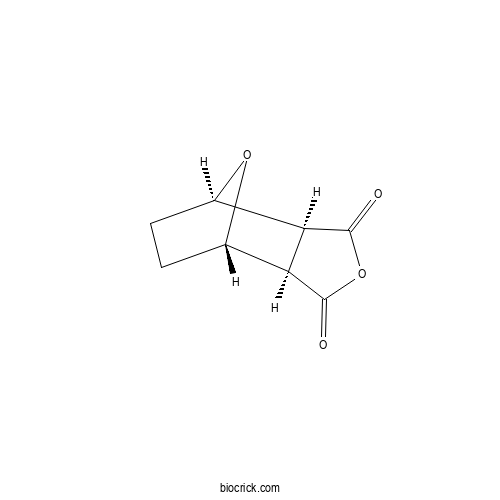
| Cas No. | 29745-04-8 | SDF | File under preparation. |
| PubChem ID | 9877482.0 | Appearance | Powder |
| Formula | C8H8O4 | M.Wt | 168.2 |
| Type of Compound | N/A | Storage | Desiccate at -20°C |
| Solubility | Soluble in Chloroform,Dichloromethane,Ethyl Acetate,DMSO,Acetone,etc. | ||
| Chemical Name | (1S,2R,6S,7R)-4,10-dioxatricyclo[5.2.1.02,6]decane-3,5-dione | ||
| SMILES | C1CC2C3C(C1O2)C(=O)OC3=O | ||
| Standard InChIKey | JAABVEXCGCXWRR-FBXFSONDSA-N | ||
| Standard InChI | InChI=1S/C8H8O4/c9-7-5-3-1-2-4(11-3)6(5)8(10)12-7/h3-6H,1-2H2/t3-,4+,5-,6+ | ||
| General tips | For obtaining a higher solubility , please warm the tube at 37 ℃ and shake it in the ultrasonic bath for a while.Stock solution can be stored below -20℃ for several months. We recommend that you prepare and use the solution on the same day. However, if the test schedule requires, the stock solutions can be prepared in advance, and the stock solution must be sealed and stored below -20℃. In general, the stock solution can be kept for several months. Before use, we recommend that you leave the vial at room temperature for at least an hour before opening it. |
||
| About Packaging | 1. The packaging of the product may be reversed during transportation, cause the high purity compounds to adhere to the neck or cap of the vial.Take the vail out of its packaging and shake gently until the compounds fall to the bottom of the vial. 2. For liquid products, please centrifuge at 500xg to gather the liquid to the bottom of the vial. 3. Try to avoid loss or contamination during the experiment. |
||
| Shipping Condition | Packaging according to customer requirements(5mg, 10mg, 20mg and more). Ship via FedEx, DHL, UPS, EMS or other couriers with RT, or blue ice upon request. | ||
Quality Control & MSDS
3D structure
Package In Stock

Number of papers citing our products


Norcantharidin Dilution Calculator
Norcantharidin Molarity Calculator

| 1 mg | 5 mg | 10 mg | 20 mg | 25 mg | |
| 1 mM | 5.9453 mL | 29.7265 mL | 59.453 mL | 118.9061 mL | 148.6326 mL |
| 5 mM | 1.1891 mL | 5.9453 mL | 11.8906 mL | 23.7812 mL | 29.7265 mL |
| 10 mM | 0.5945 mL | 2.9727 mL | 5.9453 mL | 11.8906 mL | 14.8633 mL |
| 50 mM | 0.1189 mL | 0.5945 mL | 1.1891 mL | 2.3781 mL | 2.9727 mL |
| 100 mM | 0.0595 mL | 0.2973 mL | 0.5945 mL | 1.1891 mL | 1.4863 mL |
| * Note: If you are in the process of experiment, it's necessary to make the dilution ratios of the samples. The dilution data above is only for reference. Normally, it's can get a better solubility within lower of Concentrations. | |||||
- Dopamine
Catalog No.:BCX2330
CAS No.:51-61-6
- L-Ornithine
Catalog No.:BCX2329
CAS No.:70-26-8
- Putrescine
Catalog No.:BCX2328
CAS No.:110-60-1
- 3-Methyl-1-(3-methylfuran-2-yl)but-3-en-1-one
Catalog No.:BCX2327
CAS No.:78173-38-3
- Sorocein H
Catalog No.:BCX2326
CAS No.:157382-82-6
- Cathayanin B
Catalog No.:BCX2325
CAS No.:330195-60-3
- Taurodeoxycholic acid
Catalog No.:BCX2324
CAS No.:516-50-7
- Cathayanin C
Catalog No.:BCX2323
CAS No.:330195-61-4
- Spilanthol
Catalog No.:BCX2322
CAS No.:25394-57-4
- Naringenin chalcone
Catalog No.:BCX2321
CAS No.:73692-50-9
- Glutathione disulfide
Catalog No.:BCX2320
CAS No.:27025-41-8
- N6-Isopentenyladenine
Catalog No.:BCX2319
CAS No.:2365-40-4
- L-Arabinose
Catalog No.:BCX2332
CAS No.:5328-37-0
- L-Galactose
Catalog No.:BCX2333
CAS No.:15572-79-9
- L-Mannose
Catalog No.:BCX2334
CAS No.:10030-80-5
- 5-Methoxytryptamine
Catalog No.:BCX2335
CAS No.:608-07-1
- Doxofylline
Catalog No.:BCX2336
CAS No.:69975-86-6
- Turanose
Catalog No.:BCX2337
CAS No.:547-25-1
- 3-Methyl-4-isopropylphenol
Catalog No.:BCX2338
CAS No.:3228-02-2
- 3-Amino-3-(3,4-dimethoxyphenyl)propionic acid
Catalog No.:BCX2339
CAS No.:54160-63-3
- Guanidinoacetic acid
Catalog No.:BCX2340
CAS No.:352-97-6
- 6-Hydroxyflavanone
Catalog No.:BCX2341
CAS No.:190831-08-4
- D-Glucuronic acid
Catalog No.:BCX2342
CAS No.:6556-12-3
- Bryodulcosigenin
Catalog No.:BCX2343
CAS No.:88930-16-9
The Pt(IV) complexes of norcantharidin axial-modulated by carboxylic acid ligand: Synthesis, characterization, in vitro/in vivo anticancer efficacy and hypoxic activity.[Pubmed:42810191]
Eur J Med Chem. 2026 Sep 24;320:119365.
Norcantharidin (NCTD), a semi-synthetic derivative of cantharidin from the animal-derived traditional Chinese medicine Cantharides, was selected as a potential functional anticancer ligand. Then three new Pt(IV) complexes (Pt-NCTD-bu, Pt-NCTD-pe, Pt-NCTD-he) were designed as a homologous series to evaluate how increasing axial chain length affects lipophilicity and anticancer efficacy. The axial carboxylate ligands were employed to modulate lipophilicity and coordination stability. These complexes exhibited stronger cytotoxicity against the most sensitive A2780 cells than cisplatin, with the order of potency following he > pe > bu, correlating with increasing lipophilicity and cellular uptake. All three complexes also effectively suppressed colony formation. They also overcame cisplatin resistance in A2780/CDDP cells. Mechanistically, they could release active Pt(II) and NCTD via GSH-mediated reduction, inducing ROS accumulation, mitochondrial dysfunction, DNA damage and cell apoptosis. Especially, under intracellular hypoxia condition, Pt-NCTD-he showed the highest oxygen-independent cytotoxicity. In vivo, Pt-NCTD-he (20 mg/kg) more effectively suppressed tumor growth in A2780 xenografts than cisplatin, with a 70.0% inhibition rate. Pt-NCTD-he was found to mainly distribute in the liver, indicating that a higher lipophilicity is conducive to better anticancer activity. Pt-NCTD-he also showed satisfactory pharmacokinetic properties, with a longer elimination half-life (1.3 h) than cisplatin (ca. 0.5 h). This work highlights the rational design of Pt(IV) complexes by integrating natural medicinal ingredients, providing a promising strategy for the new generation of Pt(IV)-based complexes as anticancer prodrugs.
Norcantharidin induces apoptosis in hepatocellular carcinoma MHCC97-H cells in association with altered NF-kappaB/IkappaBalpha signaling dynamics and JNK activation.[Pubmed:42769235]
Am J Transl Res. 2026 Aug 15;18(8):7405-7419.
Norcantharidin (NCTD), a demethylated derivative of cantharidin, has antitumor activity against multiple cancer types; however, its effects on the NF-kappaB/JNK signaling axis in hepatocellular carcinoma (HCC) remain incompletely defined. MHCC97-H HCC cells were treated with NCTD at 5, 20, and 40 mug/mL (approximately 29.7, 118.9, and 237.9 muM), alone or in combination with pyrrolidine dithiocarbamate (PDTC, 50 muM), a compound with reported NF-kappaB inhibitory and antioxidant properties. NCTD suppressed cell viability in a dose- and time-dependent manner, with 48-h inhibition rates of 24.3%, 51.9%, and 72.1% at the three concentrations. Based on the available MTS data, the estimated NCTD IC50 was > 40 mug/mL at 24 h and approximately 19.0 mug/mL at 48 h. Flow cytometry showed corresponding apoptosis rates of 13.3%, 36.8%, and 43.2%, which increased to 50.2% after PDTC co-treatment. Western blotting showed reduced nuclear NF-kappaB p65 signal and decreased cytoplasmic IkappaBalpha levels, together with increased phosphorylated JNK (p-JNK), while total JNK remained unchanged. RT-qPCR showed upregulation of pro-apoptotic Bax, downregulation of anti-apoptotic Bcl-2, and increased c-Jun, TNF-alpha, and IL-6 transcripts. NCTD further impaired colony formation, induced G0/G1 arrest, depolarized mitochondrial membrane potential, and increased reactive oxygen species. TCGA-LIHC bulk RNA-seq data were analyzed to provide clinical context. NF-kappaB pathway genes were differentially expressed in HCC, and enrichment analyses implicated NF-kappaB, apoptosis, TNF, and MAPK-related pathways. The NF-kappaB Core activity score showed no significant tumor-normal difference, but immune infiltration analysis revealed associations between NF-kappaB activity and the HCC immune microenvironment. These findings indicate that NCTD triggers mitochondrial apoptosis in MHCC97-H cells in association with reduced nuclear p65 signal, altered IkappaBalpha turnover, stress/inflammatory gene induction, and enhanced JNK activation, rather than demonstrating uniform blockade of the entire NF-kappaB pathway.
Norcantharidin Ameliorates Experimental Ulcerative Colitis Through Epigenetic and Metabolic Reprogramming Involving IL-6/DNMT1/SOCS3 and AMPK/SIRT1/FOXO3a-Nrf2 Signaling.[Pubmed:42589324]
Int J Mol Sci. 2026 Jul 26;27(15):6666.
Ulcerative colitis (UC) is a chronic inflammatory disorder associated with cytokine imbalance, epigenetic alterations, and metabolic-redox dysfunction. Despite the widespread use of mesalazine (5-ASA), therapeutic limitations remain. Norcantharidin (NCTD), a synthetic cantharidin analogue, may provide multi-target protection against UC. Experimental colitis was induced in male Sprague-Dawley rats by intrarectal administration of 4% acetic acid (AA). Rats received oral NCTD (10 mg/kg), 5-ASA (100 mg/kg), or their combination for 8 days. Disease severity was assessed by disease activity index, body weight, colon length, colon weight/length ratio, and histopathology. Colonic biomarkers were evaluated using ELISA, qRT-PCR, Western blotting, and immunohistochemistry. Fe(2+) and malondialdehyde (MDA) were measured as indicators of iron accumulation and lipid peroxidation. Molecular docking suggested that NCTD may adopt plausible binding poses within the binding pockets of AMPK, SIRT1, and DNMT1, providing structural support for potential protein-ligand interactions. NCTD significantly ameliorated AA-induced colitis, improving clinical and histological outcomes. These effects were associated with reduced IL-6, TNF-alpha, DNMT1, Fe(2+), and MDA levels, restoration of SOCS3, activation of p-AMPK/SIRT1/FOXO3a signaling, and enhancement of Nrf2/HO-1 defenses. Combined NCTD/5-ASA treatment produced greater clinical and histological protection, with differential effects on molecular markers. Docking studies suggested favorable interactions of NCTD with AMPK, SIRT1, and DNMT1. NCTD treatment was associated with protection against experimental colitis, linked to modulation of inflammatory, epigenetic, metabolic, and antioxidant pathways.
Norcantharidin attenuates amiodarone-induced pulmonary fibrosis via modulating miRNA-30a/GSK-3beta/beta-catenin and oxidative-inflammatory pathways.[Pubmed:42525297]
Naunyn Schmiedebergs Arch Pharmacol. 2026 Jul 29.
Amiodarone-induced pulmonary fibrosis (AIPF) is characterized by inflammation, oxidative stress, microRNA dysregulation, fibroblast activation, and excessive extracellular matrix deposition. Norcantharidin (NCTD), a small-molecule compound with reported anti-inflammatory, antioxidant, and antifibrotic properties, has attracted attention as a potential therapeutic agent. To investigate the protective effects of NCTD against AIPF in rats. Eighteen rats were randomly divided into three groups (n = 6 each): a negative control group receiving vehicle, an amiodarone group, and an NCTD-treated group receiving 0.1 mg/kg intraperitoneally for six weeks. Pulmonary fibrosis was induced by oral administration of 50 mg/kg amiodarone for five weeks. Lung injury was assessed using hematoxylin and eosin staining and semi-quantitative scoring, collagen deposition was evaluated by Masson's trichrome staining, and immunohistochemistry was performed for fibronectin and alpha-smooth muscle actin (alpha-SMA). Molecular and biochemical markers including tumor necrosis factor (TNF)-alpha, beta-catenin, interleukin (IL)-1beta, malondialdehyde (MDA), and glutathione (GSH) were measured, while glycogen synthase kinase (GSK)-3beta was assessed by Western blot, and miRNA-30a by quantitative PCR. Amiodarone significantly increased lung injury scores, collagen deposition, alpha-SMA, fibronectin, TNF-alpha, IL-1beta, MDA, GSK-3beta, and beta-catenin, while reducing GSH and miRNA-30a levels. NCTD treatment markedly reversed these alterations, restoring alpha-SMA, fibronectin, TNF-alpha, IL-1beta, MDA, GSK-3beta, and beta-catenin, while increasing GSH and miRNA-30a toward normal. Histologically, NCTD preserved alveolar architecture, reduced peribronchiolar inflammation, and normalized collagen distribution. These results demonstrate that NCTD exerts potent antifibrotic, anti-inflammatory, and antioxidant effects in AIPF, likely through modulation of oxidative stress, inflammatory cytokines, microRNA expression, and the GSK-3beta/beta-catenin signaling pathway, highlighting its potential as a therapeutic agent for drug-induced lung injury.
Norcantharidin induces nephrotoxicity by disrupting the ATF4/CTH/H(2)S pathway and promoting apoptosis.[Pubmed:42456381]
Tissue Cell. 2026 Jul 1;104(Pt 1):103749.
Norcantharidin serves as a therapeutic agent in the clinical care of malignant neoplasms. However, recent safety alerts issued in China in June 2025 highlighted its association with renal injury. Given that the mechanisms underlying NCTD-induced nephrotoxicity have yet to be completely defined, this work was designed to explore the impact of the ATF4/CTH/H(2)S pathway on nephrotoxicity triggered by NCTD. Our data revealed that exposure to NCTD triggered mitochondria-dependent apoptosis in renal cells, alongside decreased H(2)S levels, ROS accumulation, compromised mitochondrial integrity, and caspase-3 activation. Mechanistically, NCTD inhibited both ATF4 protein levels and its transcriptional function, resulting in downregulation of CTH and a subsequent reduction in H(2)S production. H(2)S deficiency impaired S-sulfhydration of Drp1, enhanced the Drp1-VDAC1 interaction, promoted mPTP opening, and ultimately triggered apoptosis. H(2)S supplementation rescued these defects by restoring Drp1 S-sulfhydration, but this protective effect was completely abolished by DTT, confirming the specificity of S-sulfhydration. Furthermore, overexpression of ATF4 or CTH alleviated NCTD-triggered apoptosis via H(2)S restoration, whereas knockdown of ATF4 or CTH exacerbated cytotoxicity. Critically, CTH knockdown abolished the protective effect of ATF4 overexpression, while CTH overexpression remained functional independently of ATF4. In conclusion, our findings established that NCTD induced nephrotoxicity primarily through the inhibition of the ATF4/CTH/H(2)S axis, which disrupted Drp1-mediated mitochondrial homeostasis. These results identified H(2)S restoration as a promising therapeutic strategy to mitigate NCTD-induced kidney injury.
A pH/glutathione-dual-responsive drug-loaded heterostructure nanozyme for synergistic chemotherapy/chemodynamic therapy against melanoma.[Pubmed:42235265]
J Colloid Interface Sci. 2026 Nov 15;722:140838.
Melanoma is an aggressive skin malignancy that originates from melanocytes. It remains a major clinical challenge because of its high drug resistance, frequent relapse, and metastatic potential. Although chemodynamic therapy (CDT) can selectively kill cancer cells by generating hydroxyl radicals (.OH) in the tumour microenvironment (TME), its efficacy is often limited by insufficient reactive oxygen species (ROS) production. In this study, we used a hyaluronic acid (HA)-modified Fe-based metal-organic framework (MOF) co-loaded with the chemotherapeutic drug Norcantharidin (NCTD) and gold nanoparticles (AuNPs) to develop a pH/glutathione dual-responsive MOF-AuNPs-NCTD@HA (MAuN@HA) heterostructure nanozyme that amplifies ROS generation for synergistic chemotherapy/CDT against melanoma. Within the weakly acidic TME, the MAuN@HA dissociates, releasing iron ions and NCTD, enabling combined chemotherapy and Fe-mediated CDT. The integrated gold nanozyme executed cascade catalytic reactions, enabled by enhanced catalase-, peroxidase-, and oxidase-like activities along with the Russell effect, generating a burst of diverse ROS (including singlet oxygen, superoxide anion, and .OH) and amplifying oxidative stress. Notably, HA modification conferred active tumour targeting. In a B16 tumour-bearing mouse model, the MAuN@HA heterostructure nanozyme potently suppressed melanoma progression. Overall, this study presented a TME-responsive nanozyme strategy that combined cascade catalysis with drug release to achieve an effective ROS-amplified synergistic therapy against melanoma.
Oxaliplatin/Norcantharidin Prodrug Co-Loaded Nanoparticles: Synergistic DNA-Repair Blockade Plus PD-L1 Downregulation for Inhibit Tumor Growth and Metastasis.[Pubmed:41717798]
Adv Healthc Mater. 2026 May;15(17):e05173.
The combination of phototherapy with oxaliplatin (OXA) represents a potent strategy for triggering immunogenic cell death (ICD) and elicit robust antitumor immunity. In this study, we construct IROTD nanoparticles (IROTD NPs) through self-assembly of a Norcantharidin (NCTD)-OXA-conjugated polymer (P2) and the near-infrared (NIR) photosensitizer DTIR780. Under 808 nm laser irradiation, IROTD NPs generate heat and reactive oxygen species (ROS) while release OXA and NCTD, result in severe DNA damage and potent induction of ICD within tumor cells. Concurrently, NCTD inhibits DNA repair mechanisms and down-regulates PD-L1expression, thereby increase the infiltration of cytotoxic T-cell and amplify systemic antitumor immunity. Leverage the enhanced permeability and retention (EPR) effect, IROTD NPs efficiently accumulate at tumor sites, result in remarkable inhibition of tumor growth and recruitment of CD4(+) and CD8(+) T lymphocytes, which collectively contribute to the activation of a systemic antitumor immunity. In a bilateral tumor model, IROTD NPs effectively inhibit both primary and distant tumor growth. Overall, this work presents a rationally designed combinatorial nanoplatform that effectively ignites systemic immune response, thus establish a prospective chemo-immunotherapeutic stratagem for cancer treatment.
Discovery, crystal structure, anticancer property of the first-row transition metal complexes of norcantharidin (NCTD) as potential inducer of mitochondrial damage.[Pubmed:41554212]
J Inorg Biochem. 2026 Apr;277:113228.
Norcantharidin (NCTD) is a structurally modified derivative of cantharidin, which is an active component derived from traditional Chinese medicine (TCM) and exhibiting specific anticancer activity. In this work, four pH-sensitive complexes of NCTD, with cationic 2-aminopyridine (AP) as the counter ion, were successfully synthesized and structurally characterized. The crystal structures resolved by single crystal X-ray diffraction analysis demonstrated that they all formed in complexes with ionic type, 2AP[M(NCTD)(2)], (M = Cu, Co, Ni and Mn), composed of the negative divalent six-coordinated species, [M(NCTD)(2)](2-), and two counter cations (AP). Our findings demonstrated that under slightly acidic conditions (pH = 6.6), the decomposition of 2AP[M(NCTD)(2)] (M = Cu, Co, Ni, and Mn) led to the release of NCTD and metal ions, which subsequently triggered a Fenton-like reaction co-catalyzed by GSH. They exhibited stronger in vitro anticancer properties than NCTD against a series of typical cancer cell lines tested, with the IC(50) values in the range of 12.41-33.43 muM, in which 2AP[Cu(NCTD)(2)], showed the best efficacy. In the most sensitive SK-OV-3 cells, 2AP[Cu(NCTD)(2)], induced mitochondrial dysfunction by triggering the excessive accumulation of ROS within mitochondria, thereby activating the apoptotic pathway. Meanwhile, 2AP[Cu(NCTD)(2)], could obviously arrest the cell cycle at Sub-G(1) phase in SK-OV-3 cells.
Norcantharidin inhibits the EZH2-mediated JAK2/STAT3 signaling pathway to inhibit the proliferation of non-small cell lung cancer.[Pubmed:41520926]
Toxicol Appl Pharmacol. 2026 Feb;507:117714.
OBJECTIVE: The purpose of this study was firstly to investigate the anti-tumor effects of NCTD on NSCLC cell proliferation, apoptosis, migration, and invasion. Secondly, it aimed to explore whether these effects were associated with the modulation of the EZH2/JAK2/STAT3 signaling axis. METHODS: This study employed a series of in vitro experiments, including CCK-8, Edu staining, colony formation, flow cytometry, and Transwell assays, to evaluate the effects of NCTD on the proliferation, apoptosis, migration, and invasion of NSCLC cells. The in vivo anti-tumor efficacy was evaluated using an A549 xenograft mouse model. Underlying mechanisms were explored via western blot and genetic perturbation (knockdown and overexpression) of EZH2. RESULTS: The results of the in vitro experiments demonstrated that NCTD significantly inhibited NSCLC cell proliferation, colony formation, migration, and invasion, while promoting apoptosis. Furthermore, NCTD effectively suppressed tumor growth in the xenograft mouse model. The molecular mechanism study revealed that NCTD treatment was associated with downregulation of EZH2 and concomitant suppression of JAK2/STAT3 phosphorylation and activation of the JAK2/STAT3 signaling pathway. Genetic knockdown of EZH2 mimicked the anti-tumor effects of NCTD, whereas overexpression of EZH2 partially reversed its efficacy. CONCLUSION: The anti-tumor activity of NCTD is associated with the downregulation of EZH2 protein expression and concomitant inhibition of the JAK2/STAT3 signaling pathway. These findings provide novel insights into the molecular mechanisms underlying NCTD's anti-tumor activity.
On the history, synthesis, and medicinal use of cantharidin, LB-100, and their analogs.[Pubmed:41502824]
RSC Med Chem. 2025 Dec 18;17(2):743-767.
Cantharidin, a defensive toxin produced by blister beetles, has fascinated chemists, physicians, and historians for centuries. From its notorious use as the aphrodisiac "Spanish fly" to its modern FDA approval as YCANTH for molluscum contagiosum, this small yet complex molecule has inspired both infamy and innovation. Over the past hundred years, some of the most eminent synthetic chemists, including Professors Diels, Alder, Ziegler, Schenck, Stork, and Dauben, have tackled the formidable challenges of cantharidin synthesis, establishing benchmarks in organic chemistry. Parallel biological studies revealed cantharidin and its analogs as potent inhibitors of serine/threonine protein phosphatases, particularly PP1, PP2A, and PP5, with wide-ranging implications in oncology, immunology, and chemical biology. Derivatives such as Norcantharidin and LB-100 have broadened therapeutic horizons, the latter reaching clinical trials as a novel anticancer agent and immune checkpoint potentiator. Despite inconsistencies in the literature, ranging from pharmacological selectivity to reproducibility of assay data, recent advances in structural biology, computational modeling, and medicinal chemistry have opened new opportunities to refine potency, selectivity, and stability of cantharidin-derived therapeutic molecules. This review critically examines the historical, chemical, and biomedical landscape of cantharidin and its derivatives, clarifies longstanding ambiguities, and highlights future opportunities to develop phosphatase-targeting therapies for cancer, autoimmune, and inflammatory disease.
Asparagine-related biomarkers and regulatory mechanisms in type 2 diabetes mellitus.[Pubmed:41480144]
Front Mol Biosci. 2025 Dec 17;12:1733878.
BACKGROUND: Type 2 diabetes mellitus (T2DM) is a complex metabolic disorder. Emerging evidence suggests asparagine metabolism might play a pivotal role in T2DM, yet the underlying molecular mechanisms remain elusive. This study aimed to detect asparagine-related biomarkers and expound their functional roles in T2DM pathogenesis. METHODS: Transcriptomic datasets from peripheral blood samples of T2DM patients and controls were analyzed. Differential expression analysis, protein-protein interaction (PPI) network, and machine learning algorithms, followed by expression analysis across cohorts were employed to screen biomarkers. Biomarker diagnostic performance was evaluated. Functional enrichment, immune infiltration analysis, and multi-layer regulatory network construction were conducted. Drug-target interactions and molecular docking were explored to identify potential therapeutics. RESULTS: A total of 90 candidate genes were detected. Four feature genes were screened via multi-algorithm integration. Protein phosphatase 1 catalytic subunit alpha (PPP1CA) and cathepsin D (CTSD) were validated as biomarkers, showing significant upregulation in T2DM samples and high diagnostic accuracy (AUC of PPP1CA = 0.969 and CTSD = 0.984 in the training cohort, AUC of PPP1CA = 0.806 and CTSD = 0.875 in the validation cohort, respectively). Functional enrichment highlighted distinct yet complementary functional roles of PPP1CA and CTSD in T2DM progression. Immune infiltration revealed elevated activated dendritic cells, mast cells, and myeloid-derived suppressor cells in T2DM samples, with PPP1CA and CTSD correlating significantly with these cell types. Regulatory networks identified shared transcription factors and miRNAs targeting both genes. Pharmacological screening prioritized Norcantharidin and naringenin as high-affinity compounds targeting these biomarkers. CONCLUSION: This study identified PPP1CA and CTSD as asparagine-related biomarkers driving immune-metabolic crosstalk in T2DM. The priicted regulatory networks and therapeutic compounds provided novel insights into T2DM mechanisms and potential intervention strategies.
Multi-pathway therapeutics in colorectal cancer: targeting EMT, CSCs, and non-apoptotic cell death for drug resistance reversal.[Pubmed:41367286]
J Drug Target. 2026 Jul;34(6):939-960.
Colorectal cancer (CRC) is a leading global malignancy, with therapeutic outcomes hampered by chemoresistance from epithelial-mesenchymal transition (EMT), colorectal cancer stem cells (CR-CSCs) and apoptosis evasion. Evidence highlights the therapeutic value of non-apoptotic cell death pathways such as paraptosis, ferroptosis, cuproptosis and autophagy as strategies to overcome resistance. This review evaluates natural and synthetic scaffolds targeting EMT-driven chemoresistance in CRC by inducing regulated cell death pathways and disrupting stemness-associated survival mechanisms. Studies from the last decade were analysed, focusing on EMT regulation, CR-CSC markers (Sox2, Oct4, Nanog), chemoresistance proteins (P-gp, ERCC1) and cell death-inducing agents. Emphasis was placed on compounds modulating Wnt/beta-catenin, TGF-beta, JAK2/STAT3/GPX4 and p38alpha pathways. Natural compounds (neferine, ajoene, baicalein, isoliensinine, curcumin analogs) and synthetic drugs (5-FU, oxaliplatin, irinotecan, Norcantharidin, cordycepin) modulate EMT and trigger ferroptosis, cuproptosis, paraptosis and autophagy. Mechanistic pathways include HUWE1-TOMM20 axis, CDH17-LGR5 signalling and mitochondrial reprogramming under acidic stress. Additionally, c-Fos-driven stemness, p38alpha-mediated survival and JAK2/STAT3-regulated GPX4 inhibition were intervention points. Simultaneous targeting of EMT, CR-CSC maintenance and chemoresistance using multifunctional natural and synthetic agents represents a promising strategy in CRC therapy. Induction of alternative cell death pathways may improve response, minimise relapse and enable combinatorial regimens for resistant tumours.
Glabridin from Glycyrrhiza glabra L. Exhibits Anti-Triple-Negative Breast Cancer Effects by Regulating Various Cell Cycle Genes.[Pubmed:40955780]
J Agric Food Chem. 2025 Sep 24;73(38):24055-24075.
Glabridin (GLA), a characteristic polyphenolic extracted from the renowned sweet plantGlycyrrhiza glabra L., demonstrates potent anticancer effects. This study aims to investigate the effects of GLA on triple-negative breast cancer (TNBC) and its underlying mechanisms. The IC(50) values of GLA in MDA-MB-231 and MDA-MB-468 cells were calculated as 62.48 +/- 2.62 and 64.77 +/- 1.86 muM, respectively. In vivo experimental results confirmed that GLA (10 and 30 mg/kg) induced no hepatorenal toxicity in mice but significantly suppressed TNBC growth (P < 0.05). Through multiomics integration, chemometric analysis, and random forest algorithm, five key genes (MCM8, MCM3, CDC6, EXO1, and ATAD2) involved in cell cycle pathways and two key metabolites (N,N-dimethylarginine and Kuwanon K) were identified. Microarray data and molecular biology experiments demonstrated that GLA significantly downregulated these key genes, thereby inhibiting the cell cycle progression in TNBC. Notably, CDC6 was identified as a target protein of GLA using a drug affinity responsive target stability and cellular thermal shift assay. Molecular docking results revealed that, compared to Norcantharidin, GLA exhibited distinct binding energy (-7.6 vs -6.4 kcal/mol) and a different binding mode with CDC6, supporting its potential as a novel CDC6 inhibitor. These findings provide valuable insights into the potential therapeutic application of GLA for TNBC treatment.
Pentoxifylline and Norcantharidin Synergistically Suppress Melanoma Growth in Mice: A Multi-Modal In Vivo and In Silico Study.[Pubmed:40806647]
Int J Mol Sci. 2025 Aug 4;26(15):7522.
Melanoma is a highly aggressive skin cancer with limited therapeutic response. Targeting intracellular signaling pathways and promoting tumor cell differentiation are promising therapeutic strategies. Pentoxifylline (PTX) and Norcantharidin (NCTD) have demonstrated antitumor properties, but their combined mechanisms of action in melanoma remain poorly understood. The effects of PTX (30 and 60 mg/kg) and NCTD (0.75 and 3 mg/kg), administered alone or in combination, in a DBA/2J murine B16-F1 melanoma model via intraperitoneal and intratumoral (IT) routes were evaluated. Tumor growth was monitored, and molecular analyses included RNA sequencing and immunofluorescence quantification of PI3K, AKT1, mTOR, ERBB2, BRAF, and MITF protein levels, and molecular docking simulations were performed. In the final stage of the experiment, combination therapy significantly reduced tumor volume compared to monotherapies, with the relative tumor volume decreasing from 18.1 +/- 1.2 (SD) in the IT Control group to 0.6 +/- 0.1 (SD) in the IT combination-treated group (n = 6 per group; p < 0.001). RNA-seq revealed over 3000 differentially expressed genes in intratumoral treatments, with enrichment in pathways related to oxidative stress, immune response, and translation regulation (KEGG and Reactome analyses). Minimal transcript-level changes were observed for BRAF and PI3K/AKT/mTOR genes; however, immunofluorescence showed reduced total and phosphorylated levels of PI3K, AKT1, mTOR, BRAF, and ERBB2. MITF protein levels and pigmentation increased, especially in PTX-treated groups, indicating enhanced melanocytic differentiation. Docking analyses predicted direct binding of both drugs to PI3K, AKT1, mTOR, and BRAF, with affinities ranging from -5.7 to -7.4 kcal/mol. The combination of PTX and NCTD suppresses melanoma progression through dual mechanisms: inhibition of PI3K/AKT/mTOR signaling and promotion of tumor cell differentiation.

Calcutta University

University of Minnesota

University of Maryland School of Medicine

University of Illinois at Chicago

The Ohio State University

University of Zurich

Harvard University

Colorado State University

Auburn University

Yale University

Worcester Polytechnic Institute

Washington State University

Stanford University

University of Leipzig

Universidade da Beira Interior

The Institute of Cancer Research

Heidelberg University

University of Amsterdam

University of Auckland

TsingHua University

The University of Michigan

Miami University

DRURY University

Jilin University

Fudan University

Wuhan University

Sun Yat-sen University

Universite de Paris

Deemed University

Auckland University

The University of Tokyo

Korea University



