
5-MethoxytryptamineCAS# 608-07-1 |
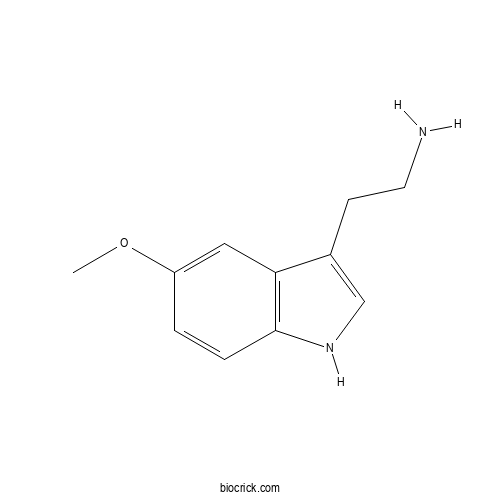
| Cas No. | 608-07-1 | SDF | File under preparation. |
| PubChem ID | 1833.0 | Appearance | Powder |
| Formula | C11H14N2O | M.Wt | 190.2 |
| Type of Compound | N/A | Storage | Desiccate at -20°C |
| Solubility | Soluble in Chloroform,Dichloromethane,Ethyl Acetate,DMSO,Acetone,etc. | ||
| Chemical Name | 2-(5-methoxy-1H-indol-3-yl)ethanamine | ||
| SMILES | COC1=CC2=C(C=C1)NC=C2CCN | ||
| Standard InChIKey | JTEJPPKMYBDEMY-UHFFFAOYSA-N | ||
| Standard InChI | InChI=1S/C11H14N2O/c1-14-9-2-3-11-10(6-9)8(4-5-12)7-13-11/h2-3,6-7,13H,4-5,12H2,1H3 | ||
| General tips | For obtaining a higher solubility , please warm the tube at 37 ℃ and shake it in the ultrasonic bath for a while.Stock solution can be stored below -20℃ for several months. We recommend that you prepare and use the solution on the same day. However, if the test schedule requires, the stock solutions can be prepared in advance, and the stock solution must be sealed and stored below -20℃. In general, the stock solution can be kept for several months. Before use, we recommend that you leave the vial at room temperature for at least an hour before opening it. |
||
| About Packaging | 1. The packaging of the product may be reversed during transportation, cause the high purity compounds to adhere to the neck or cap of the vial.Take the vail out of its packaging and shake gently until the compounds fall to the bottom of the vial. 2. For liquid products, please centrifuge at 500xg to gather the liquid to the bottom of the vial. 3. Try to avoid loss or contamination during the experiment. |
||
| Shipping Condition | Packaging according to customer requirements(5mg, 10mg, 20mg and more). Ship via FedEx, DHL, UPS, EMS or other couriers with RT, or blue ice upon request. | ||
Quality Control & MSDS
3D structure
Package In Stock

Number of papers citing our products


5-Methoxytryptamine Dilution Calculator
5-Methoxytryptamine Molarity Calculator

| 1 mg | 5 mg | 10 mg | 20 mg | 25 mg | |
| 1 mM | 5.2576 mL | 26.2881 mL | 52.5762 mL | 105.1525 mL | 131.4406 mL |
| 5 mM | 1.0515 mL | 5.2576 mL | 10.5152 mL | 21.0305 mL | 26.2881 mL |
| 10 mM | 0.5258 mL | 2.6288 mL | 5.2576 mL | 10.5152 mL | 13.1441 mL |
| 50 mM | 0.1052 mL | 0.5258 mL | 1.0515 mL | 2.103 mL | 2.6288 mL |
| 100 mM | 0.0526 mL | 0.2629 mL | 0.5258 mL | 1.0515 mL | 1.3144 mL |
| * Note: If you are in the process of experiment, it's necessary to make the dilution ratios of the samples. The dilution data above is only for reference. Normally, it's can get a better solubility within lower of Concentrations. | |||||
- L-Mannose
Catalog No.:BCX2334
CAS No.:10030-80-5
- L-Galactose
Catalog No.:BCX2333
CAS No.:15572-79-9
- L-Arabinose
Catalog No.:BCX2332
CAS No.:5328-37-0
- Norcantharidin
Catalog No.:BCX2331
CAS No.:29745-04-8
- Dopamine
Catalog No.:BCX2330
CAS No.:51-61-6
- L-Ornithine
Catalog No.:BCX2329
CAS No.:70-26-8
- Putrescine
Catalog No.:BCX2328
CAS No.:110-60-1
- 3-Methyl-1-(3-methylfuran-2-yl)but-3-en-1-one
Catalog No.:BCX2327
CAS No.:78173-38-3
- Sorocein H
Catalog No.:BCX2326
CAS No.:157382-82-6
- Cathayanin B
Catalog No.:BCX2325
CAS No.:330195-60-3
- Taurodeoxycholic acid
Catalog No.:BCX2324
CAS No.:516-50-7
- Cathayanin C
Catalog No.:BCX2323
CAS No.:330195-61-4
- Doxofylline
Catalog No.:BCX2336
CAS No.:69975-86-6
- Turanose
Catalog No.:BCX2337
CAS No.:547-25-1
- 3-Methyl-4-isopropylphenol
Catalog No.:BCX2338
CAS No.:3228-02-2
- 3-Amino-3-(3,4-dimethoxyphenyl)propionic acid
Catalog No.:BCX2339
CAS No.:54160-63-3
- Guanidinoacetic acid
Catalog No.:BCX2340
CAS No.:352-97-6
- 6-Hydroxyflavanone
Catalog No.:BCX2341
CAS No.:190831-08-4
- D-Glucuronic acid
Catalog No.:BCX2342
CAS No.:6556-12-3
- Bryodulcosigenin
Catalog No.:BCX2343
CAS No.:88930-16-9
- Lactose
Catalog No.:BCX2344
CAS No.:63-42-3
- Acridone
Catalog No.:BCX2345
CAS No.:578-95-0
- Caffealdehyde
Catalog No.:BCX2346
CAS No.:141632-15-7
- (+)-Licarin B
Catalog No.:BCX2347
CAS No.:42016-15-9
The therapeutic potential of melatonin: Focus on the SIRT1 signaling pathway.[Pubmed:42821192]
Mol Biol Rep. 2026 Oct 1;53(1):1667.
Melatonin (N-acetyl-5-Methoxytryptamine) is a pleiotropic indoleamine involved in diverse physiological and cellular processes and has consequently been investigated in numerous disease models. This molecule is primarily produced in the pineal gland and is well-known for its diverse functions including antitumor, immunomodulatory, antioxidant, antihypertensive, and sedative effects. It is also involved in the regulation of body weight, gastrointestinal function, reproduction, thermoregulation, and cardioprotection. Melatonin exerts its protective effects by modulating various molecular pathways. Among the signaling pathways implicated in these effects, the sirtuin-1 (SIRT1) pathway has received considerable attention. SIRT1 is a well-studied member of the mammalian sirtuin family that functions as a nicotinamide adenine dinucleotide (NAD+)-dependent deacetylase. SIRT1 shuttles between the cytoplasm and the nucleus, where it deacetylates histones and other proteins. This activity impacts various cellular functions such as cell survival, metabolism, growth, aging, and stress resistance. Available evidence suggests that melatonin may modulate SIRT1 activity and thereby influence processes involved in inflammation, oxidative stress, apoptosis, and autophagy in various pathological conditions. However, evidence regarding the role of SIRT1 in the effects of melatonin remains limited In this review, we examine the pharmacological effects of melatonin across several disease models, with particular emphasis on the potential involvement of SIRT1 signaling.
Synthesis and Biological Activity Assessment of Caffeic Acid Azaheterocyclic Amide Derivatives.[Pubmed:42794690]
Int J Mol Sci. 2026 Sep 16;27(18):8262.
Natural caffeic acid derivatives are ubiquitous plant phenolic compounds with documented antitumor, antioxidant, and anti-inflammatory bioactivities. However, their clinical application is limited by low bioactivity potency and poor stability. Therefore, rational design and synthesis of novel caffeic acid derivatives are critical to improve their druglikeness and broaden biomedical applications. Herein, fourteen amide derivatives (H1-H14) were synthesized by conjugating three 3,4-substituted caffeic acid skeletons with five nitrogen-containing heterocycles. Bioactivity evaluation revealed that these derivatives exhibited structure- and cell-dependent biological profiles. Among them, compounds H8 and H13 containing 5-Methoxytryptamine exerted the most potent antitumor activity by suppressing DNA and RNA synthesis and arresting the cell cycle at the G2/M phase. Derivatives with a catechol moiety (H11-H14) possessed prominent antioxidant activity, while H11 and H12, containing morpholine and 1-methylpiperazine respectively, exhibited remarkable anti-inflammatory activity. Compound H5 also presented significant protective effects against H(2)O(2)-induced neuronal injury. The cellular uptake assay revealed a correlation with clogP values: derivatives with clogP > 2.5 showed higher cellular internalization. Collectively, nitrogen-containing heterocyclic moieties and 3,4-substitution effectively modulate the multiple bioactivities of caffeic acid derivatives, providing valuable guidance for further structural optimization and drug development.
Melatonin as a hub signal integrating redox and hormonal crosstalk with multi-omics regulation in plant heavy metal stress tolerance.[Pubmed:42731282]
Plant Physiol Biochem. 2026 Sep;238:111739.
Heavy metal contamination is a major environmental constraint that negatively affects plant growth, metabolism, and agricultural productivity. Excess metals such as cadmium, lead, and copper disturb cellular functions mainly by inducing oxidative stress, disrupting nutrient balance, and causing toxicity at multiple levels of organization. To cope with these stresses, plants activate complex defense systems, among which melatonin (MT) (N-acetyl-5-Methoxytryptamine) has recently emerged as a key regulatory molecule. This review highlights MT's central role in coordinating plant responses to heavy metal stress. MT strengthens redox homeostasis by enhancing both enzymatic and non-enzymatic antioxidant systems, thereby reducing reactive oxygen species (ROS) accumulation and limiting oxidative damage to cellular components. In addition to its antioxidant function, MT regulates metal uptake, transport, and sequestration by modulating transporter families such as NRAMP, ZIP, and HMA, while also promoting detoxification through phytochelatin (PC) and metallothionein (MT) pathways. MT also plays an important role in hormonal crosstalk, interacting with abscisic acid (ABA), jasmonic acid (JA), and salicylic acid (SA) signaling pathways to fine-tune stress perception and downstream defense responses. Furthermore, recent multi-omics studies have shown that MT induces broad transcriptional, proteomic, and metabolomic reprogramming, leading to coordinated adjustments in gene expression, protein activity, and metabolic pathways under heavy metal stress. Overall, MT functions as a central signaling hub that integrates redox regulation, hormonal signaling, and multi-omics networks to enhance plant tolerance to heavy metal stress. These insights deepen understanding of plant stress biology and offer promising strategies to improve crop resilience and phytoremediation efficiency in contaminated environments.
Melatonin in Pregnancy-Related Disorders: A Review of Protective Mechanisms and Therapeutic Potential.[Pubmed:42728526]
Reprod Sci. 2026 Sep 11.
Melatonin (N-acetyl-5-Methoxytryptamine), classically known as a pineal neurohormone regulating circadian rhythms, has emerged as a critical pleiotropic molecule in reproductive physiology. Beyond its role in establishing circadian entrainment, it acts as a potent antioxidant, anti-inflammatory agent, and mitochondrial function modulator. This review synthesizes current knowledge on the multifaceted roles of melatonin in normal pregnancy and its pathophysiological implications in major gestational disorders, including preeclampsia (PE), fetal growth restriction (FGR), gestational diabetes mellitus (GDM), and preterm birth (PTB). Distinct from prior reviews, this work provides a structured, disorder-specific analysis of translational evidence with a critical evaluation of pharmacological optimization strategies, biomarker-driven trial design, and long-term developmental safety considerations. We highlight the dual source of melatonin maternal and placental and its receptor-mediated and receptor-independent actions. Compelling preclinical data and emerging clinical studies suggest that melatonin supplementation may represent a novel, safe, and effective therapeutic strategy for mitigating oxidative stress and inflammation at the maternal-fetal interface. This article reviews the mechanistic underpinnings, summarizes existing evidence in a structured format, and identifies critical gaps for future translational research.
Overexpression of Serotonin N-Acetyltransferase Cloned from the Green Algae Chara braunii Confers Peroxidizing Herbicide Tolerance Through the Induction of Protoporphyrinogen Oxidase 1 in Rice.[Pubmed:42650206]
Antioxidants (Basel). 2026 Jul 29;15(8):942.
Serotonin N-acetyltransferase (SNAT) is pivotal to melatonin biosynthesis, catalyzing either serotonin into N-acetylserotonin or 5-Methoxytryptamine (5-MT) into melatonin. Many SNAT genes have been cloned from a wide range of organisms, including animals and plants, but none has been reported in the model streptophyte green alga Chara braunii. Here, we found one archaeal CbSNAT homologue in the C. braunii genome, which showed 28% and 27% amino acid homology with human Naa50 and rice SNAT3, respectively. The CbSNAT gene, encoding a 172-amino acid protein, was expressed and purified in Escherichia coli. The recombinant CbSNAT protein exhibited SNAT enzyme activity toward serotonin (K(m) = 293 muM) and 5-MT (K(m) = 28 muM), and was located in the cytoplasm of tobacco cells, similar to other archaeal SNAT homolog proteins. To assess whether CbSNAT was functionally coupled to melatonin biosynthesis, CbSNAT was overexpressed in rice. Transgenic CbSNAT-overexpressing rice seedlings showed enhanced melatonin synthesis and resistance to both cadmium and the herbicide butafenacil. The cadmium resistance was due to the increased expression of chaperone genes such as BIP3, BIP4, and BIP5, whereas the butafenacil resistance resulted from increased expression of protoporphyrinogen oxidase 1, a target gene of butafenacil, via the transcriptional regulatory effects of melatonin. The discovery of a CbSNAT gene in C. braunii opens a new avenue for its use as a genetic resource in the development of crops exhibiting stress resistance to toxic compounds found in modern agriculture.
Melatonin Preserves Mitochondrial Redox Balance in UVB-Exposed Human Keratinocytes.[Pubmed:42650203]
Antioxidants (Basel). 2026 Jul 29;15(8):939.
Melatonin (N-acetyl-5-Methoxytryptamine) is an evolutionarily conserved indoleamine with potent antioxidant and cytoprotective properties. Due to its amphiphilic nature, melatonin readily accumulates in mitochondria, where it regulates redox homeostasis and bioenergetic function. Although melatonin has been implicated in cutaneous protection against ultraviolet radiation (UVR), the mitochondrial mechanisms underlying its effects in UVB-exposed keratinocytes remain insufficiently characterized. In this study, we investigated the mitochondrial-centered protective effects of melatonin in human epidermal keratinocytes (NHEKs) subjected to UVB irradiation. UVB exposure induced a dose-dependent decrease in cell viability and proliferation, accompanied by excessive reactive oxygen species (ROS) production, mitochondrial membrane depolarization (DeltaPsim), ATP depletion, caspase-3 activation, and increased expression of DNA damage- and senescence-associated markers, including gammaH2AX, p53, and p16(INK4a). Pre-treatment with melatonin attenuated these alterations by reducing oxidative stress, preserving DeltaPsim, maintaining ATP production, suppressing apoptotic signaling, and modulating DNA damage- and senescence-related pathways. Collectively, our findings suggest that mitochondria are a central target of melatonin in UVB-exposed keratinocytes and demonstrate that maintenance of mitochondrial redox balance and bioenergetic integrity is associated with reduced apoptotic and senescence-related changes.
Neuroimmune treatment of advanced solid tumors: 3-year survival after angiotensin 1-7, pineal indoles, and cannabinoids.[Pubmed:42549589]
Neoplasma. 2026 Aug 4:260610N190.
In a recent study, the exogenous administration of angiotensin 1-7 (Ang 1,7) together with melatonin, 5-Methoxytryptamine, and cannabidiol increased 1-year survival in advanced cancer patients, underlining the utility of neuromodulation in oncology. We now report a single-arm interventional study to evaluate the effectiveness of introducing Ang 1-7 in the neuroimmune regime, including pineal indoles and cannabinoids. Two cohorts of patients with advanced solid tumors refractory to standard oncologic treatments and with an estimated life expectancy of less than six months were studied. The full neuroimmune regimen cohort consisted of 100 consecutive patients treated over the last three years with Ang 1-7, pineal indoles, and cannabinoids, while the comparator cohort included 212 consecutive patients treated between 2015 and 2019 with pineal indoles and cannabinoids alone. Gastroprotected capsules of Ang 1-7 coupled with cyclodextrin were administered at 0.5 mg p.o. twice/day. Melatonin (100 mg) and 5-Methoxytryptamine (20 mg) were given p.o. at bedtime and in the early afternoon, respectively. Cannabidiol or cannabigerol (in the case of glioblastoma) was given at 20 mg p.o. twice/day. Clinical response, disease control, and overall survival, along with the lymphocyte-to-monocyte ratio, were evaluated. In the full regimen cohort, disease control was achieved in 67 of 100 patients, with objective tumor regression observed in 23%. In the comparator cohort, disease control was obtained in 111 of 212 patients, with objective regression in 8%. Three-year overall survival was significantly higher in the full regimen cohort (37%) compared with the comparator cohort (19%). Both treatments were associated with a significant increase in the lymphocyte-to-monocyte ratio, suggesting an improvement in systemic immune status. The addition of Ang 1-7 to a neuroimmune regimen combining pineal indoles and cannabinoids was associated with improved disease control and long-term survival in patients with end-stage solid tumors lacking effective therapeutic options.
Isolation, structural elucidation, and antioxidant potential of phytomelatonin from tomato (Solanum lycopersicum L.) leaves.[Pubmed:42422082]
Front Pharmacol. 2026 Jun 24;17:1818804.
Melatonin (N-acetyl-5-Methoxytryptamine) is an indoleamine compound present in both animal and plant kingdoms. Melatonin, a potent antioxidant, is currently produced synthetically, which is often associated with the presence of toxic by-products. This study presents a high-yield alternative by isolating and characterizing pure phytomelatonin (PMT) from underutilized agricultural waste, specifically tomato leaves (Solanum lycopersicum L.). By utilizing a multistep extraction and purification process, a yield of 53.12 mg of pure phytomelatonin was achieved. The structural elucidation and purity of the isolate were confirmed through multiple analytical techniques, including ultraviolet-visible (UV-VIS) spectroscopy, Fourier-transform infrared spectroscopy (FT-IR), nuclear magnetic resonance (NMR) spectroscopy, proton nuclear magnetic resonance ((1)H NMR), carbon-13 nuclear magnetic resonance ((13)C NMR), and liquid chromatography-tandem mass spectrometry (LC-MS/MS). The plant-derived phytomelatonin exhibited potent ABTS radical scavenging activity with near equivalence to the synthetic standard while also demonstrating strong DPPH radical scavenging activity with comparatively higher efficiency, maintaining >90% inhibition at elevated concentrations. This research validates the isolation of phytomelatonin from tomato leaves, positioning agricultural by-products as a sustainable and bioavailable source of this valuable bioactive molecule. These findings provide a foundation for future functional and exploration of melatonin's role in the pharmaceutical, nutraceutical, and agricultural industries.
5-methoxytryptamine improves hepatic inflammation and insulin resistance in a macrophage C-X-C motif chemokine ligand 14 dependent manner.[Pubmed:42365576]
Mol Biomed. 2026 Jun 28;7(1):101.
Accumulating evidence indicates that tryptophan metabolism plays important roles in insulin resistance, and glucolipid metabolism. Our preliminary study revealed a significant decrease in the serum levels of the tryptophan metabolite 5-Methoxytryptamine (5MT), in both high-fat diet (HFD)-fed and db/db mice. Notably, these levels were restored following treatment with the hypoglycemic agent, the dipeptidyl peptidase-4 inhibitor (DPP-4i) sitagliptin, suggesting a potential relationship between 5MT and metabolic homeostasis. In the current study, we demonstrated that 5MT treatment ameliorated insulin resistance and hepatic steatosis in HFD and db/db mice. Specific inhibition of the aryl hydrocarbon receptor (AHR) attenuated the beneficial effects of 5MT on insulin resistance in HFD mice. Transcriptome sequencing and subsequent validation revealed that 5MT significantly upregulated the expression of C-X-C motif chemokine ligand 14 (Cxcl14) in hepatic macrophages. Myeloid-specific knockout of Cxcl14 demonstrated that 5MT inhibited hepatic inflammatory response to improve insulin resistance in a macrophage CXCL14-dependent manner. Furthermore, molecular mechanism exploration revealed that 5MT promoted the AHR-mediated transcriptional activation of Cxcl14, which inhibited glycolysis in macrophages, subsequently suppressing their proinflammatory classical activation (M1 phenotype). Collectively, these data reveal a novel beneficial role of 5MT in insulin resistance and metabolic homeostasis, providing a rationale for new therapeutic strategies targeting insulin resistance-associated metabolic disorders, such as obesity and diabetes.
Nitrogen-Doped Carbon Quantum Dots for FRET-Assisted and Smartphone-Enabled Fluorescent Detection of Melatonin in Biological Samples.[Pubmed:42315719]
J Fluoresc. 2026 Jun;36(6):4057-4070.
Melatonin (N-acetyl-5-Methoxytryptamine, MLT) is an endogenous neurohormone that regulates circadian rhythms, exhibits potent antioxidant activity, and has been implicated in cancer suppression and neuroprotection. In this study, we report the design and development of a highly sensitive optical nanosensor based on nitrogen-doped carbon quantum dots (N-CQDs) for the quantitative detection of MLT in human blood. The N-CQDs were synthesized via a facile pyrolysis route, yielding uniform nanodots that exhibit strong blue photoluminescence. Comprehensive structural, morphological, and optical characterizations were conducted using X-Ray Diffraction (XRD), transmission electron microscopy (TEM), and fluorescence spectroscopy, confirming the successful incorporation of nitrogen functionalities with a photoluminescence quantum yield of 36.6%. The synthesized N-CQDs exhibit a highly selective and sensitive detection towards MLT, and the sensing mechanism is plausibly governed by Forster resonance energy transfer (FRET)-mediated quenching of N-CQD emission upon interaction with MLT. This developed probe of N-CQDs achieved an impressive detection limit of 4.68 nM, demonstrating its potential for biomedical diagnostic applications. Furthermore, the system was successfully integrated into a smartphone-assisted sensing platform for portable and real-time MLT monitoring. Quantitative analysis of spiked human blood samples exhibited excellent recovery values ranging from 96.1% to 104.2%, validating the reliability and applicability of the proposed N-CQD-based sensor for clinical and point-of-care analysis.
Melatonin in Livestock Production: Bridging Chronobiology, Health, and Sustainable Outcomes.[Pubmed:42314870]
J Nutr. 2026 Aug;156(8):101674.
Melatonin (N-acetyl-5-Methoxytryptamine) is a phylogenetically ancient hormone synthesized primarily in the pineal gland in response to light-dark cycles, where it regulates circadian rhythms, but it is also produced in peripheral tissues, including the gastrointestinal tract. In livestock, melatonin extends beyond chronobiology to modulate immune function, reproduction, metabolism, and adaptation to environmental stressors such as heat, transport, and high production intensity. This review consolidates current knowledge on melatonin's application in animal nutrition, tracing from its discovery and biosynthesis to its receptor-mediated signaling (MT1 and MT2). The core analysis examines melatonin's dietary sources, including cereal grains, legumes, oilseeds, and forages, and supplementation strategies across livestock species. Key physiological benefits include potent antioxidant properties (scavenging reactive oxygen and nitrogen species while upregulating superoxide dismutase, glutathione peroxidase, and catalase) and immunomodulatory capacity (increasing IL-2 and interferon-gamma, decreasing TNF-alpha and IL-6 via nuclear factor kappa-B pathway inhibition). A dedicated synthesis of effects on livestock performance reveals benefits for growth performance, reproductive health (estrus synchronization, sperm quality, and conception rates), and stress mitigation across species. The review provides species-specific dosage recommendations (e.g., 5-15 mg/d for pigs, 1-2 mg/d for poultry, 30-50 mg/d for cattle) and delivery methods (feed, water, and implants). By integrating fundamental mechanisms with applied nutritional outcomes, this work highlights melatonin's significant potential as a multifunctional nutraceutical to enhance productivity, health, welfare, and sustainability in modern livestock production systems.

Calcutta University

University of Minnesota

University of Maryland School of Medicine

University of Illinois at Chicago

The Ohio State University

University of Zurich

Harvard University

Colorado State University

Auburn University

Yale University

Worcester Polytechnic Institute

Washington State University

Stanford University

University of Leipzig

Universidade da Beira Interior

The Institute of Cancer Research

Heidelberg University

University of Amsterdam

University of Auckland

TsingHua University

The University of Michigan

Miami University

DRURY University

Jilin University

Fudan University

Wuhan University

Sun Yat-sen University

Universite de Paris

Deemed University

Auckland University

The University of Tokyo

Korea University



